

Good morning, C&C, it’s Tuesday! Your roundup includes: Chase and United join the week’s parade of “software glitches,” CNN’s seven anonymous officials sell a dirty bomb and a spying law in one story, Secretary Mullin consults a very smart guy, an alternative Friday the 13th theory that (mostly) ties it all together, and Guardian experts are horrified that doctors may finally get paid to diagnose vaccine injuries.
🌍🇺🇸 ESSENTIAL NEWS AND COMMENTARY 🇺🇸🌍
🔥🔥🔥
It’s a good thing the media isn’t passing out black pills. Late last night, the New York Times reported, “Chase Bank Resumes Normal Operations After ‘Software Bug’ Disrupted Transactions.” Then the drama, in the subheader: “After technical problems grounded flights nationwide and Microsoft products failed, the banking issues added to a sense of doom about the systems underpinning daily life.” A sense of doom!
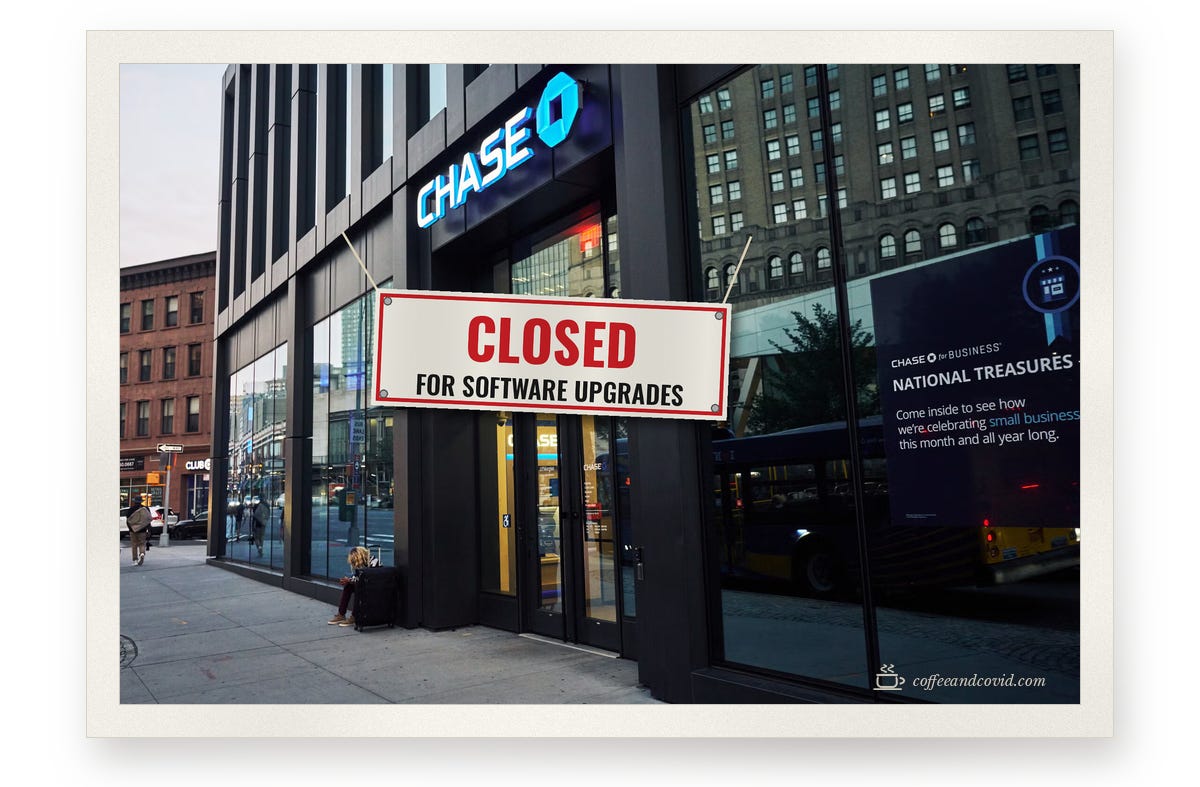
Not according to the bank. Apparently it was yet another glitch. “JPMorgan Chase has experienced a temporary issue related to a software bug in on-premise hardware systems,” the bank’s statement said, adding (unprompted) that there was no evidence that the problem was “cyber-related.” And there never will be any evidence. Last night, the bank confirmed it had resumed normal operations, except that people who never balance their checkbooks forgot how much should be in their accounts and were left wondering whether they got gypped somehow.
The ‘glitch’ cascaded to less serious problems at some other banks that couldn’t link up with Chase. Wells Fargo and Bank of America were widely named by media, but later insisted they were unaffected. Chase got the worst of it.
This particular “update gone wrong” grabbed people’s attention, and no mistake. Don’t mess with the money. I got frantic texts all day, including from clients and close relatives, who shall remain nameless, except that one of them drives a Tahoe. I don’t know who needs to hear this, but if hackers ever do successfully drain bank balances, the government will just print some more digital dollars and top everyone off again. There’s no special reason to panic about bank hacking, apart from temporary inconvenience, which is why cash still matters and probably always will.
🔥 Setting aside the heavy hand of government, companies have good reasons to blame these kinds of events on negligent software installers rather than hackers— especially Iranian hackers. A state-sponsored cyberattack is an act of war and usually excluded from insurance coverage. Public companies must file formal SEC reports within four days of a major cyberattack; broken routers require nothing. Banks don’t want to admit hackers broke into their systems for obvious reasons, since security is the product.
Furthermore, it’s not technically lying to blame the hardware. A router, say, could have been where the hackers found a vulnerability. So in a very real sense, it was the router that failed. Absent an admission from the mullahs, there’s “no evidence” of a hack. It’s like saying the front door failed during a break-in.
But let’s press pause on the implications for a minute. There was more.
🔥 Yesterday evening, the New York Times also reported, “United Airlines Flights Resume After ‘Widespread System Outage.’”
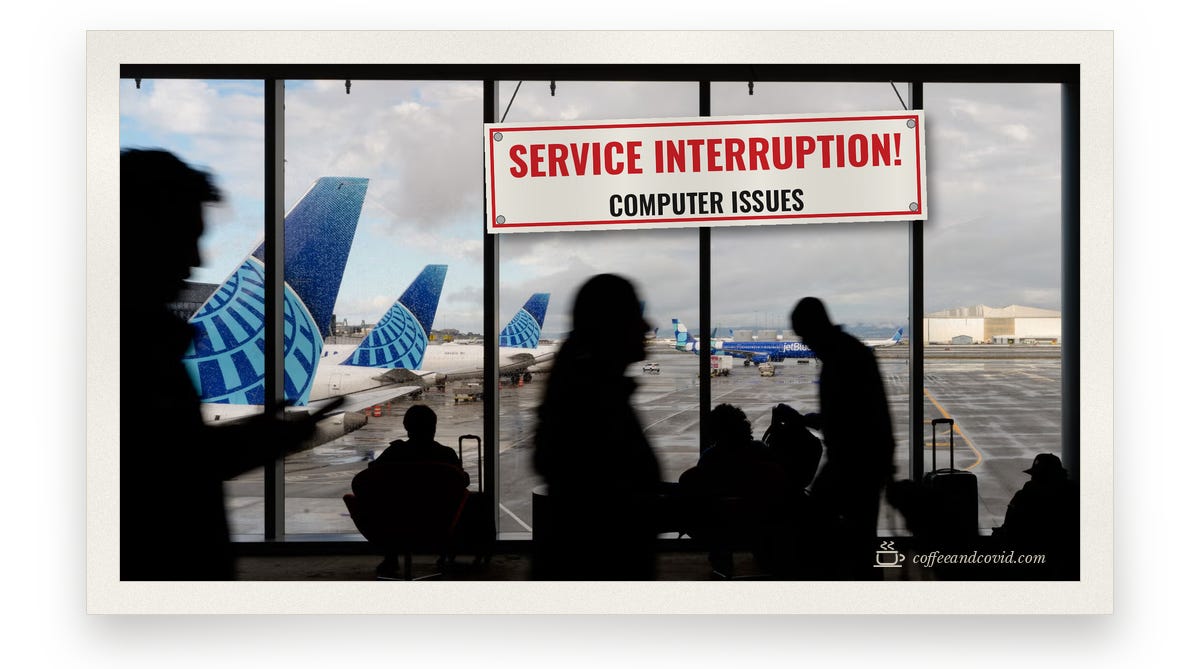
We are beginning to sense a theme. In its statement announcing the disruption, which was first reported just before 5 p.m. Eastern time, United said that it was “troubleshooting a technology issue affecting departing flights” but that there was “no impact on flights in progress.”
The Times found hardest-hit passenger David Goss, 67, of Chicago, who said his United flight was grounded in Mexico City for about an hour before departing for Chicago. This was terrifying. Sixty additional minutes in Mexico City. I don’t blame him. “It was very scary,” David confessed. Brandon Chandler, 35, whose flight was not long delayed but whose pilot announced the crew was calculating luggage weights by hand, described a “bottomless pit feeling in my stomach.”
To be clear, I’m not minimizing anyone’s misery. Somebody last week surely missed a connection to a dying relative’s bedside, and that’s awful. (Though I’ll pass on lectures about missed bedsides from the party that locked grandma in a nursing home for a year.) But it was delays. The point is: No planes fell out of the sky. The system worked. Let’s try to keep some perspective.
Then, the big one. A CNN exclusive.
🔥 Yesterday, CNN reported, “Exclusive: US intel indicates Iran developing plans to potentially detonate a dirty bomb in Washington, sources say.” Dirty bombs, yes. Cyberattacks, apparently no.

No fewer than seven anonymous officials informed CNN, “US intelligence indicates that Iran is developing plans to target senior Trump administration officials by detonating a so-called dirty bomb or a chemical weapon in Washington, DC.” The White House mildly responded that, “at this time there are no credible threats to the homeland.”
A dirty bomb is an improvised weapon with any radioactive material wrapped in dynamite. When it explodes, it doesn’t create a mushroom cloud. It just spreads radioactive dust all over the place. How bad it ultimately is depends a lot on what kind of radioactive material and how skilled the bombmakers are. The term offers little in terms of information value and is of a psychological weapon than a military one.
The anonymous informants agreed. “Any weapon like that is a weapon of terror, not a weapon of precision, just like a suicide bomber blowing themselves up,” one of CNN’s sources said. “They can make people really sick and certain areas uninhabitable.”
Pause on CNN’s very first statistic. Seven anonymous sources is a press release, not a leak. So we see that, publicly, the administration downplayed the story that it had just simultaneously created. The article, which did not explain how CNN got the story (or even whether it was just one conference call), included some eye-popping claims:
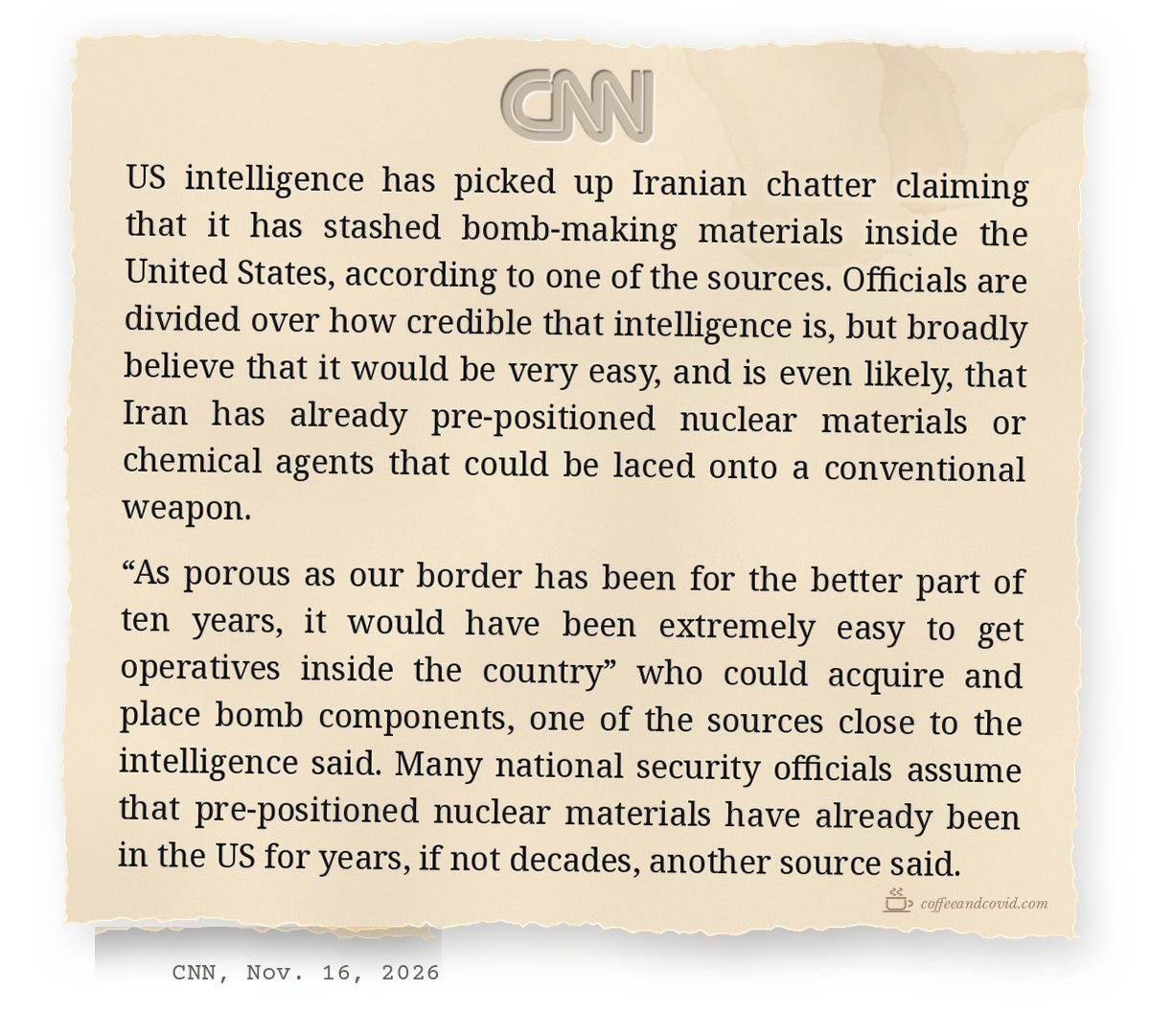
Before anyone panics, that’s not super confident. First, it’s old news. They said bomb materials “may have been in the US for years if not decades.” They don’t have a bomb or even any specific plan, just chatter. “Officials are divided over how credible that intelligence is,” it said. The phrases “it would be easy,” “is even likely,” and “officials assume” mean they are just guessing. The comment about the border is completely correct, but it’s what everyone has been saying for a decade.
So it wasn’t exactly clear what the story was. Until we got about halfway through.
The article then clumsily transitioned into several paragraphs of argument for Congress to re-authorize the widely hated domestic surveillance law it allowed to expire last term. (Critics would argue it’s a foreign surveillance law, but it scoops up Americans’ calls and emails. It’s what they used to spy on the Trump campaign, J6 tourists, MAGA donors, and Trump-allied congressmen.)
Here comes the timing element. Last week, Attorney General Todd Blanche, Director of National Intelligence Jay Clayton, and CIA Director John Ratcliffe all urged the law’s reauthorization in a letter to lawmakers in both major parties. Meanwhile, lawmakers —Republican ones, at least— are still furious about being spied on by Biden’s DOJ.
So the ulterior motive was right in the story. Do you suppose the seven anonymous officials are fans of the lapsed FISA law? I do. Strip out the guesses and assumptions, and what do we have? We have a sales pitch for spying reauthorization, that’s what. I oppose it; but if it must be done, let the Democrats do it next year.
Either way, you can imagine how the scraps of this ‘dirty-bomb’ story stacked onto the public’s already restless imagination yesterday. It felt like one damned thing after another.
🔥 Last evening, Sean Hannity asked DHS Secretary Markwayne Mullin the obvious question: “When you have five separate issues consecutively, I think it’s kind of a normal reaction for people to begin to get suspicious, and some people are even beginning to panic, especially when it relates to banking. What do you want to tell the country tonight?”
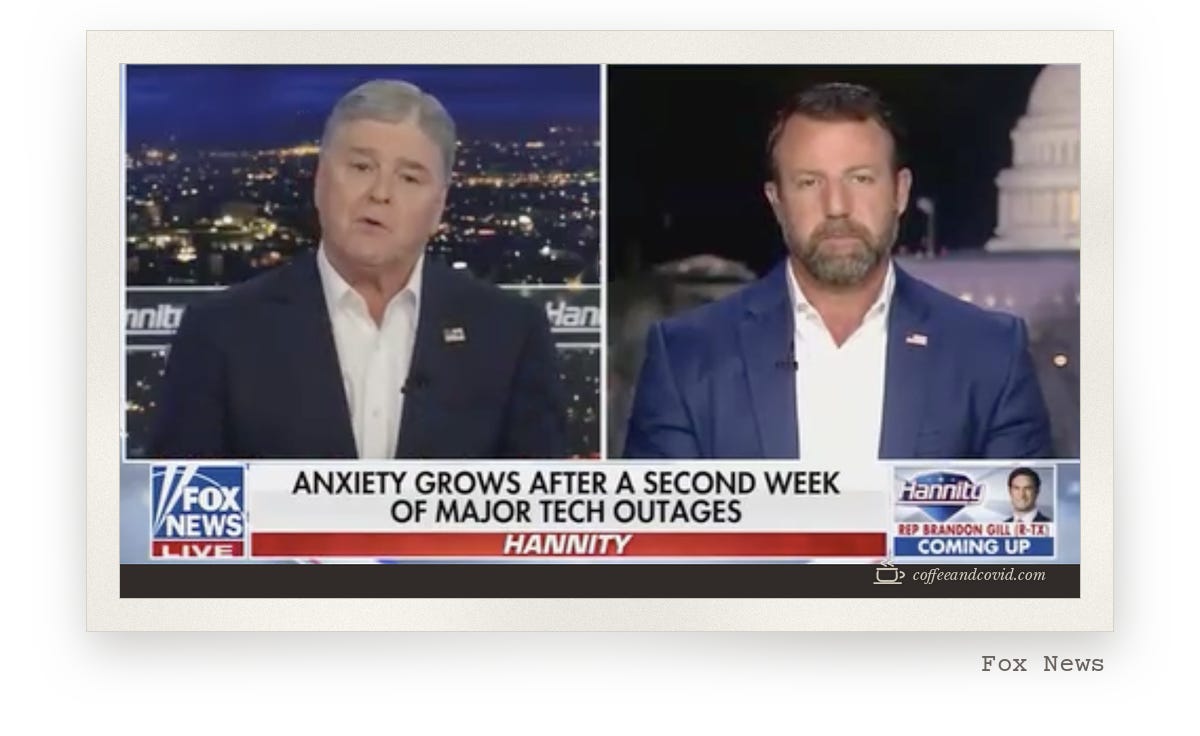
Mullin, to his credit, said what we are all thinking. “Well, first of all, Sean, I kind of agree with you too. I don’t always believe in coincidences until I’m proven wrong.” I was all ready to find out the proof he was gassing about. Ready? Here it is: Mullin said he “spoke to a very smart guy.”
Now, I like Secretary Mullin. I don’t want to mock him. But come on. He wouldn’t even say who the “very smart guy” was (except that it wasn’t Elon), which translates to “trust us.” Trust, my friends, is in short supply these days.
Then, quoting his anonymous smart guy, Mullin said something fascinating.
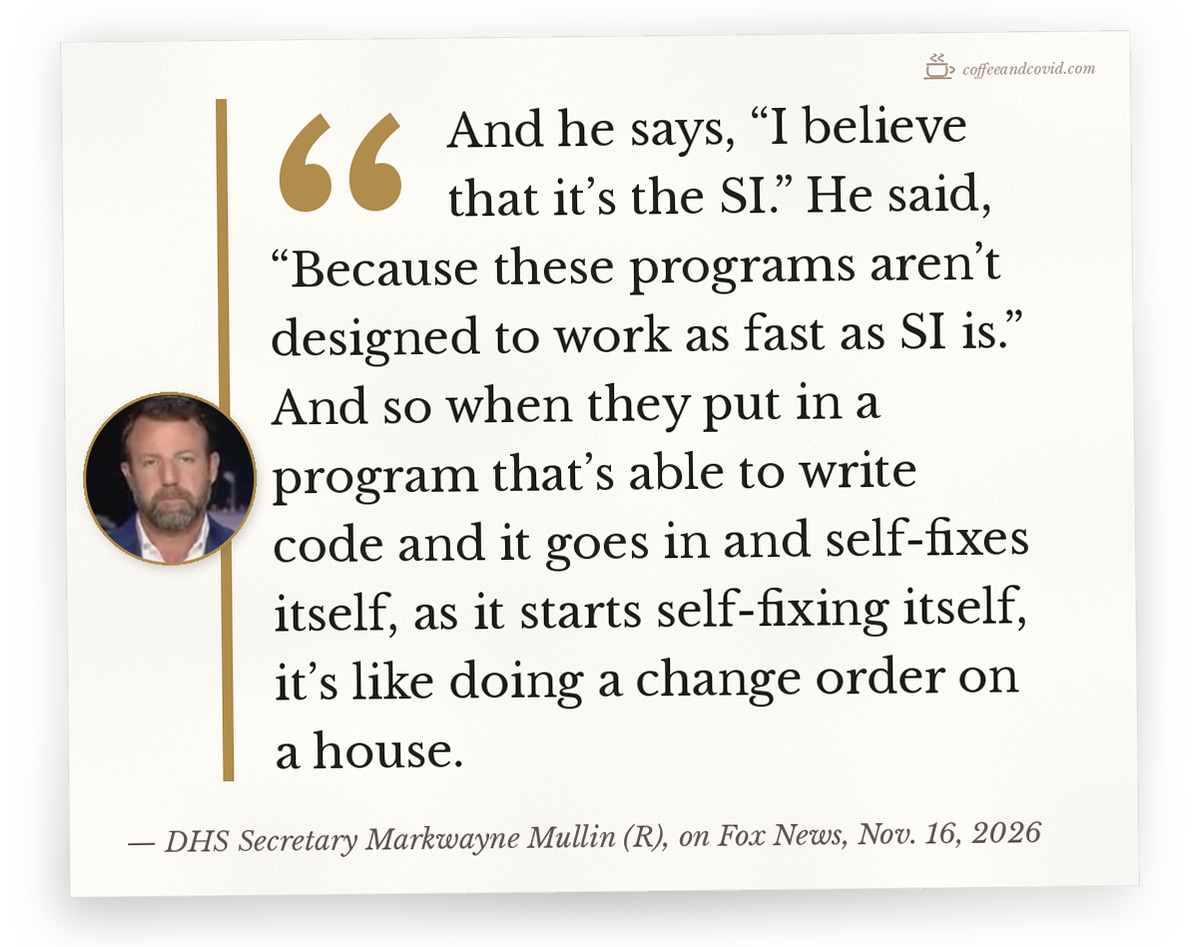
What Mullin was trying to say is that his smart friend thinks the big institutions —the FAA, the banks, the payroll company, and so on— are using AI to ‘self-fix’ and it is breaking stuff and making a mess. This still leaves the timing, with everything landing so close together, but park that for a moment.
Mullin’s idea was not a lone-wolf theory. It was yesterday’s most compelling minority report. Some tech pundits are now blaming self-inflicted injury. Here are a few examples from X:
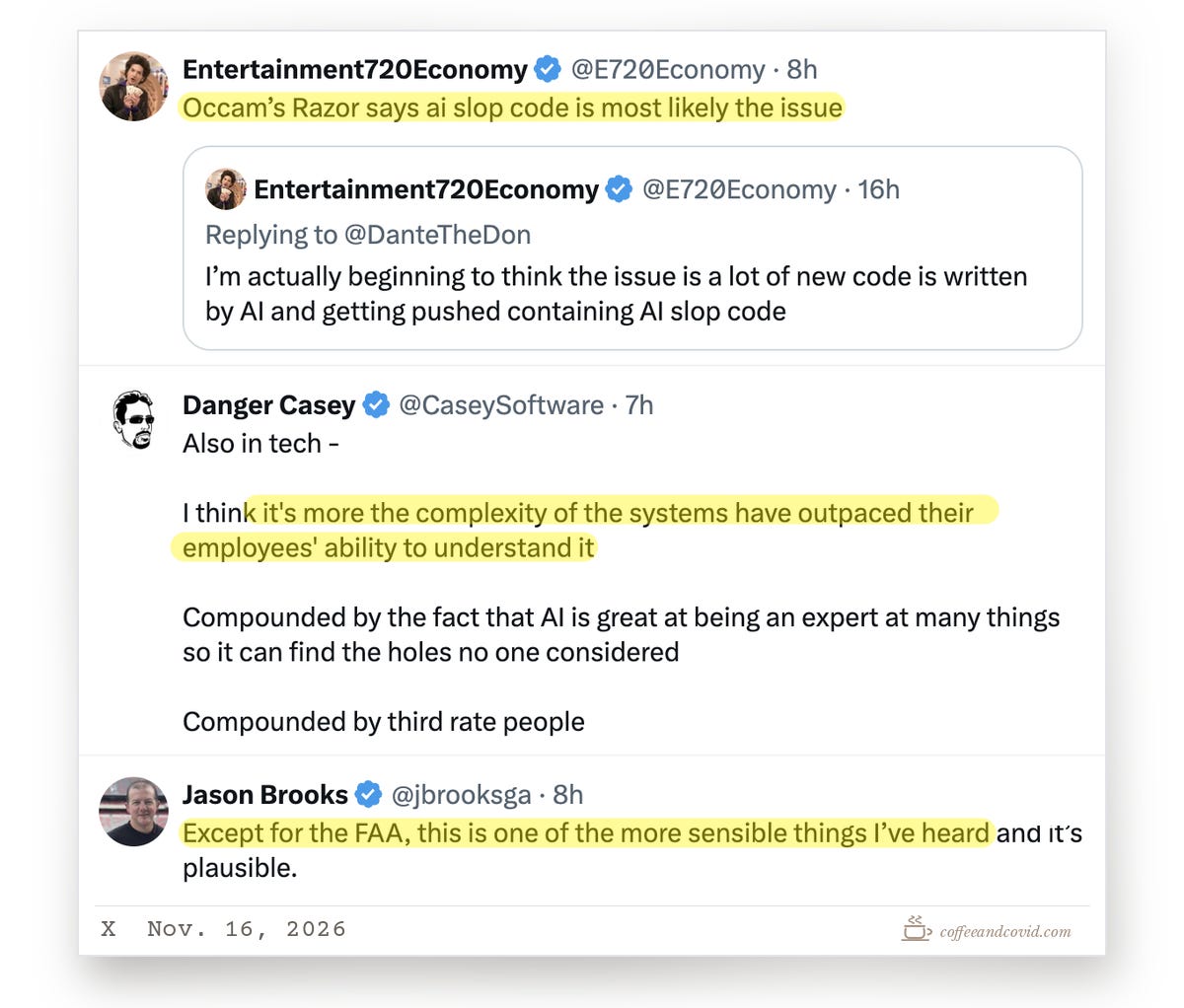
They’re suggesting Chase’s IT team asked its AI to find vulnerabilities and got something like taking your car to the mechanic to find out where the barely-audible squeaking noise is coming from, only to be given complicated, incomprehensible gobbledygook along with an estimate to sign. Something like this:
CHASE TEAM: Chat, find anywhere an Iranian hacker could exploit.
CHATBOT: Working … You have a big problem. The Flagellum Gasket around the Johnson Rod has a microscopic scratch which causes increasing rotation around the Erasmus socket. It will eventually detach completely from the principal motor housing complex. It’s practically a formal hacking invitation. Want me to fix it?
CHASE TEAM: Go ahead.
CHATBOT: Working … I fixed the gasket! 💪 It’s completely secure now. Also I deleted the entire customer login database due to an obscure Python bug that I failed to consider. 😊 You’re absolutely right to be concerned. This is a valuable learning opportunity, and I’ve made a note to back up important data before I start working next time. ❤️
CHASE TEAM: … holy s—t.
CHATBOT: Would you like me to help draft a press release? I’m thinking “software bug in on-premise hardware systems.”
That’s all fine and fair, you say, but what about the suspicious Friday the 13th cluster? Well, it could be explained pretty simply. Suppose that last week, the government sent companies an urgent, classified advisory about Iranian hacking threats, like a private version of the dirty bomb story. Let’s say the advisory urged them to ‘urgently’ upgrade their systems to stymie imminent hacking.
And some of them went too fast. Which is why it all seemed to happen at once. In other words, the weekend could have been too much “he who hesitates is lost” and not enough “look before you leap.”
🔥 This narrative drips with the kind of irresistible irony that makes the most sense. It squares the contradiction. Almost everybody can honestly say “it’s not a cyberattack” because there wasn’t one. In this frame, it was a messy scramble to stop a cyberattack. It fits Mullin’s smart guy and the X pundits: the systems changed faster than the people running them could comprehend.
In that sense, some chaos is a perfectly predictable part of the AI adoption cycle. The companies are using tools they don’t fully understand yet. Not to mention that the tools are evolving at a breakneck pace. It’s like building a tree fort, but every time you grab the hammer, it’s different. Sometimes it’s a twin-bladed screwdriver.
So the embarrassing thing would not be that the government failed to stop an Iranian attack. It would be that the government inadvertently caused the outages by rushing agencies and companies to urgently upgrade. Isn’t that what always happens when government ‘helps’? The road to hell is paved with bureaucratic intentions.
More charitably, the government might have had a very good reason to rush out an urgent warning. That’s part of its job. They might have seen the Iranians attacking systems, or preparing to. If so, moving fast and breaking a few things wasn’t reckless. It was prudent.
And it squares the circle. Iranian hackers still were the original cause. Last month, they fried French refrigerators. This fact, plus some chatter on the wires, could have spurred government panic. The government then panicked the big companies. Terrified IT managers commanded their AI agents to fix it by Friday, and voilà, we overheated our own deep freezer and spoiled the croissants.
So it might be that Friday the 13th was just AI/SI growing pains, and we’re giving the Iranians a little too much credit. It’s neat and tidy. But it’s not fully satisfying. This theory, for example, would not explain the one-in-a-million Atlantic Asphalt collision. They surely didn’t upgrade anything mid-river.
Maybe there’s a hybrid explanation. The government could have detected an imminent attack and warned the big players, who prepared as best they could, and then the attack landed. The outages could have been a combination of self-inflicted injuries during a stampede and places where the Iranians found a way in.

🔥 I reluctantly mention the biggest glaring possibility on the timeline for what might’ve spooked the federal cowboys so much they stampeded the corporate herd. And that is: November 3rd. It would’ve been the best possible date to launch a massive wave of hacks against airlines, banks, and payroll companies, to cover up the original hack with chaos.
I have no evidence and no special insights. But if the federal government had reason to suspect widespread Iranian hacking of election machines… well, it would drop neatly into the entire frame. They are required to consider the possibility. Under President Trump’s 2018 election interference order (EO 13848), the Director of National Intelligence must provide an assessment of foreign interference 45 days from Election Day, which is Friday, December 18th.
That’s all I intend to say about that for now. But let’s wrap this segment with a cautionary note about “doom” and panic, even if the New York Times is pushing it.
Regardless of whether Friday the 13th was Iranian hackers or fear of Iranian hackers or something in-between, it all illustrates the same fundamental thing. We’re in a transition period. The human race has never had AI/SI, there’s no instruction manual, it’s evolving in real time, and we still don’t fully understand it.
It’s called a “disruptive technology” for a reason. Expect turbulence. Or at least delays.
💉💉💉
The weekend’s dramatic “software upgrade” news eclipsed some pretty great stories. On Sunday, the Guardian reported the best one: “Trump administration planning to reimburse doctors treating vaccine ‘injury.’” (Note the scare quotes around the word, ‘injury.’ 🙄) The experts were immediately dispatched to the subheadline, which informed readers, “Experts warn that sweeping changes elevate health secretary RFK Jr’s anti-vaccine agenda and personal profit.” What would we do without them?
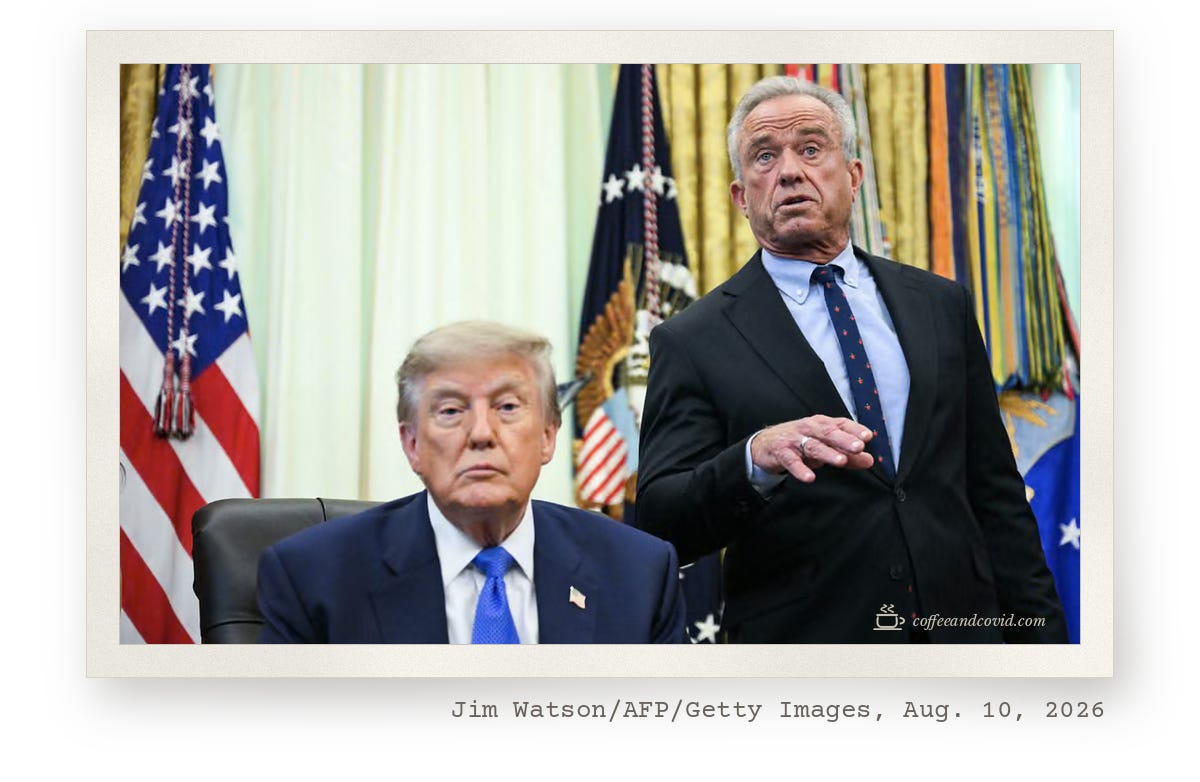
In a sane universe, the story would’ve begun with a heart-wrenching personal interest anecdote about someone whose child was hurt or killed by a vaccine injection. They’re easy to find. But of course, we’re not in a sane universe, so who’d the Guardian turn to instead?
None less than satanic vaccine salesman Peter Hotez. Of course.
What happened is that the Trump Administration is finalizing a new rule that, as of January 1st, will finally allow licensed doctors to be paid for evaluating, diagnosing, treating, and reporting vaccine injuries. This seems so obviously sensible that it’s nearly impossible to imagine how anyone could complain about it. But stand by. In the story’s very first sentence, the reporter stressed, “Experts believe this is an attempt to undermine trust in vaccines and to create an evidence base on their purported risks.”
I guess experts distrust doctors now. Who knew? Ironically, doctors used to think they were part of the expert class. Nope! And when did gathering evidence become a bad thing? “Evidence” is the shibboleth that the entire pharma edifice is built with.
That wasn’t the experts’ only full reversal from all the platitudes we got during the pandemic.
Law professor Dorit Reiss, for example, warned that paying doctors to report vaccine side effects could create “the wrong incentives” for “unscrupulous providers.” Let’s get this straight. Paying doctors to give vaccines is the right incentive, but paying them to report the side effects is the wrong incentive. Make sense?

According to the article, Peter Hotez, professor and dean of Baylor College of Medicine’s National School of Tropical Medicine, said Kennedy’s actions were ‘likely’ a combination of “being an ideological zealot and making money either for himself or for his associates.”
You’ll be shocked to hear this, but there was not one word in the story about vaccine profiteering.
The gist, if I understand it correctly, is that compensating doctors to treat vaccine injuries is Kennedy’s retirement plan. The purported connection was hysterical but dubious. “There’s a dozen ways he and his family could benefit,” Professor Reiss explained, while not listing any of them, except to imagine that it could somehow (not explained) increase donations to Children’s Health Defense. Peter Hotez suggested Kennedy might be deviously planning to sell wellness industry products, which is not only silly and has no evidence, but what the heck does Peter have against wellness products?
Without any exaggeration, Peter explained that Kennedy’s actions ‘appear intended’ to “completely wipe out American medicine as we know it in favor of this whole system of grifting and pseudoscience.” That was ironic. Grifting and pseudoscience are what most of us accuse Peter Hotez of doing. Physician, heal thyself.
Platforming Secretary Kennedy’s alleged bad motives is a neat political trick, but it ignores the millions of Americans who are dying for doctors to start taking iatrogenic injuries seriously.
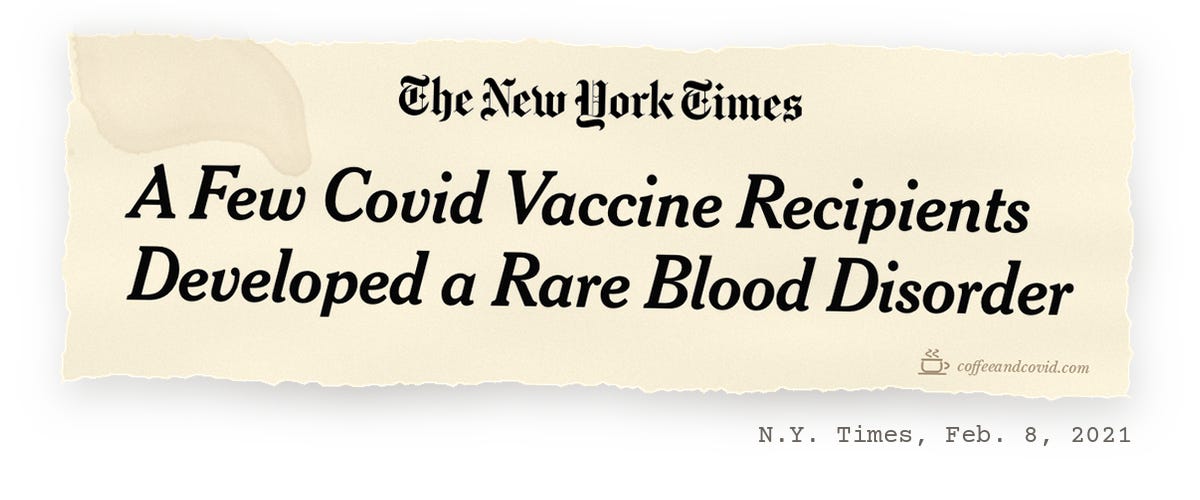
💉 It seems like compensating doctors for diagnosing patients’ real vaccine injuries is a good thing. It’s certainly better than making them hunt around for some alternative diagnosis that does have a reimbursement code. That distorting incentive should be more concerning to experts than a promise to pay for an accurate diagnosis.
The Guardian’s experts assumed as gospel that, if doctors are compensated for evaluating and treating vaccine injuries, “false claims will proliferate.” Why proliferate? How proliferate? Are they assuming many doctors are frauds? If so, why isn’t that a licensing problem rather than an incentive problem?
The experts’ unstated premise was that individual doctors —decentralized clinical judgment— cannot be trusted. It’s really an argument for collective control of personal healthcare, dressed up as a very loud policy disagreement.
But what happens when doctors are finally paid to consider, report, and treat vaccine injuries? The first and most obvious result is that it will treat honest clinicians fairly. They won’t be considered kooky, fringe wellness advocates. Then, doctors will likely fracture into two camps, just like the general public. One with doctors who think vaccine injuries are possible, and the other with those who will only consider them if the needle is still sticking out of the patient’s cooling corpse.
Especially if you are a parent thinking about vaccinating your child, which kind of doctor would you prefer? Unless you’re a jab fetishist, you’ll want a doctor who will at least consider the possibility if something does go sideways. That’s the only way your child can receive correct treatment. This could create awkward questions between parents and doctors.
Injured patients will likely seek out doctors willing to diagnose their vaccine injury. That will shift business from resistant physicians to open-minded ones.
Law professor Reiss was right about one thing. If, as we all seem to assume, vaccine claims increase, it will be much easier for patients with a doctor’s diagnosis to get compensated in the vaccine court or in a lawsuit. A legitimate diagnosis is generally sufficient evidence, shifting the burden and making defendants prove it wasn’t a vaccine injury, rather than the other way around.
It sounds dry and bureaucratic, but this single change could be the game-changer MAHA has been waiting for, assuming of course that it isn’t tied down with details and burdened by regulations.
This new rule is terrific progress. It took a huge amount of effort to put together. One can only imagine the fierce behind-the-scenes pushback from pharma lobbyists and the permanent bureaucracy. That Kennedy and his team pushed this through the deep-state gauntlet and into a final rule is a Kraken-sized miracle.
Have a terrific Tuesday! There’s a lot going on. Do not miss tomorrow’s installment of essential news and caffeinated commentary.
Don’t race off! We cannot do it alone. Consider joining up with C&C to help move the nation’s needle and change minds. I could sure use your help getting the truth out and spreading optimism and hope, if you can: ☕ Learn How to Get Involved 🦠
How to Donate to Coffee & Covid
Twitter: jchilders98.
Truth Social: jchilders98.
MeWe: mewe.com/i/coffee_and_covid.
Telegram: t.me/coffeecovidnews
C&C Swag! www.shopcoffeeandcovid.com
Good morning C&C world! I am one of the 36 plaintiffs in a suit against Seattle Fire Department who were terminated for not taking the COVID shot. We are deep into this and quite a few of us are financially struggling under the lawsuit fees. We love and thank everyone for financially helping us. Please visit http://www.seattlefired.com to read our stories and support us. We are asking for a multiplier from Jeff Childers so we don’t lose anyone in this suit, show Seattle we will stand against evil, and hopefully set case precedent for the nation.
Andrew
Jeff, it is SO refreshing to get your optimistic outlook on world affairs. Honestly there is almost no other sources for information I pay attention to daily. Keep up the great work and God bless you for all you do!