

Good morning, C&C, it’s Thursday! It’s time to turn to the Golden State —the Democrats’ fortress of woke political power— since it is experiencing two of the most unexpected and thought-provoking primaries in the country. Your roundup includes a whirlwind tour from 2026 LA to Mamdani's New York to squeegee-era 1993 and back to Sacramento; the fake fairy tale of the "young socialist voter"; what actually causes crossover moments, and why Republicans may have stopped pulling the boulder uphill on purpose; a reality-TV villain who sued his way into a runoff with hapless Karen Bass; and a jungle primary that was supposed to keep Republicans out — and just advanced two of them.
🌍🇺🇸 ESSENTIAL NEWS AND COMMENTARY 🇺🇸🌍
🔥🔥🔥
As crypto-communist Zohran Mamdani continues immanentizing the eschaton (or whatever he’s up to) at an increasingly frantic pace, I’ve been thinking back to his mayoral election. It stands out like a sore socialist thumb against the larger landscape of our otherwise encouraging post-pandemic counter-revolution. I’ve also been thinking about giant boulders, hills, and just letting go. Today, we draw a line through three mayors: Mr. Mamdani, Rudy Giuliani, and a first-time, former reality-TV-villain upstart running for LA mayor. Yesterday Fox News reported, “Karen Bass to face runoff election amid tough challenge from Spencer Pratt”
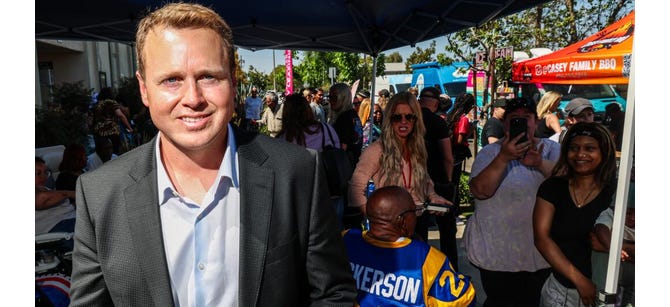
The corporate media narrative explaining Mamdani’s surprise victory —even the New York Times opposed him— is that “young people” who can’t afford to buy houses or see more than one Broadway show a week were somehow convinced by Zohran’s redistributionist message of piling more regulations atop real estate. Electing him might not make houses more affordable, but at least it punishes boomers and Gen-Xers hogging the Big Apple’s most delicious bites.
In other words, according to media, New York’s “young voters” embraced socialism because they can’t afford housing. But the average New Yorker isn’t twenty-two (median age: 37), and the city isn’t exactly shedding young adults to cheaper locales, or else they wouldn’t have a voting bloc to throw around.
Plus, the voters who media calls “young” are actually in their thirties and forties, making good money, living in neighborhoods their parents could only dream of, dining out four nights a week, and flying to Portugal for vacation. Their grievance isn’t starvation. It’s that they still can’t buy the brownstone they feel entitled to.
It’s possible. But I’m not too sure. It’s one thing to say 22-year-old baristas were blinded by happy talk about free stuff from the government. It’s another thing to suggest that a 37-year-old lawyer-and-doctor couple who holiday in the Hamptons went all in on the socialist sales pitch.
Either way, the media’s conventional theory explains that these “young voters” responded to the housing shortage by electing a political faction most associated with adding layers of costs, delays, and red tape to housing. Makes about as much sense as Mamdani’s promises of rent control, free public transportation (not subways though!), and free child care.
Let’s not forget this was a low-turnout municipal election, and what is the voting group least likely to vote in any election? Young people. It’s a fake, dumb fairy tale, but corporate media is wedded to it.
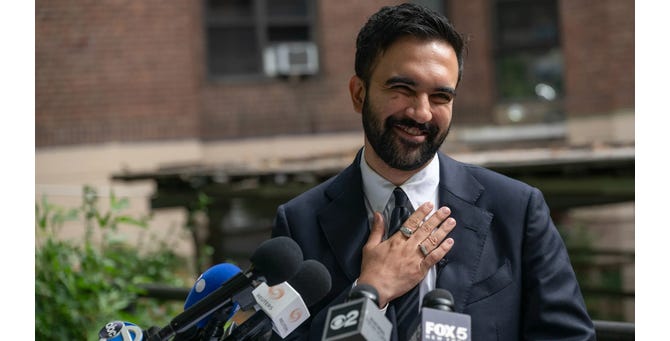
The fraudulent “young people voting bloc” wasn’t the only thing about that election that made no sense.
🔥 Actually, the most disconcerting thing about Mamdani’s election was that the Republicans never ran a viable candidate. The GOP ticket was Curtis Sliwa, a 70-something culture warrior, radio personality, and local media gadfly who’d run for countless elections and never won anything. He broke the first rule for earning party support: be someone who has proven they can win an election.
Don’t get me wrong, Curtis is a great guy, and was a powerful force for good back in the day (a fact that teases our first clue). Instead of getting behind Curtis, many Republicans —including President Trump— held their noses and supported disgraced quitter Andrew “Luv Gov” Cuomo, who was doubly cursed as a pandemic overreacher with a lingering, bloody nursing home scandal and who was absolutely reviled by conservatives.
New York Republicans shouldn’t be judged too harshly. Democrat registrations in the City outnumber Republicans six-to-one. Which partially explained —but does not excuse— their support for the hated Cuomo. Only a Democrat like Cuomo can win, they probably thought, and anybody’s better than the commie.
The only feasible way to elect a Republican mayor in New York City is in a massive crossover moment.
But … what is a crossover moment? How does it happen? Put those questions on the back burner for now. Even stranger, if Republicans really wanted to stop the Mamdani train, Sliwa could have dropped out to facilitate a Cuomo win. It’s almost like they intentionally let Zohran happen.
Put on your bathing suit. Let’s climb into the Hot Tub Time Machine.
🔥 The year is 1993. New York City had spent roughly a generation teaching its residents that urban disorder was inevitable. Crime, graffiti, aggressive panhandling, prostitution, filthy subways, open-air drug markets— these weren’t problems to be solved, they were simply facts of city life. The New Normal. The governing philosophy had become one of managed decline rather than conquest.

If you stopped at a Manhattan intersection in the early 1990s, sketchy-looking men holding spray bottles would run into traffic, smear your windshield with a filthy rag, and then aggressively demand payment. Refusing to pay invited threats and intimidation. The political establishment dismissed complaints as bourgeois whining —Mayor David Dinkins clumsily argued that “Killers and rapists are the city’s real public enemies, not squeegee pests”— as if that somehow made it better.
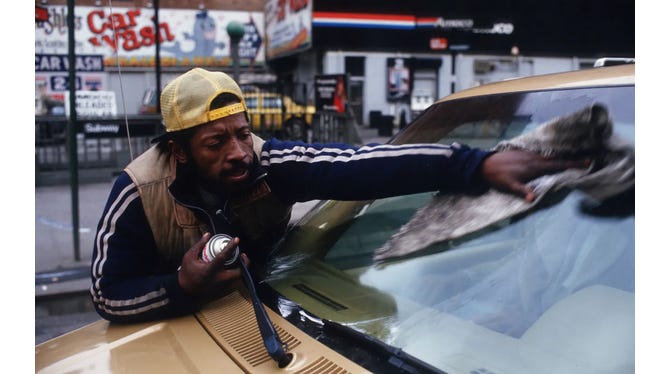
The political significance that Dinkins missed is that Squeegee men affected everyday New Yorkers. Every single day. Nobody with a car was immune.
Squeegee men were organized. They had their own “Squeegee Coalition” activist group that protested any attempt at regulation, and had free lawyers who defended them when they got arrested. (Sound familiar?) One Squeegee man, interviewed by the Boston Globe, rationalized his tactics in familiar Wall Street diction: “Everybody is an aggressor. If IBM takes over AT&T, are they going to be nice about it?”
New Yorkers parked their cars with “no radio” signs taped in the front window to keep the windshields from being broken in. Times Square was festooned in the neon glow of ubiquitous pornography. In 1991 polls, a majority of New Yorkers agreed they wanted to leave the city.
🔥 Enter Republican Mayoral Candidate Rudy Giuliani. A former US Attorney who’d handled high-profile mob cases, Giuliani ran on a “law and order” public safety platform. Progressives sneered and cited cooked crime statistics ‘proving’ crime was down. He ran against popular incumbent Dinkins and won by a nose.
He’d come close in 1989, but Dinkins eked out a victory. Four years later, in the 1993 cycle, Giuliani tipped just past Dinkins to become the first Republican elected mayor of New York City since John Lindsay in 1965. By 1993, the GOP had been out of City Hall for almost thirty years. Giuliani’s “broken windows” anti-crime plan was so successful at turning around New York’s broken culture and economic prospects that, by the time he termed out, Giuliani had been crowned “America’s Mayor,” a national title conceded even by Democrats, however grudgingly.
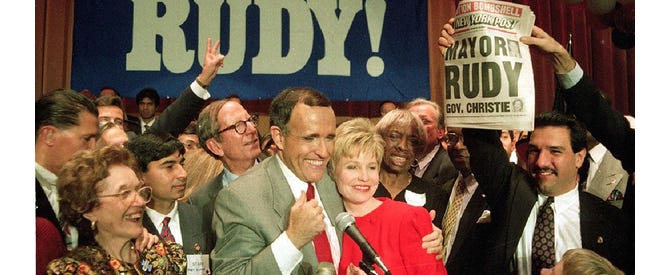
Giuliani’s election represented a crossover moment—the point at which a large number of ordinary Democrat voters stopped interpreting politics through party identity and started interpreting it through their lived experience. In voting for Giuliani, the Big Apple’s Democrats didn’t switch parties. They just said, “whatever this is, it isn’t working.” Political scientists sometimes use the term, “performance elections.”
In short, crossover moments happen when day-to-day lived experience begins to outweigh tribal identity and habitual voting patterns. Who can fix this?
Put differently, sometimes people must fully experience political reality before they will reject it. Sometimes voters must live in the utopian promised land before they decide they’d rather try someplace else. The hot poker of reality prods them out of their socialist delusions. As British Prime Minister Winston Churchill apocraphally observed, “Americans always do the right thing — after they’ve exhausted every alternative.”
Intentionally or not, I suspect that’s what happened in the Mamdani election when the GOP allowed a radio host to win the party nomination. Republicans looked at the hill, looked at the boulder, and let go of the chain. It was a strategy to win the next election cycle.
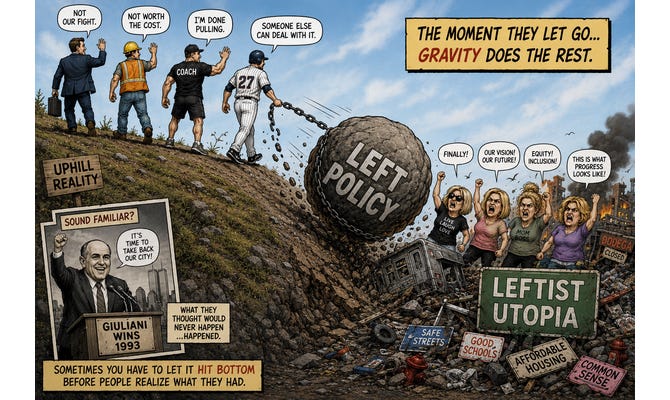
It seems to me that LA Mayoral Candidate Spencer Pratt running against hapless Karen Bass is comparable to Rudy Giuliani running against doomed David Dinkens in the 1990s. It’s just not clear whether it’s 1989 —when NYC hadn’t yet hit rock bottom and narrowly rejected Rudy— or if it is finally 1993.
🔥 In case you’ve somehow missed the electrifying LA Mayoral race, or live in Portland, it is a phenomenon. Spencer Pratt from MTV’s The Hills was one of reality television’s original professional villains. Along with his blonde bombshell wife, Heidi Montag, he spent the late 2000s playing the role of Hollywood’s shallow, fame-obsessed, self-promoting golden couple. The show famously ended with a pullback shot, revealing the scenery was just a Hollywood set, admitting on the way out that the whole thing was always fake.
Nobody would have mistaken Spencer Pratt for a conservative political commentator or a public-policy analyst.
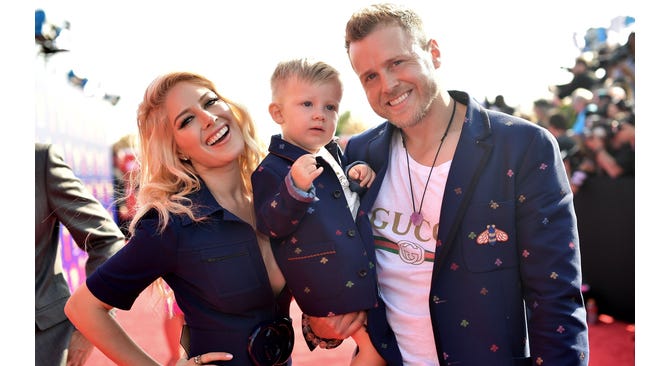
Then his Pacific Palisades house burned down. Suddenly, the former tabloid fixture was asking uncomfortable questions about brush clearance, water pressure, government priorities, and why one of America’s richest states seemed incapable of performing its most basic functions. Almost overnight, California’s most unlikely policy critic emerged from the ashes. He sued the city.
Spencer breaks the first rule of politics. He’s never established his electability. But he has satisfied the second rule of politics. He is fundraising to beat the band; in fact, he’s out-raising incumbent Karen Bass. He raised $2.7 million in four weeks, roughly matching what Bass raised in two years.
He’s also shown an astonishing ability to use social media and high-impact videos to connect directly with his fellow Angelenos. Commenters call him “raw” and “unfiltered.” They admit he has earned credibility through “authentic experience.” He’s been credited as a media innovator, if not an intuitive genius. Headline from local affiliate Fox11:

ABC called it the ‘weirdest mayor’s race ever,’ adding it ‘gets stranger as Spencer Pratt gains momentum.’ After the figures came in, Spencer told CNN, “Obviously, God wanted five more months of me exposing the failures of our mayor.”
California’s jungle primary was Tuesday, which in Valley-speak means we won’t know who won for weeks as the slow-motion mail-in ballot counting continues. Already things are getting hinky. Accusations of cheating are widespread. Yesterday, President Trump complained on Truth Social: “The Dumocrats are at it again! They are trying to STEAL THE GOVERNOR OF CALIFORNIA PRIMARY, AND THE MAYOR OF LOS ANGELES, PRIMARY… it is now under investigation by the U.S. Attorney’s Office in Los Angeles.”
But, based on the results so far, it appears Karen Bass failed to clear 50%. If she had, the race would be over, decided by the small number of primary voters. As of the latest count, Bass was at around 35–37%, Pratt at around 30%, and progressive councilmember Nithya “Noodle” Raman in the low 20s. Under the rules, that means Bass goes to a runoff election, presumably against Pratt.
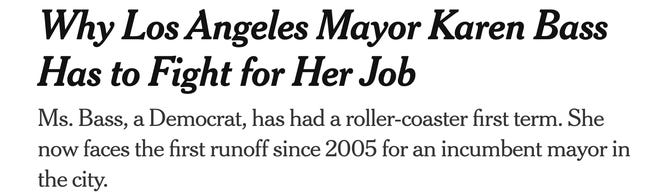
Karen Bass will be the first incumbent LA mayor to face a runoff in twenty years. Two-thirds of her own city voted against her. Headline from the New York Times, this morning:
Even though the numbers suggest Raman’s voters will break for Bass, precluding a Pratt win, crossover-moment elections don’t follow traditional math. And there’s another wildcard. November’s general election will draw many more voters than did Tuesday’s primary, since primaries are usually dominated by partisans and activists.
The bottom line is Spencer Pratt absolutely has a path to win, even though he’s a Republican running in a deep blue city, where Democrats hold a 3-to-1 registration advantage. He could not win a traditional partisan election. He can only win a crossover election, which is the fruit of deep dissatisfaction with the status quo.
Squint, and you can see fingerprints over Los Angeles. The California GOP —which in past cycles would have dutifully cleared the field for some respectable, well-funded, terminally boring party regular, who would then lose by forty points— this time did… nothing. No establishment alternative. No consultant-approved sacrificial lamb. They left the lane wide open for a reality-television villain with no political résumé and a grudge about brush clearance.
Maybe it was incompetence. Or maybe somebody read the Giuliani file. Pratt is the perfect test candidate: cheap to run, impossible to embarrass, algorithmically un-ignorable, and carrying zero party baggage to blame if it fizzles. If LA isn’t ready to cross over, Republicans lose nothing; they were ever going to win anyway. But if the city has finally reached its 1993 tipping point… well. The boulder rolls downhill all by itself.
The question for Spencer Pratt is whether or not LA has reached that crossover tipping point. And there’s only one way to find out.
🔥🔥🔥
Which brings us to another potential crossover moment— a bigger one, one beyond LA, encompassing the entire State of California. Yesterday, the LA Times reported, “Hilton and Becerra lead California’s unsettled governor’s race; Steyer faces elimination.” In yet another jungle primary, Republican Steve Hilton is currently leading, with Biden’s former HHS Secretary and pandemic villain Xavier Becerra trailing in close second place.
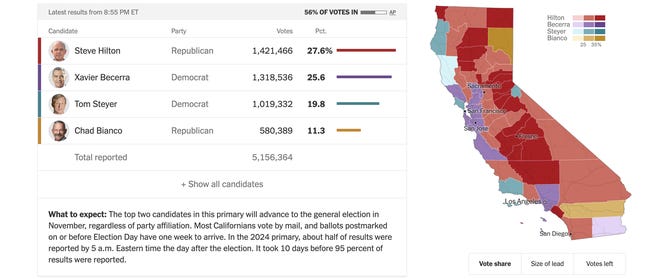
(On an aside: you can tell how politically damaging Becerra’s pandemic work was from how gingerly corporate media reports it. The LA Times only called him “a former Biden cabinet member,” too scared to mention HHS, never mind trying to use his covid stewardship as any selling point. Democrats would prefer running billionaire Tom Steyer, who spent $213 million of his own money and still couldn’t close the deal.)
The shocking thing is not just that a Republican is leading in California. Astonishingly, two of the top four vote-getters —Hilton and Sheriff Chad Bianco— are Republicans. This was never supposed to happen. California’s jungle primary system —which was designed to guarantee no Republican could ever survive to a runoff— just advanced two of them.
It looks like we might be in the midst of something even more unusual than a municipal crossover moment— a crossover moment for the largest and most important deep-blue state. Again, crossover elections suspend normal political mechanics. In other words, to forecast the November results, you can’t just compare Hilton+Bianco versus Becerra+Steyer.
As in Spencer Pratt’s mayoral contest against Bass, unusual dynamics apply in November: more general-election voters and unpredictable crossover fallout. Finally, it’s reasonable to ask whether a fair election with California’s mail-in mess is even possible, but that’s a question for a different post.
Let’s now draw the line through our three mayors and potential governor. New York in 1993 teaches that crossover moments arrive after Democrat voters have fully marinated in the failure —and that Republicans shouldn’t waste money interrupting the marinade. Viewed that way, Mamdani’s election wasn’t a defeat; it was a down payment.
LA’s runoff and California’s jungle-primary surprise will tell us whether the Western marinade has finished cooking. It is the same recipe Rudy proved thirty years ago: when ordinary Democrats stop burping “blue no matter who” and start asking “who can fix this?”, then registration math stops mattering. The only question left is the date: is it 1989 in California — or 1993? We’ll find out in November.
Either way, it is a political earthquake and more blue polycrisis headaches. And it’s way better than reality TV.
Have a terrific Thursday! Come back tomorrow for a traditional roundup of essential news and commentary, Coffee & Covid style.
Don’t race off! We cannot do it alone. Consider joining up with C&C to help move the nation’s needle and change minds. I could sure use your help getting the truth out and spreading optimism and hope, if you can: ☕ Learn How to Get Involved 🦠
How to Donate to Coffee & Covid
Twitter: jchilders98.
Truth Social: jchilders98.
MeWe: mewe.com/i/coffee_and_covid.
Telegram: t.me/coffeecovidnews
C&C Swag! www.shopcoffeeandcovid.com
Californian here. The amount of voter fraud is beyond comprehension. Mass mail-in ballots. No voter ID (It's actually illegal to ask for ID!). Mysterious ballot dumps, and zero for one particular candidate? Nothing to see here! Dems aren't even trying to hide it. They just pass a "stop Nick Shirley" law instead. Nothing to see here.
Looks like Mamdani's "free public transportation" is the same option widely available in much of the US....... walking.