

Good morning, C&C, it’s Thursday! Your roundup includes: Gas prices plummet as President Trump inks Iran deal early, and critics pounce— not on the terms in the deal, but on all the ones critics think should have been in it; negotiations continue, and we see the deal isn’t really final yet; the U.S. could restart hostilities right after the midterms; New study on remote work from home proves the experts gizzled us again with bad advice and failure to tell us about the real risks; Department of Labor targets fraud in unemployment schemes and blue governors squawk; And against all odds, the European Union passes a massive migration reform bill that implements ICE-like policies and signals something big —and great!— is afoot across the Atlantic.
🌍🇺🇸 ESSENTIAL NEWS AND COMMENTARY 🇺🇸🌍
🔥🔥🔥
After months of demanding that President Trump end the Iran War right now —including filing bill after bill in the House and Senate demanding withdrawal of U.S. forces— his critics have pirouetted in place and now insist (implicitly, at least) that he should have kept fighting. This morning’s New York Times reported, “Average U.S. Gasoline Price Falls Below $4 for First Time in Months.”
Whoops! Sorry! That was the wrong headline. But thank goodness the price of gas might be headed back to pre-war levels —80 cents a gallon cheaper— thereby narrowly averting the Second Great Depression. I don’t know how we make it through summer travel season. Some kind of economic miracle, perhaps.
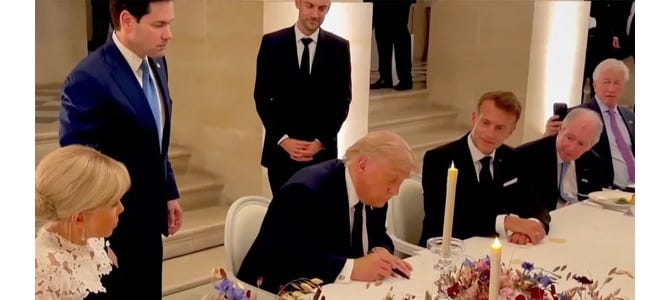
Allow me to begin again. We’ll break tradition and go with Fox News’s take. This morning’s headline: “Trump personally signs Iran deal at Versailles in major diplomatic breakthrough.” The Iranians also signed the “memorandum of understanding,” a 14-point framework outlining a final deal. Think of it as a binding letter of intent. Once again, Trump surprised the media by signing at the G7 conference in France. Yesterday, media reported the signing would happen in Sweden on Friday (tomorrow).
So far as I can tell (and I looked hard), no official copy of the executed MOU was released. But several platforms claim to have “the full deal.” If you’re curious, here is the “full text as seen by Bloomberg.” But you can already tell from the headlines and the carping from critics: there’s not much in the 14-point deal to criticize.
Critical comments are all focusing on what isn’t in the 14 points. One solid example of critics on the right was Mike Pence’s frenemy tweet, which damned the deal with faint praise and made both points (i.e., that it’s not ‘good enough’ and we should just keep fighting):
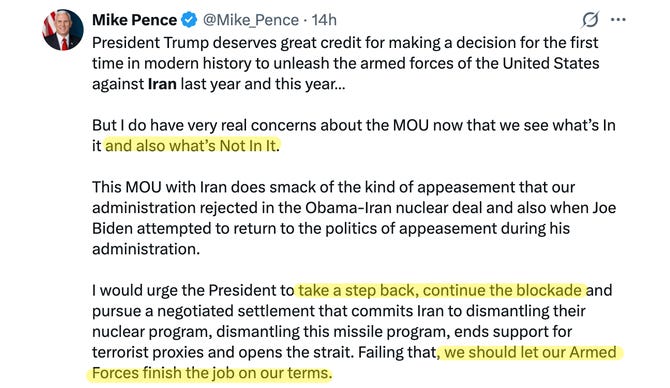
As we’ll see in a moment, Mike Pence knows better. It is far too early to complain about this deal. Anyway, here’s how the UK Guardian pitched it:

Ask yourself this question: when was the last time you remember corporate media investing this much effort in analyzing the universe of possible wish-list terms that weren’t in some peace or international trade deal? Seriously. It’s quiz time. What were all the omitted terms from the Doha Peace Accords that “ended” the Afghanistan war? Go!
Wait! Actually, now that I think about it, I do remember corporate media complaining nonstop for days about what was missing from Obama’s JCPOA deal with Iran.
Haha! Just kidding!
The obvious reason that nobody usually complains that deals weren’t good enough is that dealmaking is hard. If you lean over and tell a negotiator, make sure they have to personally deliver it in cash only, that person is likely to look at you like you have ‘UFO DISCLOSURE’ tattooed on your forehead and say something like, if you think it’s so easy, why don’t you take over.
As a lawyer who’s negotiated in more mediations than I can remember, deal points that seem easy or minor to one side are often red lines for the other side. For instance, insisting on getting an apology is a great way to ensure you’re going back to court rather than settling a case. In peace deals, there’s an extra layer of constraints: what’s politically possible.
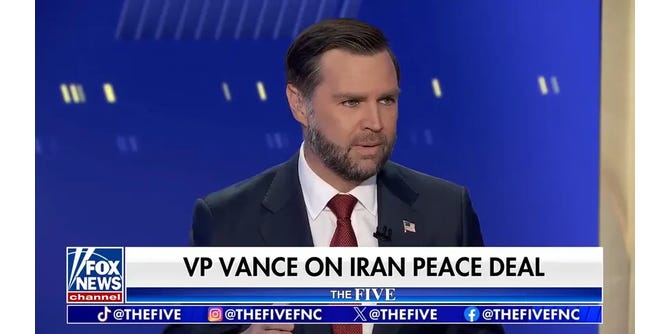
Either way, large parts of the MOU are placeholders, terms that are not yet final. Some pretty big blanks remain to be filled in. Two of the noteworthy outstanding points are Iran’s nuclear concessions versus a $300 billion foreign-investment package “contingent on performance” for rebuilding Iran’s destroyed infrastructure. JD Vance’s team will start negotiating those points in Sweden tomorrow.
That round of haggling was given two months, which can be “extended by mutual consent.” In the meantime, the Strait of Hormuz is open, a cease-fire is in effect, and countries can start refilling their depleted oil reserves with cheap gas. In fact, there’s about to be too much oil on the market, since Iran, now finally able to sell again, will rush to empty its overfull storage systems.
Meanwhile, I see little point in lighting up the cost/benefit-analysis hot takes until the deal is actually final, which could be months away. Until then, the hot takes will be inevitable but pointless (except that they let partisans score points off each other). If you want a more detailed conservative hot-take, this tweeter did a decent job summarizing the current status.
And … while the deal remains fluid, what stops the Trump Administration from running out the midterm clock with dickering and busywork, and then firing back up the whole Bomb Iran campaign? The Iranians are well aware of this possibility.
Literally, the IRGC’s only leverage was political pressure from the midterms. Past the midterms— what do they have left?
We are especially tantalized by some of the less-discussed details. For instance, will the IRGC now open Schrödinger's box and let Mojtaba Khamenei out? After all, with a ceasefire in place, Mojtaba has no reason to remain in hiding. Right? So will the mystery soon be resolved over whether Iran’s replacement ruler remains upright or has just been a cardboard Ayatollah?
The bottom line is that anyone encouraging President Trump to keep fighting till we get a better deal (cough, Mike Pence) is probably actually trying to ensure Republicans lose the Congress in November. Just saying.
🔥 Yesterday, the Hill reported, “Trump on arrival at G7 meeting: ‘I’m the boss.’” You may have already seen this widely-shared clip, but in case you missed it, enjoy this amusing video of President Trump walking into the G7 at Versailles late and, stone-faced, announcing, “I’m the boss.” Media framed it as a joke. Decide for yourself.

CLIP: President Trump pulling Ultra-Chad alpha move at the G7 (0:42).
Thing is, jokes are funny because they contain an element of truth, or at least that’s what humorless experts always say, unless the jokes are about racial, gender, or national stereotypes, like saying Mexican people like siestas. Then there’s no truth in jokes at all. But I digress.
Most social media pundits enthusiastically compared Trump’s dramatic G& entrance to the clip of Joe Biden’s cabbage moment at his final G7, when, stiff-legged, he wandered away from the other leaders to look at a parachute, and Italy’s Prime Minister Giorgia Meloni gently steered him back to the photo line.
🔥🔥🔥
The pajama party is over! Yesterday, the New York Times featured an op-ed headlined, “We Liked Remote Work. Then We Looked at the Data.” Now they tell us. “Despite its advantages,” the economist authors wrote, “remote work has significantly deepened Americans’ isolation and distress.” Gosh. Who could have predicted this?

The piece was based on a study published this month in Science, titled “Home alone: Remote work, isolation, and mental health.” The findings were pretty awful, even if obvious. “Remote workers living alone spent entire days without human contact,” the summary stated, “and their mental distress, use of mental healthcare, and antidepressants increased acutely.”
In case you needed reminding that “public health” and the media are not our friends, consider how the experts and reporters pushed remote work like it was going out of style. Headline from the New York Times, 2020:
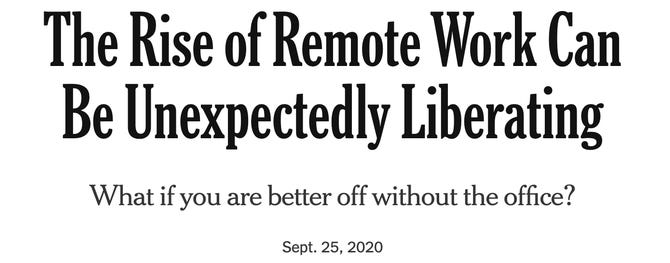
Some people are empowered by work-from-home (WFH). Many people handle it just fine. The point isn’t to dunk on WFH. The point is that, once again, we see something public health experts pushed on us that turned out to have risks of serious, undisclosed adverse effects. This seems to be something of a pattern for public health. (The list is long: school closures, opioids, etc.)
While the public health experts are busy protecting us from the virus-of-the-week, who will protect us from the public health experts?
If I were in charge, I’d suggest two reforms:
Every major public‑health policy should come with (1) a public, written impact statement with signatures, and (2) ongoing evaluations and reports on whether the projected benefits and harms ever materialized, with actual consequences for agencies when they miss badly.
I would reframe “trust the science” as “constrain the experts.” The goal isn’t to completely ignore epidemiology or pharmacology, but to make it explicit in statute that experts are often wrong. So they must always be subordinate to citizens’ elected representatives.
In other words, I’d commit specific experts to their recommendations and make politicians responsible for the experts’ decisions, by requiring all major public health policies concocted by the CDC to be first ratified by Congress and then renewed every 60 days, but only if the reports were finished.
One of the smartest things the Trump Administration did last year was require federal workers to return to the office. Many of them rage-quit in protest. The media hated it. But as the editorial and the study make clear, he was only trying to help them. The decision to bring federal workers back to the office was, apparently, one of the most pro‑worker mental‑health interventions Washington has seen in years. TAW.
🔥🔥🔥
Is there any government charity program that isn’t a fraudulent mess? Yesterday, the Wall Street Journal reported, “State Unemployment Programs Targeted in Federal Antifraud Campaign.” The subheadline explained, “The Trump administration sends warning to all 50 states about complying with measures to stop alleged fraud.”
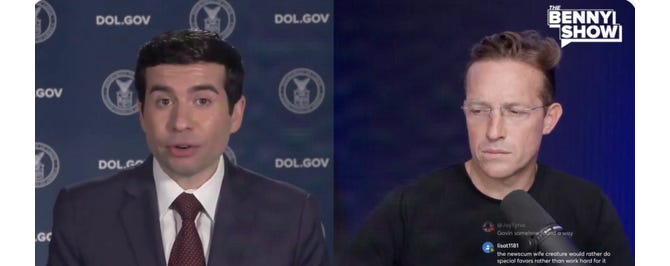
“It’s one of the largest taxpayer-funded thefts in history,” Labor Secretary Sonderling said. “How did this happen? A lack of oversight and control. Paying prisoners. Paying children. States turning a blind eye.”

I’m not sure I see the problem. After all, prisoners are unemployed. Prisoners are fraudsters, rapists, murderers, and people who sell their SNAP benefit cards to Venezuelan drug dealers. Crime is literally their job. A job they can’t do right now, due to unfortunate circumstances beyond their control, such as being arrested by police officers. Where is the empathy from this heartless administration?
“We’re taking some extraordinary measures,” Sonderling explained, “to make sure that never happens again. If states allow fraud, they will suffer the consequences.” Beyond lax oversight, there are structural problems. Sonderling explained that under the current disjointed system, a single Social Security number can get unemployment from multiple states.
The DOL’s announcement used three states as bad examples. You could probably guess which ones. I’ll just tell you: California, Illinois, and New York. (Not exactly a plot twist.) The Government Accountability Office estimated that fraud accounted for up to 15% of the total paid out through unemployment insurance programs from April 2020 through May 2023. Meaning billions.
You won’t be surprised to learn that the federal government lavishes hundreds of billions on the states to distribute through state programs to nonworkers. You could call it a wealth transfer from the better-employed states to the poorly managed ones. Anyway, the Trump Team is now threatening to suspend or cancel transfers to states that can’t or won’t get their unemployment fraud under control.
The real question is: why did this take so long?
🔥🔥🔥
In news of the weird and unexpected, yesterday Al Jazeera reported, “‘Send them back’ chants in EU Parliament after anti-migrant bill passes.” The ministers were literally hugging each other.
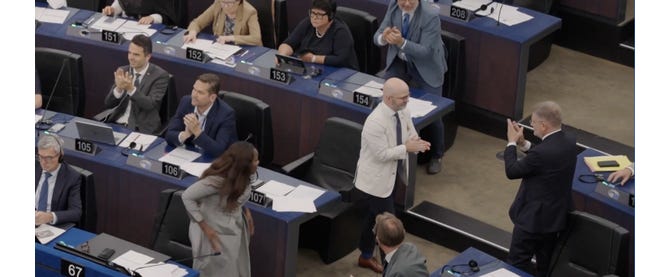
Well, maybe it isn’t that surprising. But first, the new Europe-wide law established “return hubs” in third countries, expanded detention powers (including home raids without judicial warrants), and fueled a general “hard rightward turn” in EU migration enforcement. PBS framed it as the strictest EU migration law in decades, explicitly modeled on U.S. ICE‑style tactics: extended detention periods, aggressive home searches, tougher entry bans, and offshored facilities where EU process protections are weakest.
“The new regulation will speed up the return process and increase returns of persons who have no legal right to stay in the EU,” said Nicholas Ioannides, deputy migration minister for Cyprus, which holds the rotating presidency of the 27-nation bloc. “Critics compared the regulation to the immigration policies of the Trump administration,” NPR said, without naming the critics (it was NPR and NGO activists).
“These new rules will ensure swifter, simpler, and more effective procedures across the European Union for returning non-EU nationals who have no right to stay, in full respect of international law and fundamental rights,” said Henna Virkkunen, EU commissioner for technology.
“This deal will give governments much broader powers to detain and deport people,” complained Marta Welander, a middle-aged white female activist employed by a migration NGO. “It looks set to normalize immigration raids, and expand the use of detention in prison-like facilities outside EU territory that are essentially legal black holes.”
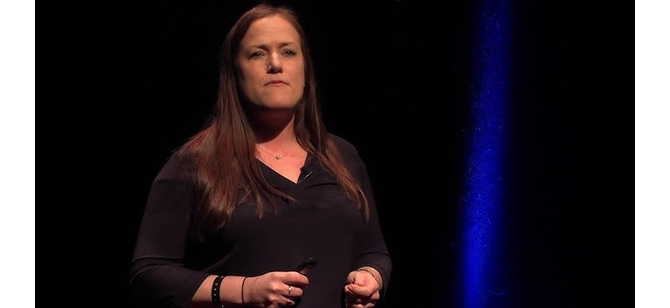
Legal black holes is also a neat way to describe migration NGOs themselves. They are basically money vortexes disguised as charities that suck up our taxes and pay lawyers to sink the ship of state.
🔥 In my view, three things made these surprising “historic” reforms possible.
First, “far-right” (moderate conservative) parties have been ascendant in Europe, a trend that accelerated after President Trump’s re-election last year. Conservative and “reform” parties now make up about a third of all elected EU members.
Second, center-left parties —also about a third— joined the conservatives to pass the new anti-migration policies. Only the far-left parties (Greens and socialists) opposed the new package and shouted “shame!” at their colleagues after the vote passed. (Although you could hardly hear them over all the joyful celebrating.) Thanks to the center-left’s flip, it passed by an unbeatable two-thirds majority.

Third, the center-left’s course correction from pro-migrant virtue-signaling to pro-sanity common sense followed continuous pressure from the U.S. over the last 18 months, which ceaselessly argued that Europe was destroying itself with its open-borders migration policies, and often linked them to America’s pullback from NATO. According to this headline from EU News, last week, a majority of EU voters now want ICE-like migration policies:
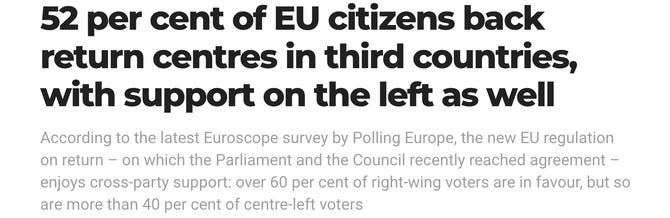
You might fairly ask why I linked this political tipping point in Europe to Trump’s re-election. After all, as the experts always remind us, correlation doesn’t prove causation. Maybe Trump’s election and the rise of sanity in Europe were both caused by some other third factor. To answer, I would point to one specific policy decision, the closure of USAID, and to one person, President Trump, over whom the EU leaders fawned at yesterday’s G7 Summit.
🔥 First, follow the money! Think-tank analysts estimate that up to $2.3 billion annually in U.S. aid ($23 billion every 10 years) was tied to Europe’s “migration management” work. USAID’s closure effectively zeroed this out, leaving a sudden, large gap in financing for development and protection projects in the countries of origin and transit.
In other words, USAID paid the countries where migrants came from, and it paid the countries through which they traveled on their way to Europe. No longer.
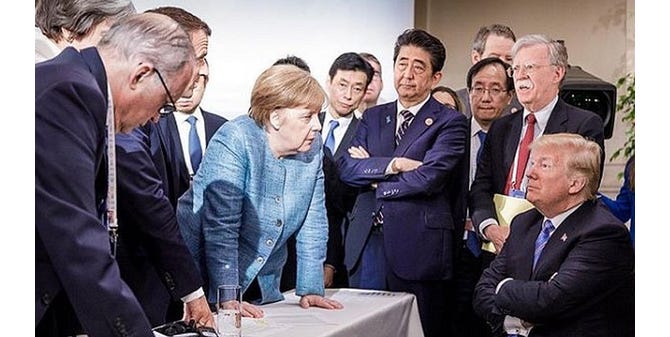
The USAID money spigot is closed. Now the EU is reversing those incentives— by paying origin countries to “host” their own migrants. And, whether it was through tariffs, NATO drawdowns, or energy markets, President Trump has beaten European politics in arm-wrestling. This astonishing turnaround was far from certain. EU leaders actively opposed him during Trump 1.0. Remember this iconic 2018 picture, coincidentally also taken at a G7 Summit?
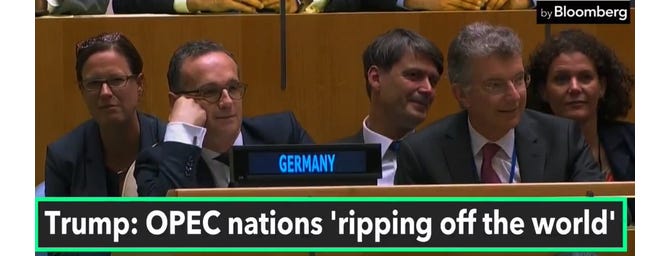
Or this nearly-as-famous shot of the German delegation at the UN General Assembly in September 2018, showing the German Foreign Minister and Ambassador smirking and laughing as Trump warned about Germany’s over-reliance on Russian oil.
Trump opposes open borders and unregulated immigration, especially in the U.S., but also in Europe. Headline from EuroNews, last September:

In July, he spoke with rhetoric resembling blunt-force trauma. “You’d better get your act together, or you’re not going to have a Europe anymore,” the President warned angrily, like he was leading an intervention. “You’ve got to stop this horrible invasion that’s happening to Europe.”
Now, in complete contrast to their smirking defiance during Trump 1.0, European leaders hang on his every word. They laugh in delight rather than derision when he strolls in late and tells them he is “the boss.” The leaders who used to resist him now want to curry his favor, because he’s got all the leverage. (TAW.)
It is difficult to overestimate how encouraging this week’s anti-migration vote is for the world’s prospects. With Europe’s electric migration issue handled by a broad coalition majority, what else could this newly empowered bloc accomplish, now that it has finally found its political legs? Free speech? Grooming gangs? Reversing decades of social degeneracy?
Could the West’s inevitable decline have just become a little less inevitable?
If, one year ago, I’d told you this was possible, you’d have laughed me right off of Substack. Yet here we are. As I assured our European cousins early last year: hang tight. After we save ourselves, we’re coming to save you, too.
Have a terrific Thursday! Don’t miss tomorrow morning’s edition, when we’ll round up even more essential news and caffeinated commentary.
Don’t race off! We cannot do it alone. Consider joining up with C&C to help move the nation’s needle and change minds. I could sure use your help getting the truth out and spreading optimism and hope, if you can: ☕ Learn How to Get Involved 🦠
How to Donate to Coffee & Covid
Twitter: jchilders98.
Truth Social: jchilders98.
MeWe: mewe.com/i/coffee_and_covid.
Telegram: t.me/coffeecovidnews
C&C Swag! www.shopcoffeeandcovid.com
Does anybody, and I mean ANYBODY, give a rats ass what Pence thinks at this point?!? He’s not a has been, he’s a wished he was that’s never been.
Jeff, this was a sharp roundup. One of the reasons your work hit early during covid is that you’ve always had a good instinct for where the real machinery sits—coercive overreach, incentive distortion, and the administrative‑state cracks most people don’t see until they’re standing in them.
If we zoom out one level, the pattern across all these stories is the same: incentives shifted, cost‑bearing returned, and the underlying structure snapped back into alignment.
Iran: the MOU isn’t a peace deal, it’s a tempo device—pause the conflict, run out the midterm leverage, reset the field.
Remote work: technocrats externalized the downstream costs; once institutions had to bear those costs again, the narrative collapsed.
Unemployment fraud: emergency‑era throughput incentives created a crack; reintroducing friction closes it.
EU migration: USAID’s shutdown removed the subsidy that kept the system distorted; once Europe had to carry its own weight, policy flipped overnight.
Different domains, same mechanism: remove the subsidy → collapse the crack → the system reverts to sanity. And by “crack,” I mean the place where incentives misalign — the gap where someone extracts value without bearing cost. Close the crack and the system snaps back to coherence.
That’s the real through‑line here. Not ideology. Not personalities. Just structure reasserting itself after a long extractive cycle. The story isn’t just that things are turning around—it’s why they’re turning around. When the incentive field changes, the politics follow like iron filings.
—Paul