

Good morning, C&C, it’s Monday! Your author is settling back in at C&C’s Florida Headquarters, 40% unpacked and 110% caffeinated. Your roundup today includes: tens of thousands of Americans rededicate the country on the National Mall while the New York Times sulks and digs up its “many scholars”; the WHO declares its next world-stopping global health emergency just in time for another funding cycle; Trump quietly closes deals with China that nobody in trad-media noticed until after the fact, including a shocking line about North Korea; and four senior Times reporters belatedly discover that the United States has spent four months annexing Greenland.
🌍🇺🇸 ESSENTIAL NEWS AND COMMENTARY 🇺🇸🌍
The worst possible thing happened for the New York Times. On Sunday, tens of thousands of Americans streamed onto the National Mall in DC to attend a daylong worship rally titled “Rededicate 250.” The Times sullenly reported this wholesome event as, “Trump Administration Pushes Narrative of Christian Founding at Rally.”
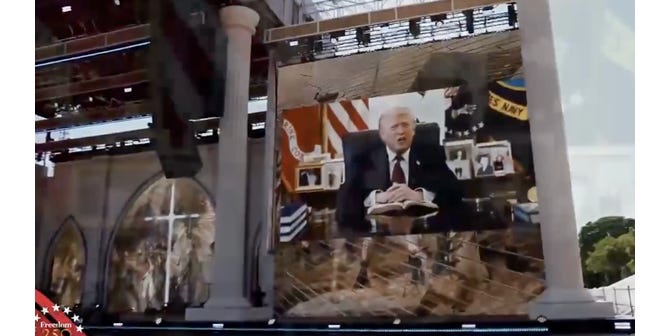
Yesterday’s celebration marked the 250th anniversary of the Continental Congress’s 1776 “day of Humiliation, Fasting and Prayer.” William Livingston submitted the resolution calling for a national day of prayer, and wrote, “it becomes the indispensable duty of these hitherto free and happy colonies, with true penitence of heart, and the most reverent devotion, publickly to acknowledge the over ruling providence of God.”
The virtuous day of worship music, praise, prayer, Bible readings, and sermons rankled. The daylong display of real virtue made the Times bitterer than if it had eaten a jumbo bag of Sour Patch Gummies on a dare. “The rally aimed to crystallize the narrative that the nation’s founding was an intentionally Christian project,” the Times sneered, and then stressed that ‘narrative’ was actually “a framing disputed by many scholars.”
Many scholars. Uh huh. Wait till you see which “scholars.” The Times was also oddly preoccupied with the weather, which, unfortunately, did not include rain. But the reporter made the most of it, complaining bitterly the rally was “under a hot, almost cloudless sky, with long lines for food and restrooms.” First world problems.
If the sunny weather was the worst thing the Times could complain about, you know it was a beautiful day.
Various members of Trump’s Cabinet and broader team appeared in person or via video, including Marco Rubio, JD Vance, Tulsi Gabbard, and the President himself, who re-read the 2nd Chronicles passage about the dedication of Solomon’s temple. (He’d read the same verses for a different event a few weeks back. I think he might be trying to tell us something.) House Speaker Mike Johnson declared to the crowds and livestream audience, “We hereby rededicate the United States of America as one nation under God.”
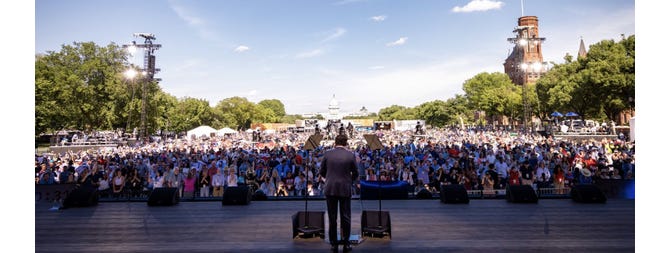
Vice President Vance observed, “The experts said that religion and faith were dying. Today, a wave of young Americans is returning to the pews, and we know that they’re looking for meaning, for authority, for direction, and of course, for closeness with God.”
🔥 By all accounts, it was a warm, family-friendly, faith-forward event, with no shootings, leatherwear parades, naked bicycle riders, or even a single fistfight breaking out at the food truck line. It must have been pure misery for corporate media reporters assigned to cover it.
So, of course, the Times undertook to undermine the event’s premise.
“Many of the country’s founders were Christians, and references to religion are present in many of their writings,” the article generously allowed, before adding that, “the role of Christianity in America’s founding is complex, however.” At last, it was time for the appearance of the many scholars.
The first of the Times’s “many scholars” was historian Joseph Ellis, who called the idea that the founders saw America as an explicitly Christian nation “nonsensical” and “dead wrong.” But the article omitted two very sensical facts about Mr. Ellis’s history that most readers would have found dead helpful.
First, and least surprising, he is a notorious anti-Christian. You’d think that’d be worth a short sentence. But never mind.
Second, and much more interesting, in 2001, Ellis was caught in a shameful stolen-valor scandal, having long claimed heroic Vietnam combat service (before becoming a tie-dyed anti-war activist). He practically wouldn’t shut up about it. But his ‘combat experience’ turned out to be closer to a hippie-fied LSD trip. He never left the US during the war— he was teaching at West Point.
After the scandal erupted, Ellis was suspended from his professor job without pay for a whole year. (Saved from firing, presumably, by tenure, a tweed jacket with elbow patches, and his subscription to the Worker’s Daily.) Headline from the Chronicle of Higher Education, August 2001:

Mount Holyoke issued a rare public rebuke of Professor Ellis, correctly calling his lies “a particularly egregious failing in a teacher of history.” No kidding.
In other words, the Times asked a historian caught lying about his own military record to be the expert witness for the founding generation’s beliefs. That was no mistake; it’s the credentialed class’s operating system.
Either way, that was the Times’ first expert. Next, and I am not making this up, the Times unearthed the completely neutral and bias-free Rachel Laser. Despite her last name, Rachel is not a beam of intellectual energy, or any other kind. No, Rachel is the president of Americans United for Separation of Church and State, which has so far filed at least seven lawsuits against the Trump Administration “related to its turn toward Christianity.”
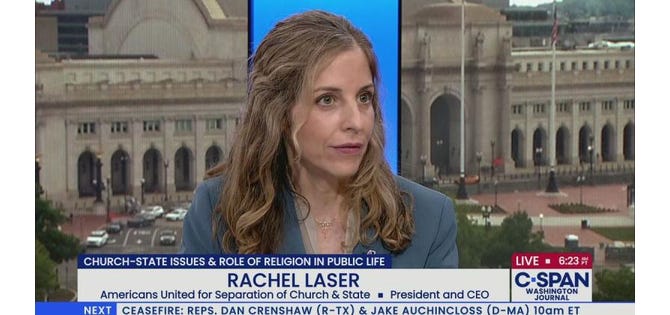
At least the Times reported those facts, which might affect Rachel’s perspective. Unsurprisingly, in a very unlaserlike way, Rachel also spewed word salad at everyone who claims the country has a Judeo-Christian heritage.
And … that was it. That was the full inventory of the Times’s “many scholars”— one Vietnam perjurer plus one litigious anti-religion activist.
🔥 Of course the story didn’t quote any scholars explaining the consensus case that the country was founded on Christian principles. It could have quoted scholars like Mark David Hall, Daniel L. Dreisbach, Thomas Kidd, or any other credentialed voice from the large body of research documenting how Christian theology, natural law, and biblical language were all deeply woven into founding‑era political thought.
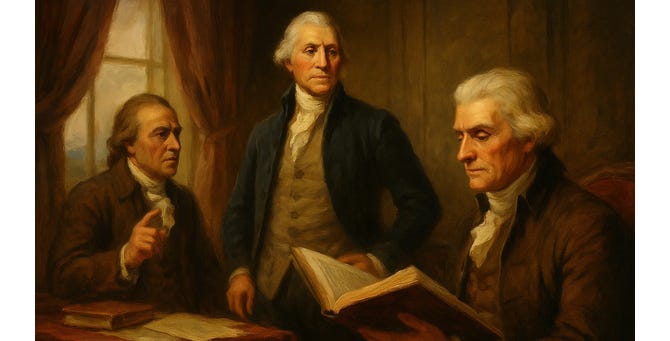
In David Hall’s 2019 book Did America Have a Christian Founding?, he wrote, “America’s founders … were profoundly influenced by a biblical worldview.” Professor Daniel Dreisbach has noted that Revolutionary‑era Americans were steeped in Scripture, and that biblical phrases and stories “flowed from their tongues” as they debated liberty, rights, and governance.
In a famous 1984 social science study, political scientist Donald S. Lutz analyzed thousands of pieces of American political writing from 1760 to 1805 and found that the Bible was cited more often than any European Enlightenment writer or classical source. Roughly one‑third of all citations in the massive sample were biblical, far outpacing Montesquieu, Blackstone, Locke, and the rest of the secular canon combined.
In short, biblical language and concepts saturated early American political culture. Documenting those facts only took me about two short paragraphs; but you won’t see anything similar in the New York Times, whose main job, apparently, is to keep its readers in the dark like pet fungi, or even actively misinform them about the religious and intellectual forces behind our own country’s founding.
Anyway. Despite the Times’s sour-grapes framing, we certainly have come a long way in a remarkably short amount of time. Maybe yesterday’s rededication finally expelled the clinging stench of Biden’s grotesque Trans Day of Visibility. That’s how I’m looking at it, anyway. Who’s with me?
💉💉💉
The hantavirus fizzled out, so a new media health hysteria has magically appeared like a twisted Marvel antihero whose superpower is keeping liberals frantic and anxious. (Democrats: hear me. It might look like it, but the media is not your friend.) Late last night, the New York Times alarmingly reported, “W.H.O. Declares Ebola Outbreak a Global Health Emergency.” Guess what the WHO’s last global health emergency was? Monkeypox. Before that, covid.
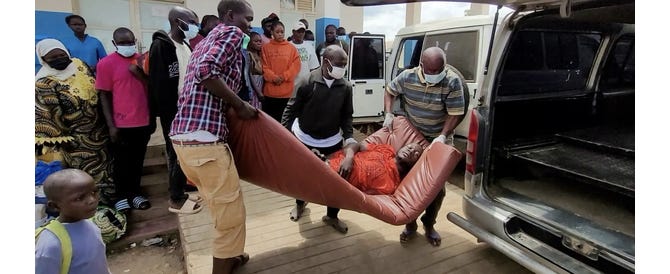
Since 2020, the WHO has declared no fewer than six public health emergencies, averaging one a year. Almost like it was scheduled or a quota or something. But I digress.
Specifically, this time it was about 246 suspected cases of Ebola and 80 deaths have been reported in Uganda and the Democratic Republic of Congo —remember those two countries— although, the Times admitted, only ten of those cases have been verified as Ebola by a lab test.
The Times failed to mention that, buried inside the WHO’s own announcement, was this sentence: “The outbreak does not meet the criteria of pandemic emergency, as defined in the IHR.” Um. They are declaring an emergency over something they say is not an emergency. This kind of Orwellian, bureaucratic wordplay exposed the whole racket in a single sentence.
Nevertheless, the Times is freaking out. We should, too! In fact, the whole public health establishment is freaking out. (Performatively, of course.)
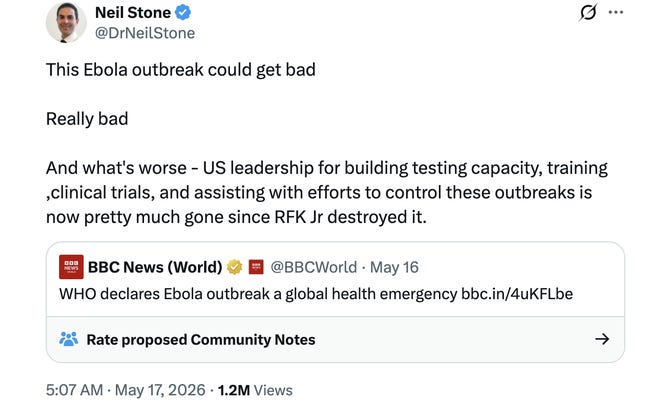
WHO Director Tedros Whatshisname called it “a serious threat that requires our collective action and global solidarity.” Public health halfwits like infamous pandemic grifter “Dr.” Neil Stone have been tweeting up a storm:
The Times warned its readers that “there is no approved vaccine and no therapeutics for the Bundibugyo species of Ebola behind the outbreak.” So … what do they expect us to do? Lockdowns? Grocery arrows? Face masks? Mail-in voting??
I promise I did not make this next part up. Just one paragraph after declaring there are no vaccines and no treatments, the Grey Lady provided her prescription for the USA: “to share vaccines, treatments, and other resources needed to contain the outbreak.” Um. Which is it? Are there vaccines and treatments, or aren’t there? The world’s dumbest newspaper.
Of course, the truth lay in the ambiguous words “other resources,” tacked after vaccines and treatments like an afterthought. In other words, they want our money.
Very late in the article, far beyond the point that most of the paper’s regular readers would have fled to hide beneath their beds, the Times finally contextualized the current ‘outbreak’ of 246 infections and 80 deaths. I report it here in the original:
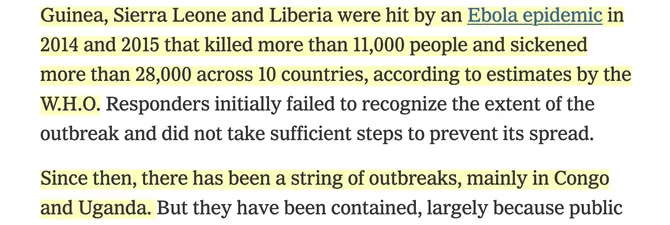
So— the current outbreak is a rounding error compared to the last big one ten years ago. And since 2014 or so, Ebola outbreaks in Congo and Uganda have become nearly an annual event. We’ve pivoted straight from hantavirus cruise ship hysteria to recycled Ebola hype.
At some point, sooner rather than later, we must consider retiring the entire “pandemic preparedness” racket. Big pharma’s and public health officials’ salaries and avenues to personal wealth creation depend too much on germaphobia and pathogenesis, which is a horrible incentive for about ten thousand reasons.
I say we pull the plug on the whole thing, and take our chances, like we always used to do back when pandemics were rare 100-year events, not 10-year carnivals of recurring corruption.
🔥🔥🔥
President Trump has returned from China. Once again, the media was caught completely by surprise. He’s running rings around them. Yesterday, Politico reported, “China says preliminary agreement reached with US to lower some tariffs.” It was the least informative headline they could think of and the only way to avoid crediting the President.
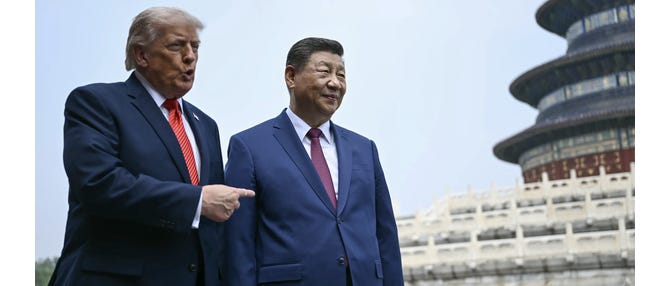
In contrast, over the weekend, the White House published its own “Fact Sheet: President Donald J. Trump Secures Historic Deals with China, Delivering for American Workers, Farmers, and Industry.” As far as I can tell, nobody but Fox covered it, even after last week’s wall-to-wall reporting of every single eyebrow twitch on Trump and Xi’s faces, like media was reading oriental tea leaves or something.
This hardly needs to be said, but major economic and military deals are never signed during the state visit. According to historical data, major trade deals average around 917 days —roughly 2.5 years— from initial talks to final presidential signature.
Anyway, the White House’s fact sheet listed three remarkable points of principled agreement that were at least potentially achieved:
The US and China generally agreed to have a “constructive relationship of strategic stability.” To make it more tangible, President Xi will visit the US later this year, and the two countries will co-host this year’s G20 and APEC economic summits.
Trump and Xi agreed that Iran: (1) may not ‘close’ the Strait of Hormuz, (2) cannot charge ‘tolls’ to travel through it, and (3) cannot have a nuclear weapon. Soon, Iran’s only remaining strategic allies will be a couple of fretful sophomores at Columbia University and the Washington Post’s editorial board.
They agreed North Korea should be denuclearized. This should have been front-page news. Without China’s support, North Korea can’t exist. Trump is slowly burying the Bush era’s “Axis of Evil.”
On top of those historic points, the fact sheet also announced that the two countries will charter two new institutions —once again, completely outside the flaccid State Department and useless United Nations frameworks— a brand-new Board of Trade and Board of Investment.
Add in the Board of Peace, and we can see President Trump is creating a new geopolitical brand— Boards. It’s classic capitalism; ‘boards’ are part of normal corporate governance.
President Trump has learned his lesson. Asking the U.S. State Department to help broker trade deals is like asking the DMV to cater your wedding. You’ll just end up standing in line for three hours to get a warmed-over hot dog and a pamphlet on sustainable emissions.
Relative to the UN’s participation— well, it’s getting clearer day by day that Trump is letting the United Nations wither on the vine, as Newt Gingrich once apocryphally said.
The two leaders also sketched out specific deals related to previous areas of mutual conflict, such as China supplying rare earths, buying Boeing aircraft, and buying US farm products like soybeans, beef, and chicken.
So far as I can tell, to the extent the trad-media reported this at all (apart from Fox), it either complained the deal wasn’t fully signed off and contracted during the state visit, or showed skepticism about it altogether, as if Trump were exaggerating it or making it up. But once again, nobody leaked, and the media was left guessing.
That wasn’t the only story that caught media unprepared.
🔥 Surprise! It seems Greenland is still on the table. This morning, the Times reported, “In Closed-Door Talks, U.S. Demands a Major Role in Greenland.” The subheadline added, “ Greenlandic officials worry about negotiations aimed at defusing President Trump’s threats to seize their island. But they have little leverage.”
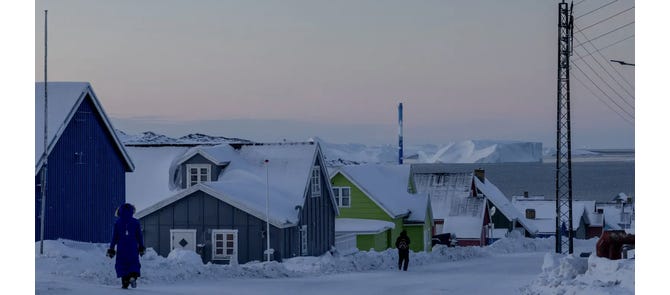
This was not a puff piece. It took four senior reporters to construct the article. The media failed to notice what was going on for four months. “For the past four months,” the article breathlessly reported, “negotiators from the United States, Greenland, and Denmark have been holding confidential talks in Washington about Greenland’s future.”
Four months without leaks. It would have been four minutes if the State Department were involved.
But now the Times is clued in, and they’ve been investigating. “An investigation by The New York Times,” it explained, “has discovered that the American demands are so steep, Greenlandic officials fear, they amount to a major imposition on their sovereignty.” If the Americans get everything they want, warned Justus Hansen, a Greenland Parliament member, there will never be any “real independence.”
The Times’ anonymous sources said Americans want strict screening and veto power to ensure that Russia or China never secures any major infrastructure or resource deals on the island. Apparently, the Greenlanders resent this.
“Greenland’s leaders feel they are being pressured to make other concessions and that they have little leverage in these talks,” the Times reported. “None of this is fair,” complained Pipaluk Lynge, chairwoman of the Greenlandic Parliament’s foreign affairs committee, as though lecturing a Nuuke kindergarten class.
What fairness has to do with geopolitics, the Times did not say.
But President Trump seems to prefer permanently resolving the problems. Dylan Johnson, assistant secretary of state, told the Times in a statement that, “This is not a president who allows problems to go unsolved for future presidents to deal with.”
That seems like common sense to me. To the Times, this is another major story that earned a spot near the top of this morning’s web page. Anyway, if you thought the Greenland dealmaking has disappeared, think again.
Now consider this: What else might be happening behind the scenes and will shock the media at some future date?
Have a terrific Monday! Come back tomorrow for a fresh roundup of essential news and caffeinated commentary.
Don’t race off! We cannot do it alone. Consider joining up with C&C to help move the nation’s needle and change minds. I could sure use your help getting the truth out and spreading optimism and hope, if you can: ☕ Learn How to Get Involved 🦠
How to Donate to Coffee & Covid
Twitter: jchilders98.
Truth Social: jchilders98.
MeWe: mewe.com/i/coffee_and_covid.
Telegram: t.me/coffeecovidnews
C&C Swag! www.shopcoffeeandcovid.com
—“Maybe yesterday’s rededication finally expelled the clinging stench of Biden’s grotesque Trans Day of Visibility. That’s how I’m looking at it, anyway. Who’s with me?”
🙋♀️
✝️✝️✝️
“Behold, I am Yahweh, the God of all flesh; is anything too difficult for Me?”
— Jeremiah 32:27
✝️✝️✝️