

Good morning, C&C, it’s Tuesday! Today begins a sprint through next Monday of multi-day mediations, travel to sites from South Florida to New York City, business meetings, and some holiday sightseeing where time permits. I am hotel blogging this morning and will do my best, but please bear with me; this too shall pass. In today’s terrific Tuesday roundup: latest lawfare lawsuit stops White House handymen from repainting weathered executive building; haunted history of executive complex; Trump finds beauty and opportunity where no one else can; House passes pensions for courageous corpsmen; historically lazy Congress stymies permanent gains; risks of over-reliance on executive action; possible pro’s of Congressional quiescence, at least in the short term; Medal of Honor bill honors heroic soldiers and sailors; historic pension bump; and examples of bravery.
🌍 WORLD NEWS AND COMMENTARY 🌍
🤦♂️ 🤦♂️ 🤦♂️
It has come to this. Two weeks ago, the Washington Post ran a quiet story headlined, “Trump administration agrees not to paint the Eisenhower building before 2026.” The sub-headline explained, “Historic preservationist groups asked for a preliminary injunction to stop the government from making any changes to the building without undergoing a standard review process.”
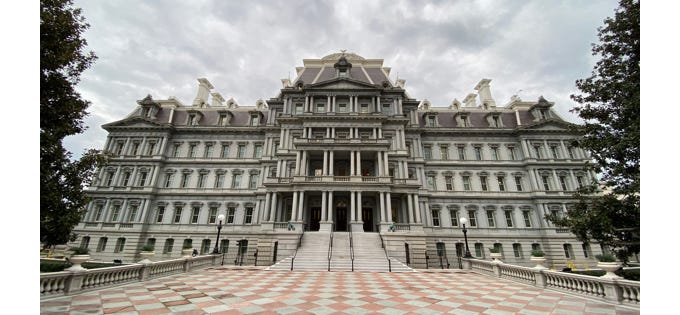
The Eisenhower Executive Office Building (“EEOB”) is more of a complex than a building. It is a vast edifice squatting just beside the White House, and houses the equally vast army of Presidential support staff, including the Vice President and his team. Frankly, it is hideous. But President Trump has seen something within the EEOB that everyone else missed. And early last month, in a politically fatal Fox interview, the President proudly proposed to beautify the EEOB, holding up mock-ups of how much better it would look after repainting.
Picture a mountainous, gothic building that eerily resembles a Victorian-era battleship that ran aground on Pennsylvania Avenue. That’s the EEOB.
It’s enormous; bigger than big. It’s a full city block of French Second Empire military excess: slate roofs, iron cresting, mansard towers, widow’s-walk balconies, and marching rows of uniform, arched windows. It’s sort of French imperial architecture, but only after it spent the summer lifting weights, gobbling steroids, and taking itself extremely seriously.
It’s drab; colorless and joyless. It resembles a giant old hotel (if Norman Bates built it) of stained gray granite, majestic, but in a gloomy sort of way, like the setting for a Stephen King showdown, or maybe a late-night séance with the ghosts of bureaucracies past. It has more chimneys than a Charles Dickens Christmas illustration, and more ornamental metalwork than a steampunk convention.
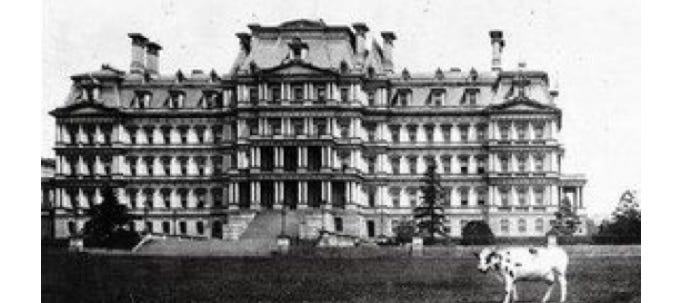
It’s a misfit; discordant and incongruous. Despite that is sits right next to the White House, and in truth is the White House’s own annex, it bears no visual resemblance to the President’s quarters. Visually, it looks like the White House’s brooding, theatrical third-cousin, some weird emo dropout relative who shows up at family get-togethers wearing a top hat and monocle and quoting German philosophers. In German.
Whereas the White House is crisp, clean, and classical, the EEOB is dark, elaborate, and undeniably weird: a 19th-century fever dream in stone, towering over the West Wing like it’s waiting for the fog to roll in.
But President Trump —the builder— has seen in the EEOB what no previous architect or critic ever has: a way to tie the two buildings together perfectly.
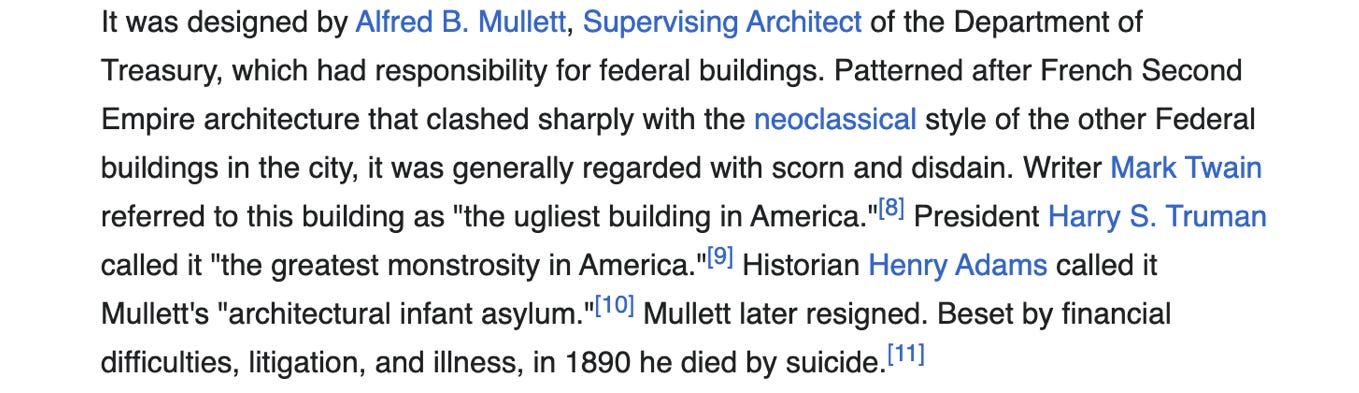
🤦♂️ Mark Twain once called the EEOB the “ugliest building in America.” From day one, the humble, optimistic architect who shot for the stars trying to build something uniquely American, and threw his heart and soul into the EEOB’s design, was utterly humiliated. He became the subject of endless scorn, incessant late-night radio show insults, and the snooty oligarchs from the Architect’s Union even stripped his little builders’ medals off his jacket, one by one, right in front of everybody. It destroyed his career. The poor man shot himself two years after the building was completed in 1888.
It didn’t help that the poor guy’s last name was Mullett. You just know he had a hard time in Middle School with that moniker. Hey Mullett! You forgot your flounder! Ha, ha!
Wikipedia’s description must be seen to be believed:
However bad as it was at the start, the EEOB did not age gracefully. Neglect has been its nursemaid. So, it is even worse now. It has weathered. And not in the romantic, ivy-draped sense. Think of Marge Simpson’s older, chain-smoking sisters. Its once-impressive granite has assumed the splotchy patina of an old battleship hull, streaked by DC humidity, diesel smog, and whatever unholy slurry wafts off Constitution Avenue traffic in the wet heat of August.
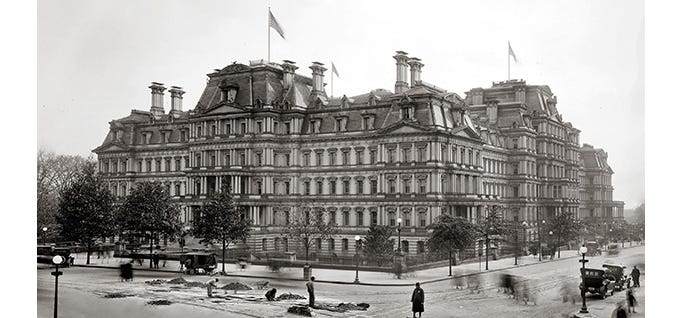
Dark vertical runoffs drip beneath its cornices like mascara on a weeping Madonna. The ornate window frames collect soot halos. The slate roof tiles have lost their original crisp contrast, and blend into a kind of charcoal blur, like someone smeared an eraser over an architectural sketch.
If you’re unlucky enough to walk by on an overcast day, the whole building seems to slump. The deep recesses between its columns harbor shadowy grime, and the carved flourishes look softened, almost melted, as if the structure has been slowly dissolving under a century and a half of oppressive DC swamp air. One observes a greenish tinge in spots — the early stages of biological colonization by algae that stick to stone as tightly as lobbyists adhere to appropriations committees.
In short: the EEOB isn’t “hauntingly historic.” Frankly, it just looks dirty and gross, like the “before” picture in an ad for industrial-strength powerwashing. For comparison, here’s Frankenstein’s Castle from the new Epic Universe Park in Orlando, which is just a little too similar for comfort:

Just saying.
🔥 In early November, during that unfortunate Fox News interview, President Trump made the mistake of (correctly) saying the Eisenhower Building “was always considered an ugly building,” and complained (correctly) that “gray is for funerals.” But he said it could be “one of the most beautiful buildings ever built.” The President had noticed that Architect Mullett had just picked the wrong color. White would bring it all together, drawing out the fine architectural flourishes and more importantly, thematically tying the EEOB and the White House together, as they should be:
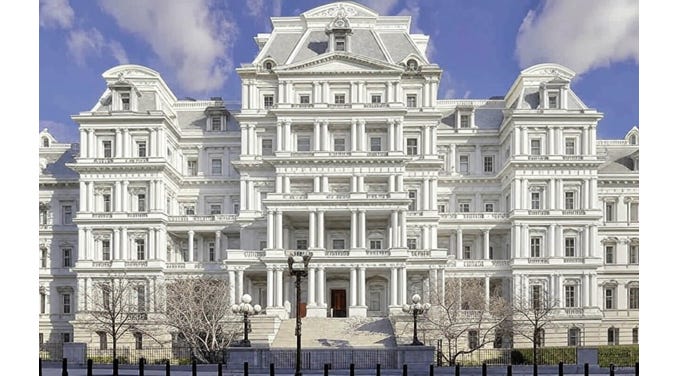
Then, unfortunately, in a rare Trumpian misstep, in his excitement, he told Fox that plans were already underway to clean up the building and paint it white to match the White House. He should have kept quiet till it was done.
That was all it took. Now his enemies had a new target. Enter the DC Preservation Society’s grey-haired lawyers, as persnickety a group of barristers who ever stepped, who instantly lodged a federal complaint for an emergency injunction, and found themselves a friendly liberal judge.
🤦♂️ It’s difficult to imagine a purer distillation of modern American lawfare than suing to stop the President from repainting his own federal office building — a gloomy Victorian beast that nobody has ever liked, defended only by progressive preservationists who mistake mildew for heritage. The idea that a chief executive can command the nuclear codes but cannot instruct a handyman to slap a fresh coat of paint on the granite gargoyle sitting next to the West Wing is the sort of constitutional absurdity that would’ve made the Framers drown themselves in Boston Harbor.
Only in the modern apotheosis of litigation-as-politics could a lawsuit be filed to preserve the “historical integrity” of a structure that has spent 150 years being mocked as a bureaucratic Frankenstein. It is the ultimate expression of Trump Derangement Syndrome; stop Trump no matter what!
The plaintiffs claim that President Trump failed to follow the proper procedures required for making substantial changes to historic government buildings. One may rightly question whether a new paint job is a ‘substantial change,’ but then one tumbles down the Alice-in-Wonderland rabbit hole of scientific experts opining about the permanent, erosive effects of paint on granite.
Under a deal struck with the judge, Trump’s lawyers agreed not to change anything before January 1st, 2026, to give the court time to consider whether the paint job is unconstitutional or something. What do you want to bet the Supreme Court has to get involved?
There’s a larger story here, about how progressives prefer Marxist chic, and despise wasteful and ‘bourgeois’ architectural elements; they hew to giant, uniform, undecorated concrete boxes. They literally hate beauty. They don’t want the EEOB to be improved. They like it ugly. That’s no exaggeration. But that analysis must wait for a different day’s post.
The moral of the story is, you can take the Mullett out of the water, but … no wait, that’s the wrong one. How about: You can’t judge a building by its cover, but you can enjoin it. No … this is it: Trump Derangement Syndrome is uglier than the EEOB.
🔥🔥🔥
This next story I found appeared precisely nowhere —apparently invisible to corporate media— but it did pop up on Quiver Quantitative’s AI scraper, headlined, “President Trump Signs Rep. Troy E. Nehls’ Medal of Honor Act to Increase Pension for Recipients.” We’ll get to the Act itself in a moment. First, let’s discuss our somnolent Congress.

You’d think the simple fact that any bill that could actually pass both chambers these days would qualify as breaking news. President Trump has signed fewer bills into law at this point in his presidency than any newly inaugurated president in the last seventy years. In the first 100 days of his first term, he’d signed twenty-four bills; this time, only five.
It’s not Trump’s fault. So far this entire year, the 119th Congress has enacted a meager 38 public laws.
Put plainly, President Trump is grappling with one of the laziest Congresses in modern history. And the 119th is barely edging out its predecessor, the 118th — the previous gold medalist in legislative loafing. As ABC News put it back in January 2024, the 118th Congress was one of “the least productive in U.S. history.” ABC headline, January 2024:

For comparison: the 113th and 114th Congresses, during Obama’s second term, passed 196 and 329 bills. The 117th Congress, under Biden, managed 362. Meanwhile, the slothful 118th blamed its flop era on “gridlock,” since Biden faced a Republican House. It could be.
But that excuse doesn’t fly this time. Today, Trump supposedly enjoys full control of both chambers — and yet Congress is still scraping the bottom of the historical barrel of feckless indolence. In fact, the 119th may well be the least productive Congress in modern history for a party that controls all three branches of government. It is equal parts disaster and disgrace.
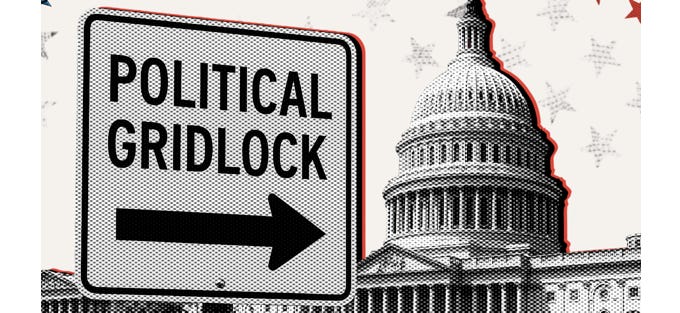
Republicans currently enjoy what every party wants but rarely gets: the White House and both chambers. Yet Trump’s second term is leaning almost entirely on executive orders, agency directives, and regulatory moves —the Project 2025 toolkit — precisely because those tools are fast and don’t require Congress.
But those executive tools are also fragile. They can’t override statutes. They’re vulnerable to progressive TDS judges. And the next administration can vaporize them with a single pen stroke. We have already lived this horror show twice: Biden’s Autopen erased Trump’s first-term EOs, and Trump is now reversing Biden’s.
The pattern, established during Trump 1.0, is unmistakable: frantic activity via executive authority, contrasted with anemic action in the U.S. Code. Unless Congress hauls itself upright and actually legislates, a massive share of what is happening now will be broomed the moment Democrats regain unified control— an unpleasant arc that could begin to ascend as soon as the next midterm.
I remain confident we will hold Congress next year. But confidence isn’t certainty. If Republicans lose the midterms, our best and last window for durable conservative reform —the kind you can’t erase in bulk lots with a factory of Autopens— will slam shut. Wasted. Flushed down the White House drain where Hunter always dropped his cocaine when Secret Service agents popped by.

And if they don’t lose? That leaves the even more uncomfortable question: What, exactly, is the use of electing Republicans to Congress if they plan to do nothing except compete for worst-in-history participation trophies?
🔥 I’ll conclude those morose thoughts with a couple of more optimistic counterpoints. It is a fact that Congress is trying like the Dickens not to spend an extra dime. As everyone knows, every single successful bill floats down the legislative pike on a greasy layer of pork. Thus, a quiescent Congress is also a thrifty Congress. So, there’s that.
Next, and more strategically, Trump’s executive orders are far more precise, rapid-fire, and laserlike than anything that squeezes out of the legislative sausage press. Bills —and their resulting laws— result from glacial negotiation and compromise, even within a party’s core regulars. Take Trump’s signature OBBB: it passed without Democrat support, but was still mangled and watered down in the legislative cookpot.
So, for now, even allowing for the additional burden and risk of reflexive litigation challenging his every directive, Trump’s executive orders and regulatory changes maintain strict Executive control without any of the nasty surprises or goofy unintended consequences that flow like sewage out of Congressional committees.
In other words: it’s trade-offs. We can imagine how it might be part of the plan for Congress in the short term to sit back and let Trump run the ball downfield. But sooner or later, Congress needs to get into gear and start passing things. We can’t win with just a running game.
Anyway, let’s return to the miraculous law that Congress did somehow manage to squeak through.
🔥 The Medal of Honor isn’t just a medal. It’s American mythology cast in gold.

The modern Army and Air Force versions hang from a light, Columbia-blue neck ribbon sprinkled with thirteen white stars, the original colonies standing guard around the nation’s highest virtues of honor and courage. The pendant is a five-pointed star of gold, laurel-wreathed, with the profile of Minerva, the Greek goddess of righteous war. The Navy’s version sports an anchor crossed with oak and laurel, evoking salt, spray, and the heroism of sailors and Marines.
Audie Murphy might be the most famous Medal of Honor recipient of the 20th century. Audie was a private in WWII who single-handedly held off an entire company of German soldiers, under heavy fire, refusing to retreat even after running out of ammo. For another example, in 1918, during WWI’s Meuse-Argonne offensive, Alvin York led a heroic charge, captured dozens of enemy soldiers despite overwhelming odds, and saved even more of his own men.

In a more modern context, during the 2009 Battle of Ganjgal, Marine Dakota Meyer drove again and again into an Afghan kill zone under withering fire, rescuing wounded soldiers and recovering bodies. He is credited with saving 36 U.S. and Afghan personnel. (Coincidentally, Dakota re-enlisted in April of this year.)
It’s not just a medal. Medal of Honor recipients also get a special lifetime pension on top of any other military or disability pay. That pension honors their extraordinary sacrifice and helps provide financial security for the rest of their lives. The last time Congress bumped up the pension amount was in 2002 —then, to $12,000 a year— and it has slowly crept up since then, via automatic COLA adjustments.
This time, perhaps with all the additional time on their hands to focus on making a single law, Congress increased the Medal of Honor pension by more than fourfold, from about $16,000 a year to $68,000 a year. It was the largest increase in history.
(I could speculate on what this suggests about the real rate of Bidenflation, but never mind.)
On the one hand, passing a safe Medal of Honor pension increase is the least our sleepy Congress could do. But on the other hand, if they are going to pass something, at least it was about backfilling and confirming our Nation’s most cherished values. So I will give them the ‘win.’ For today.
Have a terrific Tuesday! I am now off to try to resolve a difficult mediation, so please add me to your prayers if it isn’t inconvenient. I will return tomorrow with another roundup of essential news and commentary. Till then.
Don’t race off! We cannot do it alone. Consider joining up with C&C to help move the nation’s needle and change minds. I could sure use your help getting the truth out and spreading optimism and hope, if you can: ☕ Learn How to Get Involved 🦠
How to Donate to Coffee & Covid
Twitter: jchilders98.
Truth Social: jchilders98.
MeWe: mewe.com/i/coffee_and_covid.
Telegram: t.me/coffeecovidnews
C&C Swag! www.shopcoffeeandcovid.com
Only the Left would collapse over the emotional loss of a building exhibiting the bubbly effervescence of a haunted sanitarium. Cold. Sallow. Unseemly. Unattractive....altogether charmless and disheveled. I sense a correlation. Isn't it bad enough they had to deal with the atrocity of the recently christened Gulf of America? Poor cretins. They're never happy unless agitated, which is to say, they are always happy. We've got 'em on the ropes concerning the things of supreme unimportance.
✝️✝️✝️
For a child will be born to us, a son will be given to us;
And the government will rest on His shoulders;
And His name will be called Wonderful Counselor, Mighty God,
Eternal Father, Prince of Peace.
There will be no end to the increase of His government or of peace,
On the throne of David and over his kingdom,
To establish it and to uphold it with justice and righteousness
From then on and forevermore.
The zeal of the LORD of hosts will accomplish this.
— Isaiah 9:6-7 NAS95
✝️✝️✝️