

Good morning, C&C, it’s Monday! Apparently, I have to do everything, since corporate media is worse than useless. So it’s time for another Iran war roundup— except this time, it’s so much bigger than Iran. We’re connecting the dots from Iran to every other major global problem. What corporate media is reporting as five separate crises —the Hormuz standoff, the Palestinian reversal, the Gaza peace deal, the Ukraine negotiations, and the European energy crisis— are actually five pressure points in a single, breathtaking strategic play. And nobody is connecting the dots. So grab your coffee. Plus a C&C movie review.
🚀 C&C ARMY BRIEFING — IRAN WAR UPDATE 🚀
It might be history’s fastest flip-flop. On Tuesday, March 17th, French President Macron vowed, “France will never take part in operations to open or liberate the Strait of Hormuz.” Two days later, on Thursday, France signed a joint statement expressing “readiness to contribute to appropriate efforts to ensure safe passage through the Strait.” Womp, womp. The Wall Street Journal reported, “22 Countries Signal Readiness to Help Secure Strait of Hormuz.”
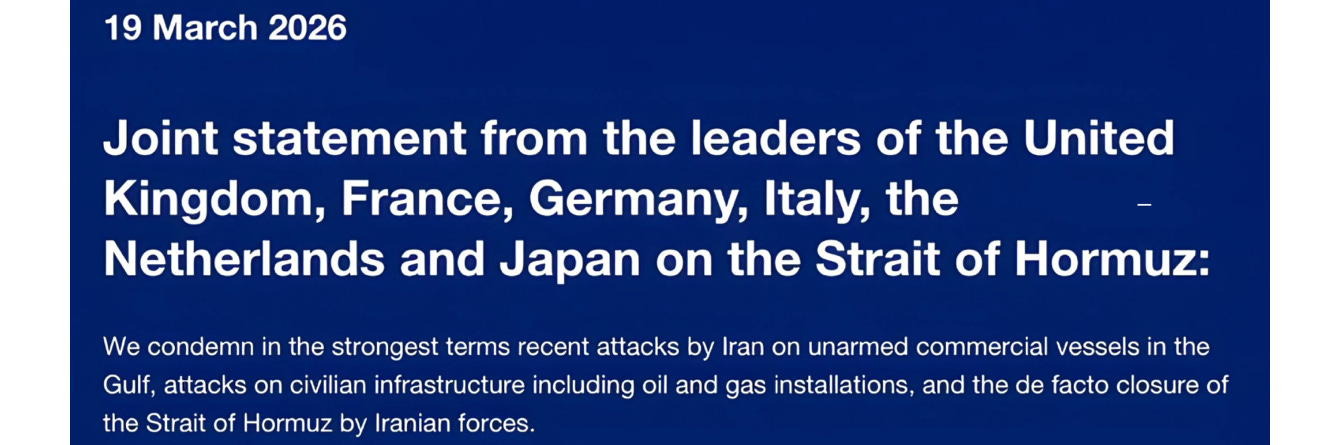
Between Monday and when the statement was signed on Thursday, trad-media ran scores of breathless stories about European and Asian countries “standing up to Trump.” For three days, foreign leaders competed to defy the American president using the strongest possible language, and media wrote glowing elegies to each and every statement of defiance as they rolled off the tickers. NBC:


Ha. “Never” only lasted two days. By Thursday, Reuters published a short, stenographic piece with this bland headline (Note how the headline didn’t include the words “reversal” or “back-tracked” or “Trump Always Wins”):

Indeed, neither the Reuters article about the joint statement —or any of the other minimal coverage— quoted the leaders’ previous statements of defiance, even though you’d think those would provide both engagement value and needed context.
The New York Times ran a front-page headline about the refusal— but not even one dedicated piece on the reversal (it was lumped into a “live blog”). NBC ran two separate stories and a TODAY Show segment on the rebuke— but nothing standalone on the 22 countries signing up. The Guardian published an editorial and an opinion column urging Europe to resist— then barely noticed when Europe stopped resisting.
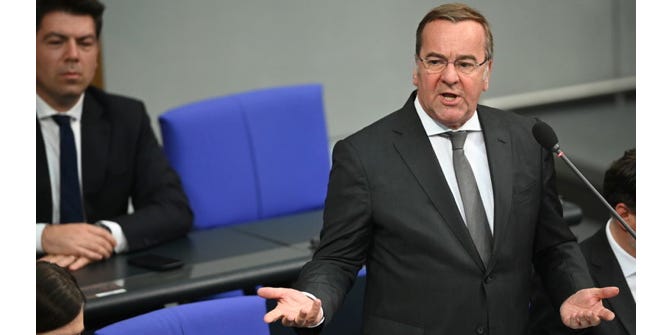
Not even one of the articles I reviewed mentioned German Defense Minister Boris Pistorius’s quip, “This is not our war.” Not one article mentioned Macron’s “never.” Not one article framed it as a reversal. No reporter asked, “Herr Pistorius, last Monday you said this is not our war. By Friday, your government signed a statement expressing readiness to secure the strait. What changed?” Conveniently for the plot, they suddenly got amnesia.
Come on. The story “three days after refusing, 22 nations sign up” practically writes itself. The fact that nobody wrote it proves that the editorial decision was deliberate. The original “allies refuse Trump” story served the narrative. The subsequent “allies reverse themselves” story would have undermined it. So the first got the spotlight, and the other got the wire service treatment.
The truth they didn’t want to report was that Trump’s pressure worked. And it worked fast. It was classic: He made them an offer they couldn’t refuse. But reporters stubbornly refused to write that story. Fine. Be that way, you ninnies. It doesn’t matter anymore, because we now have Substack and coffee blogs.
But the European flip-flop wasn’t the only narrative-smashing reversal the media buried last week.
🚀 Along similar lines, another story remarkable for what it says about the flipping trendlines appeared Saturday in two arab-owned platforms (and that’s it). Al-Arabiya reported, “Palestine condemns Iranian attacks on Saudi Arabia.”
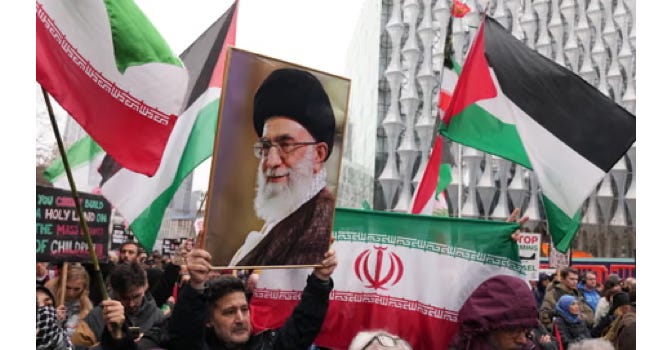
Those of us with normal lives who don’t live and breathe Middle Eastern politics could easily miss the mind-bending significance of a Palestinian Authority statement condemning Iran about anything. Much less defending Saudi Arabia.
The Palestinian Authority —the same entity that for decades has relied on Iran as its most vocal state champion, the regime that funds Hamas and Islamic Jihad, that scribbles “Free Palestine” on its missiles— just publicly condemned Iran and sided with Saudi Arabia.
On Friday, the Palestinian interior minister called his Saudi counterpart, expressed Palestine’s “condemnation of the Iranian attacks targeting the Kingdom, the Gulf states, and the region,” and reaffirmed “the State of Palestine’s solidarity with all measures taken by Saudi Arabia to safeguard its security.” All measures.
For decades, Iran justified its regional aggression —Hezbollah, Hamas funding, Houthis, the whole “Axis of Resistance”— under the banner of Palestinian liberation. And now Palestine itself says: um, actually, we condemn you.
Iran’s entire rhetorical framework just crumbled into desert dust.
And our useless corporate trad-media just... left it on the desk. No follow-ups, no analysis pieces, no “what this means for the region” explainers. They can’t handle it, because the story undermines two cherished narratives at once: the “Iran stands with Palestine against Israel” narrative and the “Abraham Accords were just a silly Trump vanity project” narrative.
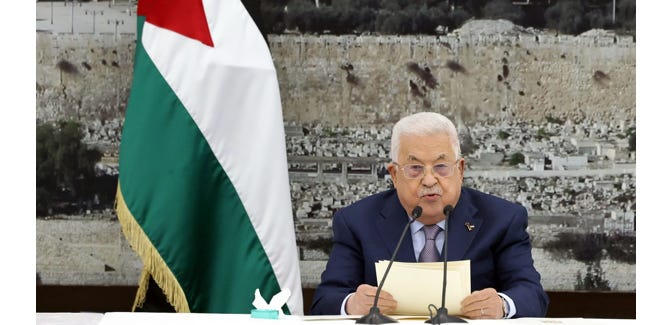
Meanwhile, the Palestinian Authority —which for decades has enjoyed Iranian military support— has not condemned the United States or even Israel for the war against Iran. This is the same Palestinian Authority that takes every Israeli airstrike in Gaza to the UN. That calls Israeli settlements a war crime. That demanded International Criminal Court investigations against Israeli leaders. That describes Israel as an occupying colonial power at every available microphone.
But when Israel and America bombed Iran —killed the Supreme Leader, destroyed nuclear facilities, and launched a full-scale air campaign— the PA’s official response was: Iran is the problem. They are basically saying, go ahead.
If Palestine is voluntarily aligning with Saudi Arabia against Iran during a war, and keeping conspicuously silent about attacks on its former ally Iran, it suggests the whole regional realignment that President Trump started wasn’t just something real.
It’s real all right— and it’s accelerating under pressure.
🚀 But why? What shifted in Israel-Palestine politics so fundamentally that it created a narrative-cracking seismology so profound that corporate media won’t probe it with a ten-foot camel prod?
President Donald J. Trump shifted the politics, that’s what.
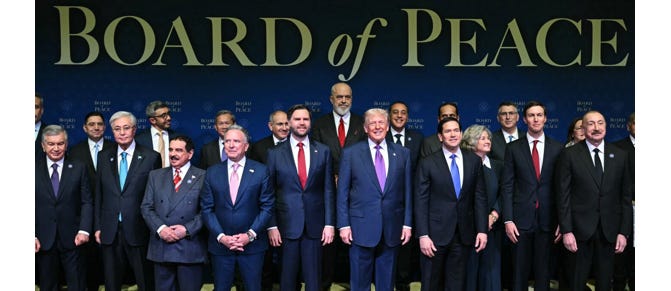
Follow the money. President Trump’s Board of Peace is dangling a $17 billion Gaza reconstruction plan that includes a new technocratic Palestinian government. A Carnegie analysis noted the plan considers sidelining the PA in favor of an “apolitical” administration, which means the Palestinian Authority risks being cut out of governing Gaza if they’re not seen as a cooperative partner.
So they quite rationally condemned Iran, embraced Saudi Arabia, said nothing about the U.S. or Israel, and are quietly positioning themselves as the “responsible” Palestinian leadership that the postwar order can work with.
It’s about incentives. The Palestinian Authority has every incentive to stay on the US’s good side. As one more Trump play, add the Middle East peace deal to the long list of preparations for this point.
Haha, this reversal wildly complicates things for the American-campus pro-Palestine folks. The Free Palestine movement just lost its primary supplier of moral authority: Palestine. Whoopsies.
It puts American Palestine supporters in the bizarre position of being more pro-Iran than Palestine, and more anti-Saudi than the Palestinian Authority. They’ve been protesting on behalf of a people whose own government just endorsed the geopolitical framework they’ve been marching against. Now what are we supposed to say?
🚀 Meanwhile, three days ago on March 20th, Trump’s Board of Peace presented Hamas —the militant group at war with Israel— with a new disarmament proposal that it is reportedly “considering.” New York Times:
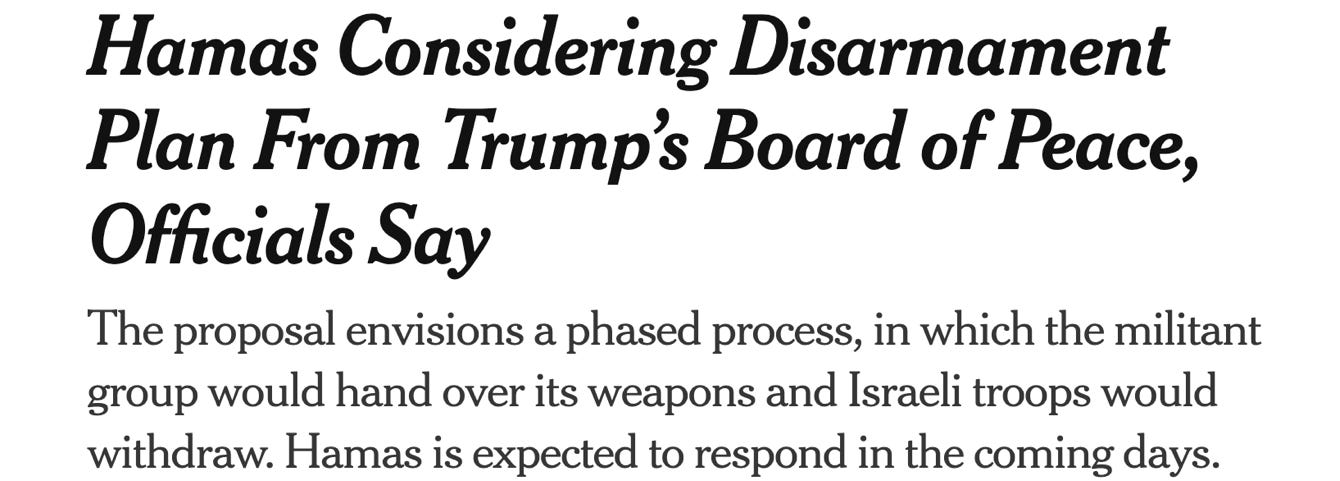
Gaza is the fractious strip in Southern Israel along the Mediterranean, now controlled by Iranian proxy Hamas, but which could be run by a technocratic Palestinian Authority, if it plays its cards right. “The Trump administration is seeking to cement the cease-fire in Gaza,” the Times reported, “even as global attention has shifted to the war between the United States, Israel, and Iran.”
You never heard of these connected developments in Gaza and Palestine, because the corporate media is distracted by all the war-candy in Iran. All its attention has shifted there.
It gets even more interesting. The very next day after the Board made the new offer to Hamas, UN Secretary General Guterres publicly said he’s cooperating actively with Trump’s Board of Peace. (Guterres can’t normally even say Trump’s name without flinching.) Reuters, Saturday:

Don’t miss this. While the entire global media apparatus is covering explosions, ultimatums, and oil prices, President Trump’s Board of Peace is quietly meeting with Hamas in Cairo, presenting a formal disarmament plan, getting the UN Secretary General on board, and offering amnesty and investment as irresistible incentives.
They’re doing this while fighting the Iran war. It’s far beyond walking and chewing gum at the same time. Goofy Joe Biden couldn’t even walk and avoid sandbags at the same time.
The Iran war isn’t just a distraction. It’s the engine making the impossible possible. Every GBU-72 bunker-buster that lands on an Iranian missile silo weakens Hamas’s resupply pipeline. Every day the IRGC spends defending its own coast is a day it’s not shipping weapons to Gaza. Iran getting pummeled is the single biggest leverage point for convincing Hamas that disarmament is their best option, because the alternative —waiting for Iranian backup— is evaporating in real time.
Even though the Times saw this happening beneath the fog of war, it never connected the strategic dots— that the Iran war and the Hamas peace deal aren’t separate initiatives. They’re two halves of the same play. It’s the same play that is also crushing European energy markets and paving the way to peace in Ukraine by forcing NATO to come to the table and be reasonable.
Iran is the singular pain point that is making peace possible in both the Middle East and Eastern Europe. Let’s pull those dots together. The Iran leverage play doesn’t stop at the Middle East. It extends all the way to Europe and Ukraine.
🚀 According to Gas Buddy, in Jacksonville —the largest metro area near where I live— cheap gas is hovering around $3.60 a gallon. Meanwhile, in Berlin, gas prices are nearing $9 a gallon. Last week, Germany even passed a law banning gas stations from raising prices more than once per day at noon. (That will backfire, of course, since stations will just raise prices higher on their one chance, but never mind.)

The Europeans need American help to re-open the Strait of Hormuz as fast as possible. That’s what transformed “not our war!” into 22 signatures in 72 hours. But there’s a second squeeze play happening, and it may be even more consequential.
Now that Brussels knows Iran can strike anywhere in Europe, they must think twice before handing their air defenses over to Ukraine. You’ll recall that on Friday, Iran fired two intermediate-range ballistic missiles at Diego Garcia — a joint US-UK base in the Indian Ocean, 2,500 miles from Tehran. They missed the base, but the message wasn’t the impact. The message was the range. London is 2,700 miles from Tehran. Berlin is 2,500. Rome is 2,200.
Diego Garcia is farther than almost every European capital. Yesterday, NATO Secretary General Mark Rutte confirmed the concern on CBS’s Face the Nation. He said, “What we know for sure is that they are very close to having that capability to hit European capitals.”
This is the quiet revolution that Friday’s strike against Diego Garcia represents. It doesn’t just change the Iran calculus. It kills the Ukraine arms pipeline from Europe— not through any diplomatic agreement, not even through Trump pressuring NATO, but through simple physics and inventory math. You can’t give away what you need for yourself.
The reality doesn’t even matter. The Diego Garcia strike just gave every NATO member argumentative ammunition to resist demands that it share its weapons with Kiev. Nobody even has to say, “We’re cutting off Ukraine.” They can just say, “we’re pausing transfers pending a reassessment of the European threat environment.” Sandbagging now sounds responsible and prudent.
🚀 Corporate media couldn’t find a dot if it had a Chinese spy balloon taped to it. On March 15th, the vaunted UK Financial Times reported, “Ukraine peace talks fizzle out as Trump’s focus shifts to Iran.” Fizzled out? It was another flip-flop.
Ukraine’s comedian-in-chief did not miss the awful significance of Diego Garcia, even if corporate media did. The very next day after the strike, Zelensky raced negotiators to Washington, “hoping to revive” the “fizzled” peace talks. On Saturday, the New York Times said Zelensky suddenly had a very bad feeling about where things are going.
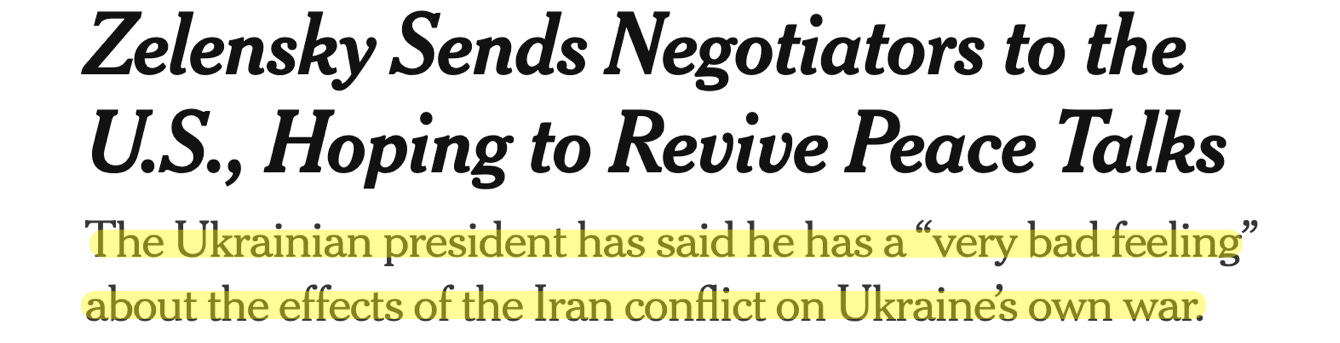
“I have a very bad feeling about the impact of this war on the situation in Ukraine,” Zelensky told the BBC. “There is one reason: war in Iran.”
Translating from broken English into regular English, Zelensky was saying: “The weapons pipeline is drying up, Europe can’t afford to support us anymore, the Americans are busy, and I need to make a deal before my leverage completely evaporates.”
Six months ago, Zelensky wouldn’t even say the word “negotiate.” He swore he would never concede an inch of territory. He insisted he would only meet with President Putin. Now he’s suddenly sending negotiators to crash the party in Washington and telling the BBC about his very bad feelings.
The Ukrainians met with Trump’s A-Team in Florida on Saturday. Special Envoy Steve Witkoff reported it on X (of course):
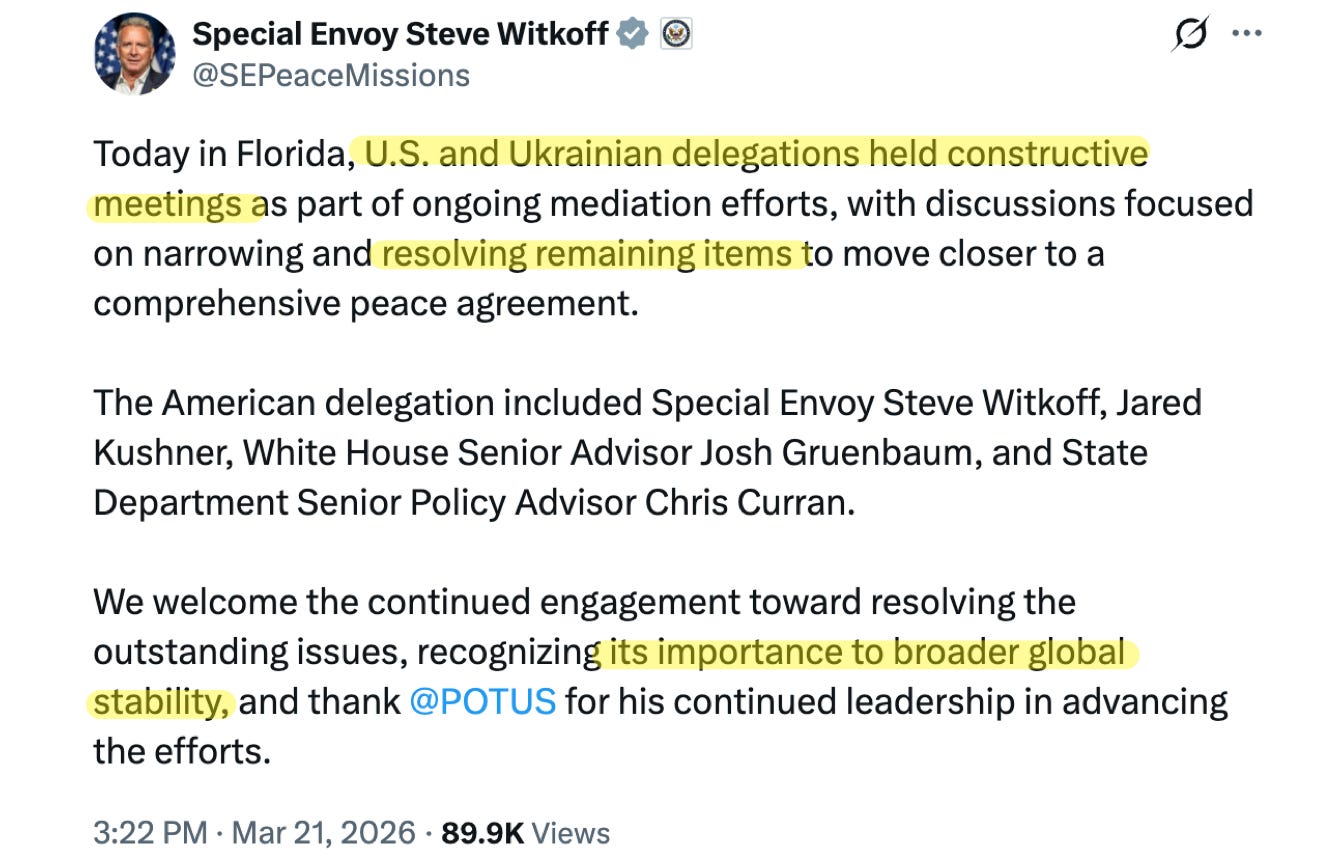
Five days after the Financial Times declared the talks fizzled, Zelensky flip-flopped and rushed negotiators to Mar-a-Lago insisting it was time to get the peace talks going again.

What do we even need trad-media for, if it is always so wrong? Why can’t they connect these dots? Corporate media is fizzling out, that’s who. Let’s admire this astonishing picture, which clueless trad-media is completely missing.
🚀 Iran isn’t a Trump vanity project waged to satisfy Israeli politicians. Iran is the single pressure point making peace possible on every global front simultaneously.
Nobody is describing the chessboard, even though all the pieces are sitting right there.
The “allies rebuke Trump” story gets 100 headlines; whereas the 22-country reversal gets a brief wire plug. Macron says “never” on Tuesday; France, Germany, and the UK sign on Friday. The Palestinian Authority condemns Iran and embraces Saudi Arabia while keeping studiously silent about the American and Israeli strikes. Trump’s Board of Peace deals with Hamas and signs up the United Nations while the world watches Iranian bomb footage.
The Financial Times declares Ukraine peace talks fizzled on Monday; Witkoff posts updates from active negotiations on Saturday, while a frantic Zelensky rushes to Washington experiencing very bad feelings. European voters stare at $9 gas and wonder why they’re still funding someone else’s war. NATO allies who pledged their Patriot batteries to Kyiv now realize those batteries might be all that stands between their own capitals and a demonstrated Iranian IRBM.
And nobody asks what any of it means. The corporate media won’t tell you any of this because it might make Trump look good. Trump isn’t talking either, because (1) it would tip his hand, and (2) he wouldn’t get decent coverage anyway, so why bother? But it is becoming crystal clear that Iran is the linchpin in a global puzzle box that includes forcing NATO to the table; ending the Ukraine war; brokering permanent Middle East peace; yes, protecting Israel; giving Palestinians a real shot with real money behind it; and all the while making historically good deals for America.
How should I —how can I— describe this? It would be impossible to script. I’m not sure anyone has ever tried anything like it. Where are the experts? The op-eds? The historians? They’re all on sabbatical.
We are truly experiencing history. The world is changing— fast. And, for once in our post-nuclear lives, everything seems headed in the right direction. Keep it going.
🌍🇺🇸 ESSENTIAL NEWS AND COMMENTARY 🇺🇸🌍
🔥🔥🔥
Yesterday, Entertainment Weekly ran a story headlined, “‘Project Hail Mary’ blasts off to record-breaking $80 million, becomes 2026’s best premiere.” The numbers were higher than that; the $80 million was domestic box office, and the global haul rocketed past $140 million. It was terrific news.

I can verify. The Childers family saw it this weekend, and Project Hail Mary has the C&C stamp of approval. It’s a feel-good, family-friendly film in a space setting; a buddy movie with Ryan Gosling where the other buddy lacks a face. It’s not a genre fave, since Michelle liked it, and she’s super picky when it comes to sci-fi. (She is, however, an Andy Weir fan; Weir also wrote The Martian, which was also a Hollywood hit.)
The premise is simple: an astronaut wakes up in space with amnesia, which is a convenient and cliché plot contrivance to let the action start midway instead of the beginning, but they pulled it off. After finding the rest of the crew dead in their sleep pods, he quickly recalls that he’s on a mission to save our Sun from a space virus— probably a highly infectious covid variant, since all the other stars seem infected too— except for one resistant star. Earth builds a ship, launches it toward the one uninfected star (using space virus as fuel, I did not make that up), when —plot twist— an alien spaceship appears.
The real movie then begins, with Ryan Gosling and Rocky the space creature bonding in difficult circumstances to overcome various obstacles and save their stars from the space virus. It’s cute, funny, science-ey, with zero horror or cheap shocks, but enough action to keep screen addicts from experiencing withdrawal symptoms. It’s also technically impressive, earning plaudits for filming with minimal CGI; Rocky the alien is a high-tech muppet, for instance.
Considering that Project’s competition is slasher movies —Scream 7: Won’t They Just Die Already?— and woke cartoon animals —Pixar’s Hoppers, where humans use robots to turn animals into rally-attending environmental activists— it’s a no-brainer. Best of all: no political messaging. Project Hail Mary is just entertainment. 100% recommend.
In a world of teen slashers and robot beavers, a movie about two guys solving a problem together feels revolutionary.
Have a magnificent Monday! Beaver back here tomorrow morning, for the only news source that makes you smarter with regular consumption: All the essential news and snarky commentary you need for a healthy diet.
Don’t race off! We cannot do it alone. Consider joining up with C&C to help move the nation’s needle and change minds. I could sure use your help getting the truth out and spreading optimism and hope, if you can: ☕ Learn How to Get Involved 🦠
How to Donate to Coffee & Covid
Twitter: jchilders98.
Truth Social: jchilders98.
MeWe: mewe.com/i/coffee_and_covid.
Telegram: t.me/coffeecovidnews
C&C Swag! www.shopcoffeeandcovid.com
Molly Englehart is one of the most perceptive, balance people I know writing today. One of her latest, copy and pasted for those who find it paywalled.
Commentary
In high school, I had a tight-knit group of friends. Like in many teen circles, what one of us did had a way of spreading to the rest. It was a kind of social contagion. We influenced each other in everything, from how we dressed to what we thought was cool. We experimented with drugs, pushed boundaries, and even losing our virginity at a fairly young age became part of that same shared culture.
But one of the most powerful contagions among us was eating disorders.
For a period of my life, I lived on Diet Snapple—peach flavored—and little else. If I ate, I felt guilty. Sometimes I would throw up. Sometimes I would take laxatives. I became progressively thinner. Whether that met the clinical definition of an eating disorder feels almost beside the point. I was engaging in behaviors that harmed my body, driven by a distorted perception of myself.
As a teenage girl, my body was changing quickly. Between the ages of 11 and 16, a young woman’s body transforms in ways that can feel sudden and disorienting. Hips widen, breasts develop, and the softness of childhood gives way to the curves of womanhood. It can feel like your body is no longer your own.
I remember looking in the mirror and seeing someone chubby and unattractive. I was convinced I was the ugly one in my group of friends. Looking back now at photographs, I see something entirely different. I was slender, healthy, and beautiful. What I experienced was, at least in part, body dysmorphia.
Now imagine something different. Imagine that the adults in my life, my parents, my doctors, my teachers, had affirmed my distorted perception. Imagine if they had said, “You’re right. You are fat. Let’s fix it.” Imagine if they had helped me get diet pills, encouraged stricter restriction, or supported the very behaviors that were harming me. Imagine if doctors, by law or cultural pressure, were required to affirm my belief that something was wrong with my body and offer medical interventions to correct it.
That would have been unthinkable.
The adults in my life did not affirm my delusion. They challenged it. Sometimes imperfectly, sometimes inconsistently, but they understood something fundamental: teenagers do not always see themselves clearly, and it is the responsibility of adults to act as guardrails.
Years later, when I was in college, another social contagion emerged: cutting. There were families close to mine dealing with children who were harming themselves. It was heartbreaking to witness. Now imagine if the adults in those situations had responded by affirming the behavior. Imagine saying to a child, “You are in pain, and the best way to deal with that pain is to hurt yourself. Let me help you do it safely.” No responsible adult would encourage that. We understand instinctively that pain expressed in self-destruction is not something to validate but something to guide a child through.
Today, we face another form of teenage distress, one that has spread rapidly in recent years. Surveys suggest that a growing number of teenagers identify as transgender or experience significant distress about their bodies, with the increase being especially sharp among teenage girls.
That does not surprise me. I was once a teenage girl in a tight-knit group of friends, confused about my body and willing to harm myself because of a distorted perception of it. When that kind of confusion takes hold in a close social circle, it can spread quickly. Teenage girls, searching for identity and belonging, can become especially vulnerable to ideas that offer an explanation for their discomfort, even when those ideas lead them further away from the truth of their own bodies.
Adolescence has always been a time of confusion. Teenagers are searching for identity, meaning, and belonging while their bodies and emotions shift beneath them. That instability is not new. What is new is how adults are responding to it.
Today, when a teenager says, “I feel like I am in the wrong body,” many adults feel compelled to affirm that belief immediately. In some cases, that affirmation extends beyond words into medical interventions that can carry lifelong consequences. I can understand the feeling of being alien in your own body. I lived it. Going from a slight, childlike frame to a woman’s body felt overwhelming. At times, it felt excessive, even wrong.
But my body was not wrong. My perception was.
The adults in my life, however imperfectly, understood that their role was not to validate every feeling I had, but to help guide me through them. They did not treat a temporary distortion as a permanent truth. They did not offer me permanent solutions to what was, in hindsight, a passing and developmental struggle.
That is what I struggle to understand today. Where are the adults in the room?
Where are the voices willing to say, with compassion and clarity, that feelings are not always facts, that confusion does not require immediate affirmation, and that the body is not the enemy? Where are the parents, teachers, and doctors willing to stand in the tension between empathy and responsibility?
We have seen social contagions before. We have watched behaviors spread among vulnerable teenagers, reinforced by peer groups, culture, and the media. The details change, but the pattern remains. Teenagers look to one another for cues on how to interpret their discomfort, and when a narrative takes hold, it can shape real behavior in powerful ways.
The role of adults is not to mirror that confusion back to them. It is to anchor them through it.
Compassion does not mean affirming every belief a child expresses. Sometimes compassion requires restraint. Sometimes it requires saying no. Sometimes it requires the courage to stand against cultural momentum to protect a child from making permanent decisions based on temporary feelings.
I am grateful that the adults in my life did not hand me diet pills or encourage my self-destructive habits. I am grateful they did not medicalize a distorted perception of my body. Because if they had, I might have made permanent decisions based on a temporary state of mind.
That is the question we must ask ourselves now. Are we protecting our children, or are we affirming them into consequences they are too young to fully understand?
✝️✝️✝️
I thank my God always concerning you for the grace of God which was given you in Christ Jesus, that in everything you were enriched in Him, in all word and all knowledge, even as the witness about Christ was confirmed in you, so that you are not lacking in any gift, eagerly awaiting the revelation of our Lord Jesus Christ, who will also confirm you to the end, beyond reproach in the day of our Lord Jesus Christ. God is faithful, through whom you were called into fellowship with His Son, Jesus Christ our Lord.
— 1 Corinthians 1:4-9 LSB
✝️✝️✝️