

Good morning, C&C, it’s Friday! April is now a memory; let’s venture bravely into May. May Day, as it happens, is a big socialist holiday. How fitting that we celebrate it by burying forty years of identity-politics infrastructure. Today’s post turned into a special edition, after I came downstairs and found it was Christmas in May. We passed over the incredible Louisiana v. Callais decision yesterday much too quickly. So did everyone else.
🌍🇺🇸 ESSENTIAL NEWS AND COMMENTARY 🇺🇸🌍
🔥🔥🔥
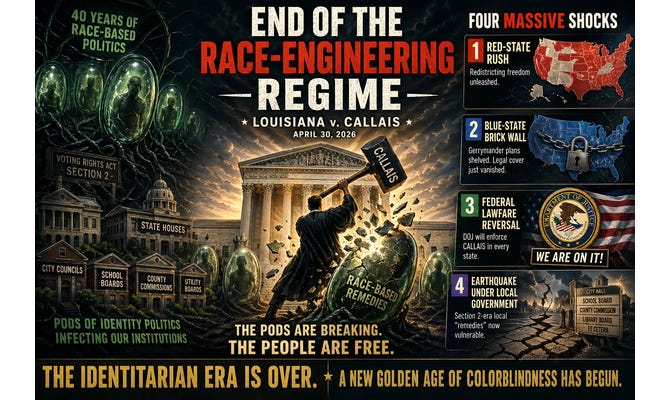
On Wednesday, the Supreme Court didn’t just tweak Louisiana’s map; it quietly detonated the Voting Rights Act’s entire race‑engineering regime, and now that shrapnel is ripping through Congress, blue‑state fortresses, and the forgotten local boards, commissions, and councils that for forty years have co-opted our democratic institutions via identity politics pods. This morning, the New York Times reported, “Supreme Court Voting Rights Ruling Could Fuel New Era of Redistricting Wars.” This could wind up being the most liberating Supreme Court decision in our lifetimes.

For fifty years, the Voting Rights Act’s Section 2 regime worked a bit like Invasion of the Body Snatchers: the pods arrived as “civil‑rights remedies,” quietly took over local institutions, and before long the whole political neighborhood had been replaced by something that looked familiar but behaved very differently. Callais represents the Earth People’s victory; SCOTUS finally breached the alien mothership and blew up all the plant people.
It’s Independence Day.
“Some fear,” the Times wrote (schizophrenically describing its own worries in the third person), “that the court’s decision will reverberate beyond the halls of Congress.” Quoting a random “Louisiana resident” (who conveniently articulated the Times’ editorial opinion in one succinct sentence), the Times said, “Judges, school board members, councilmen — doesn’t matter, it will affect them all.”
That off‑hand quote about judges and school boards was the closest the Times came to admitting how deep the body-snatching invasion got into our institutions. Just wait until you understand the full scope of what’s really at stake here— the downstream effects they’ve spent decades burying like a golden retriever hiding chew toys all over the backyard.

🔥 It feels utterly insufficient to call this an update to yesterday’s story about one of the most politically explosive Supreme Court decisions ever issued. What the Court did in Louisiana v. Callais was not just about one badly drawn Louisiana map, or even about potential GOP pickups in the 2026 midterms. This story is so much bigger than that. SCOTUS quietly unwound four decades of political pod politics that corrupted our body politic top-to-bottom.
In plain English, the ruling is already triggering at least four massive downstream shocks— three of which nobody has bothered pointing out to us, even though they are probably the biggest stories of all:
A red‑state rush to redraw maps before the midterms, now unshackled from court‑mandated “majority‑minority” districts and old Section 2 racial targets.
A blue‑state brick wall, which ambitious Democratic gerrymanders and constitutional amendments are suddenly slamming into because their legal doorway just evaporated into thin air.
A federal lawfare Uno-reverse, with Trump’s DOJ already promising to apply its civil‑rights powers to attack the race‑driven maps it used to defend, and to enforce Callais in “every state that has such a district.”
An earthquake rumbling under local government, where decades‑old Section 2–era “remedies” — single‑member districts, special minority seats, and other race‑tuned structures in cities, counties, and school boards — are now open to attack as potentially unconstitutional racial engineering. (Racers, take your marks.)
Only the first one —the red‑state map rush— was widely predicted. The other three, especially the local effects, are what make this political earthquake a magnitude‑8 event with aftershocks for two generations. As of yesterday afternoon, we started getting real‑world confirmation on all four fronts. Let me show it to you.
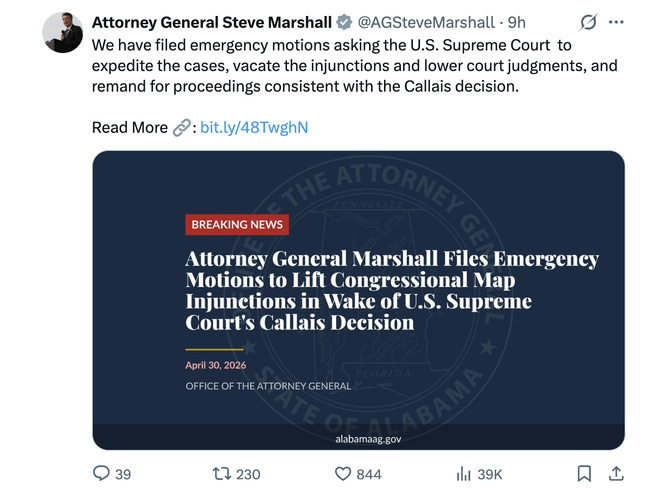
🔥 As we expected, more red states jumped into the redistricting pool yesterday, eager to enjoy their new map-drawing freedom, unshackled from racist requirements for court-mandated majority-minority districts. For instance, AL.com reported, “Alabama wants to redraw its Congressional maps, asks Supreme Court for quick review.”
(Portlanders: a “majority-minority district” is an oxymoronic congressional district drawn specifically so that one racial minority group forms the majority, which until Wednesday was legally required to prevent ‘racial discrimination,’ which was how courts explained that the best cure for treating people differently based on race is to treat people differently based on race. Progressive legal scholars call this kind of logic “nuanced.” The rest of us call it “a migraine.”)
Even in Georgia, where early primary voting has already begun, legislators have started brainstorming how to implement the new Supreme Court rules. Fox 5 Atlanta, yesterday:

Nearly everyone predicted the rush of red states to speed-run map changes before midterms. That was already priced in. But an even bigger implication surfaced yesterday. A Tri-Cities NBC affiliate reported, “‘Uncharted’: US court ruling shakes up battle for Congress.”
The story quoted two Cook Political Report analysts, Amy Walter and Matthew Klein, who admitted the consequences are so potentially vast that it is difficult to imagine all the implications. “We are swimming in uncharted waters,” they wrote.
Political strategist Caroline Welles said, “Voting rights litigation has been the main tool since 2013. If it gets blunted, Democrats are looking at structural disadvantages that feel insurmountable.” Like Wile E. Coyote, they looked down, saw only empty space, and are now at the stage of holding up a small sign that says ‘uh-oh.’
Widener law professor Michael R. Dimino noted, “The decision is very significant for the future -- it will remove an unfair advantage for Democrats.”
In other words, while everyone saw the red-state rush to redraw districts, nobody outside political skunkworks operations predicted the effects in blue states. Illinois, for example, was literally moments away from approving an amendment to its state constitution —gavel raised— that would allow Democrats to gerrymander a favorable new map, but the SCOTUS decision erected a brick wall. Chicago Tribune, yesterday:

They had their amendment gift-wrapped, bowed, and sitting in the driveway ready to ship. Then the SCOTUS UPS truck pulled in and ran right over it. Democrats are picking themselves up and beginning to grapple with the terrifying scope of Wednesday’s decision.

🔥 The third huge shock appeared, of course, in a tweet on X. John Solomon’s Just the News reported, “Justice Dept says it will enforce SCOTUS ruling in every state with racially gerrymandered districts.” Every. Single. State. It began with a letter from Senator Eric Schmitt (R-Mo.) to the DOJ, helpfully “reminding” DOJ that it has federal authority to enforce the new rules on all fifty states.
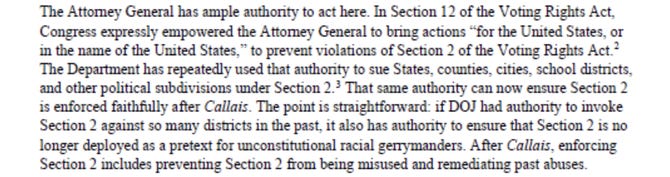
Of course, Eric also tweeted out his letter, and Assistant Attorney General (and covid superlawyer) Harmeet Dhillon promptly replied, “We are ON IT!”
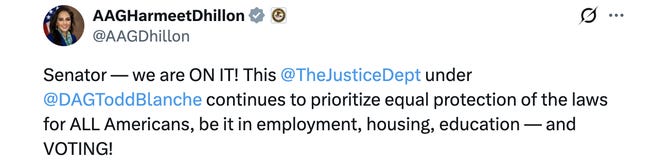
The implications are nothing less than astonishing. In practical terms, the DOJ can (and likely will) systematically review existing maps across blue states to identify districts where race was an explicit or predominant factor in line‑drawing, especially where the old Voting Rights Act framework was used as an excuse to draw pretzel-like majority‑minority districts. (Illinois’s 4th Congressional District, for instance, looks like two oddly shaped neighborhoods connected by a highway median, which is technically two pretzels, with extra salt, but whatever.)
For decades, conservatives have watched the DOJ deploy its full legal firepower against Republican-drawn maps with the grim, unstoppable efficiency of a toxic glacier. Now, a senator sends a letter, and the Assistant Attorney General of the United States responds on social media within what appears to be the time it takes to heat up a microwave burrito. “We are ON IT!” is not the language of a typical federal bureaucracy. It is the language of a guy (or gal) who has been waiting a very long time to say exactly that.
This is the today we celebrate our Independence Day moment, especially for everyone who has been on the receiving end of VRA lawfare since the 1980s. I, for one, am here for it.

By the most recent count, there are about 45 redistricting disputes —“a sprawling web of litigation”— still pending in more than 30 states in various federal and state courts. Harmeet’s announcement suggests the DOJ plans to dive into that briar patch like Br’er Rabbit, but this time attacking the race‑aware maps— rather than defending them as it has always done before.
So it’s not just that Louisiana v. Callais is spurring red-state redistricting, closing off some blue-state initiatives, and ending decades of ugly lawfare against Republican states. In normal times, that kind of win would be good enough. Conservatives, experts in unilateral disarmament, usually settle for ‘good enough.’
But this time, they’re finally flipping the script. The shiny, black cannons of lawfare have been captured, and are now being swiveled around to face Democrats. Suddenly —and unexpectedly— Democrats now find themselves sitting in the crosshairs, the defendants in what could be decades of civil rights litigation. It’s coming fast and hard.
🔥 Fourth —and possibly most significant of all— even though Louisiana v. Callais explicitly applies to congressional districts and the VRA’s Section 2, its logic could ripple throughout all other state and local offices, too. Section 2 doesn’t only apply to Congress. Anyplace where blue states have rigged the game using race as an excuse —city councilmen, county clerks, library board members, mosquito control board— will now be fair game for local lawfare challenging any racial scale-tipping.
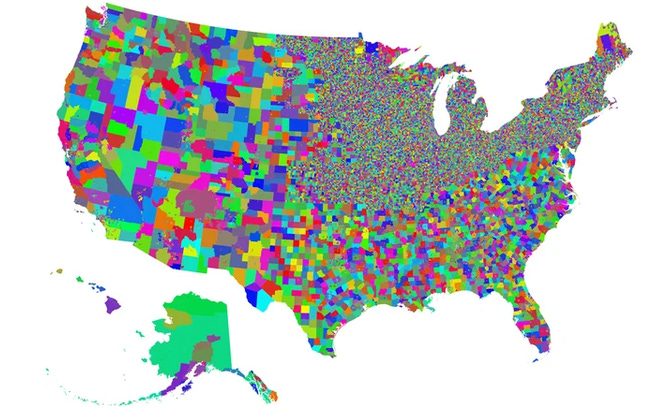
Historically, many Section 2 cases forced local governments to account for race, by abandoning at‑large elections in favor of single‑member districts, and ‘improving minority representation.’ Following the 1982 VRA amendments, Section 2 was used most heavily not on congressional maps— but on cities, counties, school boards, utility boards, and similar local bodies, especially in the South. Indeed, roughly half of all Section 2 cases since 1982 have involved local governments (city councils, school boards, county commissions, etc.)— not statewide or congressional plans.
For example, this is abundantly true in my own uniparty blue county. Alachua County is obsessed with racial politics. Red-state Attorneys General (paging James Uthmeier) can now focus directly on troublesome blue counties like mine and can bring the pain. Turnabout, after all, is fair play.
Callais gives conservative groups and individual litigants, State Attorneys General, and the DOJ’s Civil Rights Division, a brand new way to argue that all these ‘remedial,’ racially motivated restructurings themselves crossed the line into unconstitutional race‑based engineering, especially wherever local records show race was the primary driver.
If a legislature or city council carved out a special “minority opportunity” seat on a board of elections, a school board, a county clerk’s office, et cetera, and the design was openly about racial representation, as many of them explicitly were (virtue-signalers can’t help advertising their virtuous motives), all those just became lucrative targets for legal challenges.
It is a little baffling why the pod-press media didn’t prepare people for all these potential downstream effects while Callais was percolating, or why it now seems so shy about discussing them at all. I suspect they don’t want us to recognize how pernicious and widespread the VRA regime has infected our entire democratic superstructure.
The VRA didn’t just infect the superstructure; it created careers, installed institutions, and built brands. Entire organizations, pod networks, civil rights “expert” classes, and academic political identities were colonized by the idea that the Section 2 regime was both necessary, virtuous, and superior to their MAGA neighbors.
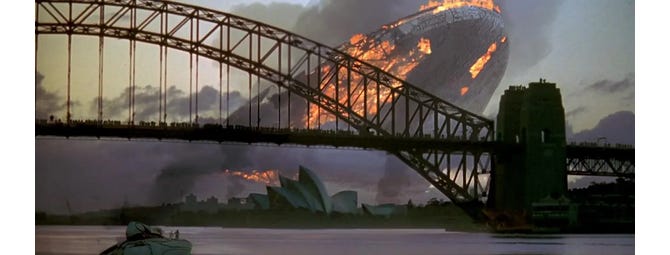
For the first time since the 1970s, we are not just hiding from the pods. We can now start ripping them up by their evil roots. Assuming the courts and DOJ follow through, we are looking at a true sequel to Invasion of the Body Snatchers with an Independence Day-style happy ending — where the humans actually take their institutions back and crush the alien pods into dust.
The hissing era of identitarianism is over. The pod-people mothership is burning and crashing into the Nevada desert. A new golden age of colorblindness has begun. Happy May Day, comrades! (The parade has been canceled.)
Welcome to Earth.
Have a fantastic Friday! …
Don’t race off! We cannot do it alone. Consider joining up with C&C to help move the nation’s needle and change minds. I could sure use your help getting the truth out and spreading optimism and hope, if you can: ☕ Learn How to Get Involved 🦠
How to Donate to Coffee & Covid
Twitter: jchilders98.
Truth Social: jchilders98.
MeWe: mewe.com/i/coffee_and_covid.
Telegram: t.me/coffeecovidnews
C&C Swag! www.shopcoffeeandcovid.com
A special shout out and blessings to Harmeet Dhillon at the DOJ. She will hopefully be the Blue State Gerrymandering Buster!
✝️✝️✝️
Now as they observed the confidence of Peter and John and understood that they were uneducated and untrained men, they were amazed, and began to recognize them as having been with Jesus. And seeing the man who had been healed standing with them, they had nothing to say in reply.
— Acts 4:13-14 NAS95
✝️✝️✝️