

Good morning, C&C, it’s Thursday! Today’s good-news roundup includes: how the S&P 500 and the NASDAQ both closed at record highs yesterday — higher than before the Iran war started — while gas prices fell and the Producer Price Index came in well below expectations, forcing the entire New York Times to publish a story so embarrassing that no individual reporter would put their name on it; how record tax refunds from last year’s One Big Beautiful Bill Act are landing in bank accounts from coast to coast, burying the Democrats’ “affordability” mid-term strategy under a pile of their own voters’ money; how New York City’s socialist mayor is spending $30 million to build a single grocery store that you could buy, already operational, for $2 million — and has already walked back his promise of “universally cheaper groceries” to a mysterious “core basket” nobody can define; and how Gallup just recorded the largest two-year swing in religiosity for any demographic group in 25 years of polling — a 14-point surge among young men that erased a decade of secularization in a single measurement cycle, but will young women follow them into the pews?
⛑️ C&C ARMY BRIEFING — IRAN WAR UPDATE ⛑️
🚀🚀🚀
Here, dear reader, you have it, straight from the biohazardous orifice of the New York Times itself, dated today at 4:36 in the ante meridian. I’m gifting you with the full pleasure of viewing what must have been a painfully difficult headline for the Times editors to approve:
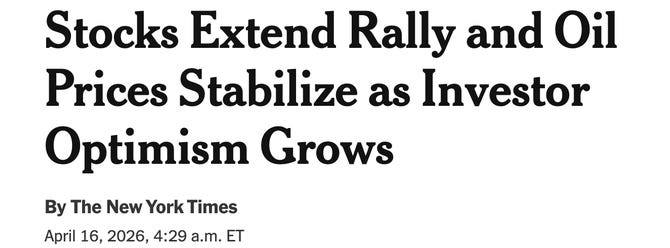
How much must the Times have hated writing optimism grows? Haha! Look at the byline! Those cowards— no reporter wanted their byline on this optimistic story. Apparently, the whole New York Times, corporately, as an institution, wrote the short piece. I am Spartacus! No, =I= am Spartacus! Reporters were ordered to appear from every department, shuffled morosely past the Business Desk, and each pressed a single key on the keyboard, doing their sworn duty, however reluctantly, like a doomed Civil War brigade charging unenthusiastically up Hopeless Hill.
For weeks, the Times told readers to brace for Trump’s “chaos” causing economic Armageddon. We got headlines like, “the biggest drop since the start of the Iran war,” with tumbling stocks and surging oil as investors “fretted” over when the conflict might end. Then came warnings that even if Trump somehow stitched together a cease‑fire, “high oil and gas prices could outlast the war,” crushing ordinary Americans and threatening the broader economy for months or years to come.
By April 10 —last week— the Grey Lady was grimly assuring everyone that “the oil shock is worse than you think,” because Gulf supply problems caused fundamental damage not yet visible in the headline numbers.
The New Statesman, March 17th:

And for most of the incredibly short war, the Times euphorically reported that Iran was actually winning, where it really counts: in the markets. By leveraging the Strait of Hormuz and sending oil toward $100, the Times narrated, Tehran was “exerting economic strain on the U.S. and its allies” even as it absorbed punishing military blows, while betting that Trump’s “capacity for political suffering is finite.”
In the Times’s reality, Iran’s drones, blockades, and mines had cleverly discovered a new kind of military leverage: putting irresistible economic pressure on the White House— proof that, however badly it was being ground to cinders on the battlefield, Iran was nevertheless relentlessly gaining ground on Wall Street and at American gas pumps.
Before yesterday, the Times was sure there was nothing to be optimistic about. The President had eaten a bad Big Mac or some rancid French fries or something, and his indigestion had led the country into a quagmire, a hasty, poorly conceived, illegal war without a plan. It was all going to get worse, too, because Trump bit off more Iranian mullahs than he could chew. He was going to TACO! Look out below!
Well … never mind. “The S&P 500 hit a record high on Wednesday,” the Times reported, “and is now 2 percent higher than before the fighting began on Feb. 28.” At the pump, “gas prices fell again.” The NASDAQ also closed at a record high yesterday.

But what about Iran? Did it nevertheless win the economic war, outlasting Trump’s military strategy, like the Times predicted (along with any number of war commentators who should have known better)? Here’s what the Wall Street Journal reported this morning:

“My sense is that the scale of the destruction now is much worse than the Iran-Iraq war,” said Kaveh Ehsani, associate professor of international studies at DePaul University in Chicago. “The sectors hit hardest by U.S. and Israeli airstrikes represent the core pillars of employment and production,” Hadi Kahalzadeh, an economist and former official in Iran’s Social Security Organization, wrote for the London-based Bourse & Bazaar Foundation think tank.
Oops. I guess Iran isn’t winning the economic war, after all.
Oh, how reporters and black-pillers brayed with hilarity when President Trump predicted the markets would quickly recover. But he was right, and they were wrong. NBC, last night:

“As far as the stock market is concerned, the war is over until further notice,” Ed Yardeni, president of Yardeni Research, said. “The rally,” NBC reported, “has also defied conventional wisdom about the impact of energy prices on stocks.” Translation: Trump was right, and the experts were wrong.
“We haven’t seen a run of gains that quick over 10 sessions since the post-Covid bounceback in April 2020,” Deutsche Bank Research macro strategist Henry Allen wrote yesterday. “Markets are increasingly predicting a positive outcome as the U.S. and Iran prepare for a new round of talks,” analysts at ING said overnight.
Fox’s Maria Bartiromo reported yesterday that the Producer Price Index —a key metric of inflation at the wholesale level— was not showing pressure on prices. “These are fantastic numbers,” Bartiromo excitedly reported. “These numbers are much better than expected.”
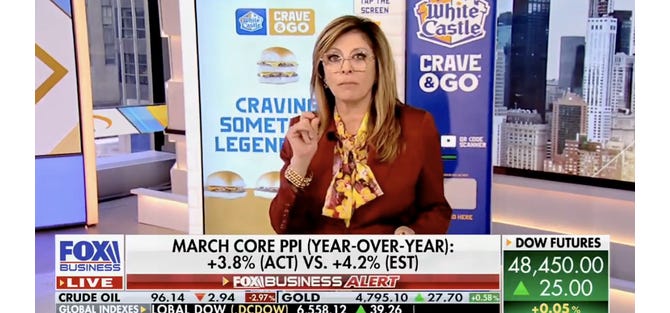
CNBC reported that the latest reports on inflation across the board were the lowest increase since August of last year, defying the experts yet again.
TAW.
🚀 We need to carefully consume our opinion news. Never outsource your own thinking. Only two days ago, even many well-regarded independent war bloggers garrulously opined that America was “stuck” in the war with “no off ramp.” For example (I redacted their names because they are smart guys, and well-intentioned. They are just suffering from TDS. I’m not dunking on them):

This week, a regular reader challenged me on X. He assembled a long list of independent geopolitical commenters (like the ones above), and asked —not unjustly— whether a mere lawyer’s opinion could cancel out the pessimistic predictions of a score of professional war bloggers. I conceded my lack of credentials, but pointed out that the disagreement begins before the geopolitics start.
All these smart guys were wrong because they started with the same flawed premise: there is no plan. And they all made the same mistake of trying to interpret Trump’s tweets literally.
Once you concede that there must be a plan —a plan we aren’t privy to— and that the President isn’t just impulsively attacking Iran out of irritation, without remembering the Strait of Hormuz, the whole analysis changes. Once you start interpreting Trump’s tweets as messaging to negotiating counterparties —which means that sometimes we won’t even know why he says something, because we aren’t part of that conversation— then you can stop puzzling over rhetorical contradictions and start looking at results.
Will they ever learn to be patient and just let the man work? Probably not. First, TDS kills. It kills brain cells, at least. Second, nobody gets clicks by making boring YouTube videos headlined “Let the Man Work.” You need engaging titles like, “The US Is Falling Off a Cliff!”, or “Trump’s Iran Obsession Will Cause World War III!”, or “Five Surprising Reasons Your Bedroom Performance Suffers Because of Oil Embargoes!”
Oh, well. It might not be super engaging or exciting, but let the man work. Or if that’s too much for you, focus on the results rather than the process. The results are looking pretty good so far.
🌍🇺🇸 ESSENTIAL NEWS AND COMMENTARY 🇺🇸🌍
🔥🔥🔥
But wait! There’s more. Beyond stock market records and lower oil prices, average consumers are getting in on the harvest of good results from Trump 2.0’s first year. As you well know, yesterday was tax day. Bloomberg reported, “Tax Refund Splurge for Many Americans Is Paying Down Debt.” It wasn’t just Bloomberg. Surprisingly, the news splashed across the entire media spectrum:
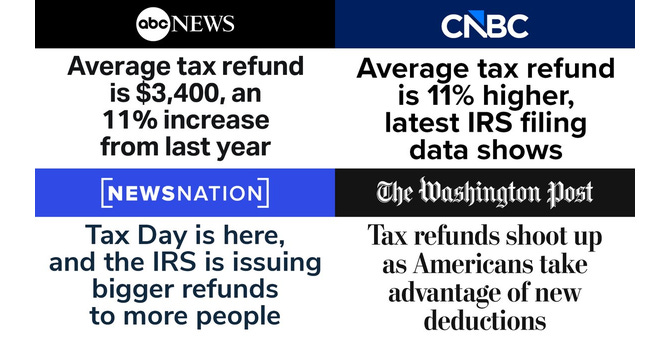
This is the happy result of the tax cuts contained in last year’s One Big Beautiful Bill Act. Most Americans didn’t lower their withholding after the OBBBA’s passage, even though it was retroactive for 2025. Now, just in time to join historic stock market highs, low inflation, and a booming domestic energy sector— taxpayers spanning the spectrum from servers to seniors are enjoying record tax refunds. It’s not printed money, either. It’s their own money.
“Many of the taxpayers said they had received their largest refund in years,” the Times reported, “money that is going toward paying down credit card debt, catching up on bills, padding savings accounts or covering the cost of a vacation.”
🔥 Late last year, the Democrats unveiled their cunning mid-term strategy: affordability. Ask yourself: when was the last time you saw a headline including the word “affordability?” That squeaking sound you hear is the released air deflating Democrats’ political prospects.
Do you think the timing of all these optimistic developments was coincidental? A happy accident? Luck?
I get it. A plan of this scale and success is literally unimaginable. We’ve never seen this kind of historic turnaround before in our lifetimes, so we have nothing to compare it to. My critics (few though they are) accuse me of equally attributing every Trumpian surge or apparent setback to 15-D chess. Well? What’s the alternative? There’s only one other possibility: Trump is just lucky.
You know what? I’m fine with that. I will happily trade a multi-dimensional chess player for a lucky president. In the grand scale of history, you can’t beat luck. But —and this is where things get really wild— what if it’s both? They aren’t mutually exclusive. What if he’s playing 15-D chess and he’s also the luckiest president we’ve ever had?
Meanwhile, the Democrats seem to be having nothing but bad luck. I’ve already exhausted middle-school euphemisms to describe Eric Swalwell’s rapidly shrinking career and Democrats’ flaccid California prospects. What about their rising stars? Like the little communist? Well, hang on.
🔥🔥🔥
Sitting squarely at the intersection of Democrat prospects and the “affordability” narrative, there may be nothing in political history quite as hilariously dramatic as the insta-mocking that Mayor Mamdani is getting over his socialized grocery store plan. Forbes ran a story yesterday headlined, “Mamdani’s Municipal Grocery Stores Risk Making NYC’s Affordability Problem Worse.” The New York Post was less … circumspect.
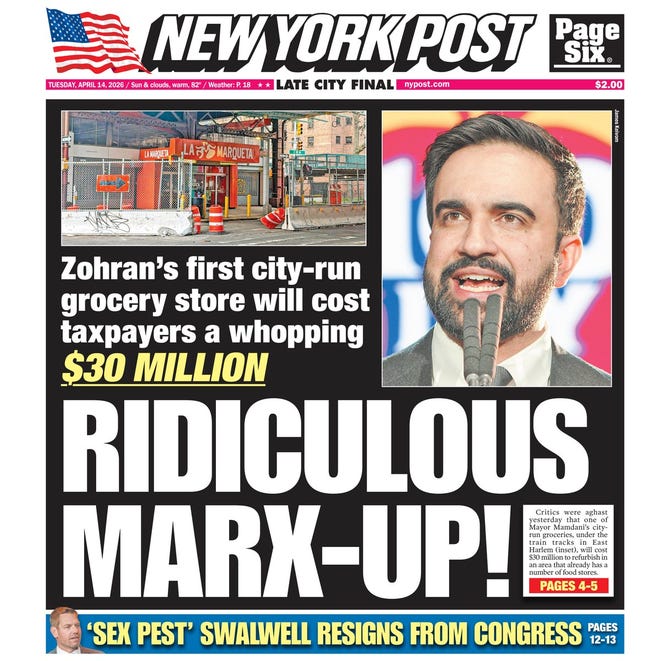
Mamdani —last year’s Democrat darling— announced a $70 million plan to build three government-owned grocery stores to prove to private providers how it’s really done, especially when you don’t have to pay rent, taxes, or salaries. Problems began immediately. The first of five store’s opening schedule slipped from three months to three years. And, unsurprisingly, even before breaking ground, it’s already over budget, now consuming $30 million of the entire budget.
And they are already walking back initial glowing predictions. “The administration is no longer promising universally cheaper groceries across the board, Forbes reported. “Instead, officials say there will be a discounted ‘core basket’ of fresh and everyday goods, but they have not yet determined exactly how the discount will be calculated.”
Forbes wondered whether even moderate discounts on a “core basket of everyday goods” would meaningfully affect the overall affordability of life in the Big Apple. Online pundits were harsher. Critics quickly found listings of already-operational groceries in Brooklyn for sale for under $2 million. Why spend $30 million to build one small grocery store when you could just buy ten ready-to-go locations for less than $20 million?

I don’t know who needs to hear this, but hoovering $30M out of New York City’s citizens through taxes to build a $2M grocery store does not actually reduce unaffordability. Instead, it just multiplies municipal unaffordability, transferring the burden from one expense category —core baskets of fruit and bread— into a different category of expense: taxes.
And even if you buy the “wealth distribution” angle, of making “rich people” subsidize neighborhood bodegas, wouldn’t it still be more efficient to just directly pay established grocers to lower their prices on the core basket? (Some economists would argue that driving rich people off eventually hurts the poor, but never mind. That argument is, apparently, too complicated.)
Sadly, the answer is that efficient, direct payments to grocers would eliminate all the opportunities to reward donors and favored constituents with unsupervised government grants and contracts. Which is one of the main reasons why communism never works. Combining politics with business creates a patronage economy, an invisible transaction tax on every single purchase. It twists markets into political pretzels, through what economists call “rent-seeking behavior”— a clumsy term meaning everybody stops trying to reduce costs through competing for business, and starts trying to climb aboard the grift train.
Let’s make it even simpler for Portland readers. Mamdani’s $30M grocery store includes costs as follows: $2M for the grocery store itself, plus $28M for friends and family. Even if it works, and actually sells price-stabilized Cheetos below market rates, then other grocery stores will close, since they can’t compete. Which is how you get Soviet-style Cheeto lines.
Meanwhile, affordability events are passing the Grocer-in-Chief. On April 9th, the New York Post, citing a study by CouponFollow, reported, “Top grocery staples have hit their lowest prices in 2 years.” So much for Mamdani’s “core basket.”
🔥🔥🔥
Finally, the best news of all. The reporting on the nation’s religious revival continues quietly apace. This morning, far-left Axios reported, “Religious resurgence stirs Gen Z.” The post-pandemic rebound —among young men in particular— holds and, if anything, accelerates. Not so much yet with the ladies.
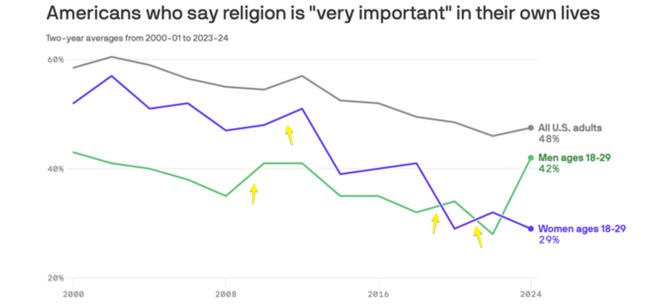
Gallup’s most recent poll found that 42% of young men between 18-to-29 now say religion is “very important” in their lives. It’s an astonishing 14-point reversal in about two years. This kind of shift doesn’t happen very often. A 14-point jump in a single two-year window is by far the largest two-year swing in either direction for any group in the entire 25-year dataset.
It is remarkable in several dimensions. It took about 10 years of gradual erosion to lose those points, but they were recovered in a single measurement cycle. The entire post-millennial secularization trend for young men was erased in only two years. It also appears wildly countercultural, since every other demographic group still scrapes the bottom. Young men are leading.
Not just that. Prior mini-peaks for young men quickly reversed. But Gallup’s monthly tracking through early 2026 shows young men’s religiosity still holding at 40% —not just holding, essentially vertical— with no retreat whatsoever from the 2024-2025 surge. This move is 3-4x larger in magnitude and shows none of the prior fade-back pattern.
Other factors suggest the trend will continue. Young men are still drifting toward the GOP, which correlates strongly with religiosity. The influencer ecosystem keeps funneling young men toward traditional structures and keeps growing. When men join religious communities, they step into sticky, self-reinforcing social structures —friendships, dating prospects, brotherhood— which compound over time.

🔥 How about the girls? Young women 18-29 are now by far the least religious female group: only 29% call religion very important, 18 points below the next bracket and less than half the rate of senior women.
But, and this is critically important, if you look at the graph above, where I added the small yellow arrows, you’ll notice a pattern. Young ladies follow young men. Each time young men’s religiosity ticked up, young ladies followed 2-4 years later (ditto for downward moves). The marriage market offers a plausible mechanism of causation. The lag makes sense, too— women wouldn’t respond immediately, but after noticing men’s shift (~1 year), then updating their own behavior (~1-2 more years).
Boomers are aging out (kicking the bucket). They have contributed outsized influence on overall secularization, since they represent one of the least religious blocs. But the conveyor belt is changing direction at the entry point. If Gen Z women follow their men, the cohort entering the 30-49 bracket over the next 10-20 years will be more religious than current 30-49-year-olds, not less.
That means the replacement math, which has been working against religiosity for 25 years, flips. The very demographic event —Boomer mortality— that analysts expected to nail the coffin shut on faith may instead be the moment the trough becomes visible in hindsight, because it coincides with the first generational religiosity reversal in 25 years at the entry end of the faith pipeline.
It’s another pandemic miracle. Covid broke the stranglehold progressive Boomers held on the culture. (C&C readers excluded, of course.) And that, perhaps, is the most encouraging sign of all.
The Times rushed to predict market doom— wrong. Democrats predicted affordability would be their winning issue— wrong, tax refunds and egg prices killed it. Mamdani predicted government groceries would work— it’s failing in real time. And secularization theorists predicted religion would continue declining— wrong again. Behold, the experts are committing Hari-Kari. Sad!
Have a terrific Thursday! Enjoy all the great news today and then haul back here in the morning tomorrow, for another uplifting but slightly snarky roundup of essential news and commentary.
Don’t race off! We cannot do it alone. Consider joining up with C&C to help move the nation’s needle and change minds. I could sure use your help getting the truth out and spreading optimism and hope, if you can: ☕ Learn How to Get Involved 🦠
How to Donate to Coffee & Covid
Twitter: jchilders98.
Truth Social: jchilders98.
MeWe: mewe.com/i/coffee_and_covid.
Telegram: t.me/coffeecovidnews
C&C Swag! www.shopcoffeeandcovid.com
✝️✝️✝️
Every good thing given and every perfect gift is from above, coming down from the Father of lights, with whom there is no variation or shifting shadow.
— James 1:17 LSB
✝️✝️✝️
I can attest that there are more young men coming to church since Charlie was executed. As well my sixteen year old grandson is involved in a newly formed Fellowship of Christian Athletes group in his Snocross Circuit. This was the first time in his 10 years of racing that Chapel was held regularly on Sunday between morning and afternoon heats. My heart was overjoyed to see young men, on their own, without parents, attending a devotional time that they sought to have.