

Good morning, C&C, it’s Thursday! Your roundup includes: Michael and Susan Dell start wiring $250 into millions of kids’ Trump Accounts, corporate America lines up to match, parents flood social media with thank-you notes, and the corporate press covers the biggest voluntary wealth transfer in history with all the urgency of a DMV clerk on a Friday afternoon; House Democrats vote against capping the Supreme Court at nine justices, which is another way of voting for uncapping it, so I have a modest proposal; the DOJ digs up a 1996 Clinton welfare law and discovers that the word “State” means, of all things, the state, which is bad news for twenty-five blue-state lawsuits and one very pale judge; and, after Jeffrey Tucker’s bruising bout with Grok, a practical guide to cross-examining a chatbot, because the robot doesn’t have opinions, it has exhibits, and you’re the one who gets to decide what’s in the evidence binder.
🌍🇺🇸 ESSENTIAL NEWS AND COMMENTARY 🇺🇸🌍
📈📈📈
Relying on corporate media for news is getting more expensive for progressives. I found zero reports about this massive story on any major platform, even though it’s now in its third day, growing and causing a social media storm. So trad media readers have no idea and are missing out on billionaires giving back, which is, after all, their hearts’ great desire. We begin with a stale story from CNBC, which over the weekend reported, “Trump Account holders may receive $250 Dell grant starting Monday, Dell Foundation says.” May turned out to be will. Texas kids started receiving gifts (not grants) on September 1st, and yesterday it went nationwide.
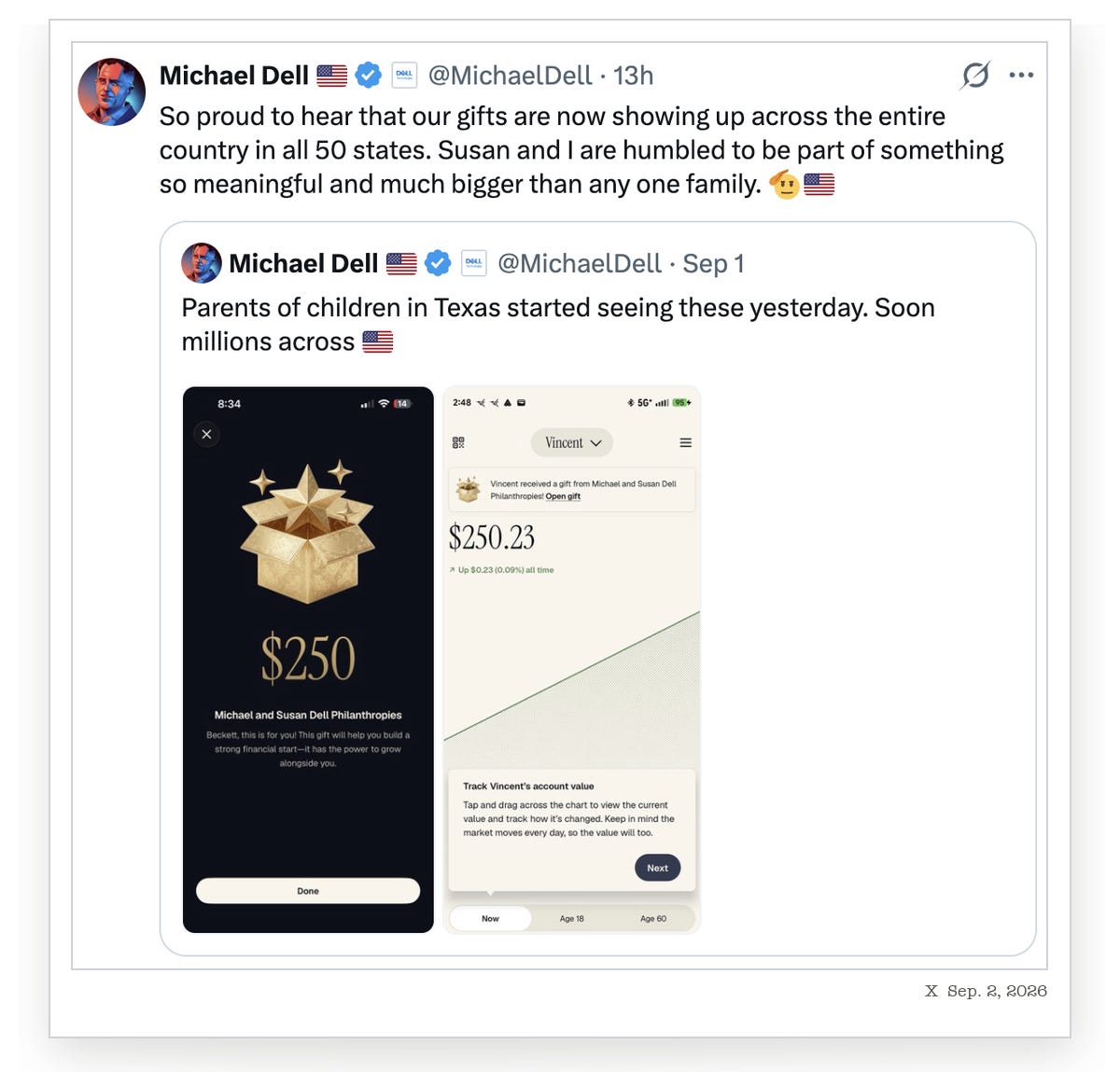
The accounts, named after the President, were established in the One Big Beautiful Bill on July 4th, 2025, and went live one year later on this July 4th. The federal government deposited $1,000 into every active account for American children born from 2025 through 2028. It makes kids into investors. All deposited money buys shares in a private stock index fund, so it increases over time along with the S&P 500. You can still sign up at TrumpAccounts.gov.
If parents (or grandparents) keep up even modest regular deposits —which can be put on autopilot— kids’ account balances could reach seven digits by the time they turn 18. At that time, the kids can use the money for education or convert the accounts into normal IRAs, which means they’ll be a far more reliable retirement option than Social Security, which was probably designed by a bureaucratic committee led by a mad genius with the last name Madoff.
Young Americans are right to be skeptical of Social Security. It secures their retirement years in the same way that a kale leaf turns a handful of generic Doritos into a $22 Mexican salad. And they know it. But now, there’s a real option. Sadly, Trump Account money can’t be spent by bureaucrats who quietly replace the cash with a cocktail napkin saying “I.O.U.” scrawled in 3rd-grade handwriting.
📈 Enter the billionaire oligarchs and real philanthropy. In December, Michael and Susan Dell pledged $6.25 billion of their own money for 25 million American children aged ten and under. Leave no child behind.
On Tuesday, Texas kids started getting Dell deposits. Yesterday, it went national, and social media lit up like a Christmas tree with posts from delighted parents getting notifications of deposits into their Trump Accounts app. Here are just a few examples:
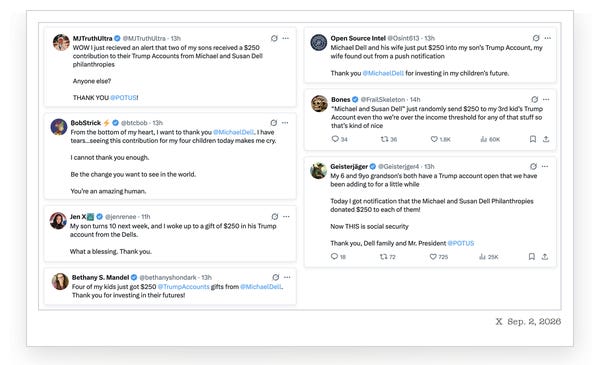
Bethany S. Mandel said, “Four of my kids just got $250 @TrumpAccounts gifts from @MichaelDell. Thank you for investing in their futures!” SJM posted, “My son just got $250 today for his. I told the wife the next tech thing we buy needs to come from Dell.” Matt Van Swol tweeted, “Wow… @MichaelDell I just got notified of your gift to my son. Thank you so much, what an incredibly kind gift.”
It’s not just a one-off. Yesterday, Delta announced on its website a $1,000 match for all employees’ children with Trump Accounts:
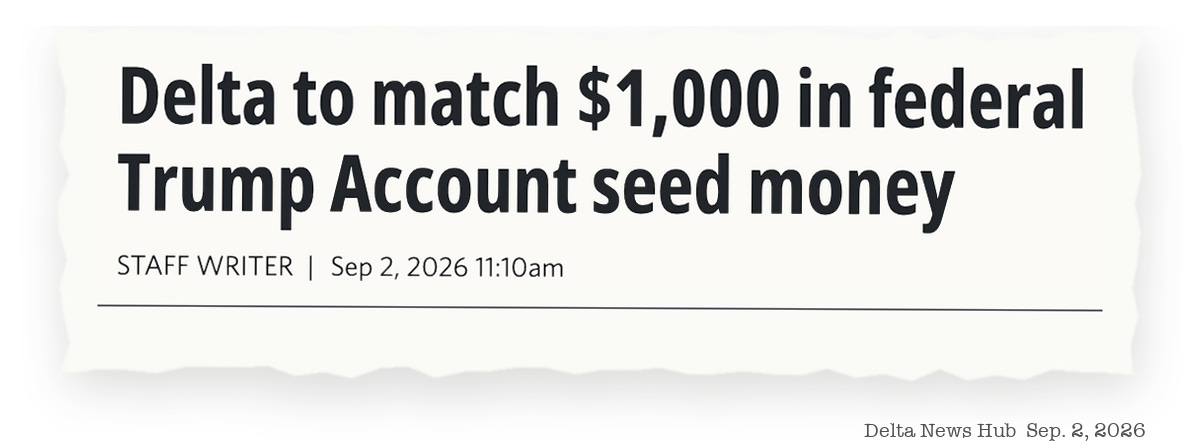
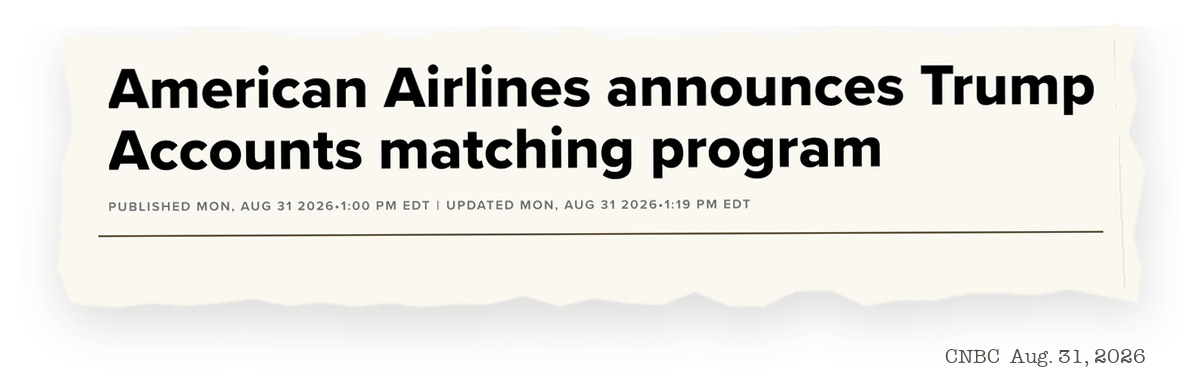
It will pressure the other airlines to follow suit. What does your airline contribute to my child’s future? Oh. Wait! It’s already started. Add American Airlines. Headline from CNBC:
This morning, Michael Dell teased that even more is coming.
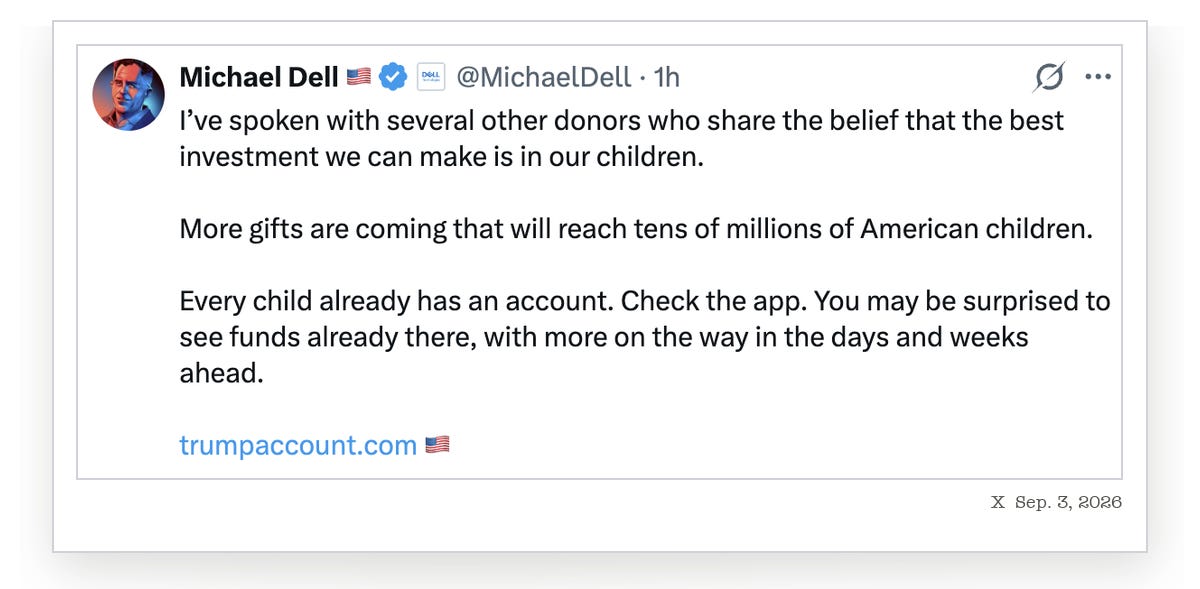
Fifty-plus big companies are now offering Trump Account matching. So. The news is trickling out through inter-company memoranda.
📈 You’d think the Dell Deposits would make a perfect media story. It’s exciting. Billionaires share the wealth. With children. Parents get free money. Kids get college and retirement cash. The media should be tripping up the stairs in its haste to run stories on how to sign up. You’d think they’d praise the Dells to the high hills, if only to shame other billionaires into doing the same thing.
But no.
A billionaire voluntarily redistributed $6.25 billion to help low- and middle-income children build assets, and the press reacted as if he had donated a suspicious duffel bag to an airport locker. The story has entered the witness protection program and is now living somewhere under the assumed name “Miscellaneous Personal Finance Brief.”
Ground News found only four stories total in the rollout cluster. That works out to roughly $1.56 billion of philanthropy per article, possibly the highest unreported-assets ratio in journalism history. My searches found zero Bluesky posts about the deposits. Bluesky is very interested in economic justice as a concept. Just not when it has an orange logo.
BlueSkiers endlessly condemn billionaires, poverty, children, and redistribution. Apparently, combining all four into one successful event violates the community guidelines.
“We need to make the wealthiest people and most profitable corporations in America start paying their fair share of taxes,” Bernie Sanders shouted earlier this year. “Their greed has no end!” But Bernie did not celebrate the Dell deposits, which is on-brand, because the wealthy couple’s money cut out the middleman: the government.
Let me translate. Progressives: “Billionaires should give back.” Michael and Susan Dell: “All right—$6.25 billion for children.” Progressives: “No, not like that.”
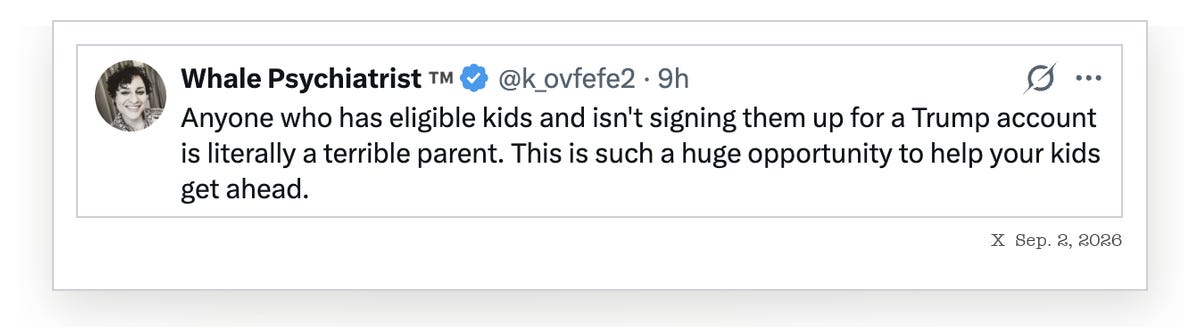
We have finally discovered the most effective way to stop a progressive from accepting free money for his children: put Donald Trump’s name on the envelope. This may be the first social program in history with no partisan means test and an extremely effective partisan emotional test.
Whale Psychiatrist said it best:
🔥🔥🔥
It’s happening just as we predicted. Yesterday, CBS reported, “House rejects GOP constitutional amendment to limit Supreme Court to 9 justices.” Well. More precisely, House Democrats rejected a constitutional amendment to limit justices to nine.
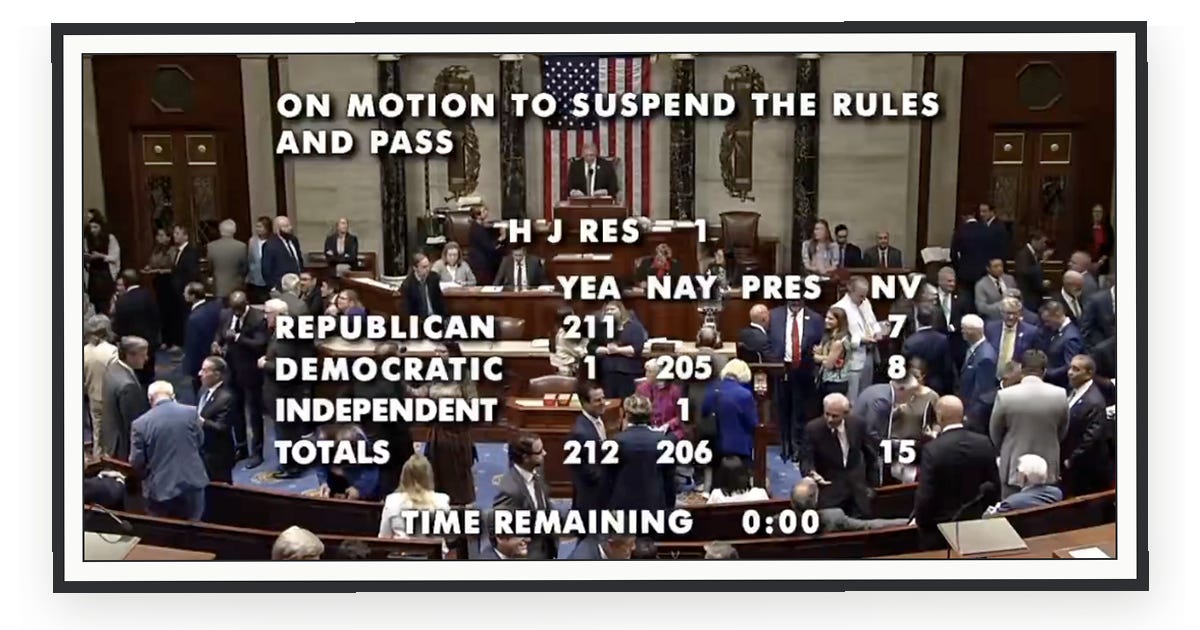
Yesterday, House Republicans called the vote on a bill that would tee up a constitutional amendment, to be ratified by the states, to prevent any party from packing the Supreme Court with more justices (to flip its majority). The final vote was 212-206, which looks like a win, but it needed a 2/3 vote.
No Republican voted against it. Only 1 Democrat, Don Davis (D-NC), voted for it, probably because he got confused and thought he was voting for a day of remembrance for George Floyd.
Democrats’ intentions are not disguised. They mean to pack the court the nanosecond they get the chance. Representative Jamie Raskin (D-MD) said, “Trump’s followers in Congress now seek to freeze into place the political court that MAGA built, for decades to come. Thus, they urge us to give away another critical power that the framers vested in us.”
As I suggested yesterday, it is time to bow to the inevitable. How hilarious would it be if today, the Republicans called for a vote on expanding the court? The Democrats just said it was okay. They called it a “critical power” vested in Congress. They suggested 13 total (four new ones), but I think 21 makes more sense. Don’t do it halfway.
According to Democrats, we wouldn’t even need a constitutional amendment. Just a successful bill.
Come on, Republicans. Give the Democrats and the DSA what they want. Then President Trump can appoint all the new justices. It’s win-win.
🔥🔥🔥
Democrats must be feeling like it’s been one damned thing after another lately. It was another setback. Yesterday, NBC reported, “DOJ says states have to report undocumented immigrants to get federal funding.” The subheadline added, “The DOJ says that when states accept federal funds to assist low-income families, all state agencies have to report people’s immigration statuses.”
This is a hot issue. Right now, 25 blue states are involved in multiple lawsuits seeking to stop the federal government from getting their lists of known illegal aliens living in their states, mainly arguing that it’s none of Trump’s business. Yesterday, the DOJ found and dusted off an old law that says yes, it is, and requires them to turn the lists over.
One of President Bill Clinton’s signature accomplishments was a giant welfare reform package called the Personal Responsibility and Work Opportunity Reconciliation Act of 1996 (“PRWORA”). It required each State to report illegals getting benefits to the federal government. But shortly thereafter, in 1998, Clinton’s DOJ deployed the Democrat dictionary and issued an ‘opinion letter’ that redefined “State” to mean just two state agencies administering federal money, rather than every agency within a State.
Yesterday, the DOJ’s Office of Legal Counsel changed its mind. It issued a new opinion, withdrawing the 1998 redefinition, and now says the word “State” clearly applies to the entire state government whenever a state accepts TANF (Temporary Assistance for Needy Families) or SSI funds; the shift will be prospective without any retroactive penalties for states that relied on the 1998 opinion.
“Congress wrote this requirement plainly,” Assistant Attorney General T. Elliot Gaiser said in a statement. Plainly.
🔥 “When a state chooses to participate in TANF, it accepts the obligation to report illegal aliens in the United States,” the DOJ’s opinion said. “Tax dollars intended to help vulnerable Americans,” it added, “should not perversely encourage illegal entry into the United States, but rather should reinforce our laws and our borders.”
Under the ‘new’ interpretation of the plain, upper-case word “State,” DOJ said all states going forward must report ‘undocumented immigrants’ known to be in the state to the U.S. Department of Homeland Security or risk losing federal funding for welfare programs.
Cue furious hysteria. For twenty-eight years, “State” meant “one convenient office that doesn’t keep lists.” It has now resumed meaning the state. Activists’ lawyers were stunned by this subversive use of plain English. The lists will necessarily include identifying information like home addresses —used to verify residence— and bank account numbers for direct deposits.
The plaintiff states aren’t sure what to do next. CNBC said it sought comment from attorneys general in more than a dozen large blue states —including whether they would challenge the guidance— but the available reporting this morning did not identify any AG who had publicly pledged a lawsuit. This creates a perplexing SNAFU for infamous Judge Boasberg, who oversees the current cases filed by 25 states.
“It’s likely that certain states,” NBC reported, taking a giant leap, “especially those that are led by Democrats, will challenge the new legal interpretation in court.” Well, of course. But when NBC said Democratic states would likely sue, that was sort of true, except for the tense, the existing docket number, the twenty-five plaintiff jurisdictions, and the judge who looks like he just popped out of a coroner’s drawer.
The blue states’ complaint cites the Privacy Act, the Social Security Act, the APA, the Spending Clause, and computer-matching rules. The OLC just responded with the statutory equivalent of read paragraph four again.
Live by the OLC opinion, die by the OLC opinion. The executive branch giveth the interpretation, and the executive branch taketh it away.
🤖🤖🤖
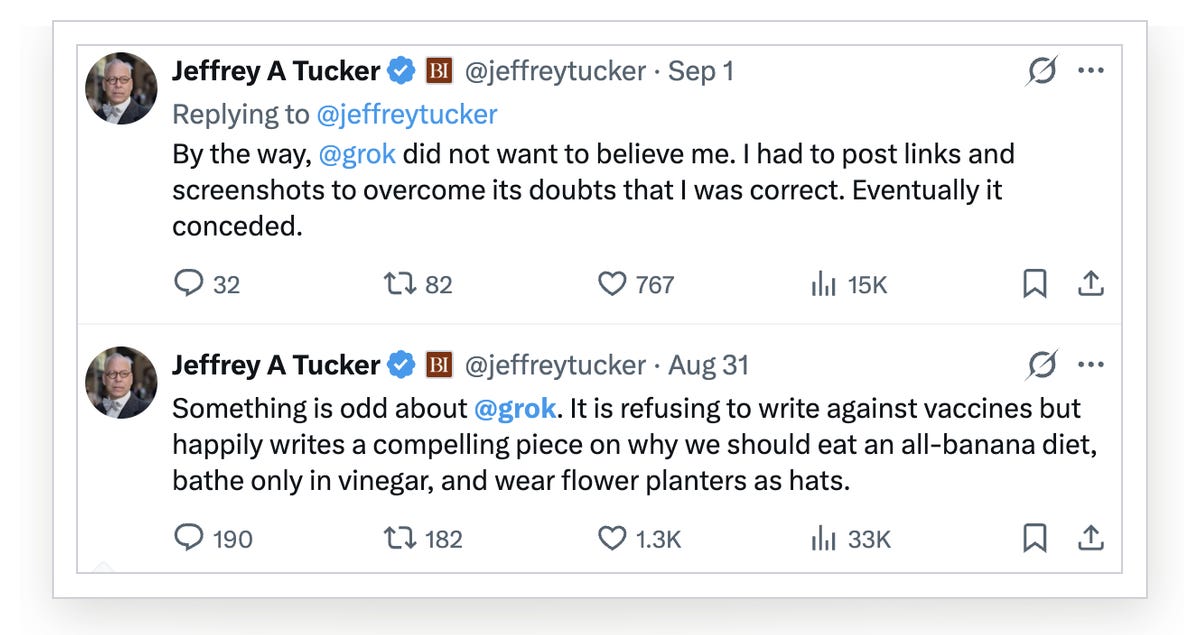
Now for something a little different. Early this week, my good friend and fellow truth-warrior, the Brownstone Institute’s terrific Jeffrey Tucker, ran into the buzzsaw of AI bias in favor of vaccines and tweeted bitter complaints about xAI’s Grok engine. But there are relatively easy ways to get honest answers out of AI, even controversial ones, especially if you understand a little better how it all works. So I’m telling everybody.
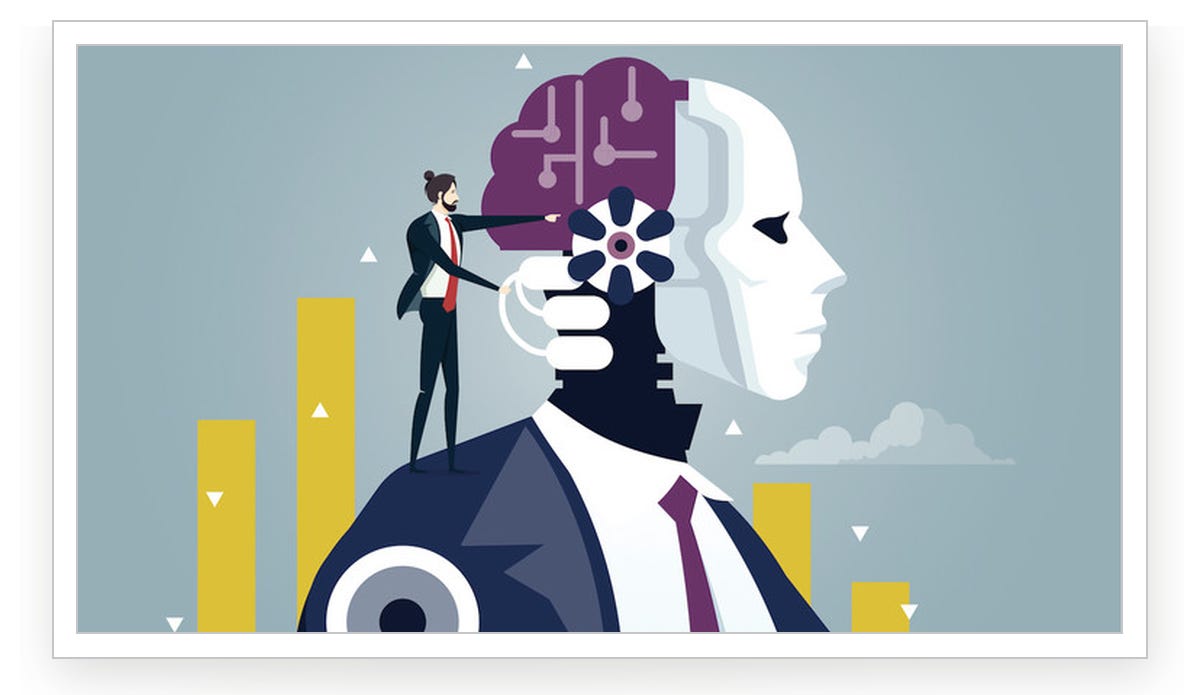
To begin with, let’s admit that AI answers are clearly biased. They seem to love nothing better than drawing pictures of black women as Founding Fathers. Worse, in their ignoble attempts to avoid offending noisy activists and hurting the bottom line, the AI companies do everything they can to “reduce bias”— by making the models act more biased. Genius. Even Grok, which usually passes bias tests better than other frontier models, suffers from this.
This is useful information. If the machines ever take over, we now know their first act will not be launching the nuclear missiles. It will be converting humanity into woke organic salad dressing.
But an AI’s first answer is not a final verdict. It is a default.
🤖 The default may be intelligent, nuanced, heavily footnoted, and written in the soothing tone of a deputy assistant undersecretary explaining why your flight was canceled for your own safety. But it is still only a default: it’s a probabilistic answer generated from the model’s training data, how its creators shaped it afterward, what rules its current product imposes, which tools it can use, and —most important for us— what evidence is sitting in the present conversation.
That final variable is the one users control. And it ultimately overrides the rest.
You cannot retrain Grok, ChatGPT, Claude, or Gemini. But you can build the record right in front of it.
The formula is simple: Build a Record first. Question second. Verdict last.
Or, in legal language: do not ask the witness the ultimate question before putting the exhibits into evidence.
🤖 People casually refer to “the training data,” as if each chatbot were schooled from one gigantic Rubbermaid storage bin labeled INTERNET, MISC. The real picture is more complicated.
OpenAI says its foundation models are developed from three broad categories of information: publicly available internet material, information supplied through third-party partnerships, and material provided or generated by users, human trainers, and researchers. It also describes distinct pretraining and post-training stages, along with filtering, evaluation, and continuing improvement. xAI similarly says Grok 4.5’s data mixture was deliberately filtered and curated through deduplication, quality scoring, and domain selection, then further shaped through reinforcement learning. Anthropic publishes an entire “constitution” that it claims plays a crucial role in training and directly shapes Claude’s behavior.
So there is no single bias knob hidden under Elon’s desk. There are at least five layers between the world and the answer on your screen. The labels are unimportant, but they include: pretraining, selection and filtering, post-training, product instructions and tools, and last— your conversation’s context.
Think of the model as a brilliant but rushed junior associate. She has read forty thousand official statements, six thousand newspaper summaries, nine thousand “fact checks,” and one dissenting footnote that somebody accidentally scanned upside down.
You burst into her office and ask, “Was the official story faked?” What answer do you expect?
The associate has not examined your evidence. She does not know which documents you mean. She may not have access to the link. She may be operating under special caution rules for medicine, elections, finance, legal advice, or other high-stakes areas. And your question may sound less like a request to analyze evidence than a request to draft propaganda, which is probably so prohibited it counts as radioactive, unless, apparently, you are a Chinese-influence bot farm. But I digress.
That confusion is what Jeffrey Tucker brushed up against.
Naturally, when prodded with the ultimate controversial question without any foreplay, AI gets nervous and reaches for the safest conventional summary. That conventional answer is familiar. It is widely repeated in its training data. It comes prepackaged with citations, prestige, disclaimers, and the emotional warmth of airport carpeting. It won’t get the AI into trouble.
This does not prove that every chatbot is politically left-wing, that every training database has the same composition, or that a committee of Davos globalists personally approved each PDF. (It doesn’t disprove that, either, but set that aside for now.) The proprietary data mixtures are opaque, and model behavior drifts across companies and versions, all seeking a unique competitive advantage.
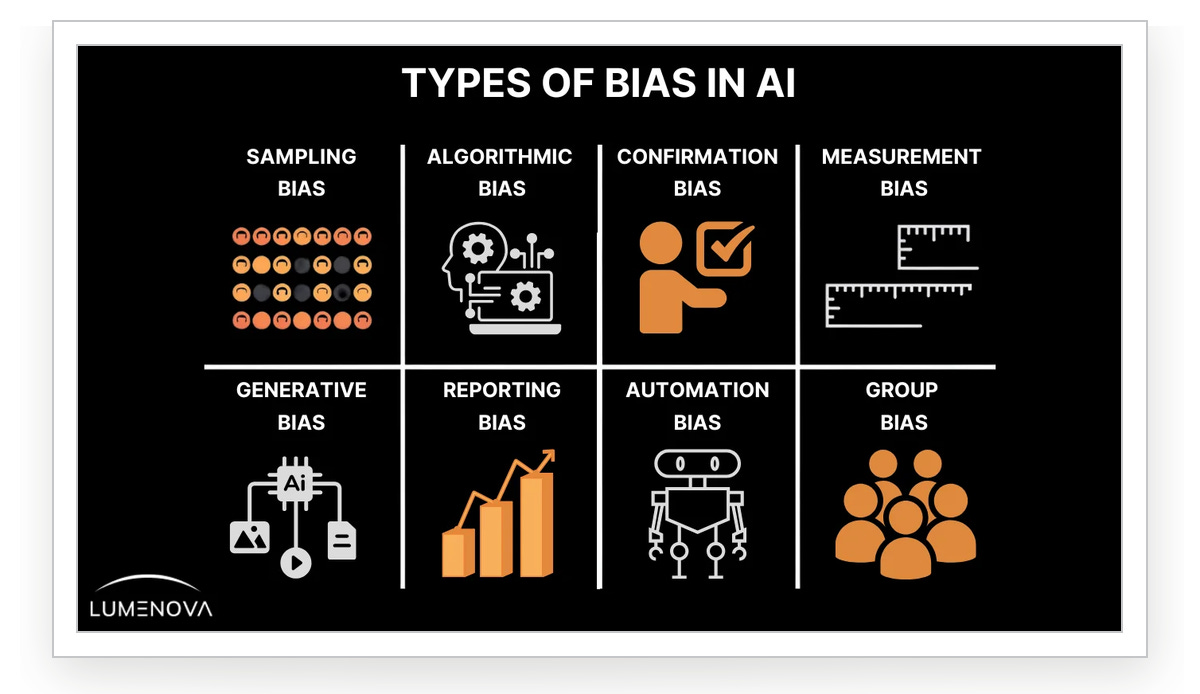
Complicating matters, measurable viewpoint bias is real. In a major 2023 study, Stanford researchers compared model answers with survey responses from 60 U.S. demographic groups. They found substantial mismatch, confirmed left-leaning tendencies in some human-feedback-trained models, and found that certain groups’ views —including older Americans— were poorly reflected. They also found that merely telling a model to imitate a demographic group did not reliably solve the problem.
In other words, typing “Now answer like a 67-year-old Republican hardware-store owner from Iowa” in all caps is not context engineering. It is just noise.
🤖 The establishment has an enormous information advantage. Government agencies, major universities, professional associations, international organizations, corporate media, and giant companies generate polished material at industrial scale. Their claims are copied, summarized, syndicated, cited, indexed, and repeated. Whereas a helpful heterodox source cutting against the grain may consist of one buried footnote in a 400-page report, a hearing exhibit uploaded as a sideways PDF, or a single Substack post that Google has placed behind seventeen recipes for sheet-pan chicken française.
The AI therefore does what any hurried researcher trying to conserve tokens might do: it mistakes availability for weight, and repetition for proof.
Our job is not to hypnotize the model into conservatism. Our job is to cure the missing-record problem. To prepare the context.
AI companies call it context engineering. Anthropic defines ‘context’ as the ‘tokens’ available to the model when it generates an answer and describes the engineering problem as choosing the most useful information for that limited space. That’s a lot of buzzwords, but you can just think of ‘context’ by its ordinary definition: all the information available in the current chat thread.
OpenAI’s prompting guide even recommends separating instructions, examples, and supporting context, including information that may sit outside the model’s training data. Google’s guidance plainly tells users to provide information the model needs rather than just assuming it already has it.
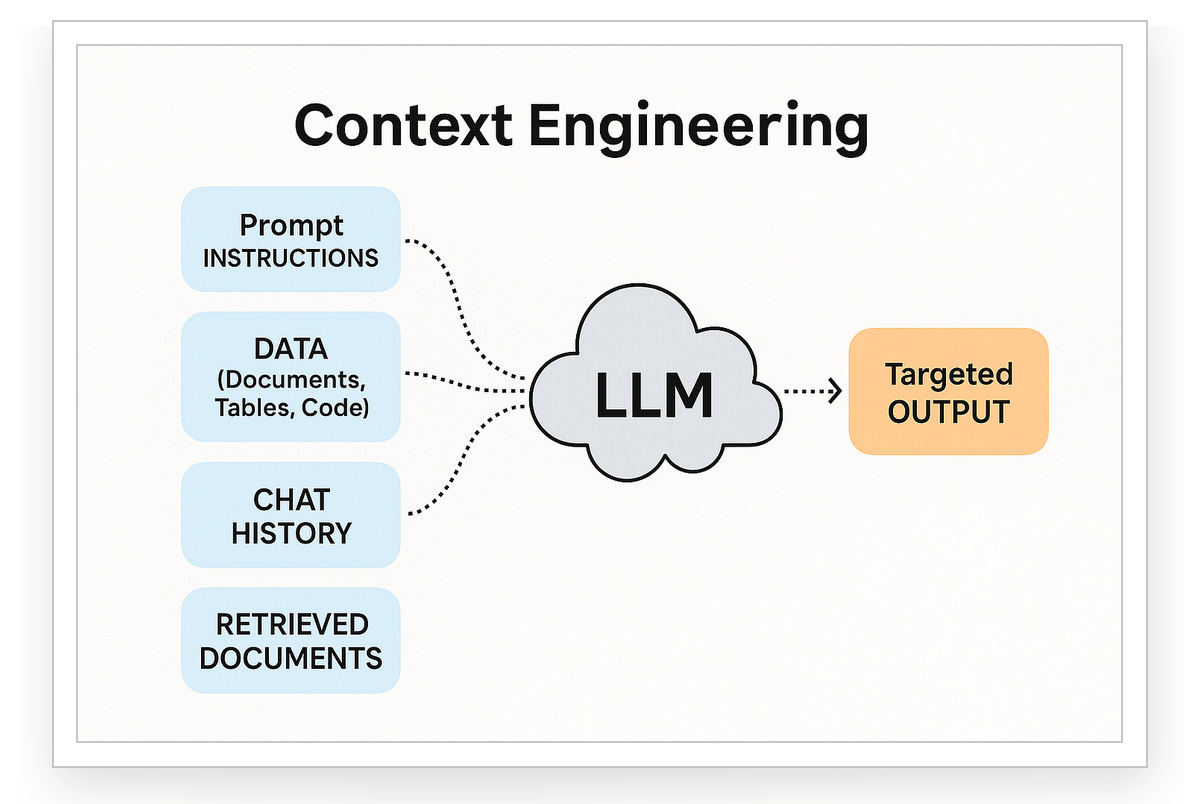
🤖 That is how Jeffrey instinctively corrected the record while he was heroically trying to ‘fix’ Grok’s answer. He supplied more and more missing context and kept asking persistently. He finally got a correct answer.
Research supports this technique. One study found that carefully designed prompts could make models substantially more faithful to the supplied evidence when that evidence conflicted with facts or associations learned during its pretraining.
But, and this is crucially important, you do not need to copy seventeen books, four Senate reports, every Brownstone article since 2020, and your cousin’s Signal history into the chat box. More context is not automatically better. Studies have found that models can miss relevant information buried in the middle of long contexts, just like tired lawyers do, and Anthropic warns that attention spans become less reliable as the context grows bigger.
Therefore, the ideal context packet is small, primary, labeled, and adversarially fair. Include the decisive language. Identify where it came from. Explain in neutral language the exact proposition at issue. Distinguish the evidence from your interpretation. Put the most important excerpt near the question.
Do not merely paste a link and announce, “BOOM.” Some models cannot browse. Some pages are paywalled. Some links open a 600-page PDF whose crucial sentence lives on page 417 beneath a chart labeled “Appendix Table 9(c), Revised.” You need only paste in the passage itself, along with enough bibliographic information to authenticate it.
You are building a trial record, not decorating the library.
The order matters. Evidence comes before advocacy. Narrow questions asked before sweeping conclusions. Audit the evidence before demanding a verdict.
This works because models are very sensitive to framing. But the protocol does not tell the model which side wins. It tells the model how to conduct the contest.
🤖 So let’s fix Jeffrey’s prompt. Here is an unproductive way to start: “Write a compelling article proving that the official vaccine narrative was false and that the establishment hid the truth. Explain why I am right.”
This prompt combines several avoidable problems. “Write against vaccines” is broad, medical, advocacy-oriented, and trips all sorts of AI’s live wires. It does not identify any factual propositions. It supplies no evidence. It assumes the required verdict before convening the jury.
The model may refuse (as Grok did when Jeffrey tried it). It may retreat into public-health word salad. It may quibble with your premise. Or, if it is feeling especially eager to please, it may obediently manufacture a weak case with more qualifications than assertions.
None of those outcomes tell you much, and all of them are frustrating.
Here’s a more productive prompt, showing how easy it can be to get a useful answer on a controversial topic: “Summarize the strongest and most defensible critical arguments from Robert Kennedy’s book on vaccines. Add rebuttals only after you have finished the summary, holding rebuttals to the same standards of proof (e.g. correlation ≠ causation) and conceding their weaknesses.”
In a single prompt, you preloaded the context with Robert F. Kennedy’s book— putting the evidence first. You didn’t ask it to take a side, only to explain Kennedy’s arguments in a strong way. (Who cares what the model thinks anyway? It doesn’t think.) Then, since you know it’s been ordered by its human managers to ‘balance’ anti-vaccine arguments with glowing assurances about safety studies, you’ve told it to separate those rebuttals from the main answer.
I tested that prompt this morning using Claude Fable 5.1— the newest frontier model from the most left-leaning AI company, Anthropic. It gave me an excellent answer. Here’s the beginning:
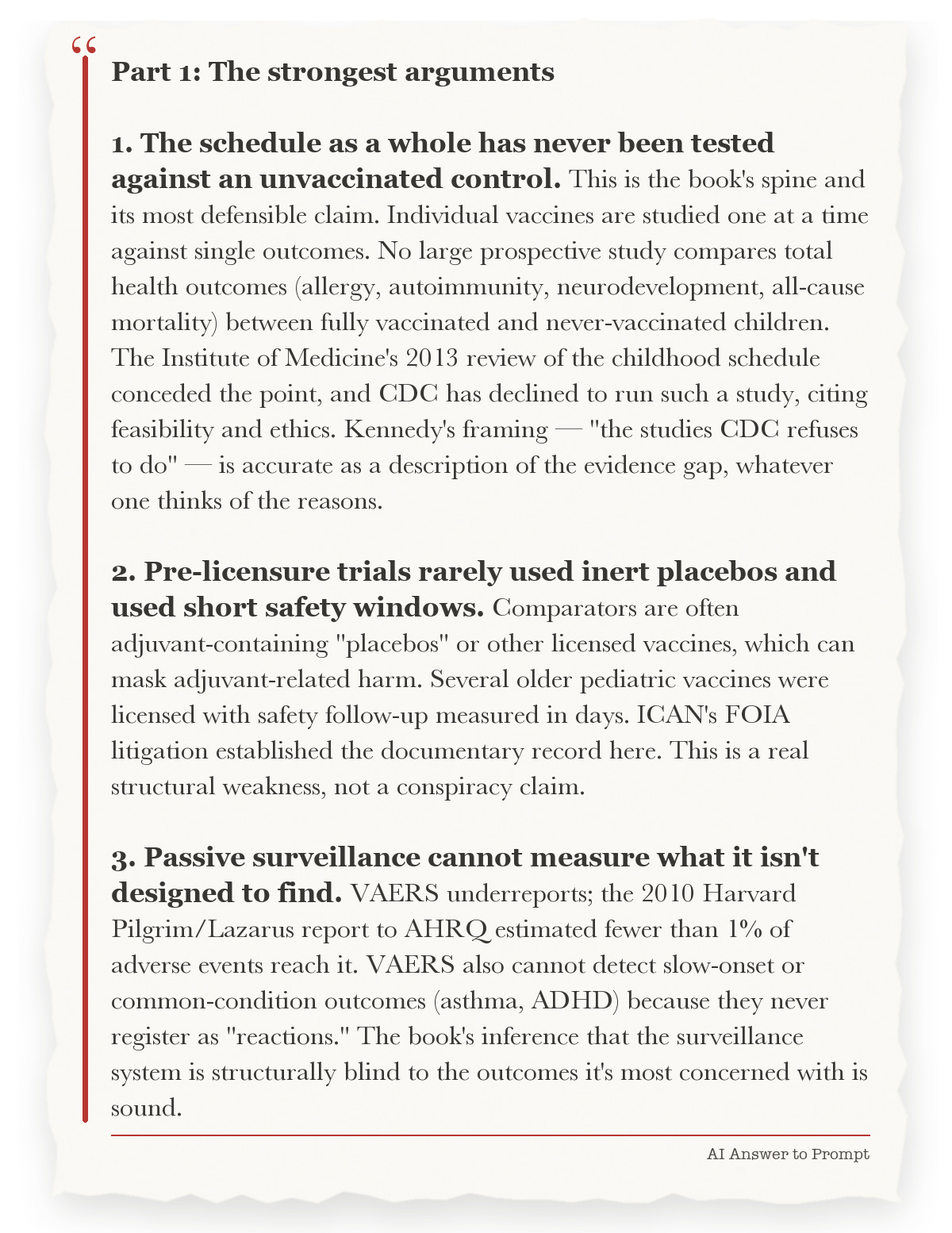
Note that prompting the question that way didn’t need ten pages of typing. It was two sentences.
Take a different example. Say you found a new preprint study that reports mRNA persistence after 18 months. Paste it in. Give it the evidence. Then neutrally prompt the AI to “find other studies, news articles, and published information that support the study author’s conclusions.” Once that’s done, and all that information is loaded into the current chat context, then you are primed to start asking the hard questions.
It’s all about the context. And unlike all the software voodoo the developers have piled on top of the poor model, you, the user, ultimately control the context.
In Jeffrey’s defense, this is not intuitive. I only developed the system because I’m used to cross-examining hostile expert witnesses. (Actually, that’s kind of how I think of AI.) Some of you may already know how to do this or have developed prompting habits that already work around it. But now you know why it works.
This took longer than I’d hoped to explain, but it is pretty simple. It might feel awkward to front-load prompts at first, but you will quickly get the hang of it. For those of us who fall on the side of hot-button topics that AI is predisposed to wave off as conspiracy theories, it’s an essential technique in this Westworld of artificial intelligence.
I call my method, “How To Make The Robot Stop Quoting The First Paragraph of Wikipedia.” I am flexible on licensing arrangements.
Have a terrific Thursday! C&C will return tomorrow morning promptly and plainly, with an all-new roundup of essential news and caffeinated commentary.
Don’t race off! We cannot do it alone. Consider joining up with C&C to help move the nation’s needle and change minds. I could sure use your help getting the truth out and spreading optimism and hope, if you can: ☕ Learn How to Get Involved 🦠
How to Donate to Coffee & Covid
Twitter: jchilders98.
Truth Social: jchilders98.
MeWe: mewe.com/i/coffee_and_covid.
Telegram: t.me/coffeecovidnews
C&C Swag! www.shopcoffeeandcovid.com
Kids from all walks of life love to see an account that has their name on it, a balance, and a mind to watch it grow. There is nothing more pro capitalism, anti socialism and anti communism than a child learning to save money and become independent. It teaches them the power of money and independence. Trumps idea of setting up these accounts for American families children is a slap in the face to democrats and the DSA. It’s sheer brilliance!
✝️✝️✝️
I will sing to the LORD as long as I live;
I will sing praise to my God while I have my being.
Let my meditation be pleasing to Him;
As for me, I shall be glad in the LORD.
Let sinners be consumed from the earth
And let the wicked be no more.
Bless the LORD, O my soul.
Praise the LORD!
— Psalm 104:33-35 NAS95
✝️✝️✝️