

Good morning, C&C, it’s Monday! It’s also December’s last full week before we shoot right into Christmas on a greased sled. Then watch out, the New Year’s fireworks will fly, and before you know it: 2026. Let’s try to squeeze every last drop out of the end of the 21st Century’s first quarter. In today’s roundup: RFK’s skeptical vaccine squad starts to break through the covid censorship-industrial complex; Politico reverts to old-school journalism; House Oversight creams DC’s out-of-control police chief, who resigns before investigation into manipulated crime data is complete; the US trade deficit rockets down to lowest levels since Trump was last in office, defying experts; Journal runs a wild, long-form, excuse-laden story trying to explain why all the financial experts were wrong but Trump was right about tariffs; and jolly Christmas news either suggests doom and gloom or that Americans are a lot happier than pollsters prognosticate.
🌍 WORLD NEWS AND COMMENTARY 🌍
💉💉💉
We must have, finally, crossed over some dark, subterranean ocean, and find ourselves approaching sunrise over strange new shores. Politico ran a story this weekend bearing the awkward headline, “This vaccine adviser to RFK Jr. has some choice words for his critics.” It was less a story about vaccines, and more of a story about the end of censorship.

The story was cast as an interview with Dr. Retsef Levi, an applied mathematician who specializes in health systems management. He has a PhD from Cornell, and has been a prominent faculty member at MIT’s Sloan School of Management since 2006. During the pandemic, like many of us, Levi was initially optimistic about the vaccines and willingly took the first two jabs.
But between 2021-2023, Levi became alarmed by the data. He began to shift toward what he called “mounting evidence” of safety problems, including myocarditis as well as broader signals of other serious adverse events. In a now-famous 2023 video, he called for an immediate halt to the jabs, arguing that surveillance data showed an “unprecedented” level of harm in younger people than any traditional vaccine.
This year, RFK appointed Dr. Levi to the CDC’s new ACIP vaccine committee, causing consensus scientists to experience an anxious, woozy feeling very similar to incipient myocarditis. August headline from BioSpace:

Levi is a brilliant data expert. He’s been tasked with compiling published and unpublished covid vaccine data, and presenting options to the ACIP. His many institutional critics usually harp on the fact that he’s not a clinical doctor, kind of like how they always say if you’re not a woman, you can’t opine about abortion, or if you’re not trans, you can’t comment on the merits of bright purple eye shadow.
So you can imagine my shock and surprise to see any article about an RFK appointee popping up on conservative social media this weekend as a recommended read. For instance, Midwestern Doctor (375K followers) was similarly startled:

Reading the story, the new framing wasn’t immediately clear. Unremarkably, the article starts out by prebunking Levi’s various policy positions, pointing out his qualifications are as a math nerd —not a proper doctor— and noted that a bunch of disgruntled former FDA members recently published a hit piece against him in the prestigious New England Journal of Medicine.
But then, suddenly and unexpectedly, a miracle appeared.
The rest of the article —the longest part— was run in a “Q&A” interview style, platforming Dr. Levi and giving him ample space to answer all the critics’ objections in his own words, which is exactly the kind of opportunity that corporate media usually works fiercely to prevent, with the stubborn diligence of Ukrainian military propagandists denying missiles landing right behind them.
In other words, it shattered the unwritten corporate media censorship agreement, under which vaccine-skeptical scientists are simply not allowed to speak, lest they accidentally misinform someone somewhere. Sure, YouTube may have stopped deleting their videos, but corporate media has remained a pig-headed holdout.
Realizing Politico was actually letting Dr. Levi speak was shocking. Based on the usual corporate media playbook, I had expected to just see a series of quotes from critics, interspersed with a few of Levi’s short, out-of-context comments to make him sound crazy.
But instead, the article’s structure gave Dr. Levi adequate room to present his counter-narrative, from questioning Hep‑B birth-dose safety, alleging undisclosed myocarditis deaths, and denying the “anti-vaxxer” label, to calling for a broader, outcome‑based safety redesign of vaccine surveillance in general.
Politico’s foray into real journalism was praiseworthy, but tentative. The Q&A style was still a cop-out, a CYA device so Politico can stand back and say hey, don’t blame us, we just printed what he said. By front-loading the piece with Levi’s critics, they’ll satisfy all but the hardcore pro-censorship crowd.
But still.
This might be the first fair treatment any of RFK’s team has received in any corporate media platform. It’s too early to announce we’ve turned the corner or anything, but we are coming up on the corner fast. This kind of old-school, both-sides journalism is going to drive the pro-vaxxers bat-guano insane.
🔥🔥🔥
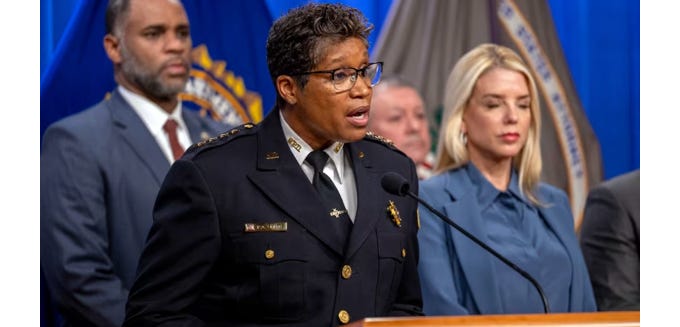
Now, I realize many of you accept official blue-state crime statistics at face value, because you assume that government-produced data must be reliable, by definition. This will be a shock. Prepare yourselves. Yesterday, CNN ran a story headlined, “House Oversight Committee report alleges DC police chief manipulated crime data.”
When President Trump first announced his D.C. law-enforcement surge in August, he correctly described the Capital as a “cesspool of crime.” This provoked a minor riot from Democrats, comparable to what happens in the DC Zoo’s chimpanzee cage after zookeepers take away their soccer balls following an unfortunate incident involving an inattentive Chinese tourist.
This summer, Democrat critics and far-left commentators repeatedly referenced official Metro DC data allegedly showing violent crime being at a 30‑year low. They argued hotly that Trump’s move was pure political theater and a disingenuous distraction from other, more important controversies, like Jeffrey Epstein, or the East Wing ballroom project.
That endlessly repeated line —“violent crime is at a 30‑year low”— became an approved talking point among national Democrats and liberal media guests who contradicted the reality on the ground.
Don’t listen to DC residents! Just look at the data!
As I reported at the time, the head of DC’s own Police Union publicly called the city’s widely reported crime decline “preposterous,” and pointed to ongoing investigations into institutional misclassifications and downgrading of reported offenses. The House Oversight Committee commenced an investigation, which had a major development yesterday when it released its report (on a Sunday!), which can be read online here.
After interviewing all the DC police commanders, the House concluded that Chief Smith is a very unprogressive bully. She “propagated an ecosystem of fear, retaliation, and toxicity,” and placed “intense pressure on district commanders to produce low crime statistics by any means necessary.” The report did not mince its words, or even grate or finely chop them:

Presumably having received a heads-up about what the report would reveal, last week Chief Smith preemptively announced she was stepping down, to spend more time with her family and teach a community college class on creative report writing.
The House report is an eye-opener. To summarize, let’s say a DC resident got carjacked and pistol-whipped, requiring six days in the hospital and nine months of physical therapy. An overworked Chief Smith would snap at commanders, “just mark it down as reckless endangerment-jaywalking,” and then race off to a DNC event to receive another award for reducing crime in the Nation’s Capital, and to drink a half-magnum of taxpayer-sponsored French champagne— all before lunch.
There are fourteen DC precincts. The House report revealed that one of the highest-crime precinct commanders told House investigators that, in nearly three years since she was appointed, Chief Smith stopped by his precinct one time. It was unannounced, and she couldn’t even stay till he got back from a call.
Despite the damning report, which describes a totally dysfunctional department where senior commanders can be transferred to managing the evidence locker after a single crime report Chief Smith didn’t like, and despite Chief Smith’s anticipatory getting out of Dodge, CNN still hard-headedly clutched onto the “crime is down” narrative:

The “data” in that paragraph was the same “data” that the House Oversight report stated in its title was inaccurate. Oh well. The House investigation continues … but Chief Smith doesn’t. Bye, Felicia!
📉 📉 📉
In another quiet story you probably didn’t hear about from corporate media, late last week the Wall Street Journal ran an article headlined, “U.S. Trade Deficit Falls to Five-Year Low.” It’s working.
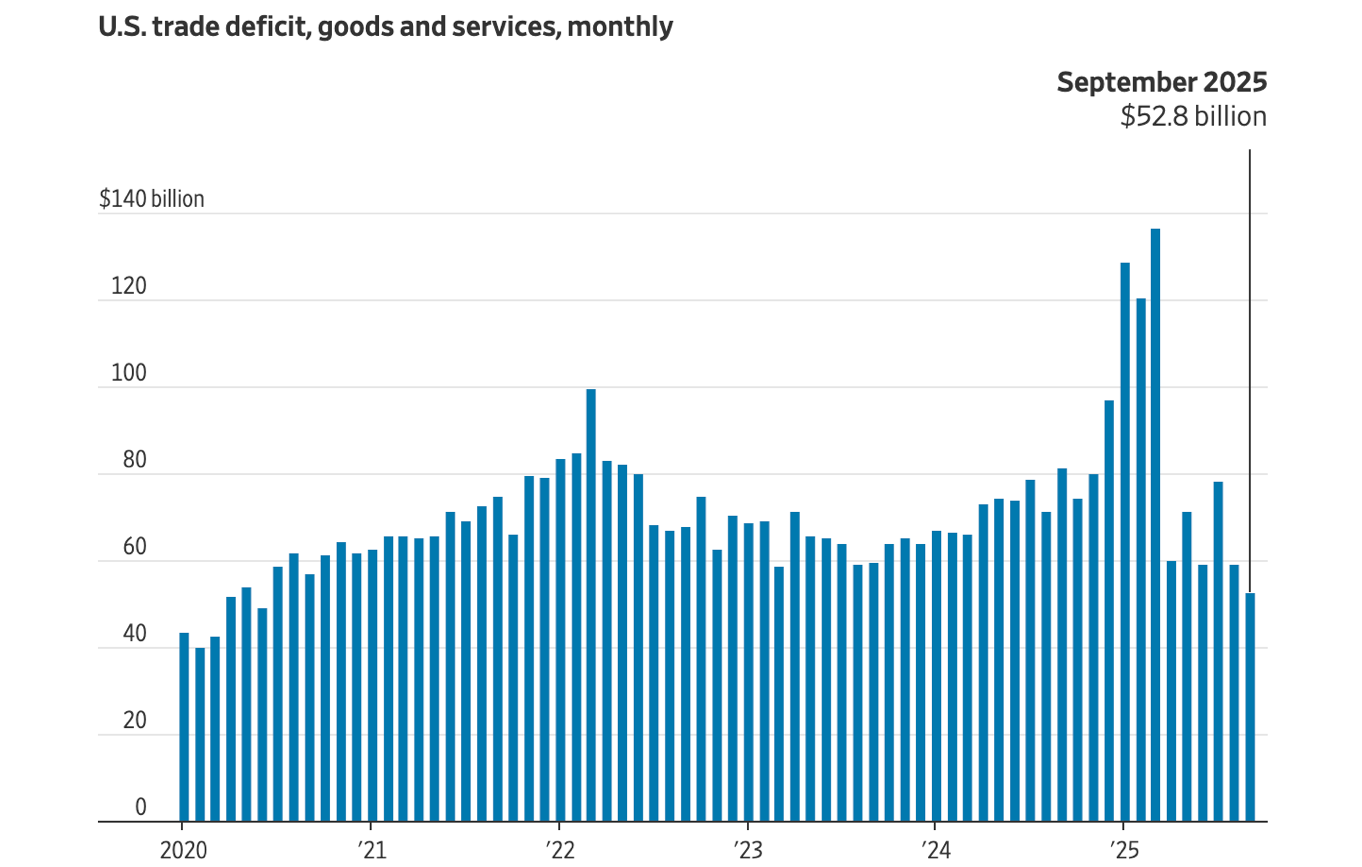
In September —the most recent reported month— American exports rose to $289.3 billion, while imports also increased, though more modestly, to $342.1 billion, netting a trade deficit of only $52.8 billion— the lowest in five years, and reversing a Biden-era deficit balloon.
The key was increasing exports. Meaning, we’re starting to sell more stuff into overseas markets. This amazing, terrific news was nearly completely ignored in the story.
Trump’s dealmaking caused other countries to lower their import tariffs, thereby boosting our exports. And his tariffs on incoming foreign goods did not prevent imports from slightly increasing. So the tariffs have not, in fact, created a global trade catastrophe, despite all the sober warnings from economic “experts.”
Not only that, but the previous low deficits from five years ago were recorded during the “supply chain crisis” of the early pandemic— inarguably unhealthy. Check this out— in pre-pandemic September 2019, Trump’s last normal year in office, the deficit was humming at $52.5 billion.
In other words, we’ve now beaten our way back to pre-pandemic levels— but with Trump’s far more favorable tariff regime. And with more exports. America is back; we are reopened for business.
📈 In related news, this morning the Wall Street Journal ran a long-form, multi-media style, infographics-packed article headlined, “Why Everyone Got Trump’s Tariffs Wrong.” What do I always tell you about headlines teasing an answer to a baffling problem? Here’s the simple version: Trump was right, and all the experts were wrong. Period.
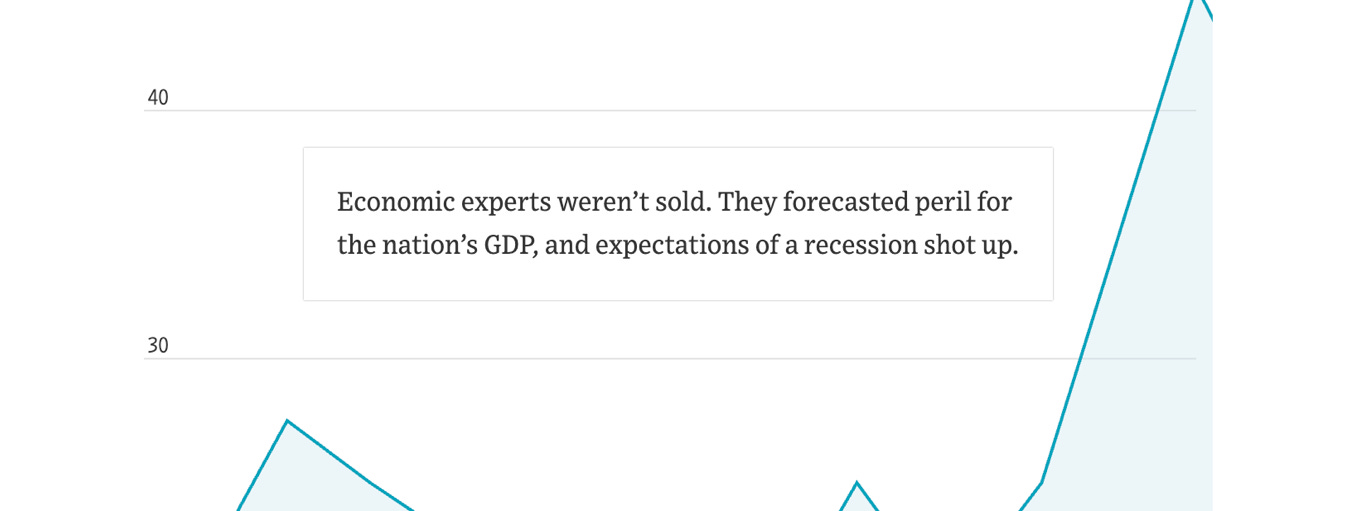
“In the days following ‘Liberation Day,’” the Journal began, “the contrast between Trump’s optimism and more dire predictions from trade experts and economists was stark.”
The Journal framed it as a story of two narratives. On one hand, President Trump promised revival: “The markets are going to boom, the stock market is going to boom, the country is going to boom,” he said. Not if the media has anything to do with it.
“Economists and business leaders,” the Journal said, “dialed up predictions of a fallout.” That’s one way to put it. They practically said we should just hang it all up and lie down. The story quoted Blackrock’s CEO Larry “The” Fink, who said, “Most CEOs I talk to would probably say we’re in a recession right now.” He didn’t say which CEOs, and useless media didn’t ask.
JPMorgan Chase —under investigation for facilitating Epstein— was even more relentlessly pessimistic about Trump’s tariffs. At the time, it gloomily warned its investors that an even more disastrous “global recession is likely.”
But … it didn’t happen. The baffled Journal marveled, “An economic collapse hasn’t materialized. Neither has an economic revival.” See? It’s nobody’s fault. Let us count all the ways the experts were wrong, in the Journal’s own words.
Firstly, fears of a recession are receding into the robotaxi’s rearview mirror. “The odds of a recession in the coming year have fallen below 25%,” the Journal said.
Second, the Journal sneered at Trump’s promises of reindustrialization. But where are all the promised jobs? Oh! Here they are: “The U.S. added +119,000 jobs in September, far more than economists had expected,” the story conceded. But that’s only one month! Yes, but “Economists don’t rule out tariffs leading to more hiring down the road,” it continued, stingily adding that “the picture is complex.” It’s so complicated! So don’t blame us for getting it wrong over and over!
Third, the Journal devoted four paragraphs and an animated chart to predicting that the tariffs would sooner or later spike prices for US consumer goods. Unaffordable! But so far, “the worst inflation fears haven’t come to pass,” the Journal was forced to admit.
Fourth, economists sneered that Trump could possibly raise any meaningful amount of money through tariffs. They laughed so hard their oat milk streamed from their nostrils. But again, wrong. “The administration scores points on this one,” the Journal reluctantly allowed. “Tariffs have raised significant revenue.” But it hasn’t replaced the income tax! True, not yet.
Fifth, the experts predicted that Trump’s crazy, unpredictable tariff regimes would catastrophically tank the economy. But, not so much: “GDP in the second quarter reached its strongest quarterly growth in nearly two years: a seasonally and inflation-adjusted annual rate of +3.8%.”
On nearly every measure, President Trump’s predictions were either correct or just haven’t been proven out yet (but are headed in the right direction). Similarly, on nearly every measure, the experts have been proven wrong. As usual, the article never straightforwardly answered the question posed by the original headline: “why everyone got Trump’s tariffs wrong.”
The Journal’s only answer: It’s complicated. Then, what do we need experts for?
Or how about this: maybe it’s not complicated. The media couldn’t conceive of any big Trump idea working, and did everything it could to make sure tariffs didn’t —couldn’t— work. It was Trump vs. all the experts. But the experts still lost. TAW.
🔥 🔥 🔥
Corporate media describes America as downright depressed and too broke to even buy a sock-darning kit to fix the holes in our footwear. But yesterday, the Wall Street Journal ran an encouraging story headlined, “Why Christmas Music Is More Popular Than Ever.” The sub-headline added the jolly news, “One music manager described a holiday hit as a ‘little ATM machine.’”

Just how merry is America? If you ask Democrats, we are practically in the Great Depression II, where students must Uber nineteen miles to school in a frigid blizzard, and even though their school is only a mile away. (Because of the terrible economy, they must ride back and forth eight times, each way.)
But if you ask the popular a capella Christmas band Pentatonix, you’ll get a different answer. This year, the group considered moving their annual holiday concert schedule up some. One member suggested starting the holiday tour as early as November 8th. “We’re like, ‘well, we don’t know if somebody in Utah is going to want to purchase a ticket for a Christmas concert on Nov. 8, but let’s try it,’” said Sara Baczewski, a relentless optimist who co-manages the group.
Guess what? Even starting so early, the 26-date arena tour has been going “super well,” Sara said. “The world is really looking for this,” she added. That remarkable accomplishment defies the obvious fact that, as the Journal drily noted, “a capella music is not usually commercially successful.”
Americans seem even more jovial this year than before the pandemic. On December 1st, 2019, 14 of Spotify’s top 50 US singles were holiday songs. On the same date this year, the tally was already up to 30. By the 10th, 20 of Spotify’s top 25 tracks were Christmas-themed. It’s another covid miracle.
Even the ’90s band Weezer is thinking of making a new Christmas album. The Journal raced to take credit in the most Scroogelike manner imaginable. The logic, if you can call it that, is that the constant deluge of bad news in the media makes people yearn for simpler, more sentimental fare like comforting holiday music.
Or, it could be that we’re all just feeling a whole lot happier, despite what the polls tell us we’re supposed to feel. Now, where’s my Christmas playlist?
Have a magnificent Monday! Sled back here tomorrow morning, for a fresh, hot cup of seasonal coffee and a brand-new roundup of essential news and snarktastic commentary.
Don’t race off! We cannot do it alone. Consider joining up with C&C to help move the nation’s needle and change minds. I could sure use your help getting the truth out and spreading optimism and hope, if you can: ☕ Learn How to Get Involved 🦠
How to Donate to Coffee & Covid
Twitter: jchilders98.
Truth Social: jchilders98.
MeWe: mewe.com/i/coffee_and_covid.
Telegram: t.me/coffeecovidnews
C&C Swag! www.shopcoffeeandcovid.com
"Outside of Christ, I am only a sinner, but in Christ, I am saved. Outside of Christ, I am empty; in Christ, I am full. Outside of Christ, I am weak; in Christ, I am strong. Outside of Christ, I cannot; in Christ, I am more than able. Outside of Christ, I have been defeated; in Christ, I am already victorious. How meaningful are the words, "in Christ." —Watchman Nee
✝️✝️✝️
For we know Him who said, “Vengeance is Mine, I will repay.” And again, “The Lord will judge His people.” It is a terrifying thing to fall into the hands of the living God.
— Hebrews 10:30-31 LSB
✝️✝️✝️