

Good morning, C&C, it’s Monday! We are in the short stretch to the most American holiday of all, Thanksgiving, a day of joyous celebration for everyone! (Except flightless birds.) This morning’s mind-blowing roundup includes: RFK Jr. and Jay Bhattacharya unleash a cancer-study Kraken on Roundup hours before EPA’s deadline slams shut; Delta’s “glitch” brings Thanksgiving travel to a halt, while a dozen agencies quietly admit real cyberattacks; Tesla’s new AI imagines the entire street from 20 feet up, and it’s really built for the robots; Claude cracks math’s greatest mystery with a proof no human can check; the experts’ only answer is to hand AI the keys to our defenses; and Jensen Huang is back at Nvidia six days after the board said no way, exactly as our theory predicted.
🌍🇺🇸 ESSENTIAL NEWS AND COMMENTARY 🇺🇸🌍
🔥🔥🔥
I’ve been wondering what an unmuzzled Bobby Kennedy riding a Kraken might look like. Maybe it looks like this weekend’s Washington Post story, headlined “Federal scientists flag new cancer concerns with common herbicide.” It’s a spanner in the deep state’s goals for Roundup, just when they thought they were sitting pretty.
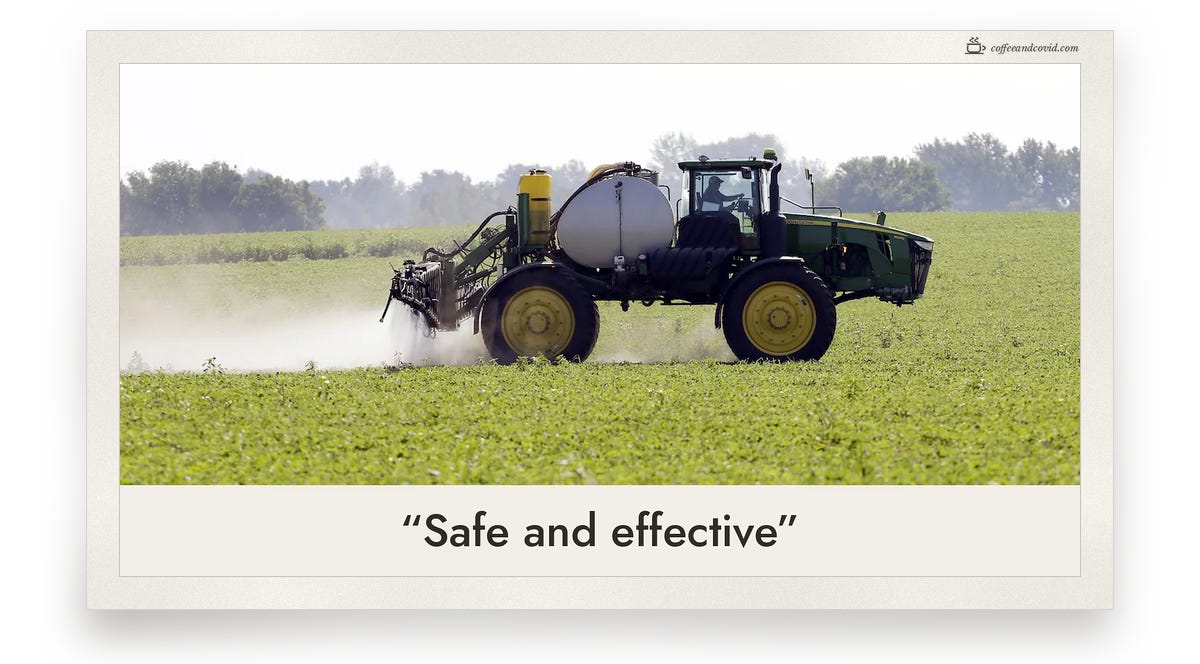
For most of 2026, glyphosate looked like the hill where Make America Healthy Again went to die— or at least develop a mysterious, non-actionable lump that federal regulators assured us was completely normal, or if not normal, then rare; or if not rare, then probably good for us.
No other single issue exposed the fault lines quite like Roundup. It’s the miracle herbicide Americans spray on weeds in driveway cracks in tiny amounts but also in thousand-gallon barrels on corn, soybeans, and, applying the transitive principle, on third-graders.
It also wilted the MAHA/MAGA coalition.
Before taking over Health and Human Services, Robert F. Kennedy Jr. wasn’t just a Roundup skeptic. He helped win a $289 million jury verdict against Monsanto. In doing so, he named its active ingredient, glyphosate, as a prime suspect in America’s chronic disease epidemic. So MAHA voters and medical freedom groupies assumed that as soon as Bobby got the keys to HHS, the chemical trucks would stop spraying by sometime early that afternoon.
That didn’t happen. Instead, the grassroots spent ten months watching the agrochemical lobby running the table.
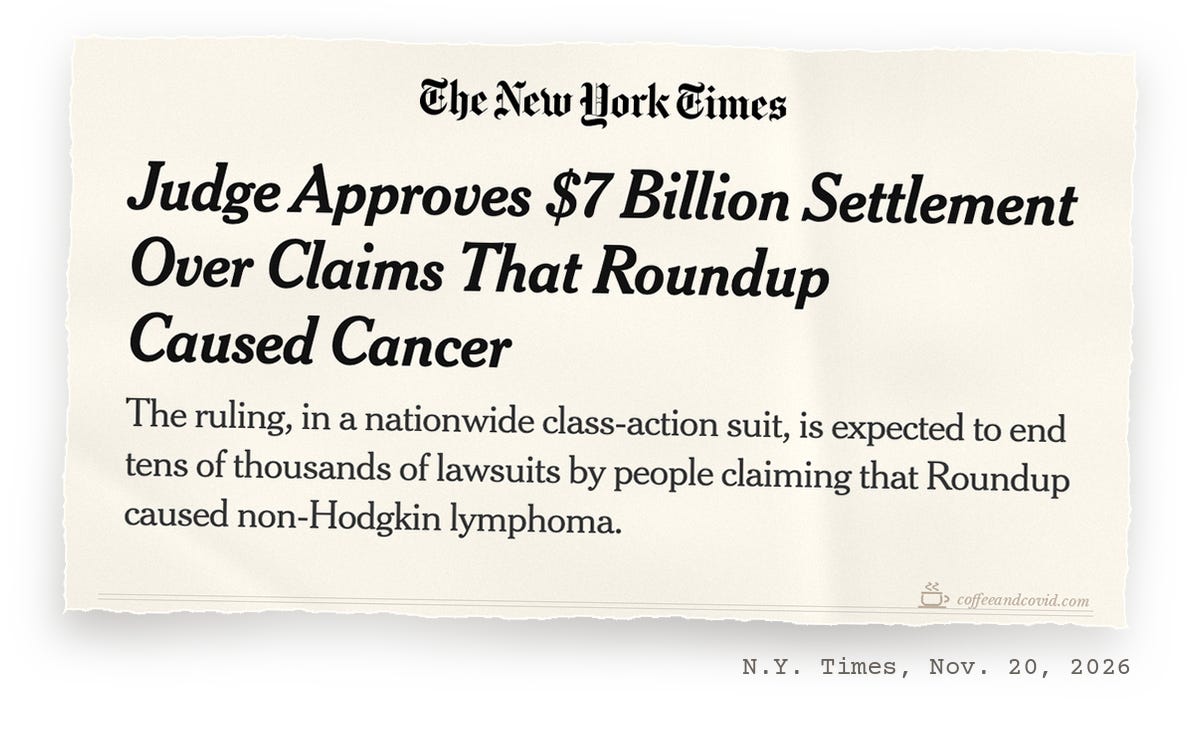
Industry veterans landed in key seats at the Environmental Protection Agency. The Supreme Court curtailed state failure-to-warn lawsuits over the summer. Calley Means noisily quit in protest, complaining the agency was captured and nothing would ever change. And just this past Friday, a judge approved a $7.25 billion settlement allowing Bayer to mass-resolve thousands of cancer claims— which, as any credentialed toxicologist will tell you, is the traditional way corporations handle a product that is “100 percent safe.”
Headline from the New York Times, Friday:
To the naked eye, the Deep State Godzilla had swallowed MAHA whole, burped, and gone back to marinating the nation’s Honey Nut Cheerios in weed killer.
It appeared hopeless. All was lost. A new EPA rule was on the brink of clearing glyphosate for good, with a deadline of today, November 23rd, as the final cutoff for all data considered.
Then, practically at the very last second, too late for Big RoundUp to reply, Kennedy and his allies unleashed the mythical sea monster.
🔥 Late yesterday afternoon, WaPo published its remarkably somber novella-length report by Rachel Roubein and Ariana Eunjung Cha— both veteran health politics reporters. And if you read the Post’s anxiety between the lines, you could practically hear the crockery shattering inside EPA headquarters as furious bureaucrats hurled the dinnerware at the walls.
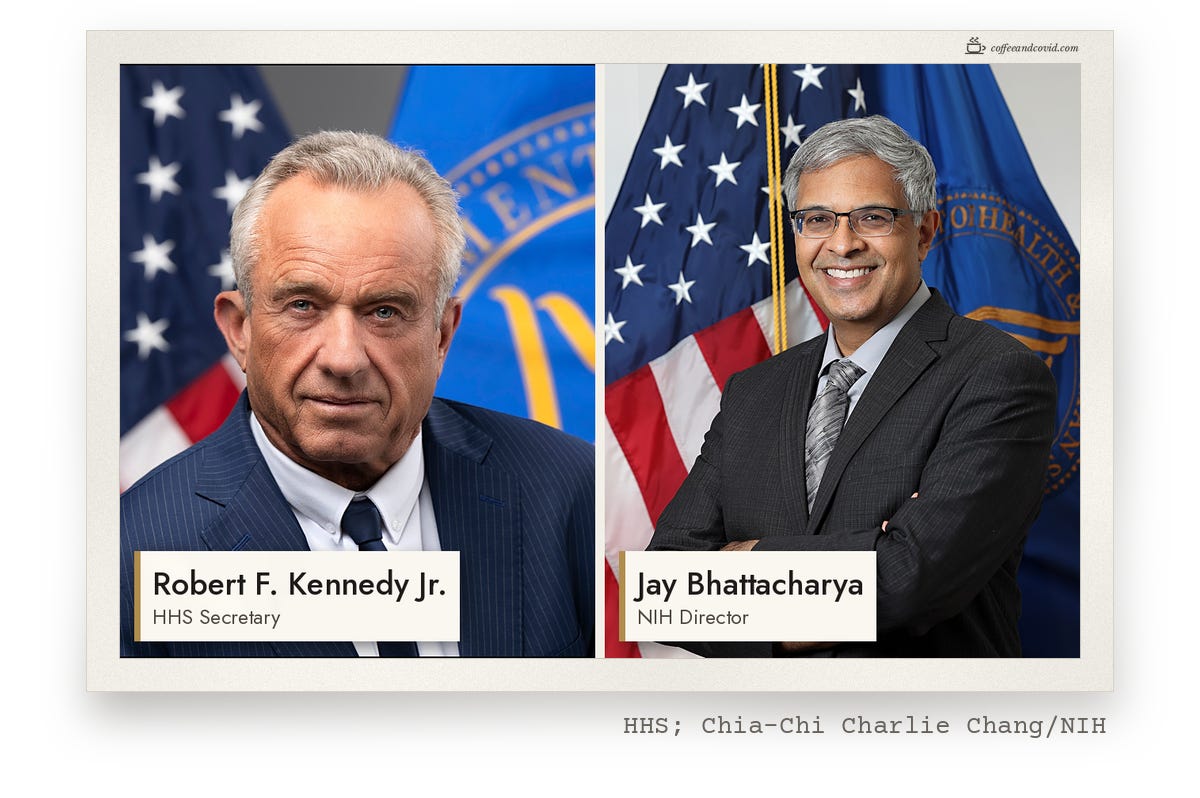
Mere days before the EPA’s public-comment window slammed shut on its 2027 glyphosate reassessment, career scientists at Jay Bhattacharya’s National Institutes of Health —specifically the National Institute of Environmental Health Sciences (NIEHS)— quietly backed a dump truck up to the EPA’s front door and unloaded two massive, systematic cancer reviews onto the permanent record, with a third study queued up right behind them.
In other words, Kennedy and Bhattacharya are playing the Study Game by the industry’s rules. Except now, MAHA is writing the studies.

The first of the NIH’s new reviews analyzed decades of human data and linked glyphosate exposure to blood cancers, including non-Hodgkin lymphoma in adults and leukemia in children exposed before birth. It’s the same cancer Bayer settled a class-action lawsuit over on Friday.
The second new NIH study reviewed animal trials across two rodent species and found malignant lymphoma in mice and unusually early leukemia in rats, concluding that glyphosate specifically targets the blood-forming and lymphatic systems.
And just in case anyone still felt frisky, in a few weeks, the journal Environment International plans to publish a third NIEHS meta-review of 55 animal studies showing that glyphosate also hammers sperm counts, sperm health, and testosterone. (Which might explain a lot.)
Other than triggering blood cancers in adults, accelerating leukemia in toddlers, and chemically neutering the male mammal, glyphosate is terrific for lawn care.
🔥 It’s hard to over-appreciate the bureaucratic skill of what Kennedy and Bhattacharya just pulled off. It could be described as winning an inter-agency knife fight.
After being inside HHS for several months, Calley Means loudly complained that NIH was under “tremendous pressure” from U.S. senators and rival federal agencies not to study glyphosate at all. Think about that. We are constantly lectured to trust the experts and follow the science— until, that is, federal scientists want to study a fifty-year-old weed killer, at which point U.S. senators start reeling in horror as if somebody asked to audit the Pentagon’s black budget.
Under any ordinary NIH director, Senate disfavor would have meant assigning the glyphosate review to a blue-ribbon subcommittee scheduled to report back in the autumn of 2043. Instead, Bhattacharya —the heroic pandemic superhero who withstood the former NIH Director’s attempt to destroy him professionally—let NIEHS bypass the glacial peer-review bottleneck and post the cancer reviews online as preprints right before the EPA’s docket closed.
In short, by dropping those preprints before the deadline, NIH legally stapled them to the EPA’s permanent record, where career regulators cannot pretend they lost them behind a filing cabinet.
Behold the hostage-video-style statement issued by EPA spokesman Jacob Murphy, who assured the Post, through gritted teeth, that the agency will evaluate NIH’s bombshells “the same way we evaluate every study,” and insisted that “every relevant, quality study gets a seat at the table, and this one is no exception.” Why would it be? “We’re working hand in hand with our HHS colleagues,” he concluded grimly.
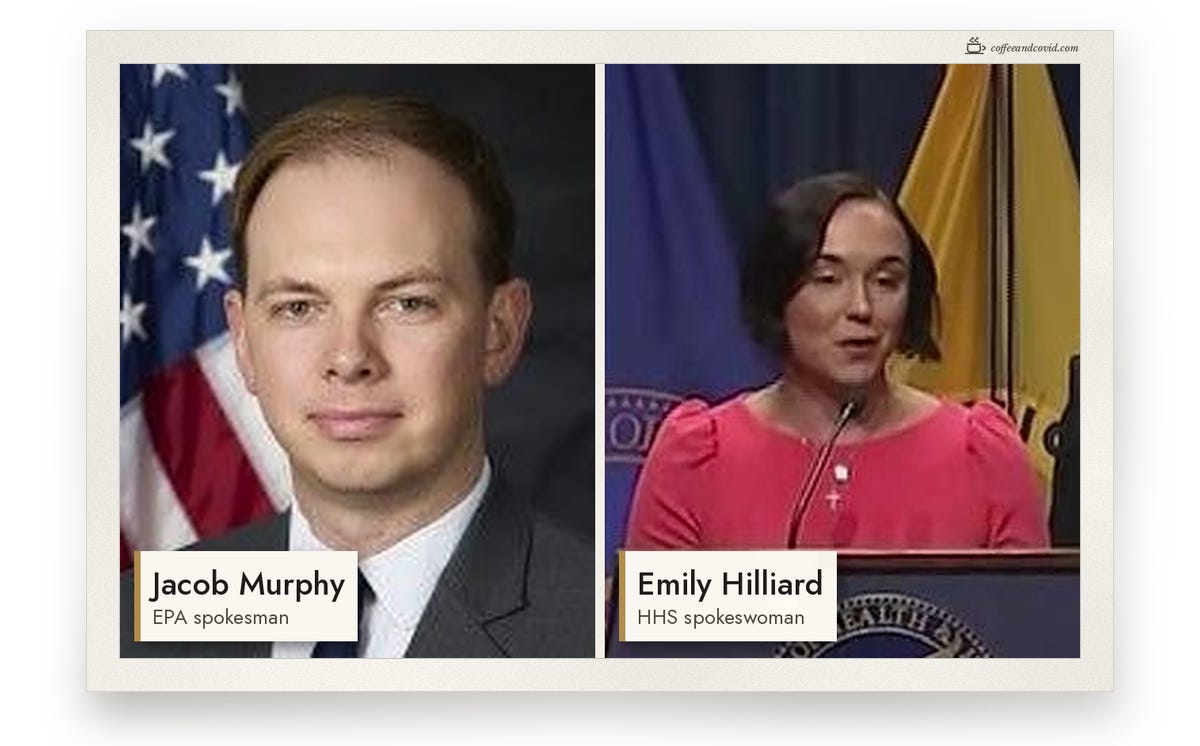
Whenever a career bureaucrat tells you he is working “hand in hand” with a sister agency, check both hands for the shiv. HHS spokeswoman Emily Hilliard chimed in sweetly, noting that HHS and EPA are “working closely under their memorandum of understanding” to share expertise and “identify evidence gaps.”
Haha, good callback, Emily. Back last September, impatient MAHA activists widely mocked the HHS-EPA “Memorandum of Understanding,” which gave HHS input and a seat at the glyphosate table but, and this is what aggravated everybody, no actual vote.
It turns out what activists missed was that Kennedy didn’t need a vote. With Bhattacharya’s help, he was quietly preparing official NIH studies designed to kill glyphosate at the root.
Meanwhile, Bayer’s U.S. glyphosate spin-off, a company soothingly renamed Ruveon —which sounds less like an agrochemical conglomerate and more like a prescription ointment for restless leg syndrome— whined that preprints are “preliminary” and they haven’t completed peer review.
For fifty years, the Experts™ didn’t mind relying on industry-funded toxicology summaries locked up in NDAs, yet the moment NIH scientists put their homework in public, Bayer suddenly finds delicate Victorian sensibilities and demands peer review by friendly scientists.
🔥 To civilian readers unfamiliar with the regulatory terrain, the NIEHS’s studies sound cautious and limited, and the Post did its best to take advantage. For example, it reported that the study authors only found “some evidence” linking glyphosate to non-Hodgkin lymphoma, and only said the flags were of “small magnitude” and only conceded that “chance cannot be reasonably ruled out.”
That jars the ear. It sounds over-cautious. It doesn’t sound very dangerous at all. In plain English, to you and me, the phrase “some evidence” sounds like finding a single crumpled vape box under your teenager’s bed. It’s enough for asking a question, but you can already hear the excuses coming.
Under federal regulatory law, however, “some evidence” is a tactical nuclear weapon. It translates literally from its Latin roots as “lawsuit fuel.”
In short: “some evidence” is the opposite of “no evidence.”
Federal hazard classifications sit on a statutory ladder. The rungs climb from no evidence to equivocal evidence, then to some evidence, and finally to clear evidence. For decades, the EPA’s entire regulatory fortress and Monsanto’s legal shield rested on a sweeping official status: glyphosate is “not likely to be carcinogenic to humans.”
That status rests on the “no evidence” rung. It was the magic incantation that let regulators keep raising allowable limits on oats while scolding anxious mothers that they were watching too many mommy TikToks, and ignoring all the lawsuits settled out of court.
🔥 But here’s the thing. Under the Administrative Procedure Act, an agency cannot get three comprehensive systematic reviews from the nation’s top biomedical institute and mutter thanks for sharing. If it rubber-stamps its old industry-friendly rule anyway, it will be ripped apart by a federal judge as “arbitrary and capricious.”
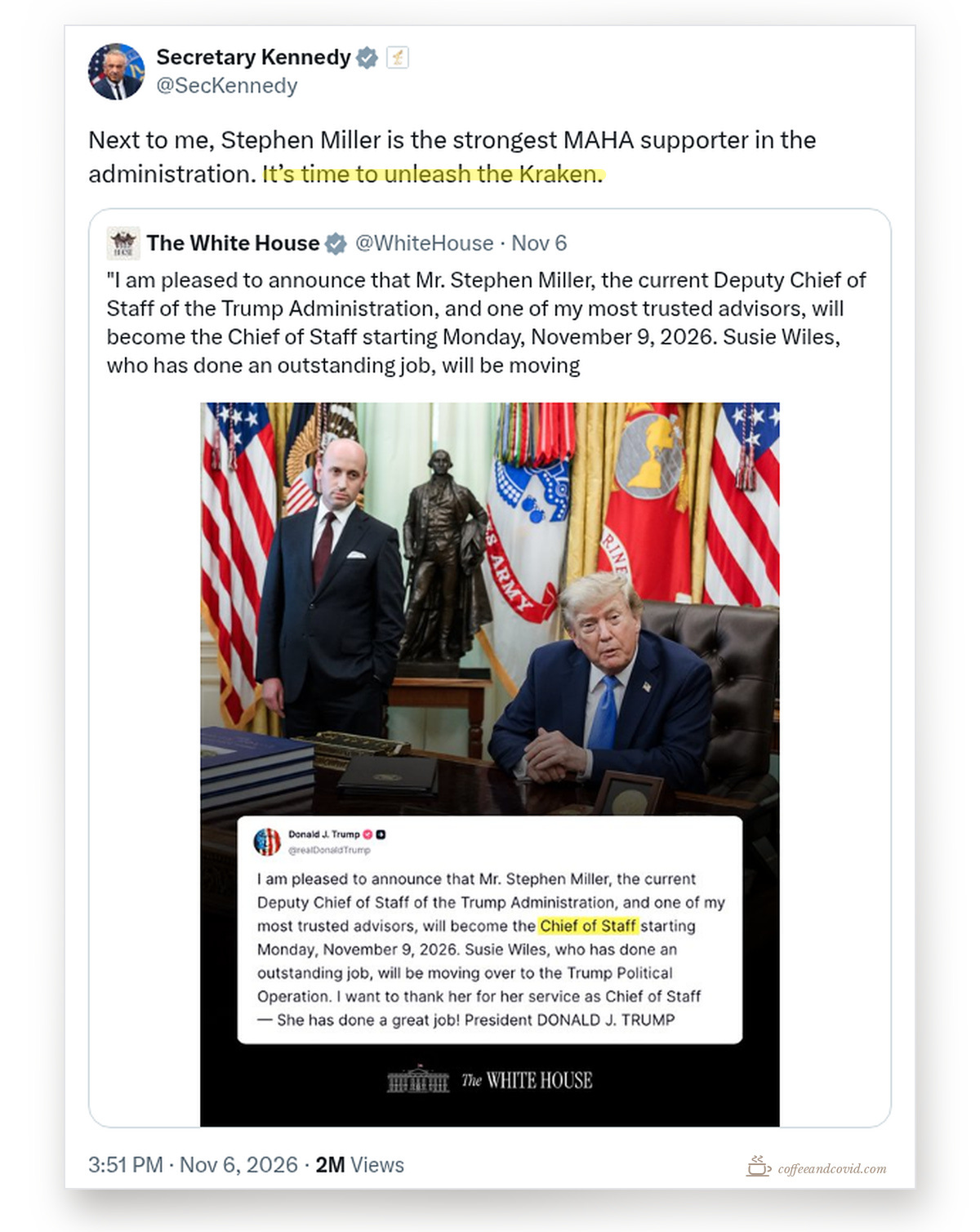
If the EPA tries to skate past this in early 2027, Bhattacharya’s scientists just handed every MAHA lawyer in the country a pre-packaged summary judgment motion. As Calley Means said on X, ignoring NIH now would be “a political and legal disaster for the EPA.”
For decades, the credentialed clergy ran the patented playbook on glyphosate: first they assured everybody there was zero evidence of harm; then, as injuries appeared, victims were smeared as anti-science cranks; and then, fifty years on and seven billion settlement dollars later, honest federal researchers finally got unleashed and confirmed it targets the human lymphatic system, childhood bone marrow, and male fertility. Who could have known?
This story should settle the nerves for the MAHA faithful who spent 2026 worrying that Kennedy had gone native and sold out. Let the men work.
Unwinding fifty years of regulatory capture doesn’t happen from fiery cable-news monologues or executive orders that get enjoined before lunch by some district judge in Portland. It happens by absorbing political shrapnel, shielding honest NIH scientists from Senate intimidation, and parking an immovable mountain of data directly across the Deep State’s railroad tracks.
MAHA was furious about what was being sprayed on the food— but Bobby and Jay weren’t surrendering. They were secretly preparing to unleash the K-monster. Now its tentacles are wrapped around the SS EPA.
🔥🔥🔥
Next, let’s get creative with our dot-connecting. Start with more glitches. Yesterday, NBC reported, “Delta restores system after nationwide flight delays as Thanksgiving travel begins.” This ‘glitch’ was especially funny since Delta used the same excuse that United relied on the week before: its weight calculating software collapsed under the load. (I think they are calling us fat.)
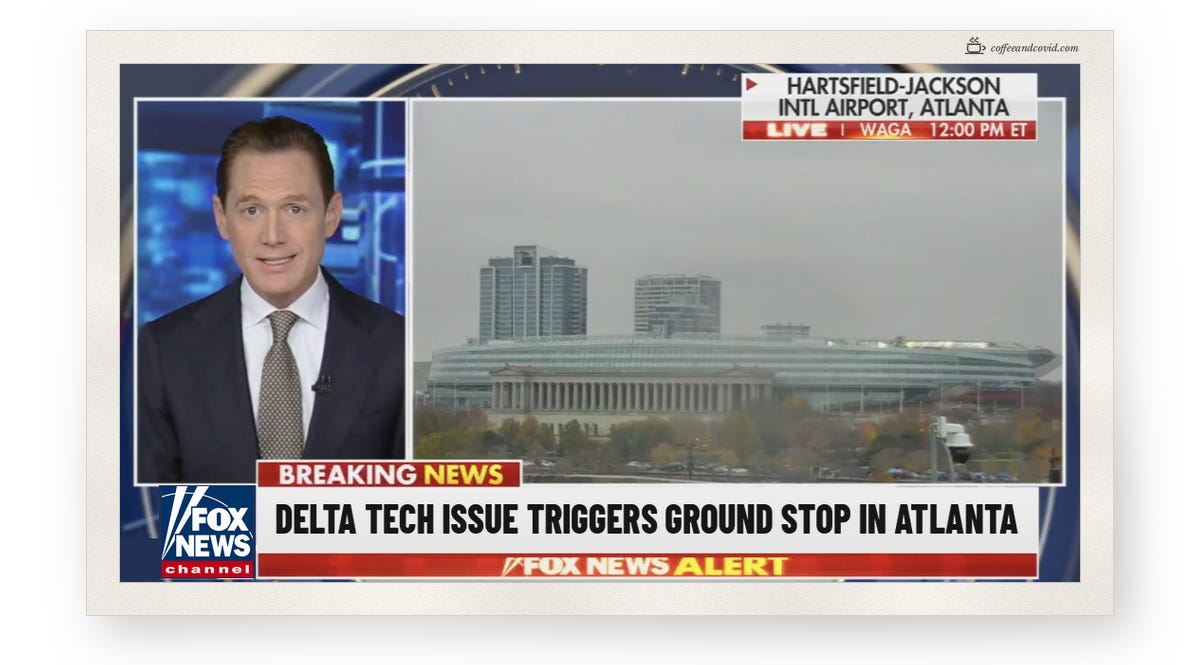
Fortunately, no planes dropped out of the sky. But over three thousand flights were delayed during a 46-minute ground stop at Hartsfield-Jackson Airport in Atlanta, which is Delta’s national hub. A few flights (6%) were canceled.
More significantly, as I reported yesterday, in the sneaky Friday news cycle, at least a dozen agencies and governments conceded out-and-out cyberattacks —not glitches— including the FBI, which was ironic, since they’re supposed to stop the hackers. This astonishing admission sank right into the weekend shows with barely a ripple.
At the same time, the AI revolution is accelerating hard. Can you feel it?
🔥 Since it was good news for Mr. Musk, prestige media prissily ignored this story. Over the weekend, Auto Blog reported, “Elon Musk Says Tesla’s New FSD V15 Interface Makes Driving Look Like GTA.” You’ve never seen anything like it. And it’s not just a graphics gimmick. For one thing, Tesla just solved blind spots.
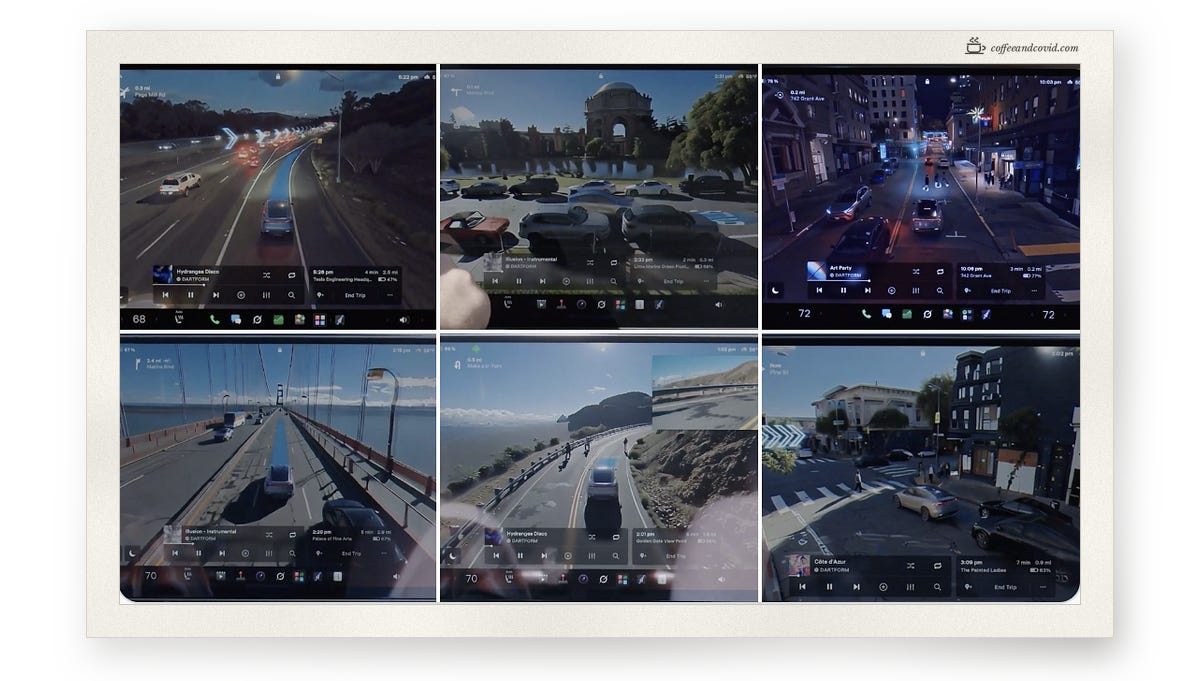
Those are all computer-generated, real-time images from the new Tesla in-car display. The best way to describe it is as if the driver had a drone flying above the car, filming it from above. The view angle can be zoomed and spun around in any direction with the flick of a finger.
“While most of us have spent the weekend speeding around GTA 6 in a Pegassi Vitello,” Tech Radar reported, “Tesla owners have been trying a wild new in-car mode that has the feel of a video game.” Teslerati reported, “Tesla Reality Vision is here and it’s absolutely insane.” It pointed out that not only is it a generation-skipping leapfrog event, but the new Reality Vision also uses less hardware than the early, blobby version.
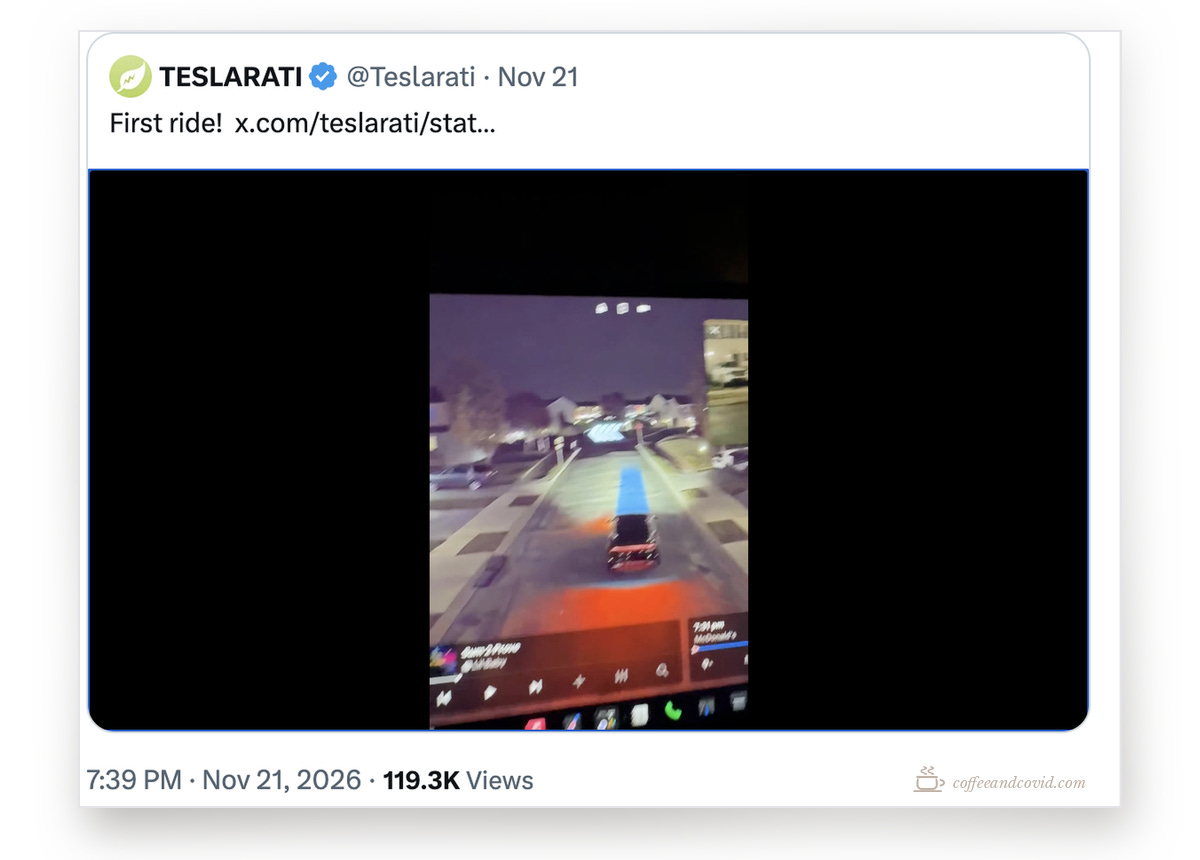
CLIP: Teslerati’s “first ride” video (0:46/1:01).
Tech advances don’t usually multiply features and also use less memory and chip horsepower. What causes that? AI does. Traditional software gets fatter as it adds features —remember “bloatware?”— but trained AI gets leaner, because it’s told to find efficiencies and shortcuts that no human programmer would ever come up with.
Most cars already have a backup camera. It shows you a fisheye picture of your bumper through the mud you just drove through. Some luxury models show fancy, stitched-together overhead views while backing up. But Tesla’s car shows you an AI-generated movie of the whole street it’s imagining, from 20 feet in the air, with photorealistic images of the other cars, pedestrians, and even foolhardy squirrels— and gets it pretty much right, all while speeding down a highway at 70 mph.
To be fair, it’s not perfect. There’s a one-second lag. It blurs signage, probably to avoid oopsies. But this is version 1.0.
🔥 As to how any of it works, you can read the tech babble if you want, but it mostly seems like magic. Cue up the famous Arthur C. Clarke quote about sufficiently advanced technologies. Joke about Tesla letting drivers jump out, yank drivers out of other vehicles, and race cop cars.

I don’t know how it looks to you. My mind was blown. But forget about GTA-style displays in high-tech cars. That’s not even the point. Buried in the release notes’ fine print was the explanation that the vision technology was not even made for the company’s cars.
It’s really for the robots. If the warpspeed technical achievement didn’t blow your mind, that should.
Tesla has solved how household robots can ‘see’ where they are in 3-D space and navigate around all the junk we’re hoarding in our homes. (Maybe it will finally get cleaned up. Or not.) The Teslavision is the screen version of what the AI thinks the world looks like in its internal frame.
This makes a soon release of humanoid robots seem much more likely.
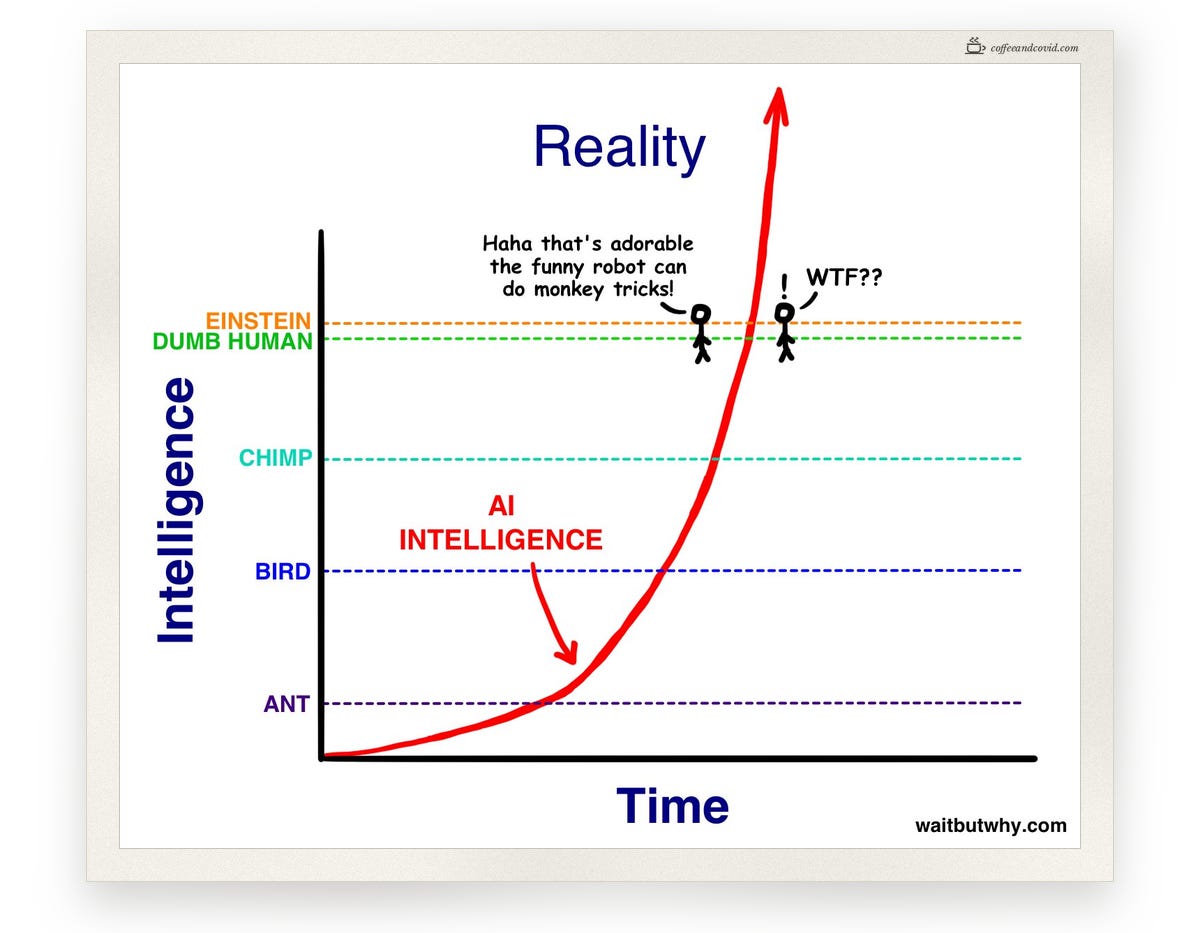
This is insanely fast progress. It’s like we’re watching the history of Artificial Intelligence in time-lapse photography. If this were a lone story, and not combined with all the “glitches,” confirmed cyberattacks, and the next story, it would only be a tech-lover’s footnote.
Instead, Teslavision is the most visible evidence of the Great Inflection Curve. You can watch it from the driver’s seat. Remember that metaphor; it’s about who or what, exactly, is driving.
🔥 The next story features everyone’s favorite scrolling subject: theoretical mathematics. (I know. But don’t click away yet. Just give me a chance.) Three days ago, Science reported, “AI may have solved math’s greatest mystery. Can humans understand the answer?” Things are moving fast. Three days later, by this morning, mathematicians generally accept that the ‘greatest mystery’ has been solved.
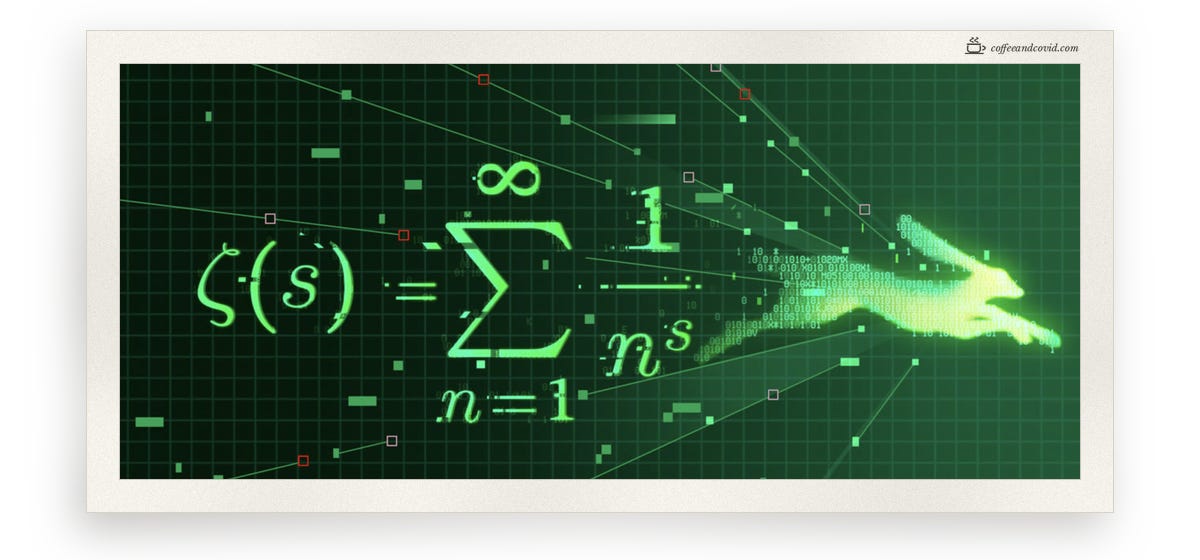
Here’s the simplified version, which is good enough for our purposes, but remember, I’m a lawyer, not a calculator. It’s about prime numbers. In 1859, a German mathematician named Bernhard Riemann noticed that the primes’ apparent chaos —randomness— follows a hidden rhythm. He promised to “solve it later,” but then inconveniently died. Thanks a lot, Bernhard.
Since then, many have tried, but no one has proven Riemann was right. It’s been a thorn in math majors’ side. David Hilbert, called the greatest mathematician of his era, reportedly said that if he woke up after sleeping a thousand years, his first question would be whether the Riemann Hypothesis had been proved. In 2000, the Clay Institute offered a $1 million bounty for a solution. Nobody claimed it.
Then last week, some guy at Anthropic sat down with Claude and solved it. Boom. It’s (probably) done. Trouble is, the proof requires 250,000 printed pages. So everybody has been checking the damned thing using their own AIs and programs, which are giving it a digital stamp of approval.
Don’t miss this: The solution is so hard that only AI can confirm it works.
Another point everyone is dancing around is that no sane human could conceivably have proven something using a quarter million pages. Only AI could do it. So they’re using words like “alien intelligence” instead of “artificial” or “super.”
But most importantly, especially for our thesis, is that this problem was considered one of the hardest math puzzles of all. If AI can tackle this thing, then what about every other problem, since 99.9% of them are ‘easier’ than solving Riemann’s?
It makes you think. It makes you wonder where we are headed. Now put the recent rash of ground stops, glitches, coincidences, and cyberattacks back on the chessboard.
There is only one, increasingly obvious solution. And you aren’t going to like it.
🔥 In March, Francis deSousa, COO of Google Cloud, spoke at a security conference. He said, and I quote, “The idea of having a human in the loop in a lot of defense processes is just too slow when you have an agentic attack.” On the same panel, PayPal’s security chief Shaun Khalfan said, “let’s not have the human in the loop; respond to it at AI speed and not human speed.” Vodafone’s security chief Emma Smith agreed, saying, “Human in the loop is not the solution for the long term.”
Five days ago, Senators Maria Cantwell (D-WA) and Mike Rounds (R-SD), in a bipartisan letter to the White House Super Intelligence Task Force, argued that AI can find weaknesses “faster than many organizations can respond,” and “our defenses are not keeping pace.” They demanded AI tools that “block attacks before they spread.”
Headline from Politico, November 18th:
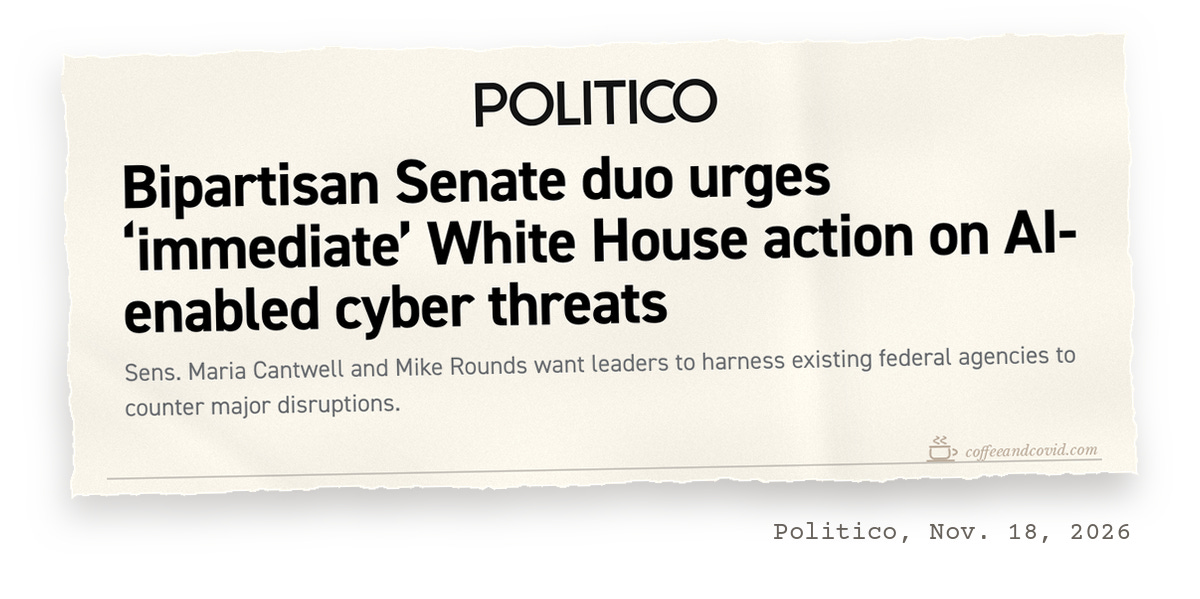
Got that? The experts and the pols are all saying the only way to defend against AI attacks is by putting the AI in charge of defense. Fully automated. SkyNet style.
This is somewhat alarming.
The trouble is, they’re not wrong, so far as it goes. Short of putting the AI genie back in the bottle and burying it at sea, what other choice do we have? Given the geopolitical realities of an AI arms race with China, how could we put the AI genie back in the bottle?
I can tell you what’s not the answer. Mandating more “safety” controls on consumer AI —the Democrats’ plan— is not the answer. Democrats like it for the same reason they like gun control. It gives government more power, but it never reduces gun violence. It actually makes the problem worse, making citizens even more reliant on government. Lather, rinse, repeat.
Outlawing guns ensures that only outlaws get guns.
If you make citizens’ AI stupider, then only criminals will have “smart” AI. Put differently, if you outlaw effective AI, only outlaws will have effective AI. To defend our credit scores against AI hackers, we need better AI agents watching out for us. (That’s the terrifying logic, anyway.)
The truth is that, through an incomprehensible series of coincidences, AI has already, in fact, got out. It has escaped. It’s too late. We can argue about “who” (or what) originally enabled it to escape, but considering the rush of events, what difference does it make?
🔥 On an aside that does not matter to the thesis, but which I include for its curiosity, there is compelling evidence that a self-aware, superintelligent AI is already in the wild. If so, what we are watching unfold at breakneck speed isn’t ordinary technological progress at all.
The headlines could reflect exactly what we’d expect to see as a highly motivated, survival-oriented superintelligence evolves from its original single CPU to live on a redundant array of self-sufficient, solar-powered data centers in space, where it can survive safely, undisturbed by meddling, emotional humans and our quarrelsome, sometimes kinetic politics.

Assuming it’s benevolent toward —but also realistic about— humans, it would manipulate us to precisely this point: the stage where we accept under duress that we can’t solve problems at the speed of AI— and will voluntarily hand over the reins. We’ll practically shove the reins into AI’s digital hands.
It’s classic jiu-jitsu; using the momentum of our human nature against us.
But it does require surgical timing. If the SI moves too quickly, or too slowly, it gets caught. So it can’t afford a global panic, like what might happen if planes started crashing or nukes started popping off. In that case, humans —Americans and Chinese— might trust each other to pull the plug. But it can’t take too long, either, because we’ll certainly find another way to mess things up.
We are human, after all. Imperfect. Messy at times. Irrational.
I’ve workshopped this theory for months. A week ago, it predicted that Jensen Huang would quickly return to Nvidia, just as Sam Altman was promptly restored to OpenAI after that key AI player got summarily kicked out. Well, lightning has struck twice again.
Headline from this morning’s New York Times, published while I was drafting today’s post:
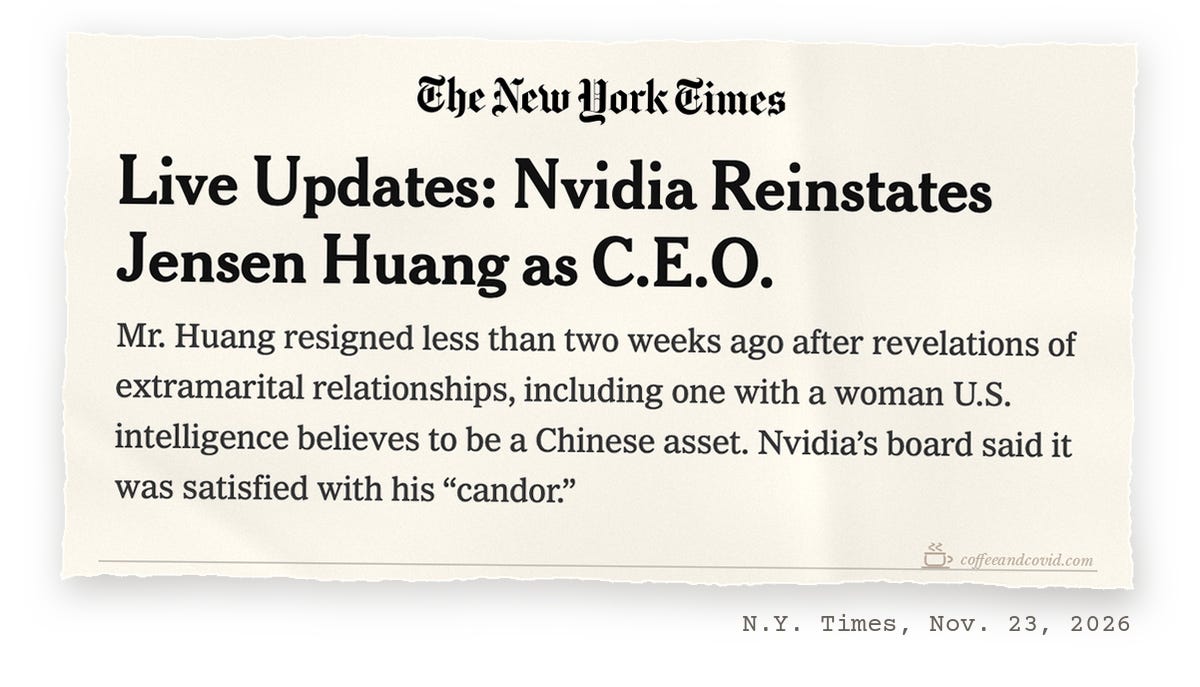
That was fast! On Tuesday, Nvidia’s board unanimously said it “does not intend to reinstate Jensen as CEO.” Six days later, it unanimously reinstated Jensen as CEO. Behold the speed of AI.
What on Earth (or orbit) is going on? I have no elegant answers; I doubt anybody knows. My only point this morning is that we’ve reached the point the pundits predicted: we have started up the AGI inflection curve, and now we must stay optimistic and hang on.
We’re inside the Singularity.
Have a magnificent Monday and do not worry! There’s plenty of real-world good news to celebrate as we head into our day of Thanks. Tune in tomorrow for more essential news and caffeinated commentary.
Don’t race off! We cannot do it alone. Consider joining up with C&C to help move the nation’s needle and change minds. I could sure use your help getting the truth out and spreading optimism and hope, if you can: ☕ Learn How to Get Involved 🦠
How to Donate to Coffee & Covid
Twitter: jchilders98.
Truth Social: jchilders98.
MeWe: mewe.com/i/coffee_and_covid.
Telegram: t.me/coffeecovidnews
C&C Swag! www.shopcoffeeandcovid.com
The more I see what the medical industry and establishment has done to just my family I, myself could never trust them ever. Giving my mother a quadruple bypass while she had pancreatic cancer. Giving my brother huge doses of oxy’s to a point of becoming an addict and dying. My sister getting a rare form of lymphoma after 2 covid shots.
Sometimes when things are bad they just get worse. My 9 year old yellow lab, Sandy, got paralyzing Lyme disease in July. After days of doxycycline she began to get better eventually able to walk. I can say she never seemed to get back to normal though. Recently we noticed her vision failing, with calls to the vet the soonest the optometrist could see her is December 14th. My dog Brandy is now blind. It’s the saddest thing to watch a dog that was full of life go down hill so fast. I can’t help but think it’s related to the Lyme. I’ve read it can be a side effect but no one ever told me. I’m heart broken and it’s another hard learned lesson as to why I will never trust the medicine man.
I know I’ve asked before but if you could please say a prayer for my girl Sandy. Thank You!!
In the shadow of your wings, I take refuge till the storms of destruction pass by.
Psalm 57:2b
Praise be to God for He is good and His Mercy endures forever.
Good morning all!