

Good morning, C&C, it’s Saturday! Time for a special edition Weekend Edition roundup: Trump’s master plan continues to clarify, and it just got astonishingly bigger— how Trump plans to defeat frenemies in Europe for ever; House Republicans torpedo the Senate’s DHS bill in spectacular fashion; the global energy crisis nobody in media is covering; Trump’s quiet takeover of the Strait of Hormuz; why AI eats more electricity than entire countries; and how all of it connects to Europe’s permanent demotion from the world stage. Peak C&C dot connecting.
🌍🇺🇸 ESSENTIAL NEWS AND COMMENTARY 🇺🇸🌍
🔥🔥🔥
“We are furious.” A political martial law match just started. Yesterday, I reported how Democrats caved on the DHS funding bill (which they did), which had omitted ICE and CBP funding, since those were already funded through 2029. It wasn’t good enough. Instead, President Trump and House Republicans launched a political offensive. Axios reported, “Johnson calls out GOP Senate over ‘joke’ of a DHS plan.” The normally mild-mannered Speaker of the House, Mike Johnson, let the Senate have it.
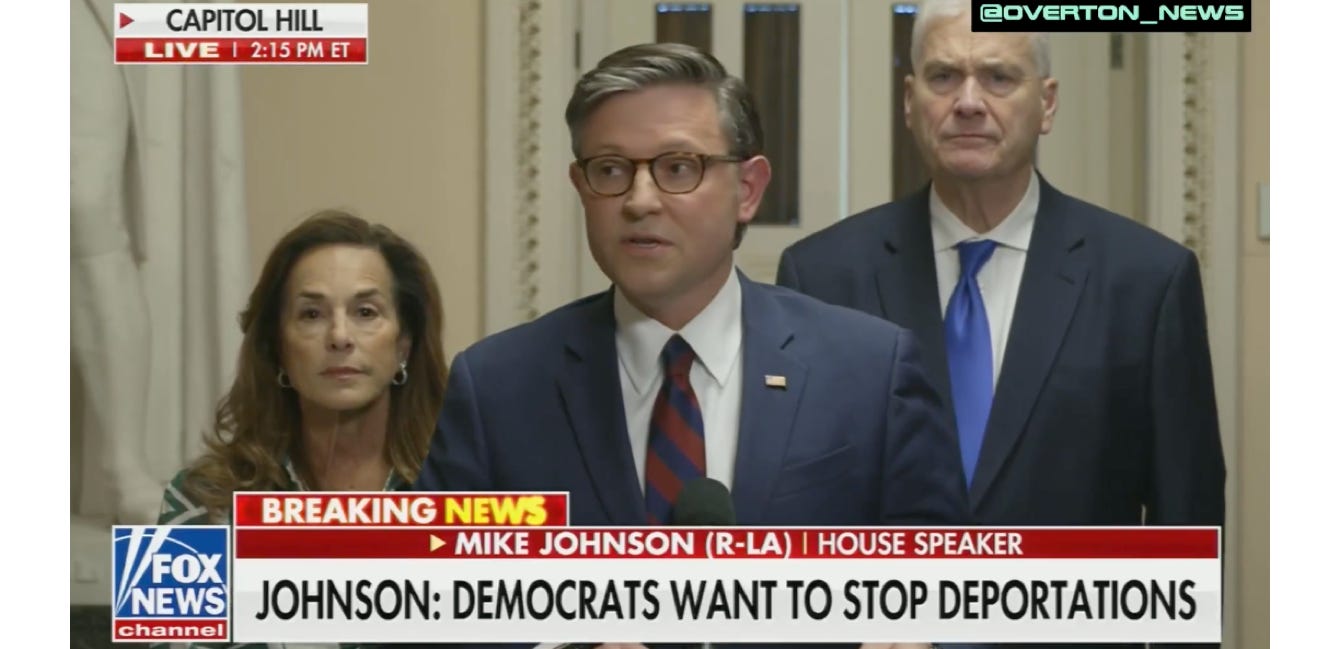
CLIP: Mike Johnson pans Senate’s funding bill and blames Democrats (9:06).
It has been a while since we’ve witnessed this kind of bare-knuckled political jiu jitsu. Just wait till I pull it all together for you. Let’s start with Johnson’s press conference yesterday afternoon. It might be a slight exaggeration —but only a slight one— to say Speaker Johnson dramatically threw the Senate’s compromise bill back in their faces. It was peak Johnson drama. Which means on an outrage scale from 1-5, he surged from his normal setting, 1.0, all the way up to 1.4.
But his message was crystal clear. In short: take this bill and bleach bit it.
You could tell the Speaker was furious because his eyebrows rose slightly. “The Senate Democrats have foisted on this appropriations process their radical, crazy agenda,” Johnson began, with more than ordinary force (for him). He might have even tapped the podium. “We call it crazy, because that’s what it is!”
“This gambit that was done last night is a joke,” Johnson stressed, holding up the Senate compromise bill. “It can’t be that every Senate Republican read the language of this bill,” he added, visibly annoyed (though it’s hard to tell with Speaker Johnson; it could also have been frustration or possibly angst). Then he read aloud the section excluding ICE and CBP from the budget (“zero dollars”).
He looked back up at the assembled reporters. “We are not doing that,” Johnson vowed sternly. “Under no circumstances are House Republicans going to be part of anything that defunds border security and immigration enforcement or reopens our border.”
“A lot of frustrations,” Representative Byron Donalds (R-FL) agreed, in comments to the Wall Street Journal. He called the Senate’s bill, and I quote, a “turd sandwich.” Representative Chip Roy (R-TX) called it “absolutely disgusting,” which is pretty much the same thing.

🔥 The President and the House are playing chess. The Senate is playing Chutes and Ladders. Trump and House Republicans know full well that immigration enforcement is a solid 80-20 issue, maybe the best one of all, and which propelled the GOP’s 2024 victory. The Democrats had caved, true, but not deeply enough.
Johnson obviously isn’t planning to let them off the hook that easily.
“These people want open borders, and they want criminal illegal aliens in the country,” Speaker Johnson said, leaning into the politics. “They want to literally defund —give zero dollars— to enforcing federal immigration law and keeping the border secure.” He shook his head in quiet rage. “That was the biggest issue in the 2024 election,” the Speaker reminded reporters, who were the only ones who needed reminding.
Note that Speaker Johnson carefully did not blame Senate Republicans. “I wouldn’t call (Senate Majority Leader) John Thune the engineer of this,” he shot back at a reporter who asked whether Senate Republicans caused the crisis. He once again blamed Senate Democrats. “Chuck Schumer and the Democrats in the Senate have forced this upon the Senate. I have to protect the House and the American people. This is not a game.”
Johnson knows that Democrats hold a losing hand. People were shocked and appalled by the long lines at American airports last weekend, where some innocent travelers watched their children grow up and graduate college while they waited to get through security, and other travelers’ emotional support animals started needing their own emotional support animals.
And Johnson knows that Americans welcomed ICE into airports to help relieve the congestion.
Trump knows that, too. The whole thing was coordinated; Johnson told a reporter he’d just spoken with the President. Since the House was rejecting the Senate’s bill, President Trump activated his backup plan. He signed the executive order that he’d warned Democrats about. Wall Street Journal, late last night:
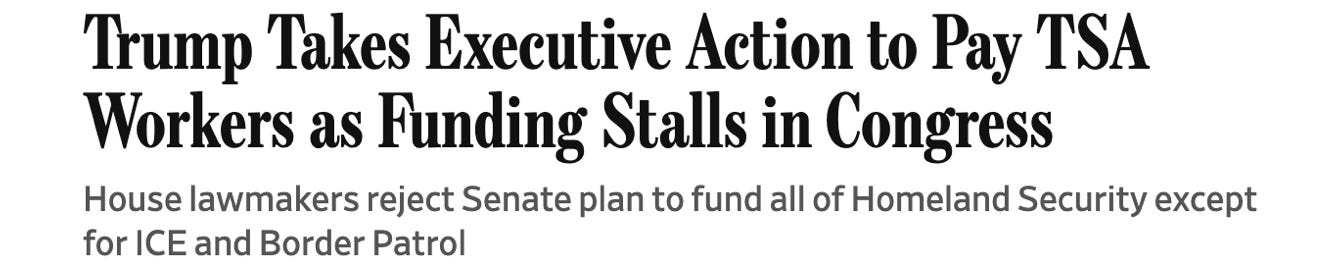
The Executive Order directed TSA workers to be promptly paid from emergency funds. It dared Democrats to sue him, and dared them to try and stop TSA from getting paid, which would amount to a massive, political unforced error. DHS said TSA workers should start receiving their paychecks as early as this Monday.
The president slammed Democrats on Truth Social, urging the Senate to nuke the filibuster: “The Republicans should TERMINATE THE FILIBUSTER, and VOTE! Haven’t they had enough of this nonsense from the Radical Left Lunatics that are looking to destroy our Country?” He linked an op-ed by Senator Ron Johnson published in the Daily Wire calling for a permanent end to all silent filibusters.
🔥 The threat posed by Trump’s executive order and the surprisingly great PR for ICE led Democrats to concede all their demands for “ICE reforms.” But the President obviously smells political blood in the water. While Senate Republicans may have settled for a “good enough” deal, allowing them to take Easter break, Trump senses leverage. He’s not letting up.
Now, ICE will remain in airports for at least three more weeks, until the Senate returns from break.
It’s also worth noting that the ICE drama at home distracts the media and Democrats from their 24x7 Iran war fixation. That’s another reason to keep it going.
The Iran war is media catnip, as these sorts of military actions usually are. But there’s an even bigger story hiding behind the missile strikes, the budget dramas, and, believe it or not, the third No Kings protest. Nobody is calling for a king, but whatever.

🔥 One bigger story that is not receiving nearly as much attention as it should is the global energy crisis. Not so much at home, though. Curious things are quietly unfolding here. ABC reported yesterday that Georgia passed a “gas tax holiday,” suspending the state’s $0.33 per gallon tax for 60 days. Several other states —including California, Connecticut, Florida, Maryland, and Utah— are also considering gas tax holidays. The article added that the federal government could also suspend gas taxes, too, when it wants.
Average American gas prices have increased less than $1 a gallon since Operation Epic Fury began. But yesterday, Euronews reported that average EU gas prices are up an eye-watering 70%— with no relief in sight. Yesterday, Al Jazeera asked, “Is Europe heading to an energy crisis?” On Thursday, the Guardian reported that hundreds of Australian gas stations have completely run out of fuel. (It’s worth noting that Australia enthusiastically cooperated with the UK on helping push the RussiaGate hoax. Just saying.)
It’s not just Europe. Though we Americans are shielded from almost all the fallout, it truly is a global energy crisis. For example, on Wednesday, CNBC reported, “South Korea braces for ‘worst-case scenarios’ as Iran oil shock deepens.” But more to the point, on Monday, the Guardian reported that the chief of the International Energy Agency (IEA) called this the largest supply disruption in oil market history. He called the current crisis “equal to the 70s twin oil shocks and the fallout from the Ukraine war” combined.
You’d think that kind of thing would get more media attention. Instead, trad-media is consumed by breathless stories about ridiculous “No Kings” rallies and fake “MAGA fractures.”

🔥 The global energy crisis took them all by surprise. The Europeans didn’t (and still don’t) know the plan. The IEA’s chief, Fatih Birol, said the “effect on energy markets of the Iran bombings and the closure of Hormuz strait was not initially understood by world leaders.”
Guess which country is best positioned to weather a global energy crisis? Hands down, it is the United States of America. Thanks to President Trump, and to the shale boom, we are now energy independent. Only a tiny fraction of US oil comes through the Strait of Hormuz. We don’t need it.
And, since January, we also have oil-rich Venezuela in our pocket. (OilPrice, two days ago: “Venezuela Oil Production Climbs to 1.1 Million Bpd.”)
Runners-up for well-positioned countries include China (which has squirreled away a vast petroleum stockpile), Russia (which NATO’s neocons sneeringly dismissed as the “gas station with nukes”), and a short list of smaller oil-exporting countries like Mexico, Norway, Brazil, and —believe it or not— Canada.
Here’s a fun question to ponder: what if the Iran war wasn’t only about stopping its nuclear program? What if the global energy crisis was the primary objective? To see this clearly, just swap a single assumption around. Media assumed that the energy crisis surprised President Trump.
But what if it’s the other way around? What if he knew this would happen? Remember, Trump has been thinking about oil, the Strait of Hormuz, and even tiny Kharg Island since the 1980s.
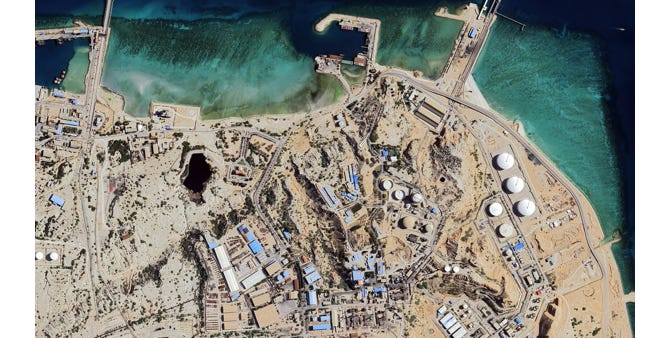
Remember— we don’t know the plan. (Nor should we.) But also, for the first time since the start of the Cold War, the Europeans don’t know the plan either. They are probably freaking out. The only countries that could meaningfully push back on what we are doing in Iran are Russia and China, but they are already insulated from the crisis.
Apart from strongly-worded messages, Russia and China have been conspicuously silent. Certainly, they haven’t pressed the issue at the UN Security Council or anything.
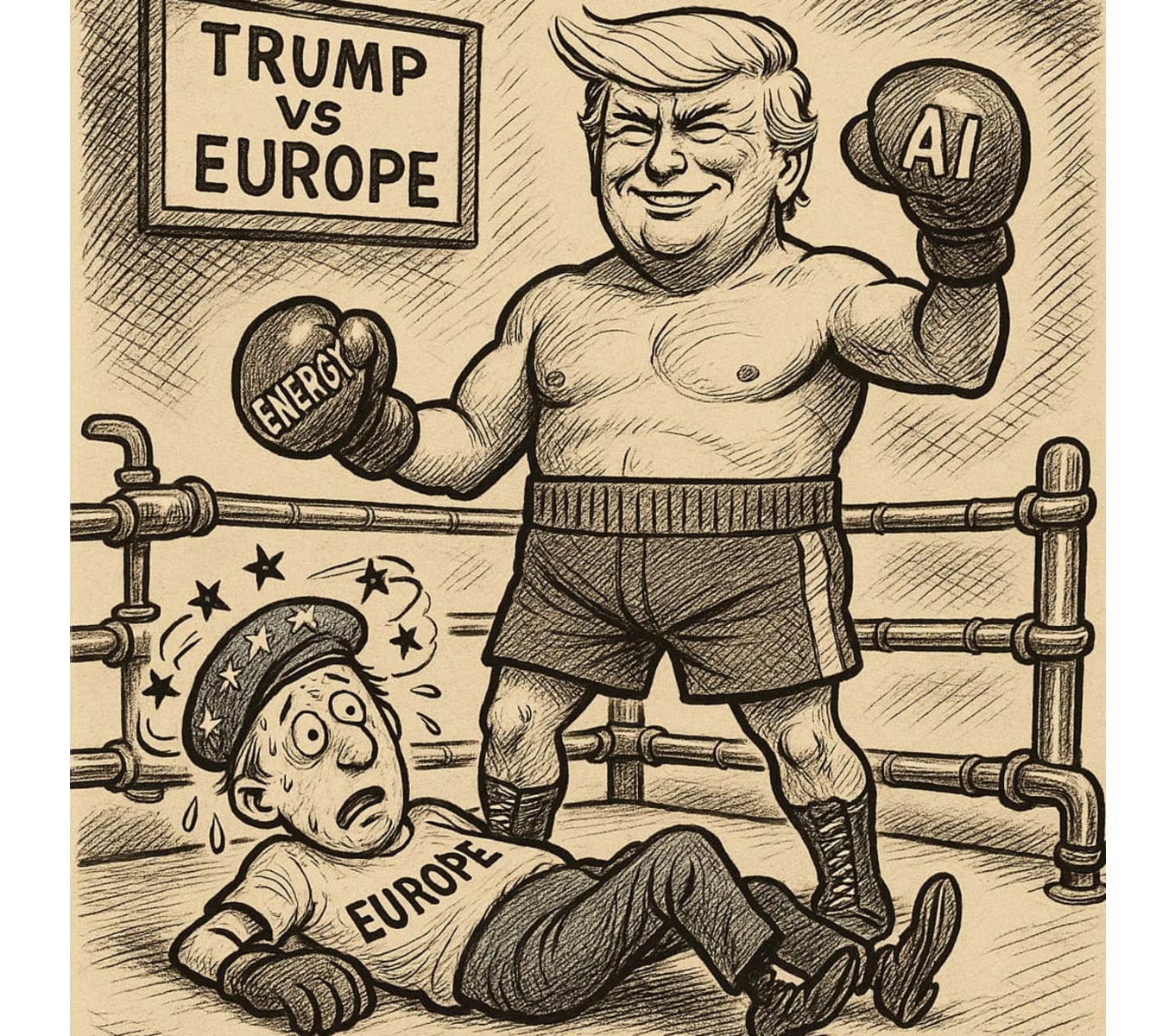
But why would he? Why would Trump intentionally engineer a global energy crisis? What would the goal be? This is where it gets really good. In the short term, leverage, and in the long-term, the total dominance of Europe. I think I can prove it.
🔥 First, I’ve already written about how the energy crisis provides Trump massive leverage against NATO and the difficult and disloyal European “allies.” The Guardian article that quoted the IEA chief said there was a simple solution to the historic global energy crisis: reopen the Strait.
It’s that easy. But consider why it hasn’t reopened yet.
Here’s the astonishing timeline. On March 3rd, Trump posted on Truth Social: “If necessary, the United States Navy will begin escorting tankers through the Strait of Hormuz, as soon as possible.” It sounded reasonable, but something else happened. Instead of ordering the escorts, Trump pivoted. He demanded that other countries send their warships to escort their own oil tankers.
Predictably, they refused.
The President rhetorically blasted Britain, Germany, Japan, and South Korea for their reluctance— but most significantly, he still didn’t send naval escorts. Except now he had a good excuse. They won’t even protect their own ships.
The Europeans sputtered indignantly, signed a joint letter pledging generic support, but dragged their wooden-shoed feet. EU’s top diplomat Kaja Kallas told Reuters, “Nobody is ready to put their people in harm’s way in the Strait of Hormuz.” France’s Macron said he’d send the French navy when “the conflict stabilized” — which is Parisian for no soufflé. NATO chief Mark Rutte told reporters it was “only logical that European countries needed a couple of weeks” to rally, since they were not given notice before the initial strikes.
Get that? They were not even given notice. Not even a heads-up to get their citizens and diplomats out before the bombs began to fall.
🔥 Meanwhile, on March 12th, Energy Secretary Chris Wright said that the Navy “may be able to start escorting ships through the strait by the end of March.” May be able to. The most powerful navy in history, already deployed in the region, and the best we can do is maybe and end of March?
Iran’s navy is deployed to an artificial reef assignment. So, what’s stopping us?
Iran’s ability to project force in the Strait has been functionally destroyed. We face no capability problem. It’s a choice. For a smarter analysis, see gCaptain’s excellent article from last week: “What if the US Navy isn’t in a hurry to reopen the Strait?”
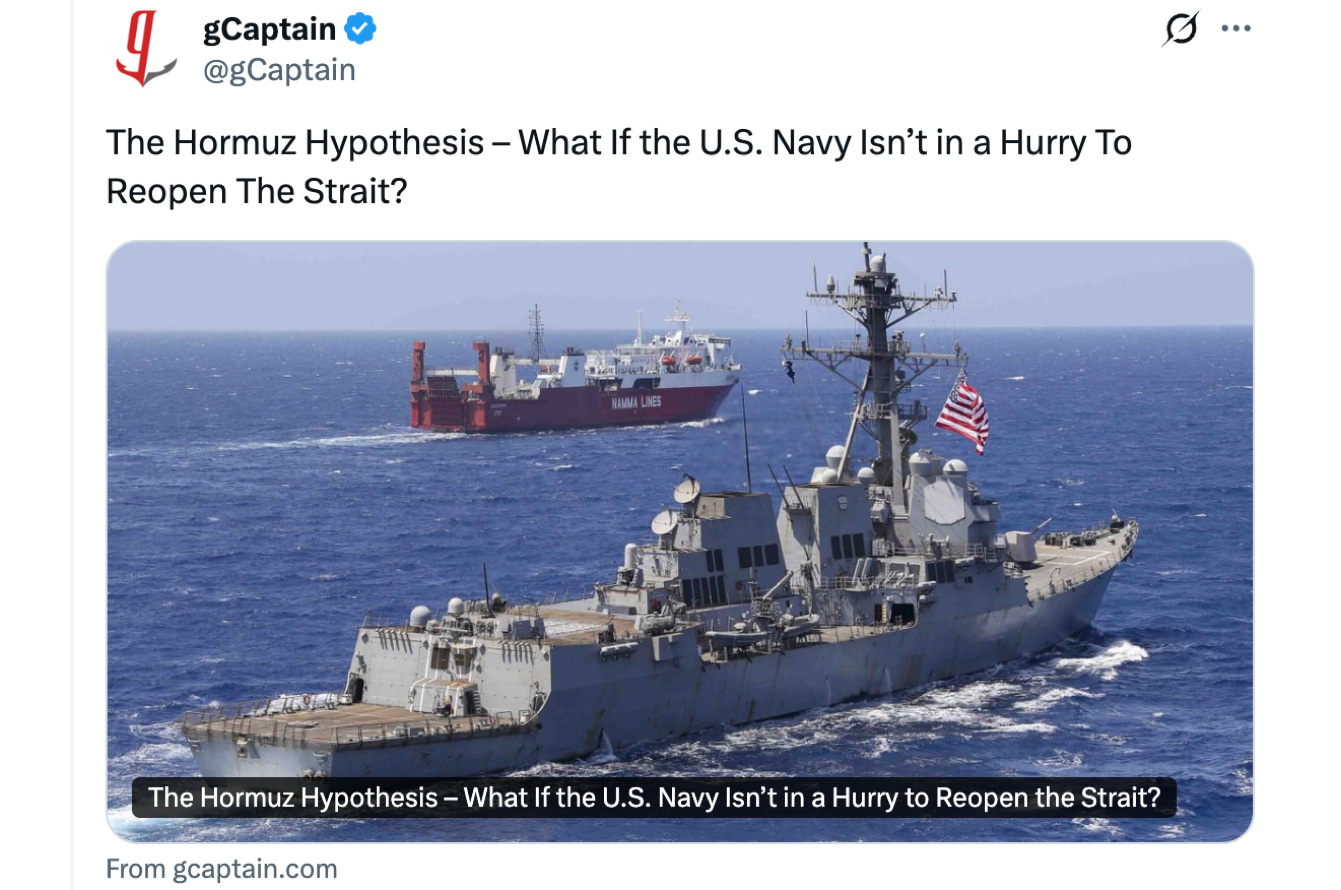
If reopening the Strait is a choice, then we are choosing not to. Instead of naval escorts, Treasury Secretary Scott Bessent announced just yesterday that a new US government insurance program for Hormuz shipping will “begin soon” — with promises that the plan will “get oil, gasoline, LNG, jet fuel and fertilizer flowing again to the world.”
Remember, for something like 400 years, London has controlled insurance availability to the Strait. But after Trump launched the Iranian operation, they had a TDS-fueled temper tantrum and peaced out. To teach Trump a lesson.
But London’s departure from Hormuz insurance leaves only the US. Which means the US decides (a) who gets an escort and (b) who gets insured. And by logical extension, who gets the oil.
Can you see it yet? If the US is the only country providing either escorts or insurance, guess who actually controls the Strait of Hormuz? Correct, we do. As our chief executive, President Trump does. He will soon hold both de facto (US Navy escorts) and de jure (US insurance) control.
To horrified European leaders watching all this become increasingly obvious, the message is unmistakable. Want your energy flowing again? Come to Washington.
As for NATO, this week President Trump has been floating comments about leaving NATO, since they proved they wouldn’t be there for us “on a small thing.”
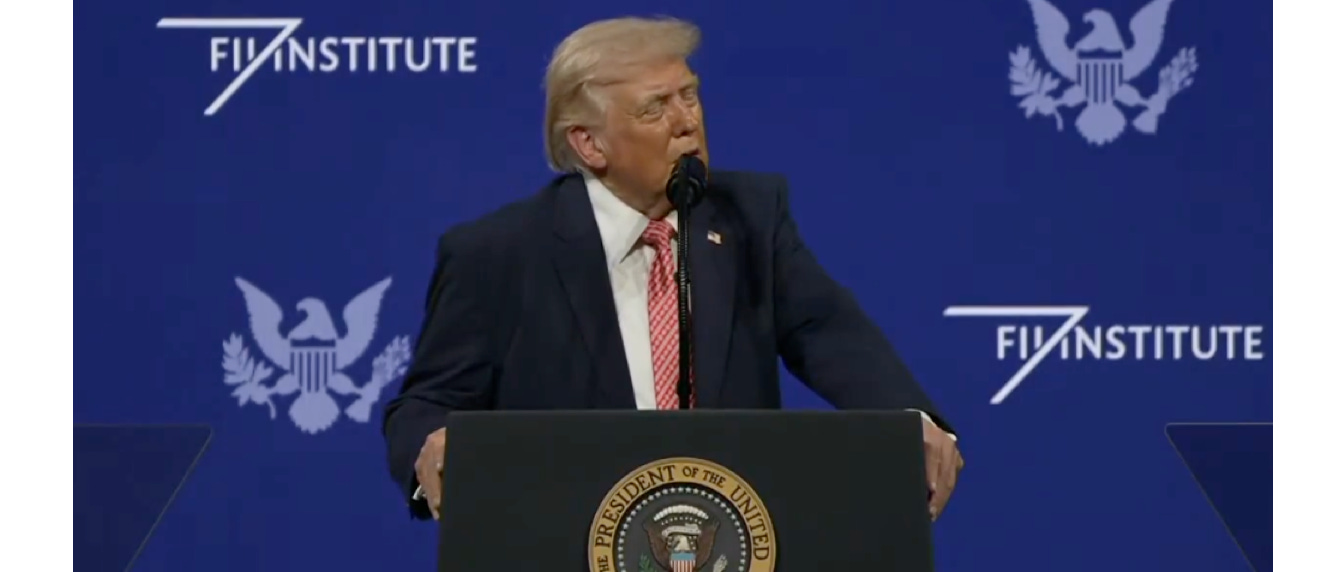
CLIP: Trump builds the case for leaving NATO (1:15).
Yesterday, President Trump even wondered about the billions we could save, by not being in NATO. “I think a tremendous mistake was when NATO just wasn’t there,” he said, shaking his head ruefully. “They just weren’t there. It’s going to make a lot of money for the United States, because we spent hundreds of billions of dollars a year on NATO, hundreds, protecting them.”
Trump mused, “We would have always been there for them. But now, based on their actions? I guess we don’t have to be, do we?” He is applying leverage.
This anti-NATO permission structure would never have arisen without the Iran conflict. So that’s the left-hand hook: massive leverage. Trump will soon have more direct, politically and economically energized leverage over Europe and NATO than any President in history. (And incidentally, over a long list of other, less troublesome countries as well.)
But leverage is fleeting. What happens when the oil crisis abates? The war with Iran must end sometime. Even if Trump successfully keeps his leverage for three more years, he’ll be gone. Can’t the Europeans just wait him out?
No. No, they can’t.
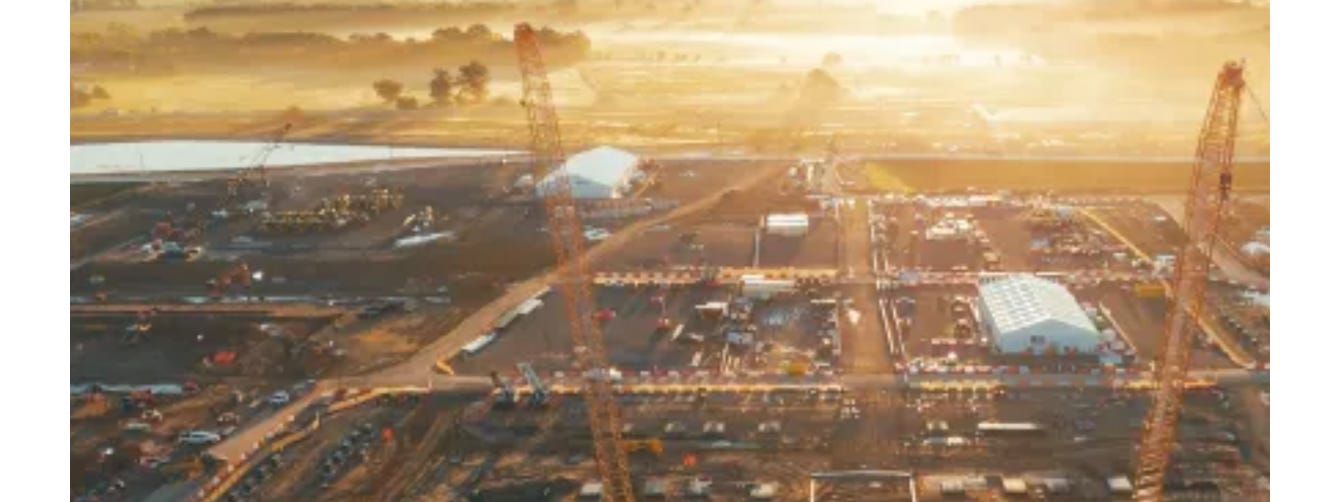
🔥 They cannot afford to wait a single second longer. It’s probably too late already. Let’s discuss an unexpected nexus of power: artificial intelligence.
A single ChatGPT query uses roughly 10 times as much electricity as a Google search. Scale that to hundreds of millions of queries per day, and you start to understand why the four biggest US tech companies —Amazon, Google, Meta, and Microsoft— are projected to spend between $630 billion and $700 billion on AI data center infrastructure this year alone. That’s a 62% jump over 2025.
By 2030 —only four years hence— total AI-related data center spending in the US is expected to hit $5.2 trillion. There’s never been anything like it. Calling it “historic” fails to capture the gist.
These aren’t just regular computers. They are the most energy-hungry machines ever built. Data centers already consume over 1,000 terawatt-hours of electricity globally— more than 125 million Japanese use in a year for everything. The Electric Power Research Institute recently projected that AI data centers alone could consume up to 9% of all US electricity by 2030.
This week, BlackRock’s Larry Fink plainly said it: AI is not a bubble. Power is the real bottleneck.
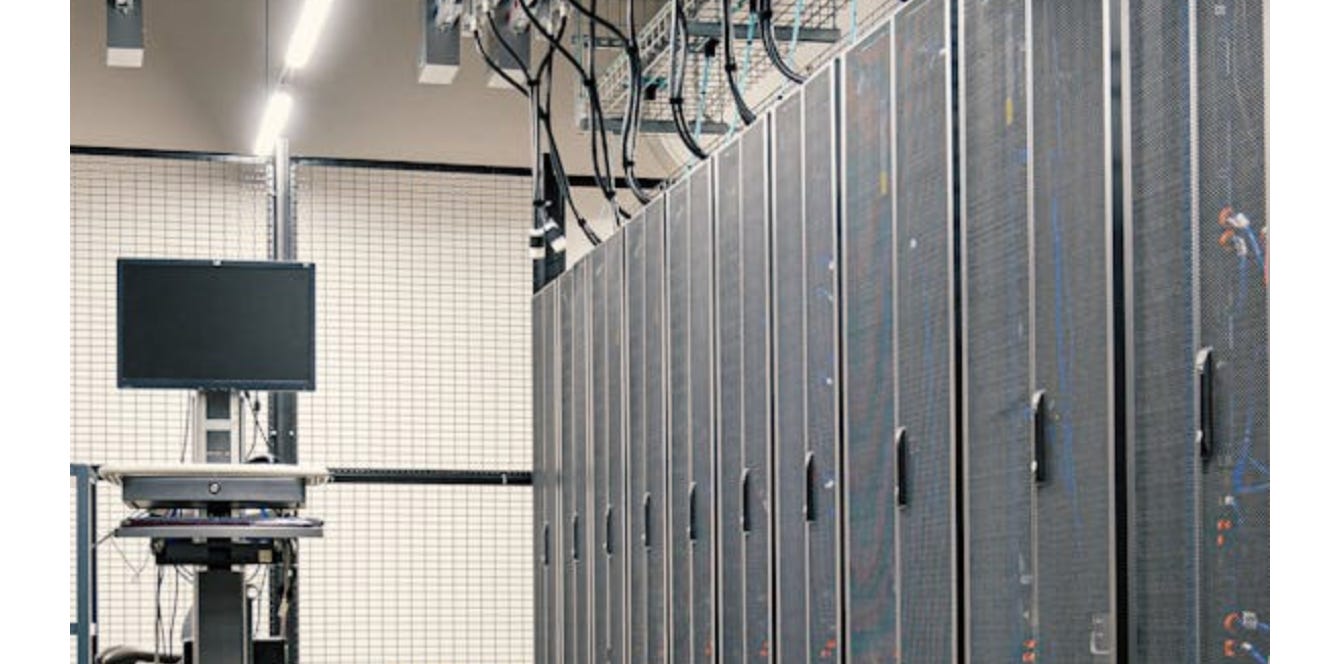
🔥 Europe was already losing the AI arms race. But now it’s over. The fat German lady has sung, left the opera, and is home tucking into a bratwurst.
Even before the Iran war, industrial electricity in Europe cost roughly twice what it costs in the United States. Three days ago, Fortune reported that the gap is widening. On March 13th, the New York Times reported that surging energy costs put German industry “really in danger.”
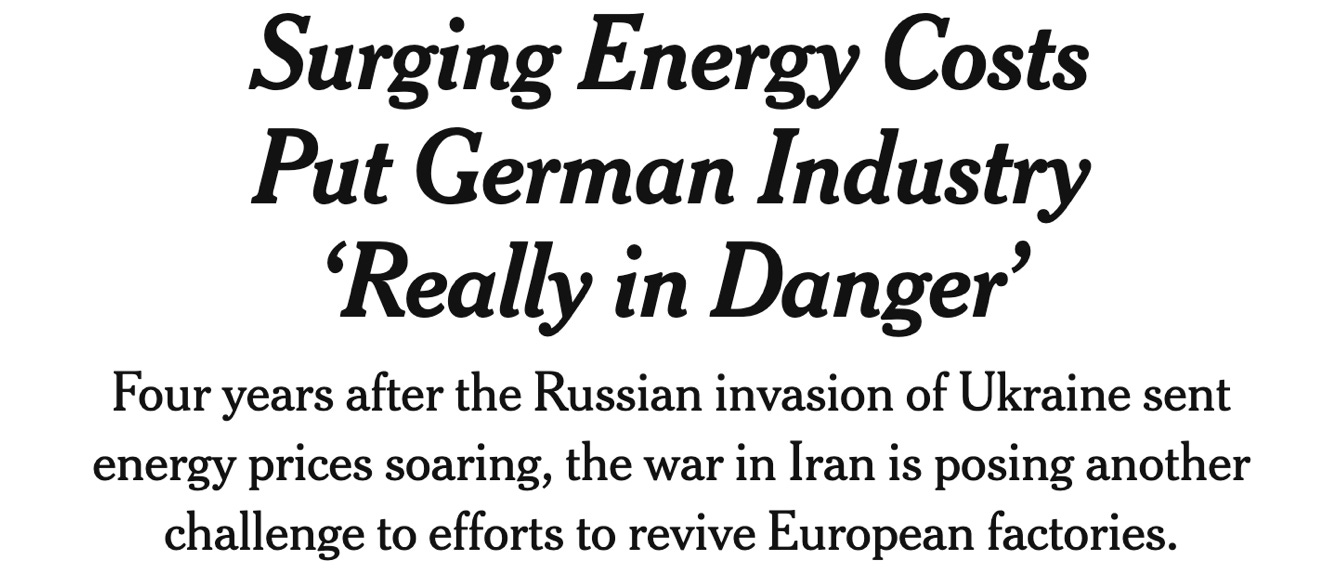
Now add a 70% spike in EU gas prices on top of that.
The Draghi Report—the EU’s landmark competitiveness review—already estimated that 70% of Europe’s GDP-per-capita gap with the US stems from lower productivity, driven primarily by a technology-sector gap. Just two days ago —one month into the Iran war— the head of the European Patent Office told Euronews that Europe has “more or less lost” the global AI race.
More or less. And Europe’s energy crisis hasn’t even peaked yet.
Facing a historic energy crisis equal to two 1970s oil shocks plus the entire Ukraine war, if they slip even 18 months behind, how could they hope to catch up? The European Commission estimated the EU needs $1.39 trillion in new energy infrastructure investment just to catch up to today.
AI isn’t just the latest wave of technology, like tablet phones, streaming music, or LED bulbs that don’t work. It’s a civilizational sorting mechanism. It’s the new dividing line between first-world and second-world powers. Countries leading in AI will dominate economically, militarily, and diplomatically for the next hundred years.
Countries that fall behind won’t just lose market share. They’ll lose relevance.
Thanks to the energy crisis, Europe is staring down that horrifying possibility right now.
At Davos, Macron begged for “sovereignty and autonomy.” But he can’t declare sovereignty when France can’t keep the lights on. They can’t build data centers when their electricity costs are double their competitors’ rates, and their grid is three energy shocks deep in the consommé.
The last time a technology revolution reshaped the global order this completely was the Industrial Revolution. The countries that industrialized first —Britain, Germany, and the United States— dominated the next two centuries. The countries that lagged behind became colonies, clients, or just … irrelevant.
AI is the sequel. It is the next revolutionary era. Whether or not anyone is saying it, the Industrial Revolution is over, and we have launched into the Intelligence Revolution.
And right now, Europe is missing the revolutionary bus. It hasn’t even bought a ticket yet. It doesn’t even know where the ticket counter is, because it is hidden somewhere behind a windmill farm.
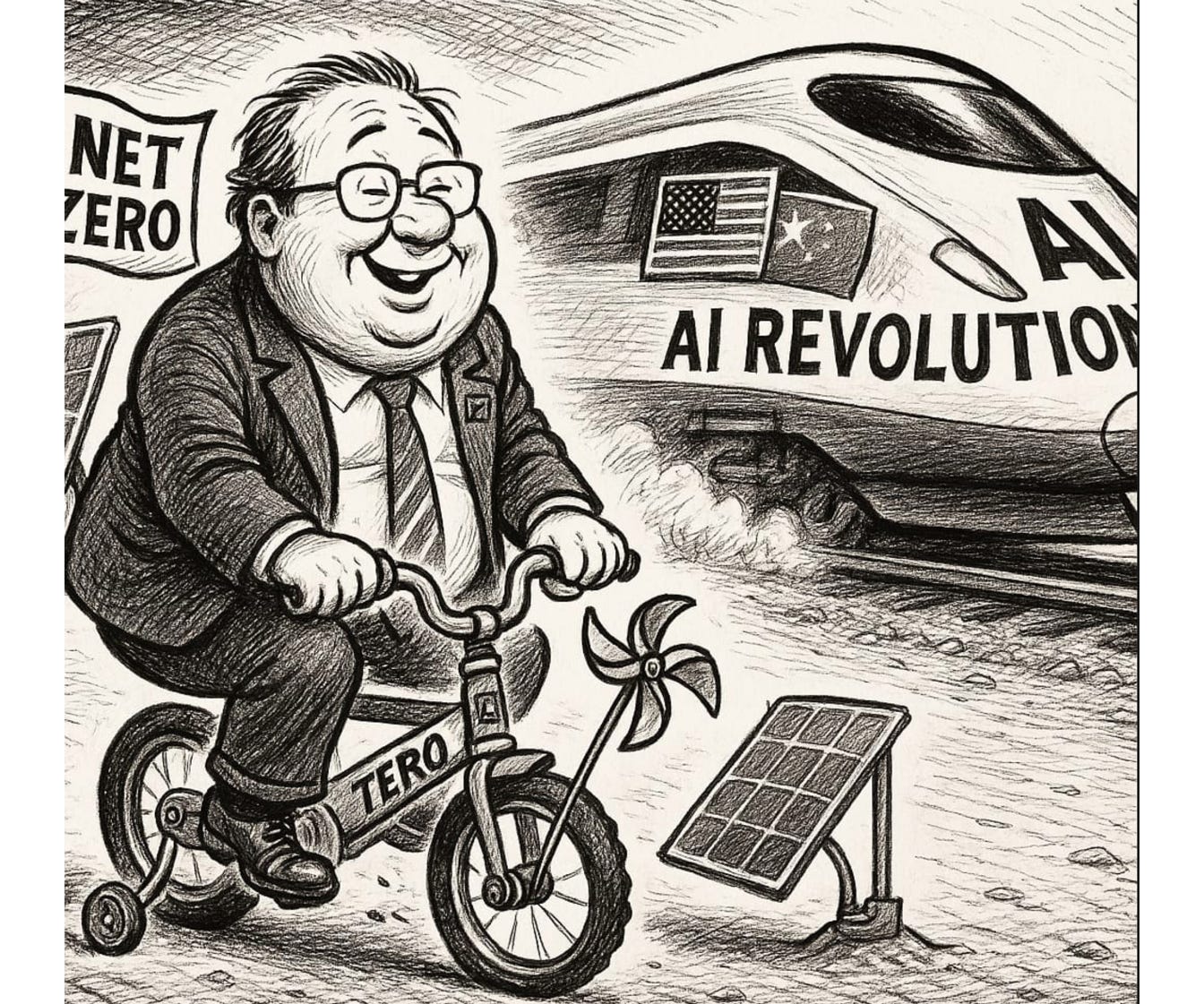
🔥 Let’s pull all these threads together. Trump attacked Iran and the Strait closed. He asked the NATO allies for help —no dealmaking this time— and they rebuffed him. The US is the only power that can reopen the Strait, and it is slow-walking doing so. A global energy crisis has arisen, most acutely in Europe, right at the precise time when energy is the single most important resource for securing a spot in the post-AI world.
AI development is not linear. It is geometrically compounding. Each generation of AI helps build the next generation faster. The models being trained today are being used to design the next chips, optimize the newest code, and accelerate the frontier research for tomorrow’s models. If Europe falls just 18 months behind, they’re not just 18 months behind— they’re 18 months behind something that’s accelerating away from them.
It’s not a gap, it’s a widening chasm.
Whether he meant to or not, Trump’s global energy crisis has doomed the Europeans to become second-rate powers. Not just for the next three years until Trump’s term is over, or even the next 30 years, but maybe for the next hundred years. Maybe even forever.
I’m not even sure which is more impressive: an insanely smart President or an incredibly lucky one. Either way, Trump always wins.
Have a wonderful weekend! Fill up with cheap gas and drive back here Monday morning, for more essential news and commentary.
Don’t race off! We cannot do it alone. Consider joining up with C&C to help move the nation’s needle and change minds. I could sure use your help getting the truth out and spreading optimism and hope, if you can: ☕ Learn How to Get Involved 🦠
How to Donate to Coffee & Covid
Twitter: jchilders98.
Truth Social: jchilders98.
MeWe: mewe.com/i/coffee_and_covid.
Telegram: t.me/coffeecovidnews
C&C Swag! www.shopcoffeeandcovid.com
I’m laughing so hard at how you describe Mike Johnson’s demeanor 🤣🤣 You nail it so well, Jeff! I have a smile a mile wide on my face just from your first paragraphs and had to come grin and laugh before I finish reading. Hilarious. He might have tapped the podium. Lololol I love C&C 😂 You really bring some of the best joy to my day, and wrapped in the news that is quite the feat!
Good morning C&C. Holy Week is approaching. Jesus died for our sins. Let us turn to God and repent so that Jesus’s sacrifice was not in vain.