

Good morning, C&C, it’s Tuesday! The dog days of August are finally over, and I could swear I detected a brief moment of a cool breeze yesterday. Or it might have been indigestion. (We don’t know yet.) Today’s terrific roundup includes: a banner day for hurt feelings — the Supreme Court rules a professor's "aesthetic injury" cannot stop the White House ballroom; Florida decides its citizens' license plates are none of the government's business and orders the cameras cut down; and the great data-center panic gets a second look after X catches 200,000 fake Chinese accounts pretending to be your worried neighbors.
🌍🇺🇸 ESSENTIAL NEWS AND COMMENTARY 🇺🇸🌍
⚖️⚖️⚖️
The Democrats’ dreams of sticking President Trump (and the country) with a bunch of porta-potties and construction dumpsters situated right beside the White House for the rest of his term collapsed into the building hole yesterday. Only in 2026 could a case like this go to the Supreme Court. The New York Times reported, “Supreme Court Allows Trump’s White House Ballroom Construction.” It’s over.

Last time around, I called out the Times for using a stale, months-old construction-site photo. This time they topped the article with a stock Supreme Court building photo, but halfway down they finally included a more recent picture— that looked like it had been taken from space. Readers couldn’t tell whether they were looking at the White House from the window of a passing 747, or possibly something growing in an NIH ‘defensive bioengineering’ petri dish. But never mind.
You’ll recall that on Friday, the Supremes sensibly chucked a DC judge’s injunction that would have pulled the plug on the East Wing construction project. That was accomplished by a ‘slip’ order— a short declarative command that gets the job done fast but leaves the commentary for later. Yesterday, SCOTUS published its full opinion, which clocked in at a relatively terse eight pages.
In a decision that was much closer (5-4) than it ever should have been, the majority tapped into the most absurd feature of this particular lawsuit: who filed it and why.
This is important. There’s an amorphous, fuzzy rule in all federal courts, a live wire that we constantly brushed against during the pandemic: standing. Standing means whether the court recognizes that you have a right to file a lawsuit in the first place. The courts have developed an objective-sounding but totally subjective test that judges use to either dismiss or green-light the most ridiculous cases imaginable.
Which is what was happening here, until the conservative Justices (excluding only John Roberts) called it what it was: a farce.
⚖️ Meet the National Trust for Historic Preservation, a 501(c)(3) NGO that, in a time before memory, was probably founded for a good reason. Now it’s another elite club and laundromat masquerading as a charity. Consider that its “Chief Executive Officer” is no selfless volunteer; the job earns over half a million dollars in salary. The current CEO is Brent Leggs, so the Trust put its best Leggs forward:
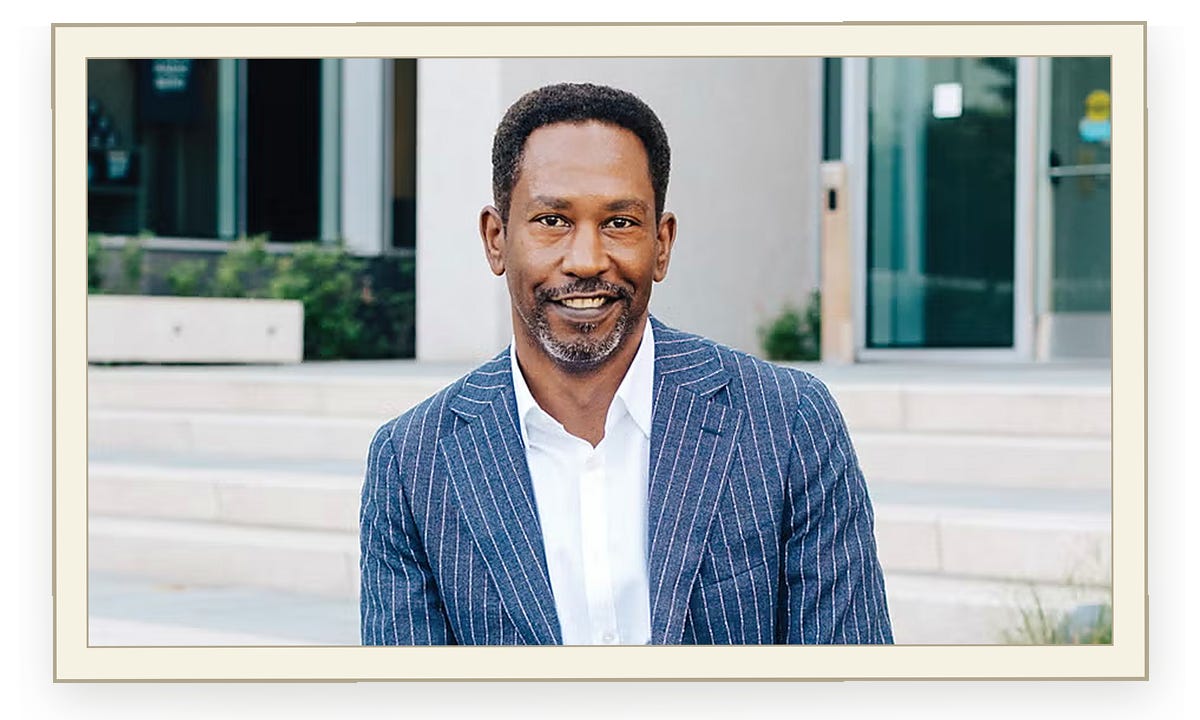
The Trust’s “charitable purpose” is, ostensibly, the preservation of America’s historic buildings. But one could be forgiven for skepticism. Its 2025 tax form disclosed $18.4 million in staff salaries, $3.4 million in executive pay, but only around $7.69 million in program grants to meddle in local building project decisions.
As for those grants, behold the Trust’s website. The Trust’s stated goals include “telling a truer history, equitable communities, climate change(!), and advancing racial equity and social justice.” Probably not what the original charter had in mind. The current Trust killed the original institution, skinned it, and now wears its authority around like a skin suit.
Anyway, even though the Trust is arguably aimed at building preservation, they can’t just sue the federal government every time it breaks ground or puts up a screen door. Being a professional busybody with a huge budget isn’t enough. To have standing to sue under federal law, a plaintiff must “identify a concrete, particularized injury caused by the project and redressable in court.”
A charity isn’t injured by building projects. It needs an injured human. So they found Professor Alison K. “Kim” Hoagland, who is also, happily, a Trust board member and lives in DC, near enough to the White House to take walks where she occasionally glances at the construction project. Prepare for a dose of credentialism.

This entire silly case was based on the Trust’s argument that the East Wing Ballroom is harming Professor Hoagland. She doesn’t like it, you see. It offends her professorial instincts. She would prefer a drastically different design. A smaller one. So, for purposes of establishing standing to sue, the Trust called her “particularized injury” —and I am not making this up— an aesthetic injury.
In other words, it hurts her feelings. In April, Professor Hoagland told NPR the ballroom is “a distraction… something big and irrelevant and asymmetrical… They could make it lower. They could make it almost hidden. They could make it deferential to the White House.”
Yeah, okay.
⚖️ The majority described the Trust’s injury theory as an “unprecedented and limitless” view under which “virtually every citizen had standing to challenge virtually every government action that they do not like.” Citing a slew of previous Supreme Court cases, it scolded, “Mere offense, disagreement, or distaste does not qualify as a concrete and particularized injury under Article III.”
That was a perfectly sensible way to evaluate standing for a random citizen who claims the vision of a Trump building project ruins the aesthetics of her afternoon strolls. Tossing that silliness should be that simple. But over the years, the doctrine of standing has slowly become totally incoherent.
The Trust and the four dissenting justices —led by Chief Justice John Roberts— cited a single Supreme Court case in which the Court somehow found that an environmentalist might have standing to block a building project because “he wanted to look at a crocodile.” The environmentalist still lost. You can’t make this stuff up. The minority admitted that, as unlicensed non-professionals, you or I would probably lack standing since we don’t know what we’re talking about.
But Justice Roberts wrote, “The White House is not just any building, and—when it comes to historic preservation—Hoagland is not just any person.” In other words, the minority argued that Professor Hoagland should have standing because she is an expert. Credentialism. Cue the rolling of already-over-rolled eyes.
Thankfully, the majority flatly rejected that theory. “Our standing rules,” the majority wrote, “contain no such special carveout,” and standing is not measured by either “the intensity of the litigant’s interest” or the litigant’s “special interest in the subject.”
Too often, the standing rules let judges flush cases they don’t like. The standing standard has become so flexible that judges in my cases have found that people with crippling vaccine injuries lacked a sufficiently particularized injury to sue the government or pharma companies. Losing standing kills your case right out of the gate. Do not pass go. Do not collect anything.
But fortunately, by a wafer-thin, one-judge margin, the Supreme Court held that Professor Hoagland cannot single-handedly stop a White House renovation project simply because she thinks it is too big, even if she did write a few books about architecture. ’Bye, Felicia.
The most delicious irony is that the Trust came for a ballroom and wound up buying a new Supreme Court precedent that will strangle activist-NGO standing for a generation. They lost the courthouse key for everybody.
⚖️ Finally, don’t be too hard on Chief Justice Roberts. Part of his job is like a preservation society. As Chief, he’s responsible for preserving the Court’s institutional credibility and its appearance of neutrality. He is very smart. Personally, I think he penned the dissenting opinion to show evenhandedness and to keep it from becoming an anti-Trump tirade.
🔥🔥🔥
Flock camera haters enjoyed a massive win yesterday. NBC reported, “Florida bans Flock and other license plate readers from state highways as backlash grows.” The subheadline added, “The state said it was ordering cameras removed from the right-of-way of state highways ‘to preserve Floridians’ sovereignty and quality of life.’”
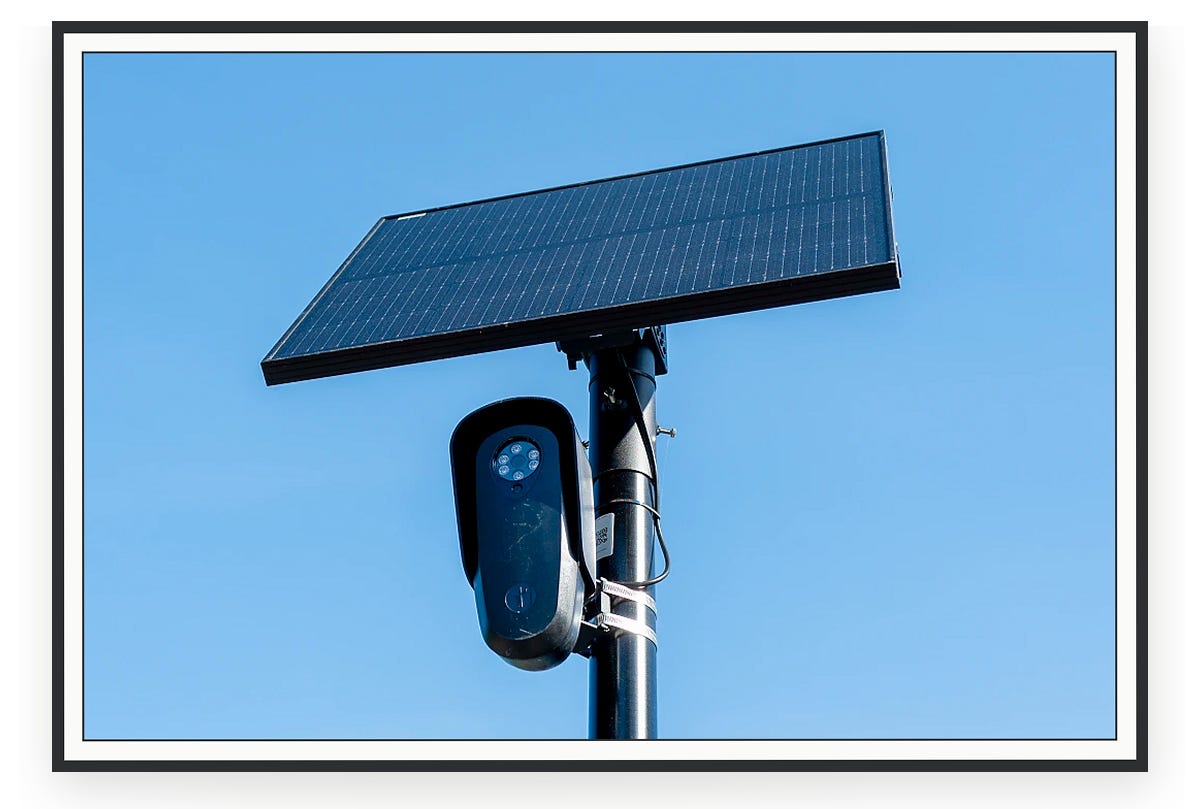
Yesterday, Florida’s Department of Transportation published a one-page memo that stripped local police of the ability to place surveillance cameras and license plate readers on any state highway in the Sunshine State.
The DOT memo cited a “recent exponential increase” in deployments of law enforcement cameras, as well as “concerning reports of misuse, data privacy concerns, and surveillance schemes” that merit immediate action “to preserve Floridians’ sovereignty and quality of life.”
You must understand that Florida is a sovereign land where citizens wish to be left alone with their boats, their fried alligator nuggets, and their comprehensive theories about which neighbor reported the shed to the homeowners association. That is also why we usually tint our car windows to the approximate opacity of a welding helmet. And we value the freedom to rapidly transit six lanes without signaling if Publix closes in eleven minutes.
Today, in fact, began Florida’s annual sales tax holiday for guns and ammunition. It lasts for four months. So.
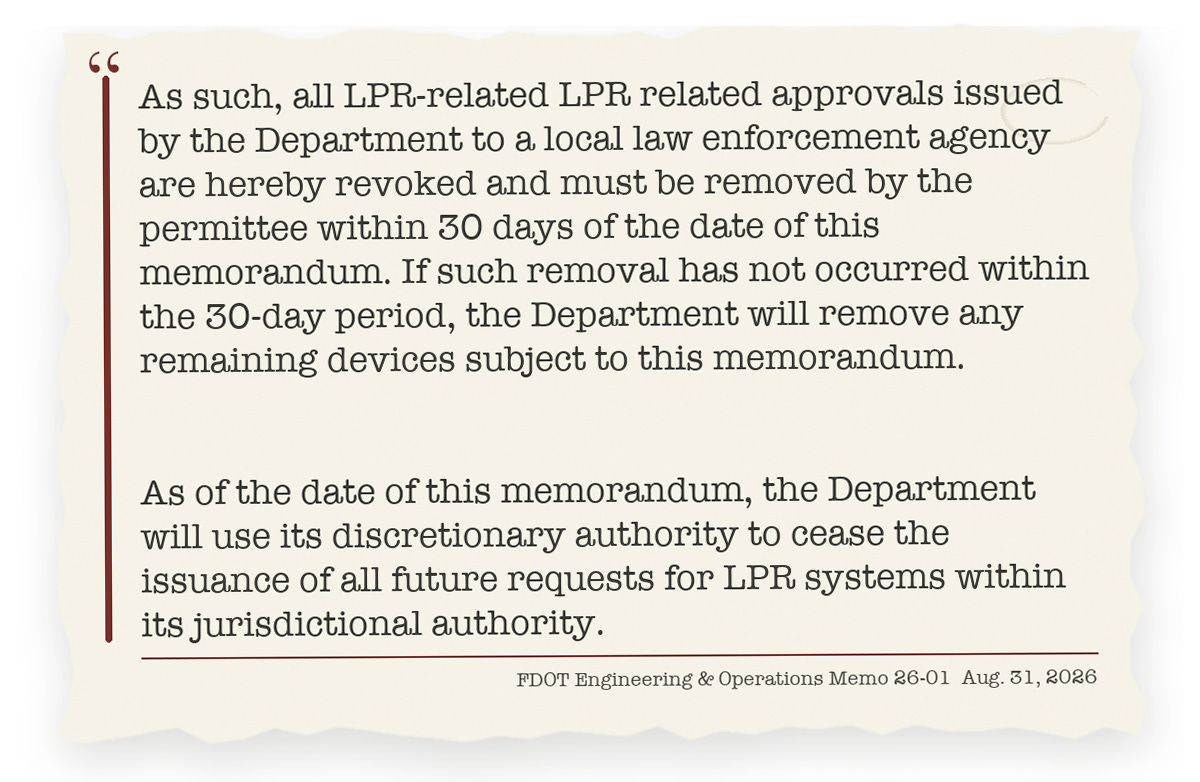
🔥 The state said it was canceling all existing Flock permits within 30 days, otherwise they’ll cut them down, and no new permits for license-plate readers (LPRs) will be issued:
It’s spreading. Jacksonville’s Sheriff’s office said it would cancel all LPRs throughout Duval County, not just ones on state highways or next to Buc-ee’s. Yesterday, Governor DeSantis told reporters, “You want to get in your car and you want to go down to Buc-ees in St Augustine, it’s really none of the government’s damn business.”
Last week, Texas Governor Greg Abbott (R) halted all state funding for Flock cameras. Nationally, over 100 local governments have canceled or not renewed their LPR contracts since the beginning of last year, NBC reported. Here in Alachua County, Sheriff Chad Scott announced he’s pulling all 27 of his own cameras, and said, “Those people are not suspects, and they should not be treated as such.” Get the Flock out of here.
For its part, Flock has belatedly announced changes in response to people’s privacy concerns. It has reduced the default period for storing people’s movement data from one month to one week. It has also said it will do more to lock out law-enforcement users whose searches show “abnormal activity.” (Translation: abnormally stalking their lovers.)
Flock, faces an existential crisis of credibility, prefers to look on the bright side. Gamely trying to defend itself, Flock insisted in a statement, “In just the last few weeks in Florida, the technology was used to find missing children, led to the arrest of a murder suspect, and assisted in solving numerous other crimes.”
In fairness, Flock cameras do find missing children. But so does milk, and the carton doesn’t log your shopping trip.
Governor DeSantis, who obviously isn’t relaxing into lame-duck status with only four months to go before he leaves office, was highly critical of the camera technology. “These cameras that are out there now — who’s to say they’re only doing the license plate?” he wondered. “I think it’s capturing people in their cars. I think it’s capturing way more information than they’re letting on. And you’ve seen the abuse.”
This kind of thing might be odd for a lame-duck governor in the final months of his last term, but it might also be terrific for a 2028 presidential run. I’m only saying.
Personally, I’m sitting this debate out. At this point, not even including Flocks and other LPRs, there are more cameras than Americans. Ring doorbells, driveway monitors, convenience store opticons, camera-enabled eyeglasses, and neighbors keeping a wary 24x7 eye on each other. Share your Flocked-up thoughts in the comments.
🔥🔥🔥
Bookending the Flock camera debate is the equally loud war on data centers. Yesterday, the President declared a side. Like clockwork, the sharklike editors at the Washington Post smelled blood in the water and gleefully reported, “Trump says voters who oppose data centers will ‘kill the Golden Goose.’”
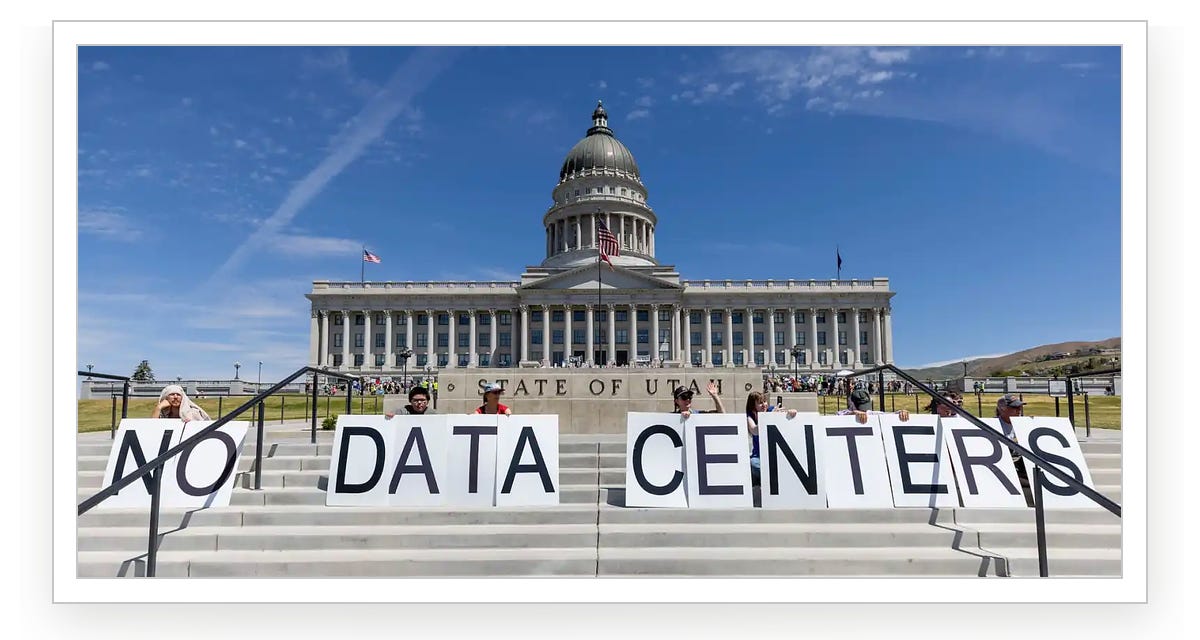
Polls show Americans from both political parties are increasingly hostile to the server farms central to the artificial intelligence boom. Some Republicans running for office this year have publicly broken with Trump on the issue. In July, Florida issued regulations requiring, among other things, that new data centers obtain special water permits and not increase local citizens’ utility rates. It passed 37-zero in the state senate.
At bottom, it is, in fact, NIMBYism (“not in my backyard”). Americans love instant AI answers. They simply prefer the machine producing them to live three counties away with a separate water supply.
Yesterday, President Trump issued a dramatic and unusual warning to all of us. “The only reason that communities throughout the U.S.A. should not want Data Centers is if they want to end up being backwards and poor,” Trump wrote on Truth Social.
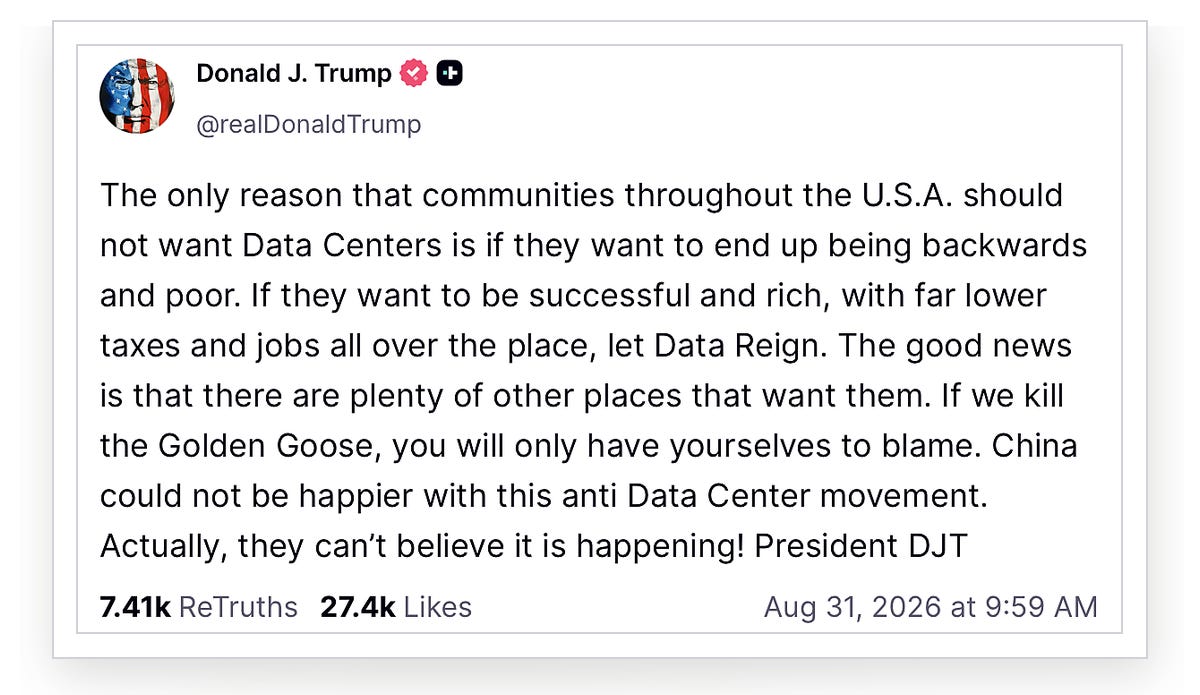
“China could not be happier with this anti-Data Center movement, he added.” The President was not entirely wrong.
🔥 America’s turmoil over data centers has reached a fever pitch. AI companies have done a terrible job of advocating for themselves, instead preferring to torture everybody with constant claims that their models have become smart enough to lie, hack, and steal, and that we’re always five minutes away from a Terminator-style breakout as Skynet becomes self-aware and kills us all.
Meanwhile, AI still constantly hallucinates and refuses to admit what race the Founders were.
Trump’s first correct point was that the debate is not organic. Not even close. It is heavily influenced by well-heeled anti-data center forces, including our literal enemies, who are falling behind us in the AI arms race. In June, Politico ran a story about Chinese astroturfing:
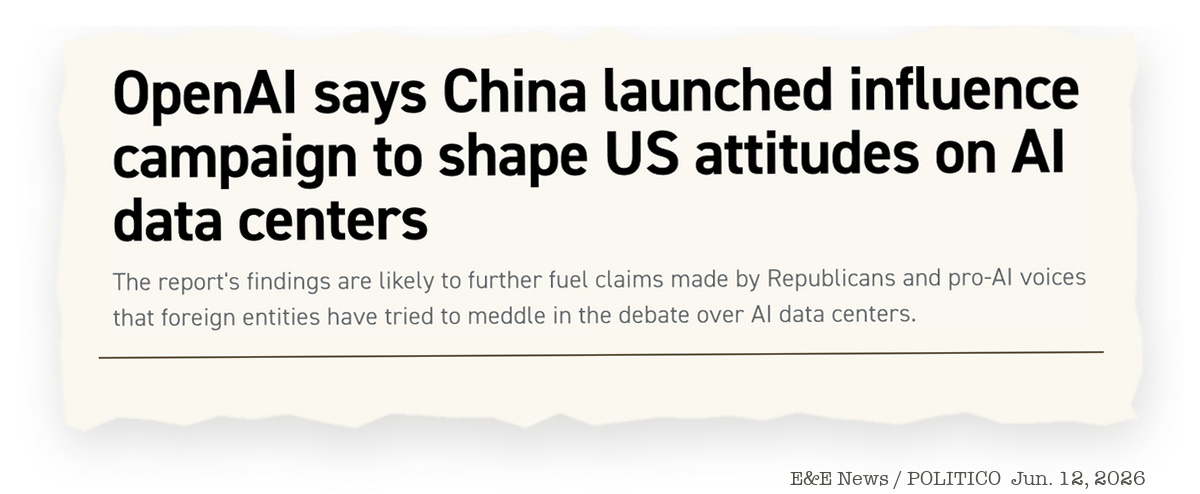
OpenAI caught the Chinese doing it because they were using ChatGPT to help “frame their messages” for the American public. Irony.
Late last week, Fox News reported that X (fka Twitter) had caught another Chinese influence operation, once again targeting data centers.
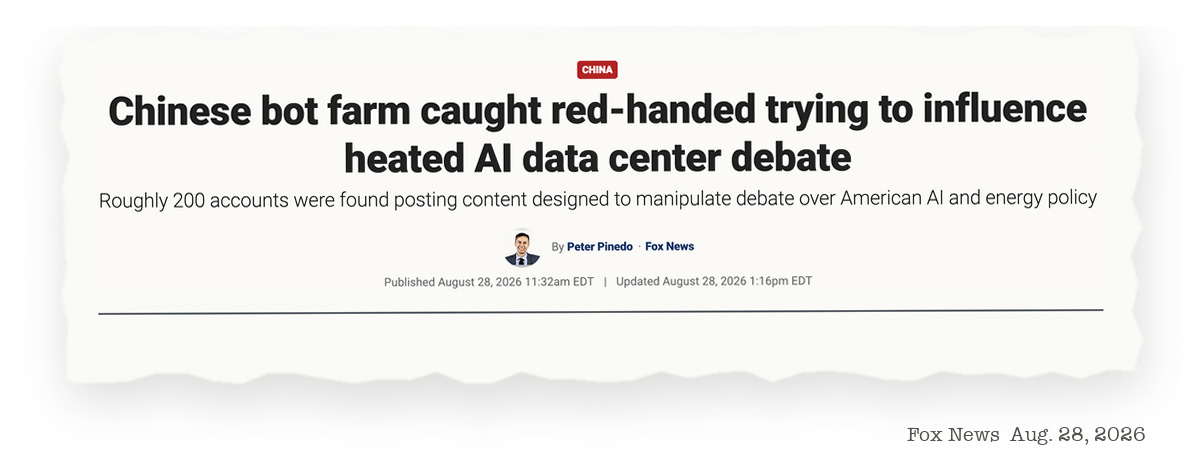
X’s Global Government Affairs account said the platform’s safety team identified a bot farm of approximately 200,000 inauthentic Chinese accounts “involved in influence operations.” Of those, 200 were dedicated to anti-data center advocacy, but disguised as authentic Americans.
Posts by these accounts claimed that AI data centers are driving up household electricity prices and straining the grid. One meme shared by the X team depicted horrified citizens standing across from data center developers holding bags of cash under the caption, “Data centers get subsidized while we foot the bill!” Another meme said that “the AI industry is booming, but the costs are being borne by ordinary people.”

This week, President Trump told reporters that local communities and states should want to welcome data centers because “the jobs are enormous, and the money paid, the taxes paid are just enormous.” That is all true. Blue-collar workers are earning six figures on data center projects, and small villages of supporting vendors are emerging around data center locations. Small towns that were largely forgotten are reappearing on the travel map.
Even vaccine-injury poster boy Senator John Fetterman (D-Pa.) warned that China benefits. “AI supremacy and energy dominance underpins our national security,” Fetterman said. “China continues to fuel and benefit from our overreaction. I reject the political pandering and hyperbole over data centers or AI doomsdaying.”
🔥 The alarming water claim, which lingers like herpes in some parts of social media’s fever swamps, holds that each chat query vaporizes a gallon of water. Not that anyone cares, but that fake statistic has been debunked for months. Data centers use less water than an average golf course. They mostly recycle their water, which is used for cooling the CPU farms.
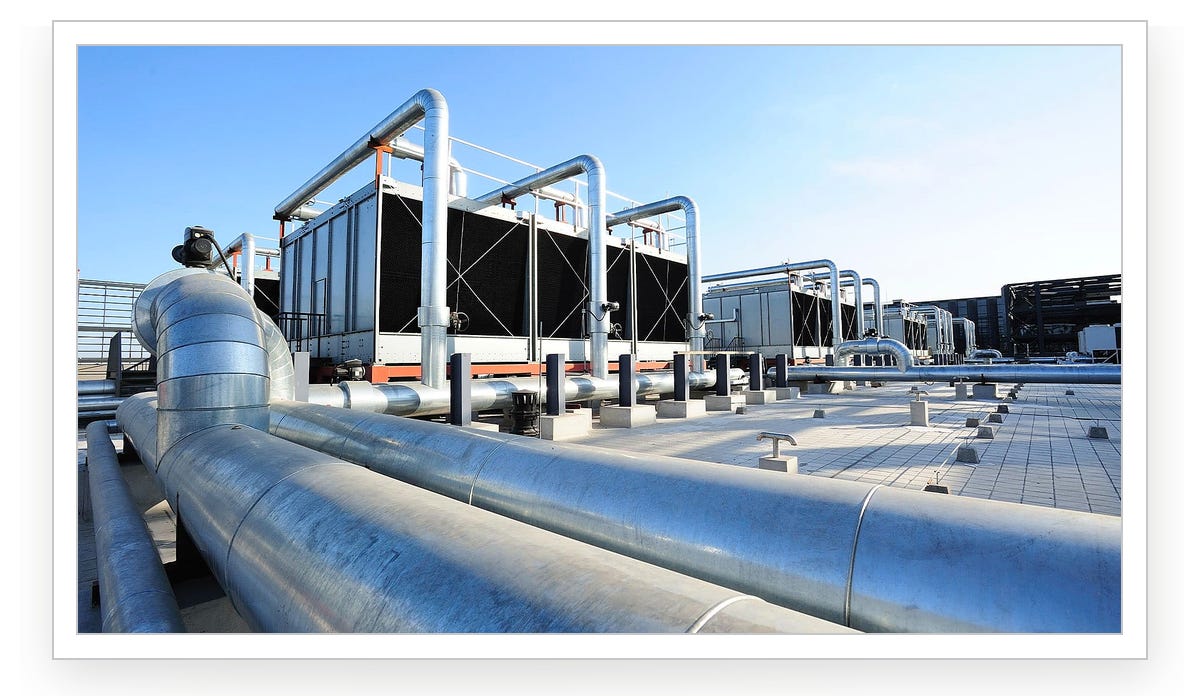
Nobody ever pickets golf course construction. But the data center has become America’s village witch: blamed for water shortages, high electric bills, lost jobs, neighborhood disruption, artificial intelligence, tech billionaires, and probably whatever happened to cursive.
But the current real debate has now focused on power use, even though America has a terrific grid compared to nearly every other country, like in Europe, where rolling blackouts have become as common as Muslim immigrants. Here in the US, we are not running out of juice. The argument is that data centers require cities to build specialized substations for them, and once online, draw enough power to raise local rates by some unspecified amount.
Fine, as far as it goes, and it could even be true, but it is a manageable concern, not an apocalyptic Skynet situation. “I think probably 99% of the backlash to data centers has come in areas where building a data center means higher utility and higher electricity for the people on the ground,” Vice President JD Vance said yesterday. “If you build a data center, you should be putting power back into the grid, not taking it out, and if that is happening, I don’t think the data centers are that controversial.”
But the nation’s moral panic has already skipped past ordinary questions about rates and zoning and arrived at the giant humming cube is coming for your neighborhood.
That less scientific line of complaints has to do, as with the East Wing Ballroom, with aesthetic injuries. “Neighborhood disruption” can mean a legitimate noise or traffic problem. It can also mean somebody has spotted some construction equipment from the artisanal pickle store. Details matter.
None of this means homeowners should subsidize a trillion-dollar industry’s electric habit. Residential customers are ratepayers, not involuntary venture capitalists. The best data-center policy can fit on a bumper sticker: bring your own power and pay your own tab.
The solution is simple. A server farm should add generation, instead of arriving at the grid like a distant cousin who brings six children to Thanksgiving and asks whether anyone has a spare bedroom. They should be built in out-of-the-way locations, such as those we already reserve for sewage treatment plants, airports, and landfills.
Fortunately, America already possesses engineers, zoning codes, utility commissions, and more lawyers than any build-location emergency could possibly require.
🔥 Yesterday we looked at the explosion of paid social media outrage. There is every reason to think that the data center debate is, to some unknowable extent, as fake as Nancy Pelosi’s smooth brow. What we know for sure is that the world is in a race for AI supremacy; that the race is measured in months, not years; that the US is currently winning that race; and that data centers are fueling an extraordinary economic renaissance. That is all true.
We also know both the Chinese and the Democrats are furiously hostile to them. That doesn’t prove data centers are harmless. But it should make us skeptical of the political volume dial. And the argument don’t build datacenters is crazy.
Trump correctly called data centers a “Golden Goose.” Opponents increasingly describe them as Godzilla. This leaves uninformed voters choosing between magical poultry and a radioactive lizard when all they actually need is a utility rate schedule. Here’s where I land: Stay off the social media bandwagon. Build data centers intelligently. And fast.
Fortunately, Professor Hoagland could not be reached for comment on the aesthetics of server farms.
Opinions vary. Let me know what you think.
Have a terrific Tuesday! Switch back here tomorrow morning for even more essential news and caffeinated commentary.
Don’t race off! We cannot do it alone. Consider joining up with C&C to help move the nation’s needle and change minds. I could sure use your help getting the truth out and spreading optimism and hope, if you can: ☕ Learn How to Get Involved 🦠
How to Donate to Coffee & Covid
Twitter: jchilders98.
Truth Social: jchilders98.
MeWe: mewe.com/i/coffee_and_covid.
Telegram: t.me/coffeecovidnews
C&C Swag! www.shopcoffeeandcovid.com
Flock is just the government outsourcing violations of the Fourth Amendment to private companies, exactly how government outsourced violations of the First Amendment to social media companies like Facebook and Twitter.
Both instances need to be punished so severely that government doesn't try the "end-around" ever again.
Every time the democrats use the courts for their hatred of Trump it’s another attack on Americas institutions. The courts were not made to go after political opponents because democrats get emotionally bothered by actions of republicans, they were made for people that break the law. A lot of the disrespect for America’s institutions started with Obama and the Mike Brown case. Democrats pushed millions onto the streets and burnt chunks of major cities to the ground while forcing police to stand down.
Although Bill Clinton soiling the Oval Office was disgraceful, his selling of super computers to the communist Chinese allowing them to pinpoint targets in the U.S., along with missile and nuclear technology, was blatant treason; all for just a 1 million dollar campaign donation. It also was a blueprint for traitors like Joe Biden to sell out America which he did 10 fold.
All the democrats do is destroy things as communists do. Trying to stop the construction of the ballroom because it hurts their feelings is just another step in the wrong destructive direction.