

Good morning, C&C, it’s Monday! Your enthusiastic roundup includes: a 224-page government report that may be the most consequential document for American Christians since the First Amendment itself; the colorful family tree of the man suing to stop it; a cross-eyed English innkeeper’s son who changed the world while Harvard called him names; a WitchTok tarot reader who burned the deck and found something better; and Joe Rogan, sitting in a pew, asking questions that 30 million people are now asking along with him. Also: how to leave your mark on history with a single email before July 12. Grab your coffee refill. More records are being crushed.
🌍🇺🇸 ESSENTIAL NEWS AND COMMENTARY 🇺🇸🌍
⛪⛪⛪
In late 2020, experts began saying it was too early to call a national resurgence in faith a “Third Great Awakening.” They said the trend needed to continue for longer than two years. Then, three years. Four. Year after year, they had to push the goalposts back so often they mounted them on wheels. But whatever was happening then is still happening now, six and a half years on. Yesterday, Perth Now reported, “Viral TikTok tarot reader loses fans after turning to God.” You could say it just wasn’t in the cards.

We’ll get to Alex’s story shortly. But first, let’s put it in context. Guess which year marked the reversal of America’s decades-long slide into secularism? That’s right: 2020. Covid. The pandemic. Peak woke.
The most dramatic sign might be the surge of young people —especially young men— returning to church, and church attendance among younger generations now exceeds that of their elders. Over the last six years, we’ve also witnessed Supreme Court decisions unleashing school prayer, states reinstalling both the Ten Commandments and Bible study to public schools, appellate circuits charting pro-religious courses, an entirely unlikely and unexpected “Tradwife” movement, high-profile conversions by major influencers (like Russel Brand and Tucker Carlson) and occult superstars (Kat Von D), and full-throated, unapologetic emphasis on Christian faith from top leaders like Vice-President JD Vance and Secretary of State Marco Rubio, one of whom seems likely to be the Republican Presidential nominee in two and a half years.
They say Christianity thrives best under persecution. If that’s true, the Biden Administration supplied plenty of that, even if it was relatively low-key in historic terms. (In other words, nobody here was burned at the stake or otherwise jacked up. Other countries are a different story.) The Trump Administration delivered the equal and opposite counter-reaction, elevating open Christianity across the federal government, hosting a days-long Faith Festival on the National Mall to Rededicate the Nation to God, which even featured the President of the United States reading Bible verses and signing pro-faith executive orders in papery reams.
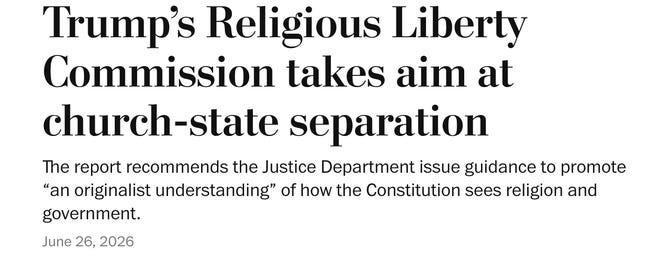
If you thought the movement was slowing or petering out, think again. Before we get to Alex the Tarot Reader’s dramatic conversion, there was much bigger news on Friday. Corporate media reacted with shock and horror to the Administration’s latest major religious freedom move. It was a big one. Headline from the Washington Post:
On Friday, June 26 —a date we should probably write down somewhere— the Department of Justice issued a book-length, 224-page draft report blandly titled, “Religous Liberty Commission.” The subtitle simply stated, “Americans’ First Freedom.” Read the 12-page executive summary and skim the table of contents even if you lack time for the whole thing. You’ll thank me.
Far too often in our national life,” the report’s summary explained, “religion is treated not as a protected and valued contribution to public life, but as a problem or annoyance to be managed, restricted, or sidelined.” This, it explained, is bad. It suggested the solution is proactivity rather than reactivity, cultural cultivation rather than compliant complaisance.
“Safeguarding religious liberty requires more than defending legal rights after they have been violated,” it said. “It requires cultivating a culture that understands why those rights exist in the first place.” It was nothing less than a declaration of war on liberals’ established secular worldview.
One of the report’s most unequivocal recommendations was for the DOJ to aggressively tear down the wall separating church and state. WaPo explained that the report advised DOJ to “issue guidance to promote ‘an originalist understanding’ of how the Constitution sees the relationship between religion and government.”
At an Oval Office news conference about the report, Texas Lt. Governor Dan Patrick repeated the report’s reccomendation that any official —in government, schools, military, hospitals, etc.— who alleges a citizen violated church-state separation must in writing “point out exactly where you have violated the Constitution, because you have not, and from this day forward, that phrase should have no power over people of all faiths ever again in America.”
The Religious Liberty Commission, which issued the report, was created by Trump’s executive order last May. Guess how Democrats reacted? Of course, they sued before the ink dried on Trump’s non-Autopen-signature. The lawsuit complained that the Commission was made up of all conservative Christians (and one Orthodox Jew), who are groups the Times’ unnamed “experts” argued make up a minority of Americans.
The Rev. Paul Raushenbush led the plaintiffs’ group suing the Administration. Paul derisively called the Commission “Christian nationalists” and sneered that the report was “a betrayal of the original intention of the promise of religious freedom guaranteed in the First Amendment,” and dismissed it as “a wish list of divisive, unpopular ideas far-right religious groups have pushed for years.”
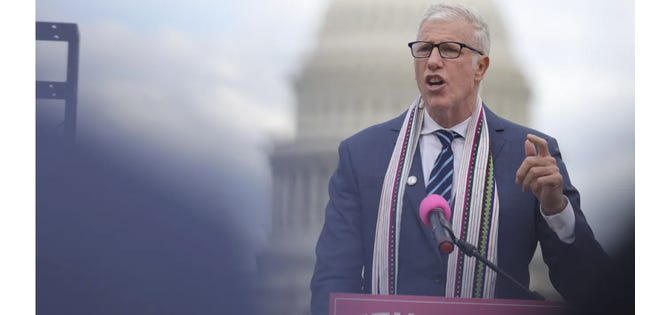
The Times never mentioned Raushenbush’s own colorful background, describing him only as an “Interfaith minister.” Ha. If only. Paul Brandeis Raushenbush is married to Brad. So, not exactly mainstream himself. His entire professional career is built on the proposition that ‘majority’ headcount is irrelevant to the validity of a religious claim or the legitimacy of religious representation in public life.
Pastor Paul was also the Huffington Post’s executive editor for religion, and was named for his great-grandfather Louis Brandeis, the first Jewish Supreme Court Justice (and almost certainly an atheist). Paul is also the great-grandson of Walter Rauschenbusch, a Baptist pastor who invented the “Social Gospel,” which harmonized progressive activism with Christian tradition and more or less created the modern religious left.
That’s who sued President Trump, not that you’d know it by reading the Nation’s paper of record. The man who politicizes faith is suing to stop the president from doing the same. But never mind. None of Paul’s background interested the New York Times’ reporters.
Paul was right about one thing, though. Christians have longed for the day that any elected Republican president would platform any of these concepts, much less try to roll back progressives’ destructive “separation of church and state” mythology.
The report is truly historic. Every American Christian’s daily prayer list should include thanks to God for what’s happening. Even Pastor Paul’s deluded congregation.
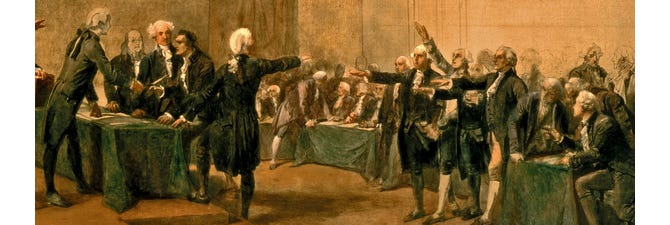
🔥 The left’s “wall of separation” doctrine has always been a legal fabrication built not on the Constitution but on a selective reading of one private letter.
Thomas Jefferson included the phrase in his 1802 letter to the Danbury Baptists— and the great historical irony is that he wrote it to reassure them that the government could not interfere with their church, not to warn churches away from public life. The left took that metaphor, redefined it to mean the opposite, and weaponized it for 70 years to systematically purge religious expression from public institutions.
Every Republican president since Reagan has given religious conservatives the rhetorical nod while largely leaving the legal architecture of “separation” untouched. What makes Trump’s Commission historic is that it attacked the doctrine itself — not just individual cases of religious discrimination, but the foundational framing that has been used to justify all of them.
Recommending that the DOJ issue formal guidance redefining the Establishment Clause is not just a symbolic gesture. It’s replacing the operating instructions that the entire federal bureaucracy uses whenever it encounters religion in public life. This is not radical; it’s returning the definition to its original condition before FDR’s secular wrecking crew first weaponized Jefferson’s private comments.
Texas’s Dan Patrick poked his finger is the myth’s biggest lie. The Committee is shifting the burden of proof. For 70 years, the burden has been on the religious person to justify their presence in public life. This report says no, the burden is on the government to show a specific constitutional violation. That is a real reversal.
The report remains a draft, with public comments open until July 12. That means the left has about 13 days to flood the comments portal and claim the final version was dogged by “public opposition.” If you want to weigh in, and you should, the portal is live at justice.gov/religious-liberty-commission/resources.
According to those instructions, public comments can be emailed to the Commission at RLC@usdoj.gov. The email subject line should be “PUBLIC COMMENT – [TOPIC OR CHAPTER NUMBER] – [NAME].” Topic or chapter just refers to particular issues you might be commenting on (‘chapter’ refers to the report). [NAME] means your name. Like this:
PUBLIC COMMENT – Chapter 10 (Vaccines) – Jeff Childers
PUBLIC COMMENT — Parent’s Rights — Jeff Childers
If you only want to support it generally, use “General Comment” or “Chapter 14,” which is “the Path Forward.” Comments will be published as public records, so leave off your address and phone number.
But your comment will be preserved and recorded for all time. So that’s pretty cool. Leave your mark.
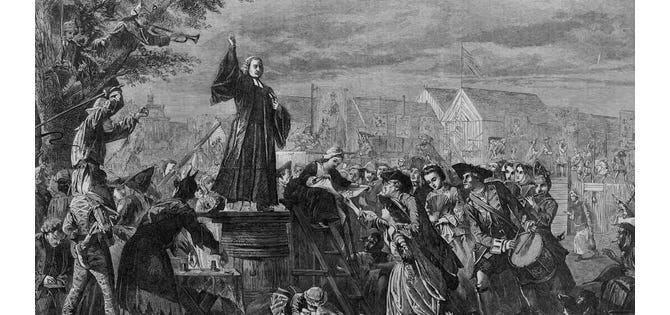
🔥 For years, I’ve argued from evidence that America is amidst a new “Great Awakening,” a historic, transformative period of religious revival. Experts sneered. It’s too soon to say, they said. Well, they sneered at the First Great Awakening too.
In 1744, a cross-eyed itinerant English evangelist named George Whitefield began drawing huge crowds of newly converted Christians as he traveled back and forth through the early American colonies 30 years before the Revolution. There is now no doubt that he launched the First Great Awakening. Benjamin Franklin famously calculated that Whitefield’s voice could carry to 30,000 people in the open air and was so impressed that he helped publish his sermons.
But the fact it was an awakening only became inarguable decades later. Then, in the white-hot heat of the moment, critics pecked it apart. Critics sneered and called Whitefield “Dr. Squintum.”
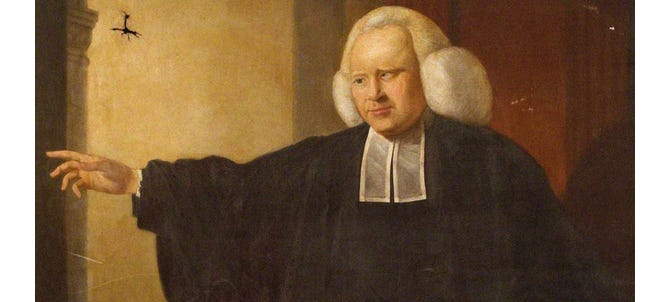
Can you guess which institution tried hardest to destroy the wandering preacher’s reputation? It was Harvard. In official testimony against Whitefield in 1744, Harvard’s faculty jointly accused him of … excessive enthusiasm. I am not making that up. The “experts” of 1744 wrote, “We look upon his going about, in an Itinerant Way, especially as he hath so much of an enthusiastic Turn, utterly inconsistent with the Peace and Order, if not the very Being of these Churches of Christ.”
Excessive enthusiasm. In other words, he was too excited about Jesus. Too much pep. Excessive Ned Flanders energy. A man dangerously over-invested in the Gospel. If only he could tone it down some. And don’t overlook Harvard’s dark warnings about public safety. It should sound familiar.
The First Church of Boston’s head pastor —what you might today call the establishment— found the danger even without squinting. He complained bitterly about Whitefield’s converts singing in public. “When this is expressed among some sorts of people by singing through the streets and in ferryboats, from whatever cause it sprang,” Pastor Chauncy wrote, “it is certainly one of the most incongruous ways of expressing religious joy.”
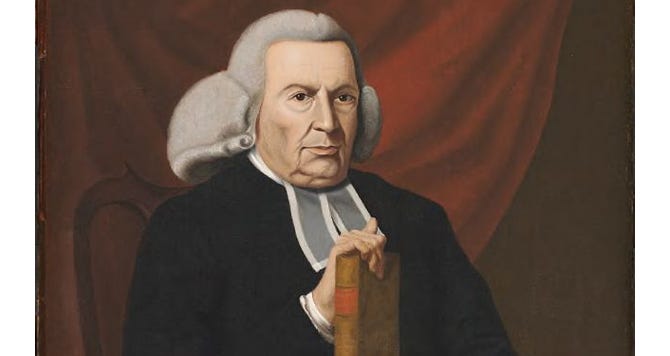
In other words, Harvard and Pastor Chauncy were saying Christians should pray at home or in church, not in public. Exactly what the progressive Supreme Court said before its landmark 2022 decision in Kennedy v. Bremerton, which reversed decades of judicial tradition and held that a high school football coach could lead his team in prayer on the field before a game.
That was four years ago. We’ve come a long way since then.
I shouldn’t omit mentioning that a 1921 Cambridge American History Encyclopedia included an entry about the Whitefield controversy noting that Harvard’s historians were remarkably honest, in retrospect, about what was really driving the establishment’s opposition to Whitefield’s Great Awakening.
The real problem wasn’t theology. It was turf and money:
“The New England clergy, as chosen members of a close corporation, abhorred the disturbers of their professional etiquette and were alarmed at poachers upon their clerical preserves. It not only threatened their social pedestals, but it touched their pockets to have these ‘new lights’ taking the people from their work and business and leading them to despise their own ministers.”
The more things change, the more things stay the same. However silly it seems now, calling Whitefield an “enthusiast” in 1744 was like calling someone a conspiracy theorist or a Christian nationalist today. In other words, a dismissive epithet designed to end the conversation by pathologizing the movement rather than engaging with its substance.
🔥 Which finally brings us back to Alex the Tarot Card reader, who appeared to her one million followers on TikTok last week, now with natural fingernails, to announce the shutdown of her popular occult channel. “This will be my final post,” the bewitching influencer said. “I am not going to be offering any more readings or sessions. I’m not going to be creating any more tarot content. And once this account is gone, I will not be returning.”

CLIP: Alex the Tarot card reader explains her unexpected retirement — “Jesus saved my life” (10:00).
Until last week, “Alex Reads Tarot” was a prominent ‘WitchTok’ creator. She offered daily tarot readings, zodiac updates, paid spiritual readings, the whole occult ecosystem. Then she went silent, nuked her accounts, deleted every single video, changed her handle to “Alex in the Ordinary,” changed her look, and posted a 10-minute testimony announcing she had become a Christian.
She didn’t just leave WitchTok. She burned the deck.
And —this is the most remarkable detail— Alex said she won’t be making any more social media content at all. She’s stepping out of the spotlight entirely to pursue God. No rebrand, no pivot, no monetizing the conversion. Just … gone. POOF. Not even a cloud of sulphuric smoke.
That wasn’t just a career pivot. It was a crucifixion of the self.
For non-Christian readers, the Bible is perfectly clear in its prohibitions against divination. Basically, occult practices invite contact with unclean spirits. Once you allow for the existence of a spiritual plane where intelligent entities live, then spiritual hygiene becomes a lot more serious. (One of the most amusing ironies of modern life is how secularists laugh at Christians for believing in invisible demonic spirits, and Christians laugh at secular folks for believing in invisible UFO aliens. Guys! Stop arguing … just LOOK … it’s basically the … oh, never mind.)
Imagine what it must take to surrender a million-strong TikTok following, with all its financial benefits, social advantages, and ‘self-worth’ currency.
In Matthew 19, a rich young ruler tragically walked away from Jesus sad because he had great possessions and wasn’t willing to let them go. Alex walked away. Full stop. Which means she found something she valued more than a million people telling her she mattered every morning when she opened her phone.
“This truly isn’t something that I say lightly, as this has been my life, my work for years,” Alex said. “Tarot has always been a very significant part of my path, and walking away from something like that isn’t easy. There’s sadness, but at the same time, there’s a peace in that decision that I can’t quite explain.”
You might call it a peace that surpasses all understanding. (Anyhow, that’s how the Bible describes it.)
“I don’t know exactly what comes next for me,” the young lady admitted. “But what I do know is that Jesus Christ has saved my life, and I can no longer ignore that reality.” Alex was only the most recent one.
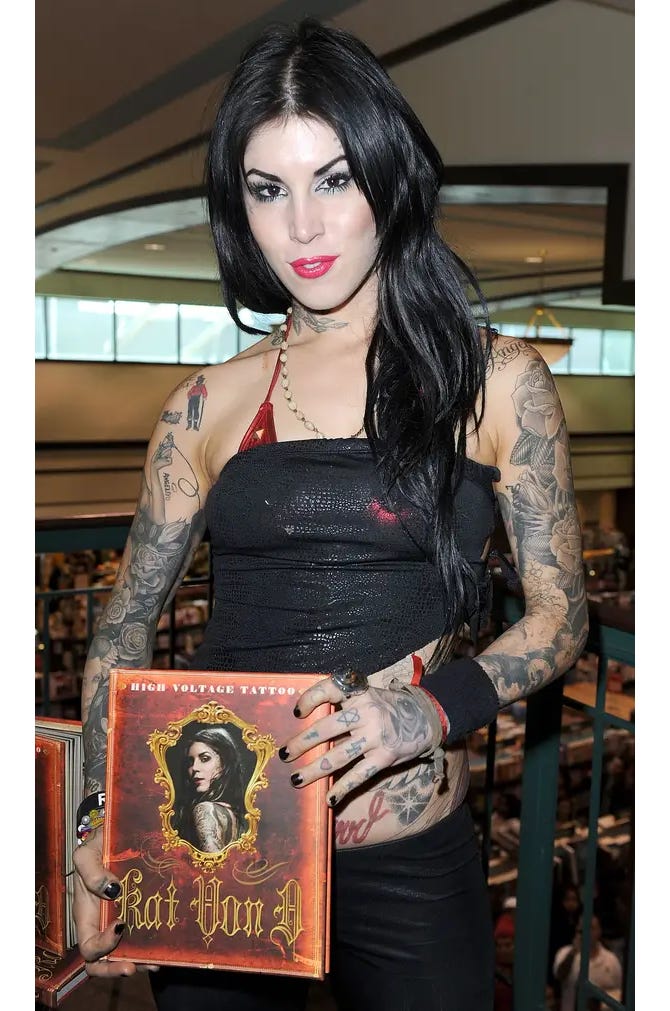
I’ve long followed these dramatic social media conversions, starting with former witchy tattoo enthusiast Kat Von D (pictured above), and carrying through other high-profile influencers like Russel Brand, Tucker, and even Joe Rogan —the biggest social media star in history— who is now practically teetering on the edge of the baptismal fountain.
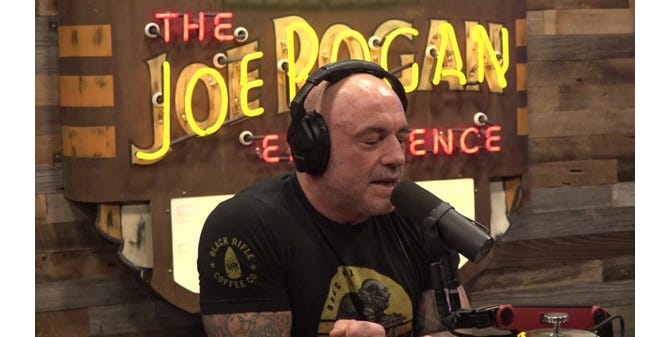
Behold what Rogan said last October, in a podcast with Konstantin Kisin delivered to 30 million listeners. First, Rogan said he enjoyed going to church. He defended the Bible against atheist critiques, and then he said:
“Christianity in particular is the most fascinating to me because there’s this one person that everybody agrees existed, that somehow or another had the best plan for how human beings should interact with each other and behave and was the best example of it and even died in a nonviolent way, like didn’t even protest, died on the cross supposedly for our sins. Like, it’s a fascinating story. What does it represent, though? That’s the real thing. What was that? What happened? Who was Jesus Christ, if it was a human being. What was that? That’s wild.”
Too much enthusiasm!
It’s beyond wild. The reason I keep covering this trend is that it’s one of the most important, and maybe even fundamental, components of the time we’re all living through. It matters not whether you’re a believer. It’s affecting us all in the most remarkable and unexpected ways.
🔥 The historical timelines for Great Awakenings weren’t natural cycles. They were information cycles. The First Great Awakening spread at the speed of horseback, word of mouth, and Benjamin Franklin’s creaky printing press.
In those days, it took years for news of a revival in Northampton, Massachusetts to reach Charleston, South Carolina. The reason famous colonial evangelist Jonathan Edwards had to write A Faithful Narrative of the Surprising Work of God in 1737 was that it was the only way he could inform people in other colonies about what was happening in his church.
The revival phase used to require a generation to complete because that’s how long it took for the ideas and the testimonies to slowly spread through the colonial culture.
But social media has collapsed that propagation time from decades to hours.
Alex —a relatively small Witchtok creator— posts a 10-minute testimony on a Sunday night, and by Tuesday morning 81,900 people have seen it, including people from rural Georgia, suburban Ohio, to downtown Seattle. People who would never have run into each other in any other context.
Kat Von D’s conversion reached millions of people who would never read Christian media. The Asbury Revival in February 2023 drew 50,000 visitors to a small Kentucky town within two weeks— not because of corporate media coverage (don’t make me laugh) but because people were posting videos from inside the chapel in real time.
What required 30 years to spread in 1740 now spreads in 30 hours. Which means the compression of a modern revival phase might also be proportionately speedy. If the First Great Awakening’s revival phase lasted a generation because that’s how long it took for information to travel, then a revival in the age of TikTok, Instagram, and X might achieve the same cultural saturation in five to ten years rather than thirty.
We have arrived at an astonishing moment in time. Amidst swelling youth attendance, record Bible sales, favorable SCOTUS decisions, and a steady stream of unlikely influencer conversions, Christians have now just witnessed the publication of an enthusiastic book-length government report calling for the fundamental, structural dismantling of the legal architecture that has suppressed public faith for eighty years.
And that report has arrived at the one moment in living memory when the entire federal government —from the Oval Office to the Cabinet to the courts— is not merely open to it, but practically yearning for it.
It all feels penultimate. Meaning, one tiny step from some glorious conclusion, a new Great Awakening, and maybe, just maybe, a Golden Age. Let me know what you think in the comments. And be enthusiastic.
Be encouraged and have a magnificent Monday! Meet me back here tomorrow morning, for more essential news that the corporate media is ignoring along with highly caffeinated commentary.
Don’t race off! We cannot do it alone. Consider joining up with C&C to help move the nation’s needle and change minds. I could sure use your help getting the truth out and spreading optimism and hope, if you can: ☕ Learn How to Get Involved 🦠
How to Donate to Coffee & Covid
Twitter: jchilders98.
Truth Social: jchilders98.
MeWe: mewe.com/i/coffee_and_covid.
Telegram: t.me/coffeecovidnews
C&C Swag! www.shopcoffeeandcovid.com
Always remember a government big enough to give you everything you want is a government big enough to take away everything you have, including Your Freedoms, Your Liberties and Your Property.
✝️✝️✝️
“Therefore everyone who hears these words of Mine and acts on them, may be compared to a wise man who built his house on the rock. And the rain fell, and the floods came, and the winds blew and slammed against that house; and yet it did not fall, for it had been founded on the rock. Everyone who hears these words of Mine and does not act on them, will be like a foolish man who built his house on the sand. The rain fell, and the floods came, and the winds blew and slammed against that house; and it fell—and great was its fall.”
— Matthew 7:24-27 NAS95
✝️✝️✝️