

Good morning, C&C, it’s Wednesday! Initially, I planned just a short follow-up to yesterday’s story about the new America.gov website and its day-long launch event. It was the biggest launch of any single Trump 2.0 initiative, which should reveal something. But when corporate media almost universally ignored it in substance (only reporting to mock it), despite its obvious newsworthiness, I decided to deliver a special edition. Wait till you see the big picture that media is pretending doesn’t exist. You’ll understand why they don’t want to talk about it. This is a breaking C&C story.
🌍🇺🇸 ESSENTIAL NEWS AND COMMENTARY 🇺🇸🌍
📈📈📈
Picking right up where we left off yesterday, this may not be Trump 2.0’s most geopolitically impactful improvement, but it could be the one with the most direct effect on normal people— and not how you might think. Admittedly, the surprise announcement of a new federal website was not intuitive. In a rare moment when his team of writers stumbled over an actually funny joke, Jimmy Fallon noted that the Administration looked at two things nobody trusts —the government and AI— and said, “hey, let’s combine them!” Predictably, the New York Times mocked the rollout, reporting, “Trump Launches Government Chatbot That Contradicts Some of His Claims.”
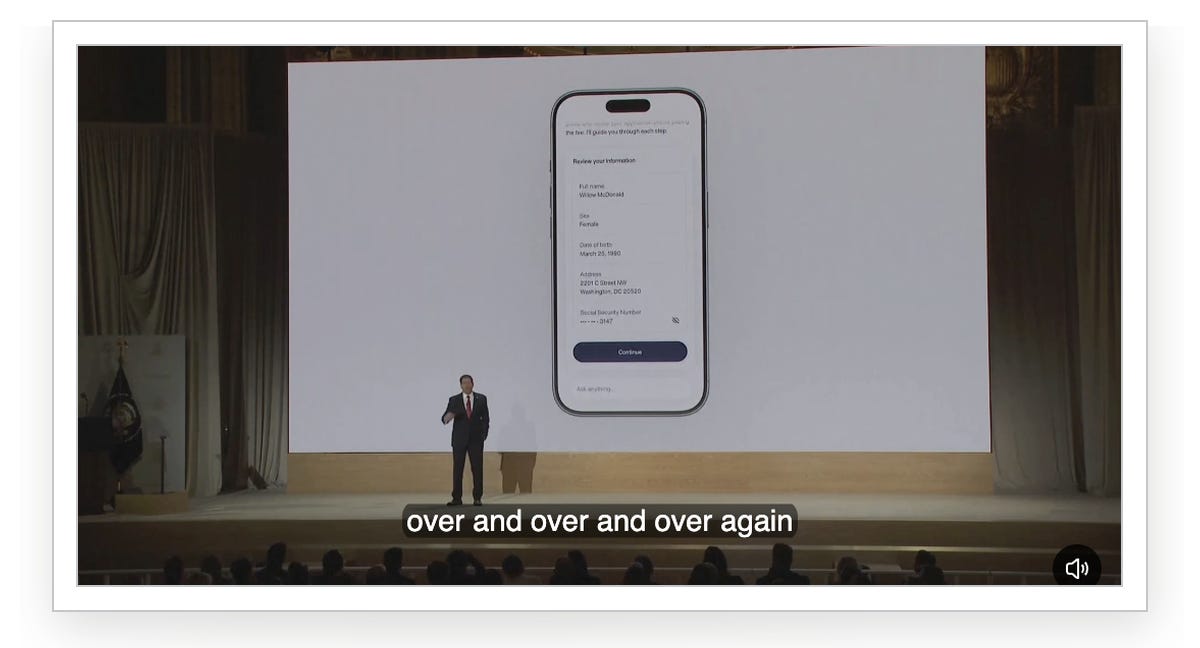
It was arguably one of the most remarkable government events we have ever seen, in which most of the Trump Cabinet and a remarkable in-person collection of the country’s top tech leaders held an “Apple Launch Event”-style, day-long rollout of the America.gov one-stop web portal in what can charitably be called the beta version. Everything about it was extraordinary.
Accompanying the public events, the President signed his latest executive order, this one simply titled, “Streamlining Access to Government Services Through America.gov”. Reading past the simple title, we began to see that something new was happening. Right in its introduction, the EO clarified that this was not just bureaucratic fine-tuning, not one more federal “customer service” website piled atop all the rest, but its modest goals included redefining government itself:
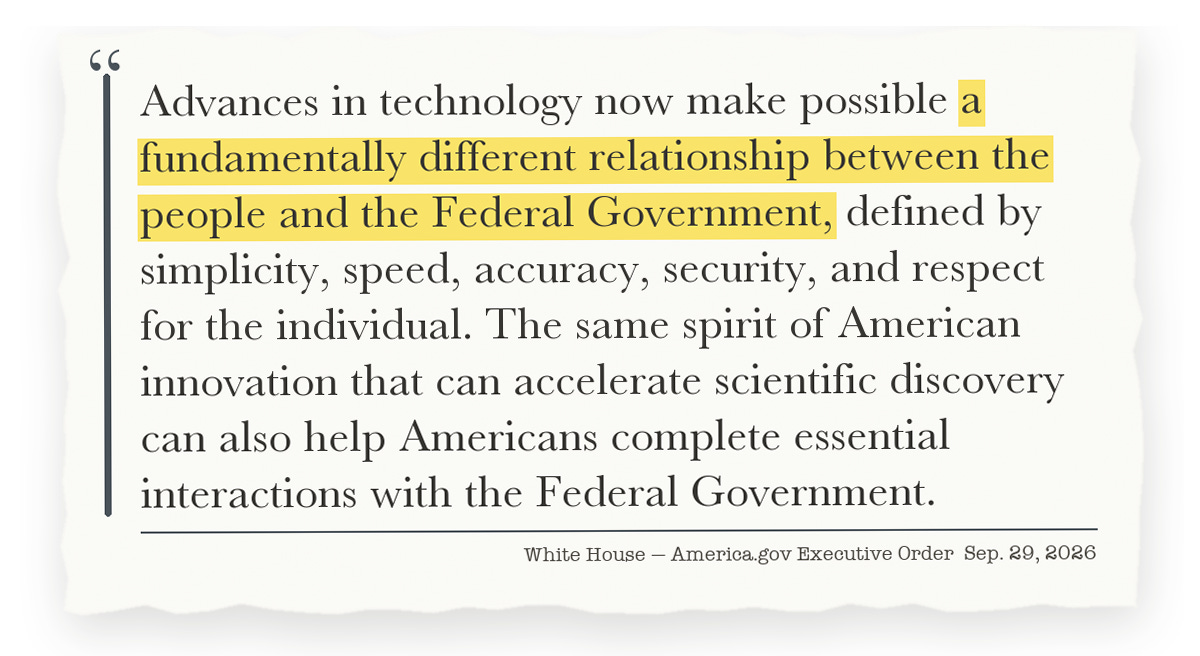
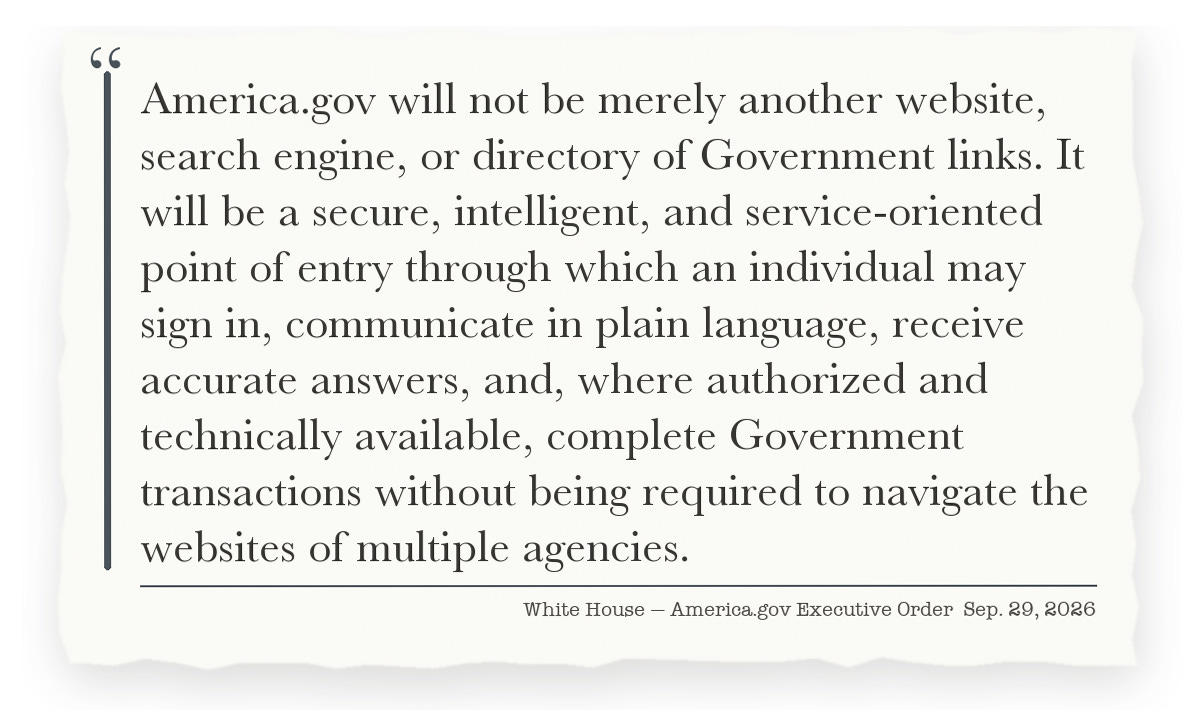
Many of you will be reassured that the order repeatedly stressed the importance of privacy, of not using people’s queries to assemble dossiers on American citizens, and it won’t replace any existing ways of working with the government. It explicitly excluded income tax filings and military/intelligence information, which seems reasonable. Other than that, America.gov is meant to be a single point of entry for most government transactions and reliable information.
To give you an idea of how mind-blowing this rollout was —and everything that corporate media refused to report— here is a CNBC clip from yesterday with normally anti-Trump anchor Andrew Ross Sorkin gushing about America.gov.

CLIP: CNBC Squawk Box anchors marvel about, of all things, a new government website (4:15).
“By the way, the president deserves credit,” Sorkin, a former New York Times staffer, said. It was so out of character that, when he said it, co-anchor Joe Kernan exclaimed: “Oh my g-d! Now I’m getting hot flashes!”
Sorkin, who attended yesterday’s launch event live, reported in amazement that “It was one of those moments where you actually thought the government was working for you.” This is the point. Nobody is used to the government making things easier. It always makes stuff harder.
It made an impression. “For 29,000 websites, the ability to get a passport, the ability to get your Medicare,” Sorkin explained. “I mean, it was like being at an Apple product announcement.” In other words, it was nothing like the government we are used to.
Let’s quickly touch on a few revolutionary things the corporate media wants you to never find out about.
📈 First, there’s the promise that so struck Andrew Ross Sorkin— of even a single government initiative to make anything easier rather than harder. Take passports. When Secretary of State Marco Rubio explained that Americans can soon apply for and renew passports in mere moments, from anywhere, and then track the shipment in real time, I nearly dropped my sandwich.
For most people, visiting the post office to renew the family’s passports ranks somewhere just above a dermatologist appointment to get a few pre-cancerous spots frozen off your face and right below an emergency HOA neighborhood meeting to “discuss” the RV in your backyard.
It’s not just the post office ordeal. My most recent renewal visit involved first stopping for a Walgreens passport photo that bore a stunning resemblance to a Pinellas County mugshot. (For $16.99, they could at least have thrown in the height indicator.) And of course, only later, while we were waiting to be called on with our little pulled appointment ticket, did Michelle point out the stray strand of hair in the picture jutting out wildly from behind my left ear and lending the whole thing a slightly maniacal look. Think of a picture next to a Miami Herald headline saying, “Police seek help locating suspect.”
And then, when it was finally our turn, came the inevitable discovery that the third birth certificate in the stack was not a certified copy, and would we like to schedule another appointment for when we come back with the right one?
So, given how much everyone dreads the passport experience, you might think the Times could find something to say about a collective passport upgrade. Nope. The word “passport” didn’t appear in the story at all. Apparently that wasn’t news fit to print. (But the Grey Lady’s front page did find room to run a critical breaking story headlined “Indoor Cats Are Getting Outside, Thanks to ‘Catios’.”)
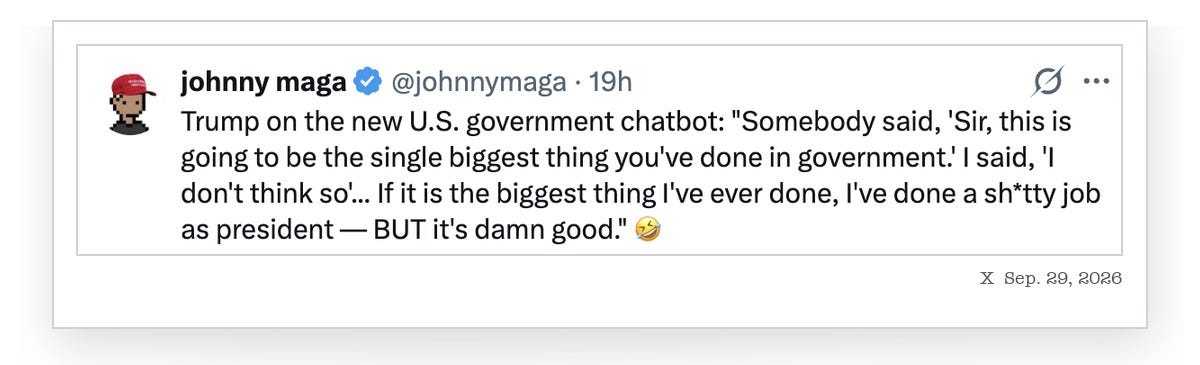
To be fair, it wasn’t just the Times. Virtually the entire corporate media, and all the prestige platforms, embargoed the historic launch. But social media noticed. And even President Trump reported that people were telling him it was “the single biggest thing you’ve done in government.”
📈 Next on the list of notables was the lack of leaks for a massive, government-wide software project that must have been a logistical T-Rex, not only to build the thing, but even just for the launch event itself. Still, nobody outside the Trump Team saw it coming, even though it’s obvious in hindsight they’ve been preparing for almost two years.
Among all the other technical wizards at the event was Edward “Big Balls” Coristine of DOGE fame. Now we can see at least part of what the DOGE teams were doing early last year when they invaded every federal agency (making Democrats squeal in outrage). They were wiring it all up for this.
In other words, this new AI-driven, single-start federal services portal was planned from Day One. At the time, DOGE spoke openly of “modernization” and “efficiency,” but everyone thought that was just the same tired, endlessly recycled initiative Americans have been promised since the Eisenhower administration.
But there was a real project. And somehow they kept it all tightly wrapped until yesterday.
So that’s two.
📈 Third, the breathtaking scope. Reducing the friction and cost of dealing with the government is already huge and is a praiseworthy goal. But this is so much bigger. President Trump said, almost offhand: “Nobody can any longer complain about providing proof of citizenship or voter ID. They’re always saying, ‘It’s too complicated, too complicated.’ It’s not complicated anymore.”
He was right. What have the SAVE Act’s critics focused on like obsessed maniacs? How hard it is to get a passport. Think of the poor married women whose names changed! Think of the black people who can’t fill out the forms! The irony was too rich. They were literally blaming the government for being too complicated, so of course —q.e.d.— we can’t check people’s IDs for citizenship. Don’t be ridiculous.
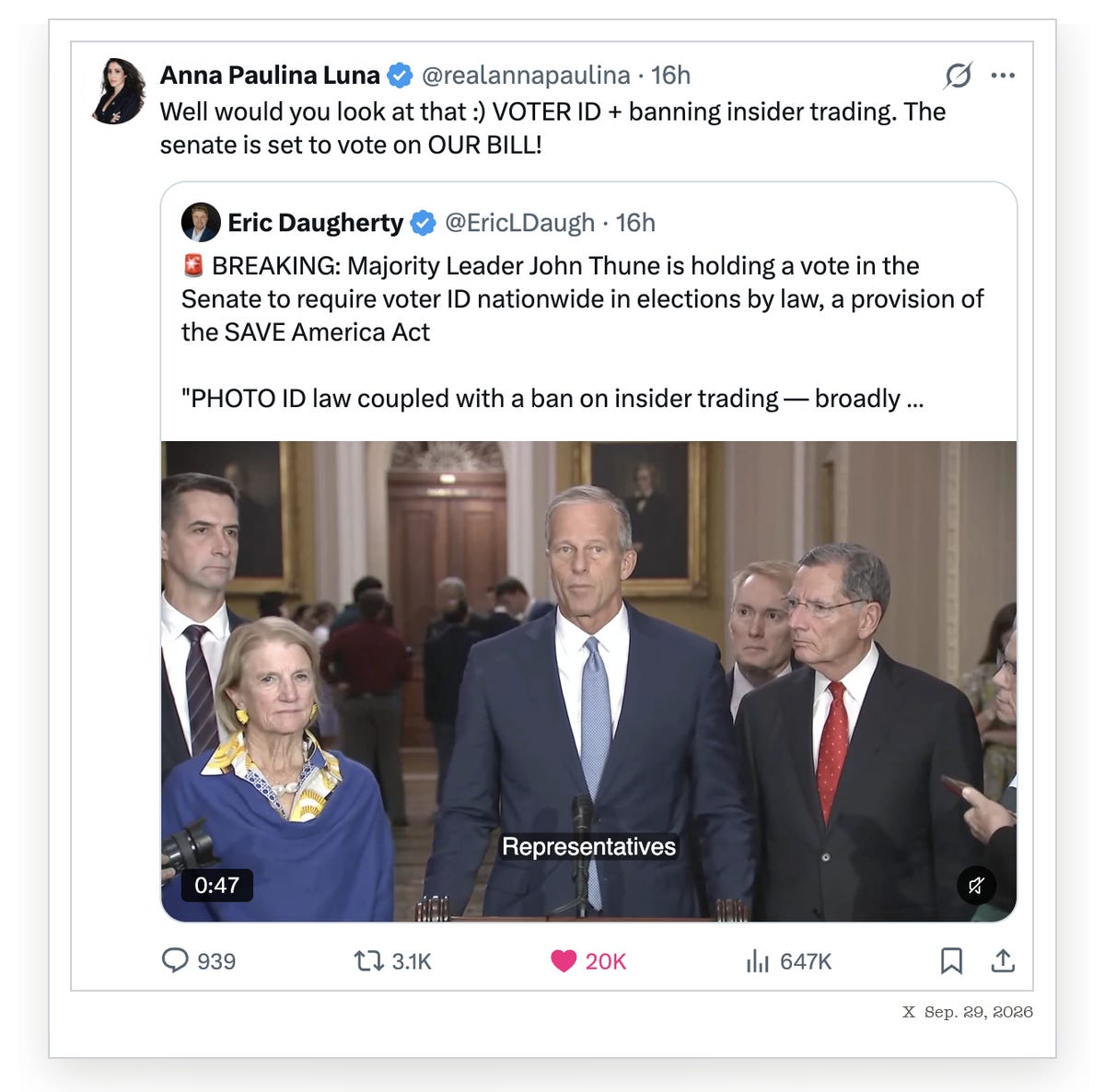
Welp. Trump’s website team just put that complaint to bed. So now what will they complain about? And look at this: also yesterday, Senate Majority Leader John Thune announced another vote in the Senate on the SAVE Act’s federal voter ID requirement. Terrific timing, wouldn’t you agree? Right after America.gov took the excuse away.
Can you see it yet? This isn’t just the latest government efficiency program. It’s a comprehensive plan to remake how government works from the bottom up.
Also yesterday, Trump rebranded artificial intelligence to super intelligence, at least as far as the government is concerned. He is ditching A.I.’s baggage. The product isn’t new, but the name is. It almost doesn’t matter whether super intelligence is a good name or not. It’s different.
Nobody should be surprised. After all, he’s rebranded the Gulf of America and the Department of War. Now this. It’s the president’s unique ability to roll roughshod over longstanding labels everyone else would shrug and accept as written in stone, just something to be worked around. Not Trump. He just changes the name and moves ahead.
📈 Given all that, it was unsurprising that, yesterday, Trump also held a White House roundtable and luncheon with every AI luminary in America. The President is not accepting any slowdown. And he somehow, seemingly effortlessly, got them all on board. Even though going along will cost them trillions. Their IPOs were counting on a slowdown.
Behold, the Wall Street Journal, this morning:
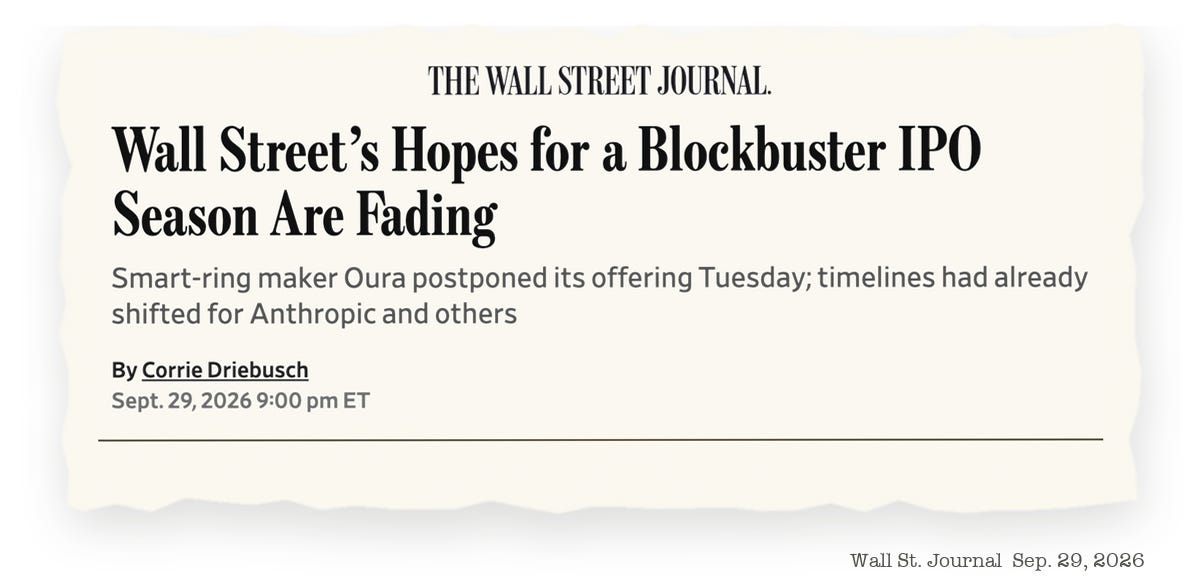
Trump is telling them not to slow down, which means they must compete harder. Forget about the IPOs this year. That’s the last thing they want to do. The competition in AI is brutal. You’ve seen it. Every single day brings another new product announcement. The leading tech companies need a slowdown, to catch their breath, build their moats, and get consumers tied into their product lines where it becomes impossible to escape.
Till yesterday, they wanted the government to make everyone slow down. Thus, we saw an “AI safety” craze coupled with incongruous requests for more government regulations.
The IPOs are big money. It’s literally a trillion-dollar game. Media wants it. Wall Street wants it. But only the first AI companies to go public will enjoy the lion’s share of profit— but they need room to maneuver, not hyena-like packs of smaller competitors constantly nipping at their heels and announcing new competitive breakthroughs right before the IPO kickoff.
So they bought influencers. They bought the corporate media, which went to war for them. But yesterday, President Trump told them all “no.” He said, “we’re staying out of it.” He said, “keep competing, except faster. And safely.” And they all smiled and nodded. I can’t remember ever seeing a rising industry begging for government involvement and the government keeping out and the companies rolling over like a favorite family Dachshund.
Don’t worry about the AI companies too much. They’ll be fine. Trump also just created a breathtaking new market. Here, I’ll show you.
📈 We’ll end with the profound downstream implications. I’m still connecting the dots, but there’s something deeply emasculating about this for the Deep State. For today, I’ll offer one example. We’ve learned that the deep staters and Democrats (but I repeat myself) have largely operated through networks of NGOs and “charitable” nonprofits.
Everybody was getting rich, except us. Every halfwitted Democrat politician seems to own a portfolio of 501c3s and c4s that are funded by government grants. If a former bartender could manage to do it, why couldn’t every entrepreneurial American? We can’t because the process is intentionally opaque. Compliance seems complicated and risky. The grant opportunities are hidden in boulder-sized balls of red tape.
It was invisible; there was no easy way to figure out what generous federal grants AOC, Newsom’s wife, or Stacey Abrams were applying for. The grant notices and awards were “published” in the sub-basement of an annex to the Congressional office building in DC. Soon, presumably, they will be online, in one place, surfaced with an English-language prompt.
So what happens when anybody can create 501cs and apply for grants —not just the deep state insiders— by logging into America.gov and asking for the forms? (The answer is that the rules are probably about to get overhauled, but that would be an even better outcome.)

In the terrific 2005 sci-fi classic Serenity, the Operative said, “If your quarry goes to ground, leave no ground to go to.” The America.gov website could help tear all the cover off the deep state’s hidey holes. Think about it.
📈 Finally, I suggested that Trump is giving the AI companies a gift of a vast new market. He told them no regulatory slowdowns, but neither did he leave them empty-handed. America.gov didn’t just modernize citizen access to the federal government. It created fifty new state modernization projects.
Speaking for myself, as a Florida lawyer, the Sunshine State has 67 counties, and each one has a separate court system with a unique website and authorization process to access so-called “public records.” Every judge has her own website with her local rules. The DMV has its own system. Business registrations have their own. Every school district runs a separate and distinct login. The property appraisers all have their own.
This is why we have paralegals. Because if I had to learn how to navigate all of that, I would retire and go collect shark’s teeth on the beach.
Now that President Trump has proven the concept for the entire federal government, all 29,000+ separate systems, establishing that upgrading is not only possible but has already been launched in version 1.0 —all within the Executive Branch, without needing a single act of Congress— how long until every state governor succumbs to the pressure to do the same thing? Citizens won’t long accept archaic, “Internet 1.0” service. And Trump just proved it can be done fast.
Passports are one thing. Now imagine being able to quickly and easily renew your vehicle tag or driver’s license from home in a few clicks. No DMV. You won’t even need a stamp. This is all coming next. And now, thanks to the example set by America.gov, it’s coming much sooner.
This is how —via a single website with a chatbot— President Trump just redefined government itself. And even though America.gov looks obvious in hindsight, only Trump imagined the possibilities. Nobody believed our dysfunctional government could pull something like this off.
Here is where the commercial opportunity happens. Each state must now contract with an AI company to help build out its own massive upgrade project, to wire up that state’s thousands of separate state and local systems as well. How much do you want to bet those conversations have already started?
In 1998-99, the tech industry experienced a major boom thanks to the “Year 2000 bug” that forced all of corporate America to upgrade its software over 24 months so it wouldn’t crash from dates that were stored with a two-digit year.
This upgrade cycle will make the Year 2000 bug look like an iPhone update.
The DOGE team members, each of whom undertook horrifying professional risks to join up in 2025, will never want for work. Anthropic and OpenAI are poised to sign multiple multi-billion-dollar state contracts. They’ll need to staff up. The economy just got another massive boost.
📈 I will leave you with this. The New York Times saw America.gov with all its profound implications— and all its reporters could think to do was ask the website, “Who won the 2020 election?” I would call it a spectacular failure of imagination, except it is really a symptom of something far more significant. It is the dying death rattle of an expiring industry.
Like the legacy model of government, unless it reinvents itself, the New York Times has become obsolete. And I, for one, am ready to serve up the popcorn. 🍿
Have a wonderful Wednesday! Get back on the website tomorrow morning, and log in for another terrific installment of insightful essential news and highly caffeinated commentary.
Don’t race off! We cannot do it alone. Consider joining up with C&C to help move the nation’s needle and change minds. I could sure use your help getting the truth out and spreading optimism and hope, if you can: ☕ Learn How to Get Involved 🦠
How to Donate to Coffee & Covid
Twitter: jchilders98.
Truth Social: jchilders98.
MeWe: mewe.com/i/coffee_and_covid.
Telegram: t.me/coffeecovidnews
C&C Swag! www.shopcoffeeandcovid.com
Joe Gebbia, Big Balls, and the DOGE team are unsung heroes in the admin. Patriots in control. Contrast with Obama’s healthcare.gov, a disaster that took years and billions of dollars.
Blue states are tiresome empires of dust even more inefficient and corrupt than Africa: https://yuribezmenov.substack.com/p/empire-of-dust-ccp-congoits-all-so-tiresome-meme
Imagine if Trump could come up with an AI system that could run the entire American government with its soul intention to Make America Great. No corruption, fraud, no two tiers of justice, no sweetheart deals, no insider trading. We could replace the entire government and all of the hacks and be back in the black in no time.
Look at the Bidens for instance. We payed for his hair, we paid for his teeth, we paid for all of his surgeries, his kids to be born, his kids insurance, his transportation, his phones, his utilities, all of their protection, it never ends. Eventually we’ll pay for his final resting place and all of his families as well. It’s like cradle to grave. Imagine a government that truly looked out for just the citizen and their interest. I think we’re on to something.