

Good morning, C&C, it’s Thursday! Today’s roundup includes: Washington's most generous new debt-forgiveness program — up to $1.8 million wiped clean, one small condition attached, and somehow Democrats hate it; the Times' heartbreaking profile of a woman seventeen years late for a court-ordered flight home; a freshman Congressman's one-page bill that accomplishes what nine black robes couldn't; House Republicans stapling the SAVE Act to everything that isn't nailed down, then daring the Senate to keep peeling it off on camera; fourteen states running the most effective copy-and-paste operation since the invention of the college term paper; and Joe Biden's bold legal theory that his words are public record on paper but classified in audio — an argument two D.C. judges declined to hear, in every sense.
🌍🇺🇸 ESSENTIAL NEWS AND COMMENTARY 🇺🇸🌍
🔥🔥🔥
Yesterday, the New York Times ran an unintentionally encouraging story headlined, “Trump Administration Pressures Some Immigrants to Self-Deport With Fines Up to $1.8 Million.” In other words, just like the ABC Revolving Bar at 2am: you don’t have to go home, but you can’t stay here. The self-deportation story might be bigger than we think.
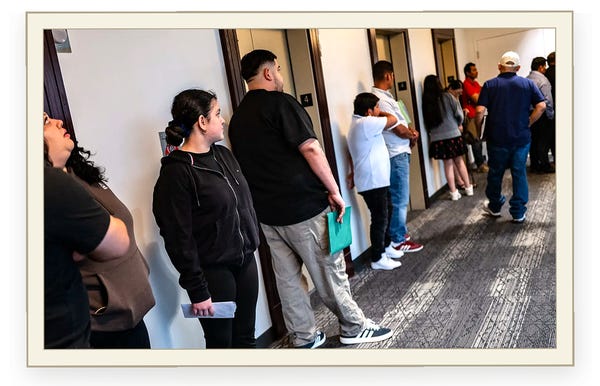
“More than 100,000 people,” the Times reported, “have received letters from DHS informing them that they owe $998 for each day that they have stayed in the U.S. whenever an immigration judge has ruled they have no legal right to remain in the country.”
$998 a day can add up quickly.
The ability to levy fines has been on the books a long time, ever since a 1996 immigration reform package that Congress promised Americans would tighten up immigration. Then once it was passed, legislators diligently got down to work by pretending like the new rule didn’t exist. “Until President Trump,” the Times admitted, “no commander in chief had imposed such penalties.”
It took thirty years to exceed a fine of $0 a day. Every previous president was too yellow-bellied to try it.
Lacking any legal basis to complain, the Times platformed a human interest angle designed to generate suicidal levels of empathy in middle-aged white liberal women. It described Vivi Vasquez, a hardworking, Mexican illegal immigrant minding her own business, who ‘cares for seniors,’ who has been quietly living ‘under the radar’ without permission to be here for seventeen years, but don’t worry.
The Times editors assured readers she has applied for a “humanitarian visa application.”
Not a visa, mind you. An application for a visa. After 17 years. And as we shall soon see, long after a judge entered a final order of deportation against her (but of course the Times omitted that saucy fact). It’s not just that her application’s chances are a long shot.
Never mind that she’s not being persecuted or anything. How can she possibly get a visa while she’s under a judge’s deportation order that she wilfully defied for 15 years? The Times did not speculate about that, because it would ruin the narrative.
🔥 Apparently, at least 100,000 people are still sitting around, still on the books, for years and decades after being ordered to leave just like Ms. Vasquez. They know where they are. They mailed them letters.
Unsurprisingly, the Times credibly accepted the manifest threshold problems with her silly visa application without any critical analysis, which it reserves for Trump’s midnight tweets threatening the Ayatollah. But the visa application excuse is even dumber than it looks; a humanitarian visa is intended only for short stays in cases of emergencies from persecution, wars, disasters, disease outbreaks, or, for that matter, outbreaks of communism. That kind of visa makes no sense at all given Vasquez’s described legal posture.
Frankly, I doubt it exists.
Either way, the Times rushed too quickly to include Ms. Vasquez’s DHS letter, for one reason— it couldn’t wait to show readers the eye-watering $1.8 million fine at the bottom. (I told you that $998/day can add up.) But the form revealed much more, showing the Times once again mendaciously twisting the facts to satisfy its story’s needs instead of writing an honest story based on the facts.
Here’s Ms. Vasquez’s DHS notice, from the Times’ own story:
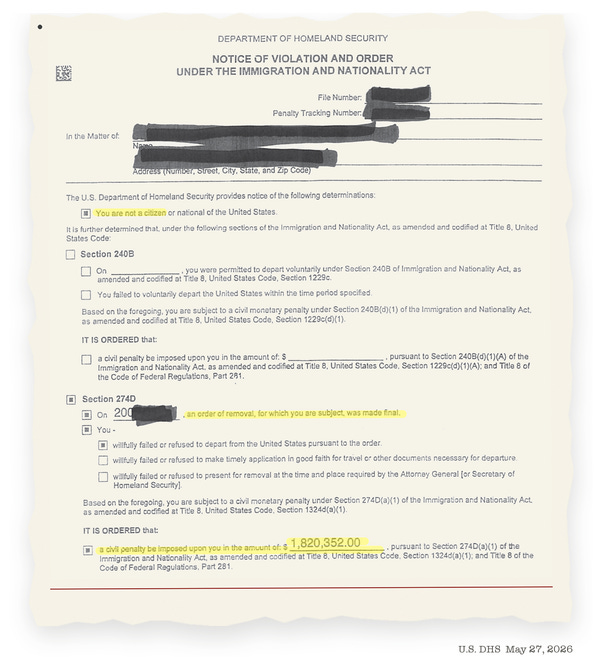
(Why they redacted her name but then printed it in the article is anyone’s guess. Don’t ask me to explain why the Times does things.)
Before getting to the admittedly steep fine, DHS’s handy-dandy form and its checked boxes revealed two equally damning facts:
Vasquez is not a citizen, is thus here illegally, a fact that both Vasquez and we already knew.
Sometime, over 15 years ago (the unredacted part of the year shows “200…”-something), a judge ordered her removal. She was here for a few years, then went to court and— case closed. But she still didn’t leave, which in some circles is considered poor guest behavior.
That second box, my friends, is the only spot in the Times story where it disclosed that Vasquez was not an innocent visa applicant getting chewed up by the system, but someone who’d already had her day in court, years and years ago, and is now continuously defying the entire American justice system— an act of judicial defiance that, if you are a Republican and a citizen, earns you a stretch in federal prison. Just ask Steve Bannon.

Anyway, the DHS notice came with a helpful pamphlet (in Spanish!) explaining how to use the app to self-deport, along with an offer to forgive her legal fines— if she took the opportunity to leave. Seems like a very fair offer with generous terms. But the Times was outraged. Bullying! Threats! Excessiveness!
However, there was exactly zero evidence in the story that Ms. Vasquez is meaningfully considering returning to Mexico. So I guess it’s not that much of a threat.
🔥 The Times later added that she has now received a second, sterner letter (this one mentioned but not published). “Unless she promptly paid, it said, the government would refer her debt to a private collection agency; initiate federal collection litigation; report her to credit bureaus, ‘which could adversely affect your credit rating;’ and consider the debt in her future immigration proceedings.”
Most important: the fines allow the government to seize the person’s federal payments. In a different example from the story, a man who’d defied his own removal order saw his $11,000 tax refund captured by collections to pay down his fine. So.
The 100,000 letters cited by the Times’s story are encouraging, but fall well short of the kinds of numbers we need to see for effective mass deportations. Never fear, though. The story explained that, “the fines are part of a parallel effort by the administration to squeeze undocumented immigrants and make it harder for them to live in the United States.”
In other words, the fines and letters for people who’ve defied their removal orders like Ms. Vasquez are just one part of a bigger, broader self-deportation effort. Given the logistical nightmare of deporting mass numbers against their will, self-deportation is the only reasonable strategy.
Aggressive involuntary deportations (roundups and catch-and-deport) might thus be seen as a smaller part of the larger self-deportation strategy, which is emerging as having been the real story all along.
🔥 Yesterday, U.S. Representative Brandon Gill (R-Tx) — who has been crushing it lately— announced his new bill that attempts to answer the Supreme Court’s disappointing birthright decision.
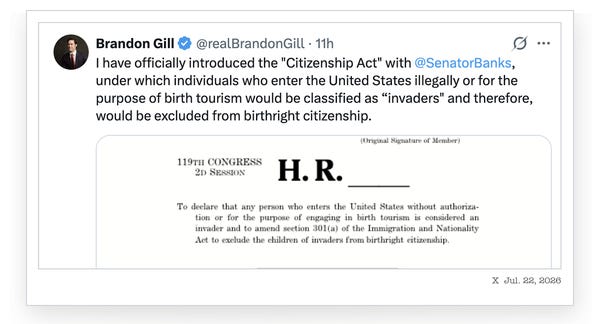
The bill is elegant in its simplicity. It simply defines, for legal purposes, any non-citizen who enters the country without documentation or for birth tourism purposes as an “invader.”
Under the Supreme Court’s own decision, invaders have no right to birthright citizenship. Under Wong Kim Ark, the precedent SCOTUS relied on to decide Trump v. Barbara, the court carved out three narrow groups that do not automatically get citizenship rights. One of those groups is children of invading or occupying military forces.
Gill’s proposal might actually be a more elegant solution than a Supreme Court decision, since it would leave undisturbed the many, many folks who’ve relied on the existing birthright rules and have joined the national melting pot. While I see (and could be persuaded to agree with) the argument they should be denaturalized and removed anyway, that would create the kind of chaos and turmoil that makes it a non-starter with a current SCOTUS majority.
The bill isn’t perfect. The court has carefully connected “invaders” with “foreign militaries,” so it could still reject that definition as applied to civilians who entered without papers, rather than as part of any recognized military force.
Still, it is a nice start. Other bills have been filed. We need these kinds of creative solutions, and more of them. You can’t win if you don’t take shots on goal.
🔥🔥🔥
Speaking of shots on goal, the House unleashed a torrent of passed bills yesterday, all including SAVE Act language, and at least one bill that could overcome the 60-vote requirement. The Hill reported, “House passes reconciliation framework for Pentagon boost, voting restrictions.”
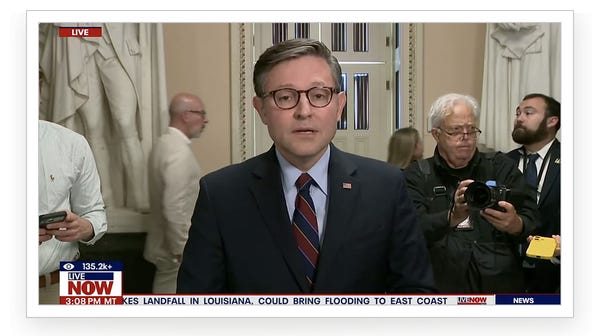
CLIP: Speaker Johnson announces a reconciliation bill with SAVE Act provisions (1:06).
Before we raise our hopes up too high, Senate Majority Leader John Thune recently forced a direct vote on the SAVE Act that lost 48-51. So we might not even have 50 votes supporting the SAVE Act, for Vice President JD Vance to break a tie on.
Worse, a few of the 48 votes in favor seem squishy, meaning that those Senators might flip if there were a realistic possibility the SAVE Act might actually pass.
Still, the House deserves credit. Unlike most of this term, it actually got a lot of work done yesterday— and is still trying to kick the SAVE Act into the Senate goal net. As Ari Fleischer noted:

It might not go anywhere in the Senate, but Senators know that every time they are given a chance to vote and strip out the SAVE Act, it is another time they look like complete jackasses.
🔥 Yesterday, the Washington Post reported, “House passes stock-trading restrictions for lawmakers, but not a full ban.” The subheadline explained, “The bill would bar future stock purchases by lawmakers and their families but let them keep existing holdings. An added voter ID provision clouds its prospects in the Senate.”
Cynical critics complain that, by combining stock restrictions and voter ID requirements, the bill is unserious and will just get shot down in the Senate. That analysis may have some merit. But it ignored the political cost to the Senate I mentioned above.
Let’s review a historic parallel.
From the mid‑1990s through 2002, Senators John McCain and Dianne Feingold (and allied reformers in both parties) introduced and re‑introduced campaign‑finance bills year after year, with essentially the same core objectives: banning party soft money and tightening rules on issue ads. (We’ll leave aside whether or not it was a good idea.)
McCain and Feingold faced repeated filibusters, procedural roadblocks, and intense opposition from party establishments and interest groups, but they relentlessly kept bringing back slightly modified versions each Congress until they finally assembled a coalition to pass the BCRA. That persistence, over multiple Congresses and news cycles, resembles the way SAVE‑style proof‑of‑citizenship and voter‑ID requirements are being pushed repeatedly by the House at the federal level and —importantly— copied in state legislation.
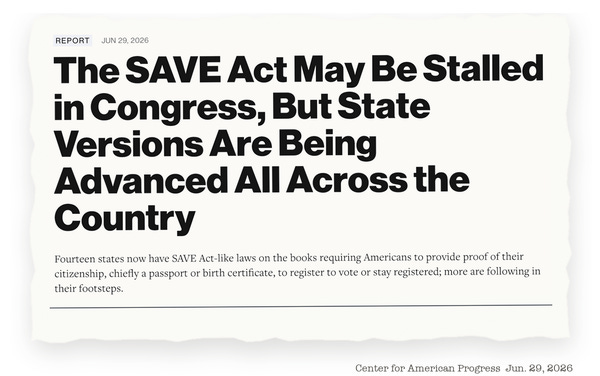
That latter fact —state laws mirroring SAVE Act-style requirements— might be the quiet, buried lede of this entire debate. Three weeks ago, the Center for American Progress published an encouraging status update:
It reminds me of another historic parallel.
Beginning in the late 20th century, “shall‑issue” and then permitless/“constitutional carry” regimes emerged for the first time in a few states and then progressively marched across the map. Early adopters on shall‑issue concealed carry included states like Washington (1961), Indiana (1980), and several northern plains states in the mid‑1980s, which then became the template for later legislation elsewhere.
Over time, advocacy groups and aligned legislators ran the same basic playbook —introducing similar bills, cycling through defeats and partial wins, and coming back with slightly modified versions— until, by the mid‑2010s, almost all states allowed some form of licensed public carry. Along the way, the Supreme Court helped out with key decisions supporting Second Amendment rights.
In the last ten years, the movement pushed further, into permitless carry: by summer last year, 29 states allowed concealed carry without a permit, with Vermont never having required one and 28 other states joining between 2003 and 2024.
Gun‑rights advocates succeeded by using early‑adopter states as proofs of concept and then cascaded across the map. In 2026, SAVE‑style advocates are now doing the very same thing, except for citizenship documentation, ID, and rules for registration and voting.
You might argue that we don’t have 40-50 years to get this right. True. But there are a couple of encouraging developments. First, in less than a year, fourteen states now have SAVE-style requirements, with several more states considering passing those laws. And others, like Alaska, are considering symbolic laws —such as making noncitizen voting illegal, but not requiring proof of citizenship— which aren’t the solution but do show incremental progress.
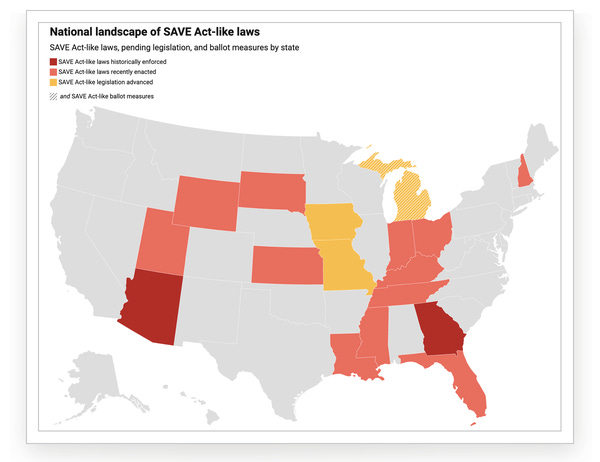
Here’s the encouraging part: The velocity and pace of state passage of SAVE laws far outpaces the slow start of the pro-2nd movement. So it is happening faster. And ask yourself this: could more big red states, like Texas, be far behind?
🔥 Second, you’re probably thinking that the states that need SAVE the most (cough, California) will be the last ones to board the train. That is undoubtedly true. But the same was true with gun rights, which eventually captured the bluest of blue states as well.
Next, every state that does join tilts the national pinball table further away from the fraud trap. This counts the most in cases like presidential elections, mostly because purple states that pass these laws will become redder. So even if the movement currently omits blue states, you cannot dismiss it as “ineffective.” It has effects.
🔥 To consider just one example, state-level citizenship requirements make it difficult or nearly impossible for the homeless to vote. Nobody’s arguing that any citizen should be disenfranchised whether they are living in a sidewalk tent or not. But chronic addiction and mental illness —to the point of “living outside”— might be considered “red flags” that a person needs to sit this election cycle out. Just saying.
But there’s an even bigger picture. Every state that successfully passes SAVE Act-style citizenship and ID requirements —without provoking Armageddon— further disproves the Democrats’ goofy narrative of structural racism and disenfranchisement-by-proxy.
🔥 Those labored arguments —that black people and married women won’t be able to get ID to vote— remind me of a classic business technique. Over the years, I’ve encountered CFOs whose first move was to cut off every employee’s company-issued credit card and then wait to see who complained. After which, the CFO made case-by-case exceptions until the real needs were covered, and opportunities for fraud had been greatly reduced.
See? Before the new CFO, the company allowed employees to keep charging for their OnlyFans subscriptions and fishing gear purchased on a Monday morning (I did not make those examples up) because it seemed too hard to fix and enforce the limits without inconveniencing everyone.
In a similar scenario, I once met a client’s senior network engineer, who on his first day had immediately canceled every employee’s security rights to all network assets. He then camped in his office for 72 straight hours, personally answering the phone (which was ringing off the hook) and piecemeal replacing individual security access and building network rules— until only the minimum necessary access had been restored, and the chances of unauthorized access had been shrunken to a minimum.
The states passing SAVE Act laws are basically doing the same thing. They are running the credit-card/minimum-access test in real time. They are passing document requirements and then waiting to see who needs help in getting their documents, rather than hand-waving at generic and hypothetical communities like poor black folks and married women.
🔥 So far, there has been a conspicuous absence of activist hysteria over any actual widespread disenfranchisement in the SAVE Act states. Here in Florida, for example, I cannot recall seeing a single report about any group experiencing widespread disenfranchisement after tougher ID rules passed. Activists are still arguing about felons.
I’ve told you before that the Administration has not shoved all its chips onto the square of passing the SAVE Act through the Senate. Just like they’re doing with the mounting incentives for self-deportation, the Administration is pulling all the levers simultaneously— including this week’s dramatic surfacing of real voter fraud to the point of undeniability.
Democrats can (and will) resist, but their coalition is weakened, fracturing, and plagued with polycrisis.
Shots on goal.
⚖️⚖️⚖️
Finally, last month, Politico reported the wonderful news, “Federal judge gives DOJ green light to turn Biden’s audio files over to the Heritage Foundation” The subheadline added, “It’s a major blow for the former president, who in May sued the DOJ to block their release.” Biden’s lawyers appealed. Two days ago, the DC Circuit denied the former president’s bid for an emergency injunction. CBS reported, “Appeals court denies Biden bid to block release of tapes with biographer for now.”

In the 2-1 decision, Judges Sri Srinivasan and Gregory Katsas said, “We conclude that Biden has not shown a likelihood that the requested materials must be withheld from disclosure.” (Judge Florence Pan dissented.)
You may recall the infamous Robert Hur interview, where he took Biden’s unsworn deposition about illegally keeping classified documents in his garage, offices— and under his bed, for all we know. The interview happened right during the peak of Trump’s prosecution for keeping some of his presidential materials.
Hur didn’t exonerate Biden. He found Biden to be unprosecutable because he was a “sympathetic, well-meaning elderly man with a poor memory.” Hur’s 2024 report also relied on Biden’s 2016–2017 recorded talks with ghostwriter/biographer Mark Zwonitzer for “Promise Me, Dad,” noting they showed “diminished faculties and faulty memory” and were “painfully slow.”
At the time, Democrats were outraged, because that concluding passage in Hur’s report inflicted significant political damage on Biden, who was then preparing for his re-election campaign.
Ever since, Heritage has been valiantly attempting to get the audio from the Hur-Biden and Zwonitzer interviews. The Biden folks tried to derail audio disclosure by publishing redacted written transcripts, and when Trump’s DOJ agreed to turn over similarly redacted audio, Biden sued to stop it, incoherently arguing the audible version should be protected by executive privilege.
The logic of how the audio could be privileged while the written transcript wasn’t remains as mysterious and elusive as the Yeti, Sasquatch, or the infamous and terrifying Florida Skunk Ape. (FOIA doesn’t recognize any “audio is privileged, text is not” rule.)
“We conclude that any remaining incursion on personal privacy from disclosure of the now-redacted materials likely does not outweigh the public interest in disclosure,” judges Srinivasan and Katsas reasonably found.
It has become increasingly clear that Democrats’ widespread “sharp as a tack” and “vigorous and engaged” narratives were not only short-sighted but were ultimately self-destructive, like a long, burning fuse leading to a stack of ACME dynamite piled right next to Wile E. Coyote.

They’ve already tried to contain the blast radius by having friendly journalists write an exposé or two about the “Biden cognitive coverup.” But they’ve also tripped into the coverup sinkhole, through the DNC’s bungled promise to produce an “after-action report” for donors and base voters, which only created more angst and doubt. How did this happen, and how do we stop it from happening again?
DNC’s Answer: 🦗 🦗 🦗
The damage “sharp as a tack” has done to the Democrat brand cannot be overestimated. It’s almost like Biden’s team was buying a short-term smokescreen, at the cost of the party’s brand’s eventual failure. As Robert Conquest eloquently explained in his third law of politics, “The simplest way to explain the behavior of any bureaucratic organization is to assume it is controlled by a cabal of its enemies.” Bookmark that.
Think of it. Rank-and-file Democrats were led by Biden’s inner circle to willingly attach the party’s credibility to empirically fragile claims about the health of Biden’s brainpan— including reassuring donors and primary voters of something that, as soon as they lost control of the White House, would inevitably be revealed as demonstrably false at the time the reassurances were given.
It’s one thing to lie to Republicans. It’s another thing to lie to donors on private calls. I expect some will be furious. And it will only hurt for a very long time.
If the Biden team were, as some QAnon followers believe, actually controlled by “white hats” coordinating massive disclosure of Democrat and media corruption, what would they have possibly done differently or better than this? The liberal D.C. judges were right to emphasize the “substantial” public interest in these recordings; they’re not gossip, they’re evidence.
After four years of constant corporate media gaslighting, I cannot wait to hear those interviews. How about you?
Have a terrific Thursday! Get back here tomorrow morning, for more essential news and caffeinated commentary in the Friday roundup.
Don’t race off! We cannot do it alone. Consider joining up with C&C to help move the nation’s needle and change minds. I could sure use your help getting the truth out and spreading optimism and hope, if you can: ☕ Learn How to Get Involved 🦠
How to Donate to Coffee & Covid
Twitter: jchilders98.
Truth Social: jchilders98.
MeWe: mewe.com/i/coffee_and_covid.
Telegram: t.me/coffeecovidnews
C&C Swag! www.shopcoffeeandcovid.com
✝️✝️✝️
But as for me, the nearness of God is my good;
I have set Lord Yahweh as my refuge,
That I may recount all Your works.
— Psalm 73:28 LSB
✝️✝️✝️
Curious about the DSA (Democratic Socialists of America) platform?
https://youtu.be/QsOYaQSpiz4
James Lindsay reads it to you, while providing the history of their bad ideas. This is the stuff behind Mamdani, AOC, et al.
You can also just go to their website and see it for yourself. It's ridiculous how crazy it is/they are.