

Good morning, C&C, it’s Friday! Your roundup includes: House Democrats quietly vote to make Trump’s dreaded Fraud Division permanent, and corporate media forgets how to howl; three Wall Street Journal reporters and one Michigan retiree discover that almost everything still costs money; the rest of the economic dashboard — record income, record-low poverty, five percent growth — that the Journal somehow couldn’t find room for; and a full week of the voter fraud that never happens, from Fort Worth to Pinellas to Skid Row, plus Utah’s insignificant problems.
🌍🇺🇸 ESSENTIAL NEWS AND COMMENTARY 🇺🇸🌍
🔥🔥🔥
We begin with Fox, since none of the prestige platforms would touch the story with a ten-foot pole. Yesterday, Fox News reported, “Democrats reluctantly hand Trump major victory on key program targeting Tim Walz.” The sub-headline explained the surprising House vote: “The bill passed 352 to 72, with Hakeem Jeffries among Democrats backing Trump’s National Fraud Enforcement Division.”
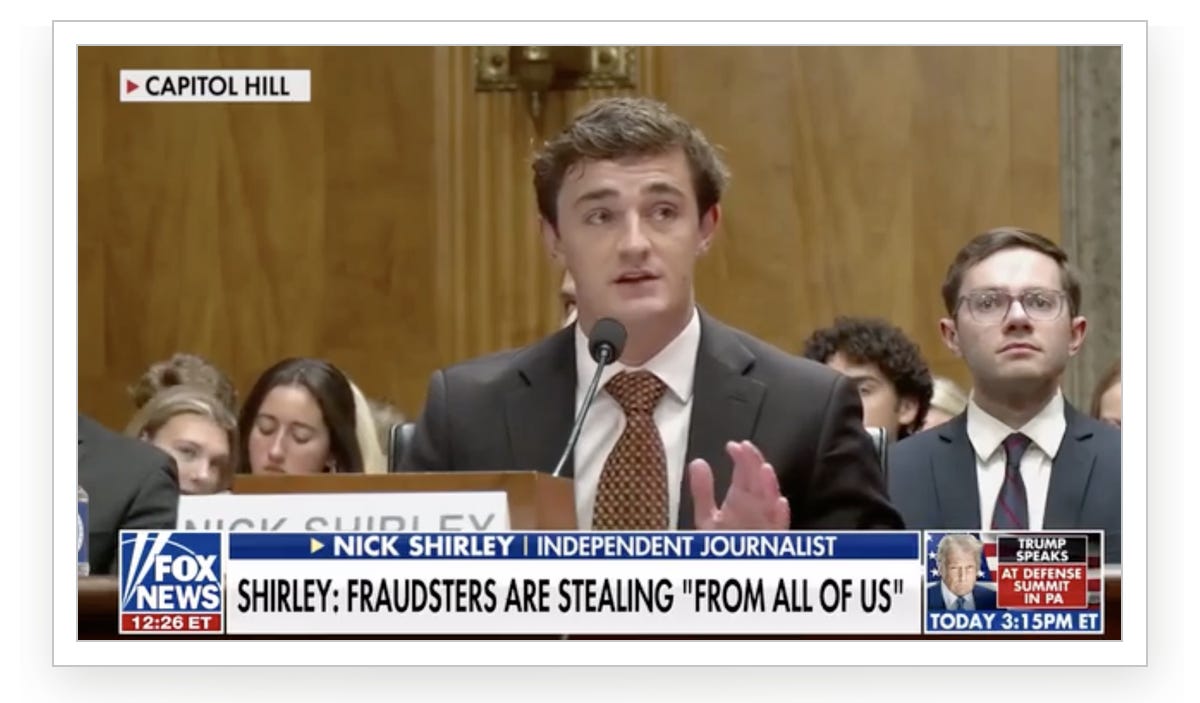
There were plenty of reasons for corporate media to cover this story. Democrats are known for members’ voting discipline and rarely split their vote this way. As my grandma Coon used to say, you could wear out a rocking chair waiting for another vote like this to come along. That alone was news. But the split vote also showed that the bill’s subject matter was important enough even to many Democrats that the representatives were forced to bail out of the party bus on this one.
According to reports, House Democratic Whip Katherine Clark’s floor guidance advised blue representatives that the party’s committees “strongly opposed” H.R. 9576. Yet late Wednesday, over 140 House Democrats voted with all Republicans to make the DOJ’s National Fraud Enforcement Division permanent.
Before Wednesday, the Times, WaPo, and the WSJ all heavily reported —you might even call it endless carping— about the Fraud Division. The nonstop series of stories mostly focused on claims that: Trump is weaponizing fraud enforcement to persecute his enemies, like Minnesota Governor Tim Walz, he is acting extra-constitutionally (kingly), and he keeps personally terrifying Times reporters by sneaking into their bedrooms at 2 a.m. and sticking live marmots up their pajamas. (Or something like that.)
Anyway, the point is, since it was first created, reporters basically couldn’t shut up about the Fraud Division. So it is remarkable in about six dimensions that the House just voted to make permanent the dreaded Fraud Division that corporate media obsesses over so much. Where are the howls of outrage? More, it passed with help from a majority of Democrat representatives, including House Minority Leader Hakeem Jeffries, who has personally complained so much about the Division that it seemed like he could get a lottery prize from them and would just criticize how the check was folded.
“This is hardly some kind of great breakthrough in law enforcement or criminal justice,” Representative Jamie Raskin (D-MD) said on the House floor, “but it is perhaps the least offensive piece of legislative flotsam and jetsam that has washed ashore in the last 48 hours of Republican chaos and retreat here in the House of Representatives. I’m joining his bill.” (Ilhan Omar voted nay.)
One suspects the Fraud Division is so incredibly popular with the American people that a majority of House Democrats were trembling at the horrifying prospect of voting against it and then being savaged on social media.
And the corporate media knows it, too. That’s why they suddenly have nothing to complain about.

🔥 It seems like a long time, but the DOJ only started up the Fraud Division in April. If passed by the Senate, the bill will cement the new crime-fighting division into federal statute, making it much harder for a future administration to simply abolish or restructure through an executive order. The division’s charter is to chase federal fraud cases that affect public funds and federally funded programs. Remember that italicized part. It’s the key.
Contrary to the disappointment we’ve become accustomed to in that fickle chamber, the bill’s prospects in the Senate appear strong. The Democrats’ House support is a good sign that Democrat senators will be pulled along, too. (But don’t start counting chickens; the Senate could still smother it in committee. Here is where some public encouragement of Senators could be helpful.)
One of the first things a commercial litigator learns is that the definition of “fraud” is as vast and uncountable as the dizzying constellation of human malfeasance. There are all kinds of commonplace fraud. Nigerian scammer fraud, Bernie Madoff-type investor fraud, Everglades building projects, and senior citizen ripoffs involving astrologers and fortune tellers, just to name a few. Fraud is, unfortunately, common as dirt. Over half my business cases involve at least one allegation of fraud and a surprising number where the parties swap fraud allegations against each other like they were Pokémon cards.
But the Fraud Division is only focused on one type of fraud: Fraud against the government. Meaning, welfare fraud. Medicare scams. Autism centers. Covid loans. Private healthcare providers. Somali SNAP bodegas. Quality Learing Centers.
To put it mildly, this is not the type of fraud enforcement that Democrats normally embrace. It exposes uncomfortable failures in the sprawling public-benefit and public-subsidy programs Democrats designed, fund, and defend. It undermines fundraising, vote buying, and unevenly targets protected progressive communities. It threatens to cut off lucrative side hustles for Democrat officials.
In short, a permanent DOJ office with the full-time charter of pursuing public benefits fraud is a blue nightmare. The fact they’ve been forced to support it, however tepidly, shows the incredible success of the Trump Administration’s yearlong campaign working with influencers like Nick Shirley to teach the public how invasive the problem has become.
Come on, Senate. Let’s get it passed.
📈📈📈
Election propaganda is reaching deafening levels and will only get worse as the midterms approach. We have lots of work to do to protect our brains. Let’s begin with the Wall Street Journal’s latest alarming submission, placed at the tippy-top of its web page this morning, headlined, “Weeks Before the Midterms, Almost Everything Is Getting More Expensive.” Time to panic!
Presumably, since the article planned to cover “almost everything” (almost—weasel word alert), a whopping three Journal reporters collaborated on their joint economic story— an economic story that mentioned the midterms before the prices. Before examining your grocery receipt, the Journal would like to establish which election it should affect.
The article did mention some difficult news. Unfortunately for its headline, a lot of that news is good. And the things they left out are even better. Everything isn’t perfect yet. But depend on the Journal. If a cup is one-eighth full, it will fully explore the bottom of the glass. With graphs.
The Journal began, as it must, by grudgingly acknowledging a “robust economy driven in part by President Trump’s tax cuts, reduced regulations and historic AI spending.” Unemployment is a low 4.1%— now flirting with the 3s. Household net worth has reached $186 trillion, up $26 trillion since the fourth quarter of 2024. Consumer spending remains strong. These facts were allowed to skate quickly through the article, accompanied by security, before being escorted away from the headline.
Please do not interact with the good news. It has somewhere else to be.
The reporters even anticipated the possibility that some readers might be doing okay. But that is bad. “Even those workers whose wages are keeping up with inflation might be feeling irked,” they warned. An economist explained that getting a raise can require negotiating, changing jobs, or leaving co-workers. The horror.
So if you didn’t get a raise, that’s bad. If you did get a raise, that is probably also bad, because now you don’t get to see Wanda from Human Resources. The Journal is leaving no American behind. If you are currently experiencing prosperity, a trained economist will be with you shortly to explain why it hurts.
Now, to be fair, the piece reports a handful of real pressures: wages recently lagging inflation, expensive fuel, and painful borrowing costs. It attributed some inflation to tariffs and the data-center build-out, and the energy shock to the Iran war. But the question is not whether expensive things exist. The question is how the Journal packaged them into a pre-election weather system called Trump.
Consider the history. Well down the story, the Journal acknowledges that inflation reached 9.1% in June 2022, during Cabbage Biden’s asterisked presidency. (The current figure is 3.4%.) That is unsurprising. Biden printed $6 trillion in two years, which guaranteed inflation for years to come.
Lower inflation does not mean prices have settled back down to their old levels. It just means they are now rising more slowly. Nor does an earlier peak excuse every current policy. But the accumulated damage has a history, and the Journal itself dates its cumulative 27% price increase from January 2021, when Biden took office— not from Trump’s inauguration.
Somehow, Biden-era inflation has nevertheless acquired the narrative qualities of an abandoned mattress. Nobody remembers buying it. Nobody knows who put it by the curb. The tags are cut off. But it is now suddenly in Trump’s apartment, and the Journal demands to know why he hasn’t gotten rid of it yet.
Most of the story’s dramatic machinery runs on fuel prices and interest rates. Gasoline appears, then diesel, then heating oil. These are different expenses with real consequences, but they are also close relatives. It’s a disappointing family turnout for a headline promising “almost everything.”
Then came the interest-rate maneuver. The Journal explained, correctly, that “The Fed raised rates to cool inflation.” It also explained, correctly, that the effect takes time. Higher rates can make borrowing more expensive now while restraining inflation later. That is a trade-off, not an economic contradiction.
But my goodness! The editorial possibilities! Inflation hurts. The treatment for inflation also hurts. This gave the newsroom both the disease and the treatment to work with. It’s like covering a hospital exclusively through headlines like Wife Tortures Feverish Husband With Cold Washcloth.
By Thursday, three reporters are consulting economic experts on whether the patient enjoyed the washcloth.
The article even explained that people sometimes mistake interest rate increases for a cause of inflation because the two occur together. This useful clarification arrived after the article marched rates and prices down the street in the same terrifying parade of horribles. Thank you for the distinction.
Eventually, it reached the Journal’s main point, the electoral evidence. The story supplied economic data and a Republican strategist’s warning, but the three reporters only found one on-the-ground member of the voting public: Stacy Hislop, a 64-year-old Michigan retiree who plans to vote for Democrat Abdul El-Sayed. It did not say that she switched from Trump, changed her vote because of the latest rate increase, or represents any quantifiable electoral swing.
Stacy’s financial concerns deserve to be taken seriously. Anyone living on a fixed income while fuel prices spike is bound to feel somewhat oppressed. What deserves the joke is the journalistic promotion: she described her household budget and emerged as a one-woman bellwether for control of Congress.
Still, you have to admire the Journal’s economy of scale. Three reporters. One Michigan voter. “Almost everything.”
Now let’s see what the Journal left out. You won’t believe this.
📈📈📈
The week has been practically bursting with great economic news. As we just saw, it took three Wall Street Journal reporters —David Uberti, Justin Lahart, and Aaron Zitner— to discover, weeks before the midterms, that gas, mortgages, and dinner out (“almost everything”) still cost money. What the trio of reporters somehow could not find room for, in a newspaper that sheds charts the way other people shed carbon dioxide, was the rest of the dashboard. Our first omitted example appeared in Wednesday’s Investing Live, which reported, “Atlanta Fed GDPNow estimate for Q3 growth jumps to 5.1% from 4.4%.”
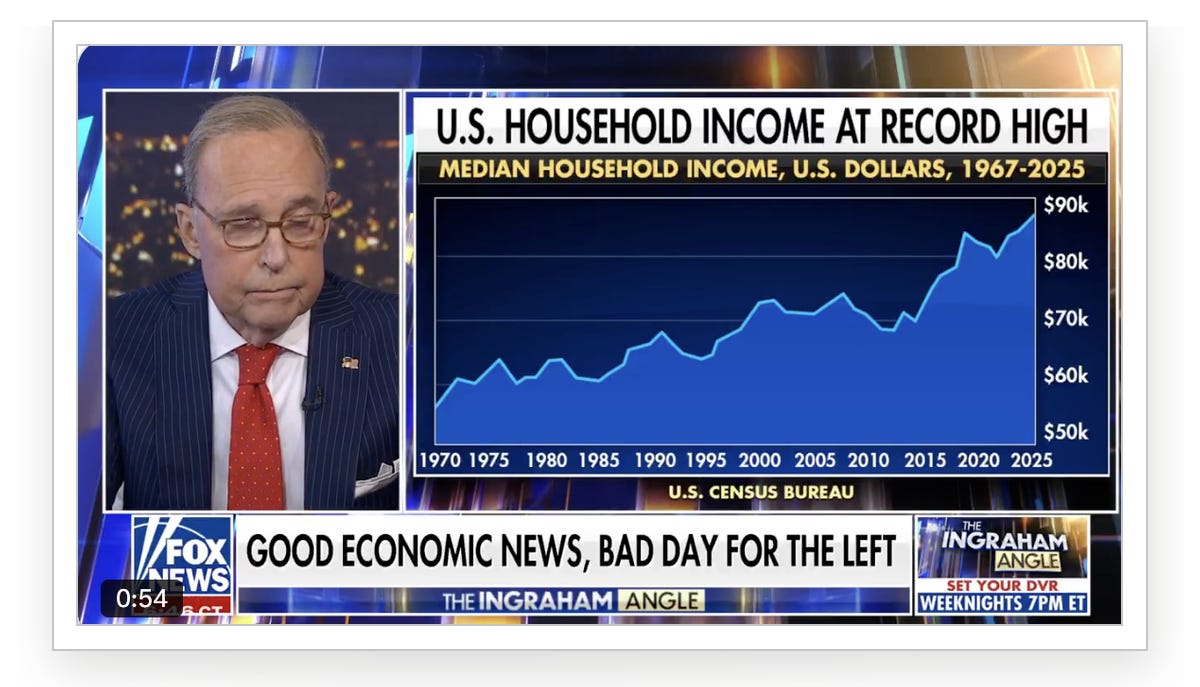
5.1% growth is a lot. On Laura Ingraham’s show, Larry Kudlow called it an economic boom. Retail sales are running around 6%, business investment in machinery, equipment, and data centers is up over 20%, productivity is up about 3% a year for almost two years running. It’s the kind of revolutionary clip America has not seen since the boom of the Reagan ’80s, which was itself historic, and which rewrote economic textbooks about what was considered possible to achieve through government policy.
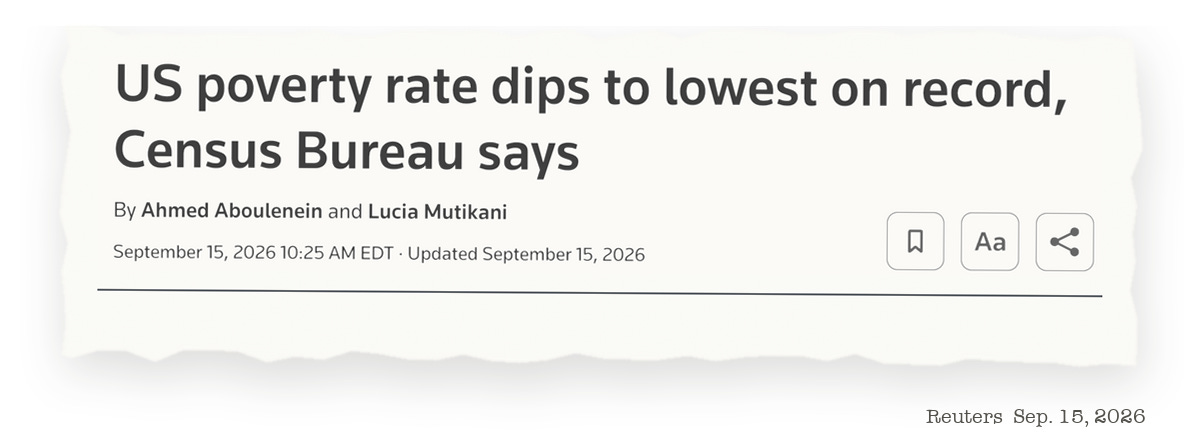
Then came the Census Bureau, announcing even more shattered records. On Tuesday, the agency announced that real median household income hit $87,460— up +2.6%, reaching the highest on record since 1967. Not only that, but the official poverty rate fell half a point to 10.2%. Reuters, not exactly a Trump Super PAC, headlined it as the lowest poverty rate on record.
Treasury Secretary Scott Bessent did not make it up. Looking pleased as punch (as well he might), he read the specific numbers out loud to congressmen: poverty down -50 basis points, real median income up +$2,250, black incomes were up +4.8% —the highest of any group— and whites were also up +2.9%. Child poverty has hit its lowest figures in history. Hispanic poverty also hit a historic low.
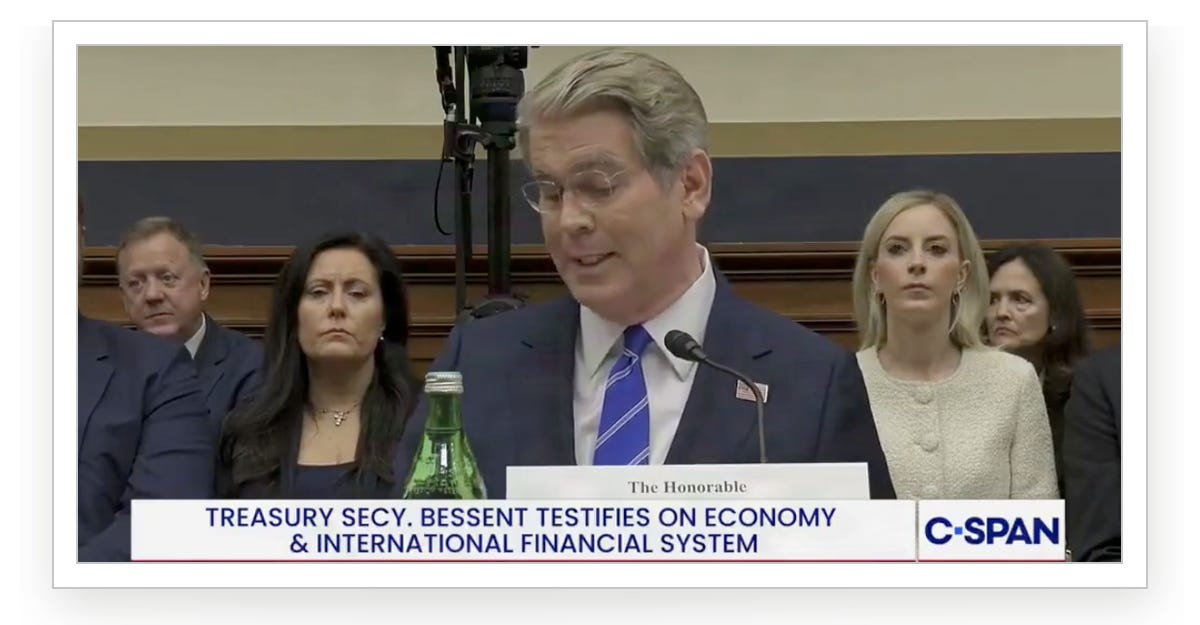
The Journal’s contribution to this record-breaking financial data dump was a vibe check on the price of fast-food hamburgers and a single Michigan retiree rage-voting for a socialist.
So yes, gas is expensive, because we are finally stopping Iran from getting nukes and oil markets have opinions. Interest rates bumped up— in order to slow inflation. Dinner costs what dinner costs. None of that needed a three-byline special. What did require three bylines was the narrative decision to frame a booming, high-income, falling-poverty economy as a midterm horror story about the price of avocado toast— while burying the Atlanta Fed, the Census Bureau, and the highest real median household income in American history under the mattress with the spare adjectives.
Maybe it was a staffing problem. Maybe, if they had assigned a fourth reporter, they could have found the big story.
🗳️🗳️🗳️
Let’s enjoy some dueling headlines. First, yesterday’s headline from KCCI-Des Moines:
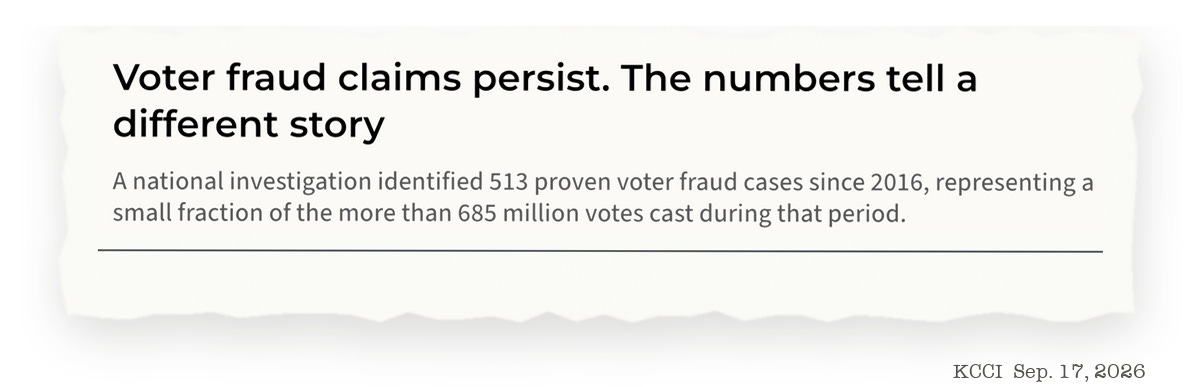
KCCI’s experts found comfort in the lack of voter fraud convictions. “It shows to me, again, coming from – looking at internationally and comparatively – it shows to me how strong our system is,” elections ‘expert’ Michael McNulty said. Lack of convictions is a weird way to measure strength.
I keep trying to explain to them that “proven voter fraud cases” is not any kind of valid measurement of how much voter fraud is going on. Prosecutions rely on diligence and focus by local officials, whose attention spans compare unfavorably with below-average kindergarten art students. Measuring overall voter fraud by convictions is like measuring the iceberg by the part that hit the boat. They seem able to model viruses from now till the next hundred-year pandemic, but they can’t seem to make any models for voter fraud.
But never mind.
🔥 Next, Tuesday’s headline from Fox-4 Fort Worth:
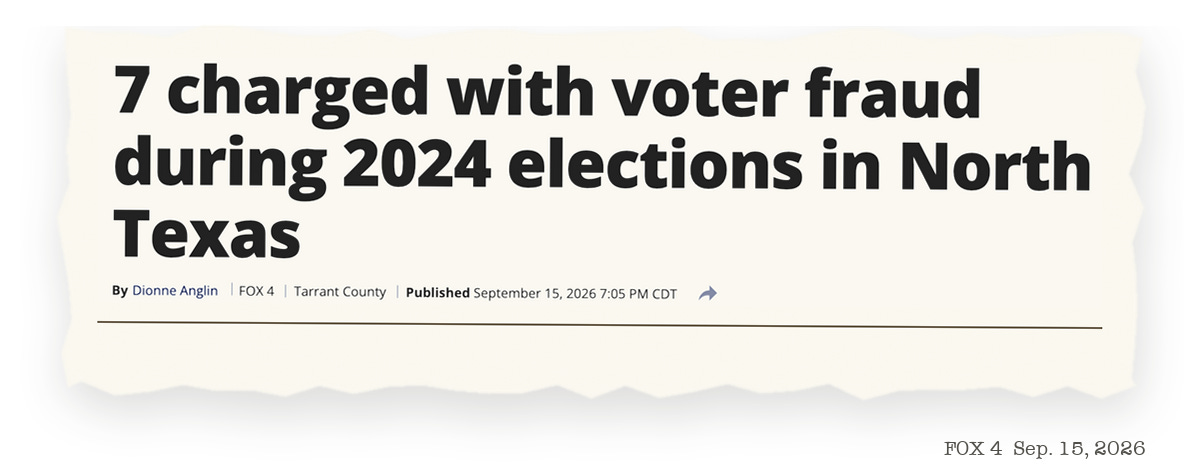
The thing that never happens keeps happening.
Five of the seven were arrested on September 14th. One was arrested on September 11th. Another surrendered to federal authorities on Tuesday. Get this: “All seven of the suspects,” the story said, “are non-citizens from Nigeria, Mexico, India, and the Democratic Republic of the Congo.” (Six were “lawful residents,” meaning Biden-asylum or something, and one was an illegal.)
Two more suspects were charged but haven’t yet been pinched. They remain at large. For now.
Reporters asked Ryan Raybould, the U.S. Attorney for the Northern District of Texas, whether the arrests were politically motivated. I did not make that up. “We don’t care who that person voted for,” Raybould patiently replied. “Just like we prosecute every violent crime vigorously, we’re going to prosecute every instance of voting fraud very seriously.”
🔥 Next, we find this revolting news nugget in Tuesday’s Salt Lake Tribune:
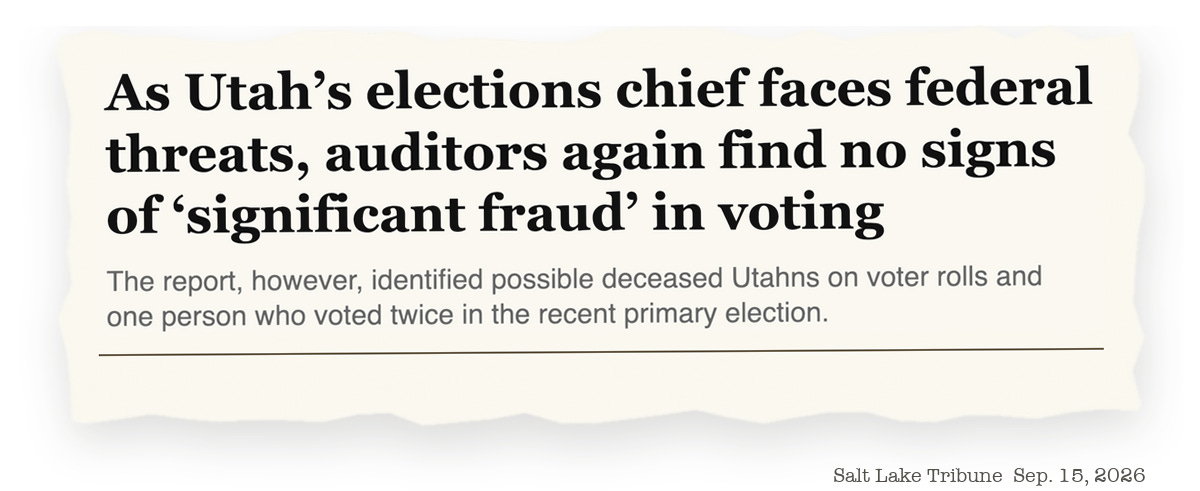
No signs! State legislative auditors, the story explained, investigated Utah’s voting systems and found no evidence of “significant” fraud. This is like asking the fox how the hens are doing. The fox reports no “significant” poultry losses.
The “insignificant problems” included: hundreds of active dead voters, missing drop-box security seals, a ballot-processing room without camera coverage, a skipped 1% signature audit, a county clerk auditing an election that he was also on the ballot for, and at least one guy who voted twice in the recent primary elections.
They found enough insignificant problems that Deputy Elections Director Shelly Jackson asked lawmakers to “work with election officials to reach a consensus on how to address issues rather than introduce new legislation.” Why? Jackson explained, “We have concerns that overly prescriptive legislation will have the undesired effect of removing otherwise eligible voters, leading to disenfranchisement.”
Uh huh.
🔥 Finally, we’ll close with a trio of stuff that never happens. First, yesterday’s submission from Tampa Bay WTSP-10 News:
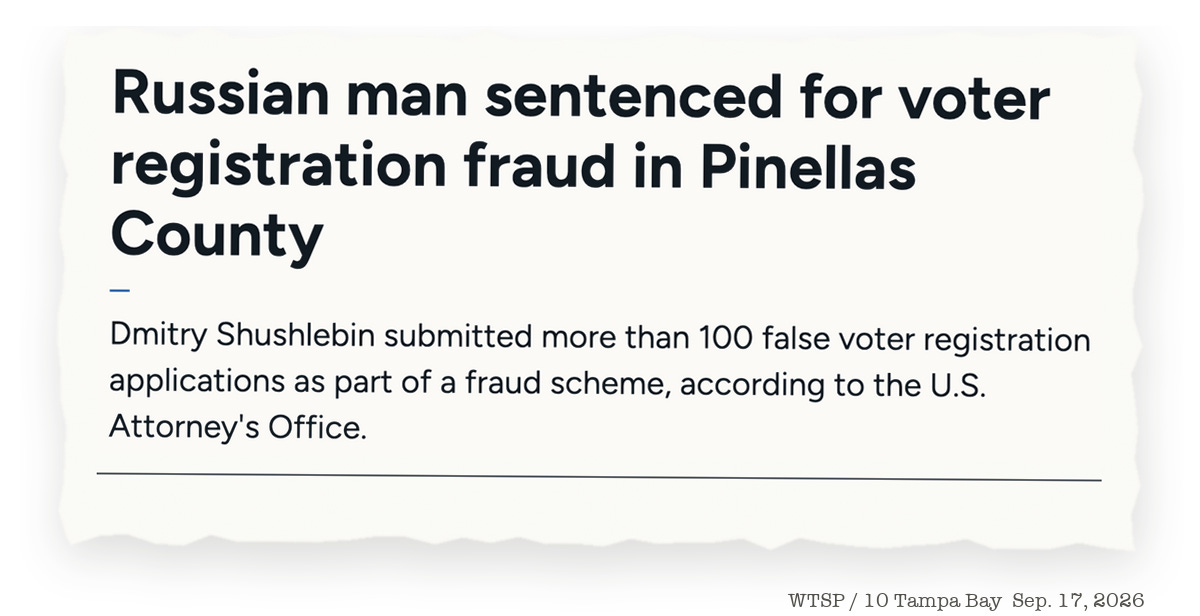
“According to the Department of Justice,” WTSP reported, “Shushlebin hired another man, Sanjar Jamilov, and others in 2023 to submit 132 fraudulent voter applications to the Pinellas County Supervisor of Elections.” This insignificant problem appeared in Florida. Imagine how bad Utah must be.
For this and credit card fraud, Shushlebin, 45, of Miami Beach, was sentenced to six years in federal prison, followed by three years of supervised release. Special Agent in Charge Rodney Crawford of the FBI’s Tampa Division said, “The FBI is committed to supporting our election security partners, ensuring fraudulent schemes never have a chance to succeed.”
Shushlebin is not a citizen. He is Russian.
🔥 Also from Florida’s WTSP this morning, we found a second example of insignificant voting fraud problems.
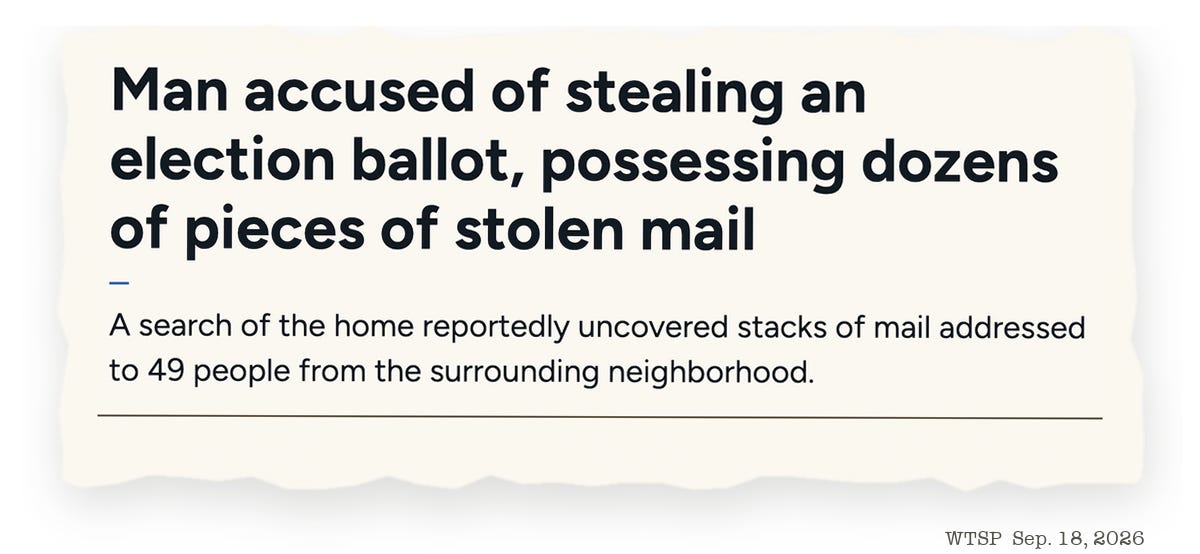
According to the Pinellas County Sheriff’s Office, Corey James Lamberson, 27, was squatting in a vacant Tampa Bay area home. He was stealing the entire neighborhood’s completed election ballots from their mailboxes. (Also their credit cards.) Lamberson was charged with stealing or unlawfully possessing an election ballot and unlawful possession of five or more pieces of personal identification information.
Non-experts like us might get the misleading idea there’s a tidal wave of election fraud, and the cases they’re nabbing are the tip of an iceberg of fraud.
🔥 Oh, what the heck. There are so many just from this week that I can’t just do one more. I will quickly leave you with a final series. These are not all the ones I found. From the DOJ’s website, Wednesday (Boston):
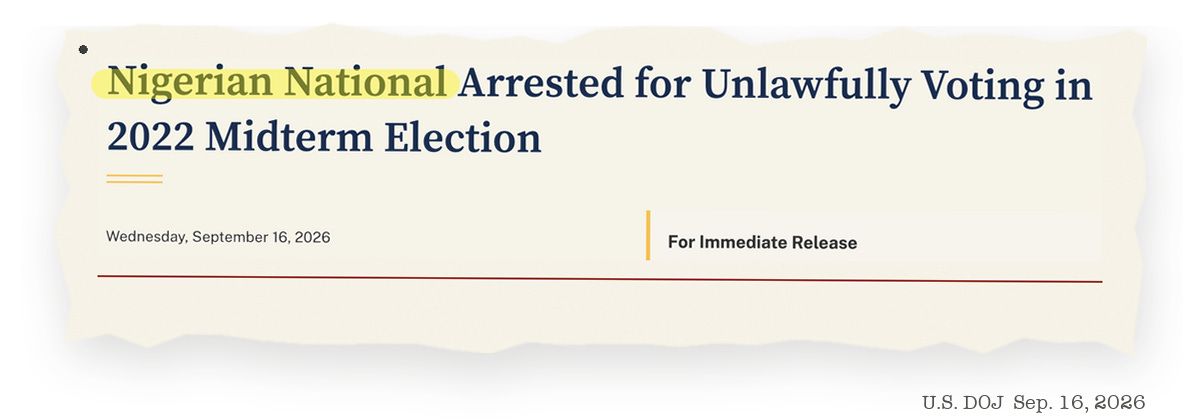
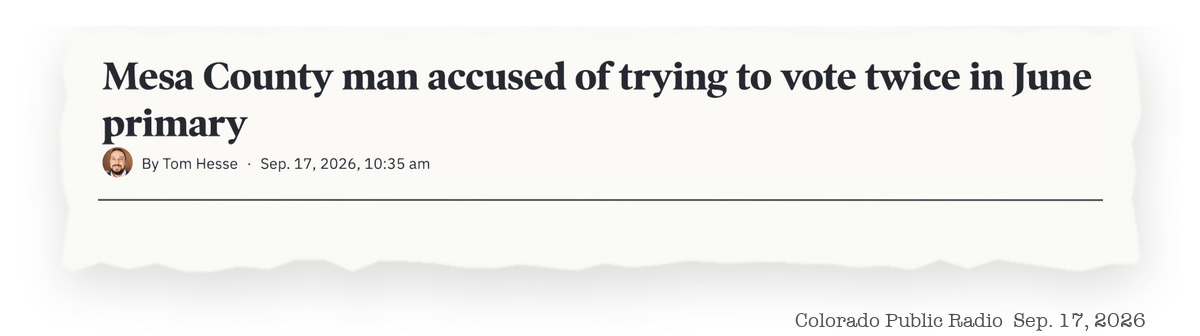
CPR News, yesterday (Grand Junction, Colorado):
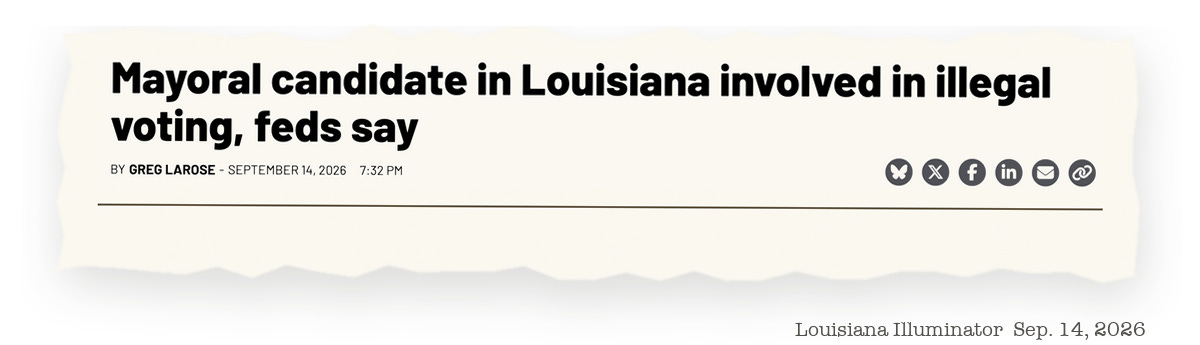
The Louisiana Illuminator, Monday (candidate Bridget Johnson, 53, was helping illegal aliens vote):
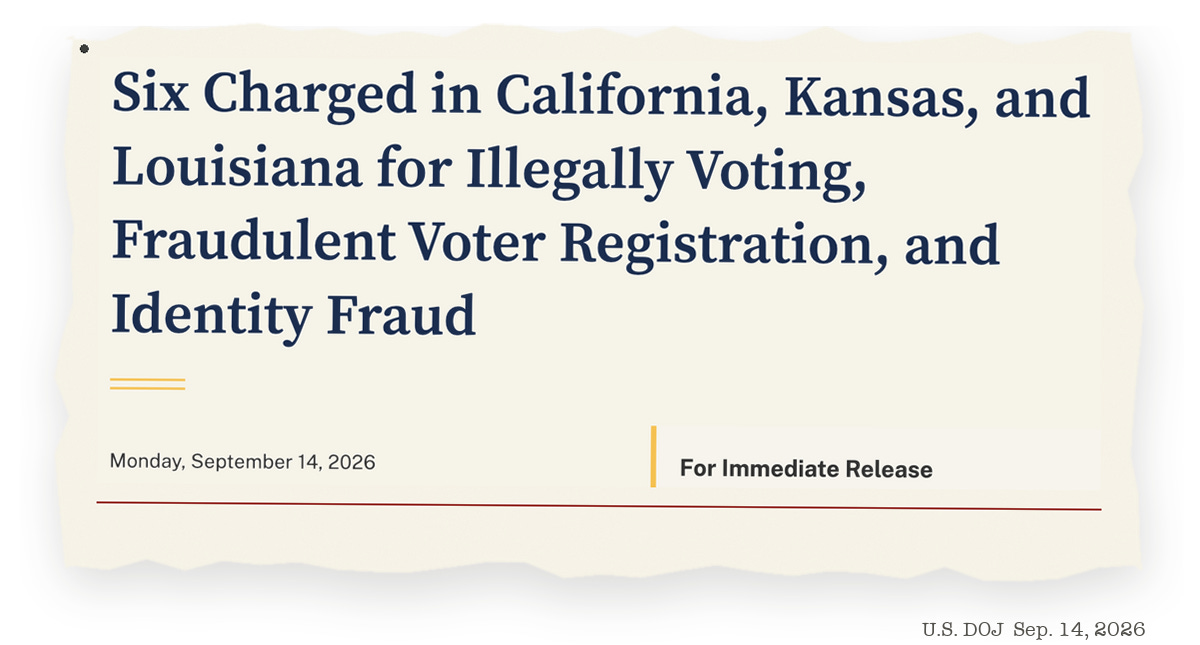
The related press release from the DOJ, also Monday (charging five more with milking “Skid Row” homeless for votes in LA):
But remember— there is no evidence of widespread voter fraud. There are so few arrests and convictions, experts tell us, it is insignificant. I feel like making a website like enterprising resisters did during covid called “Here Is The Evidence!”
There is an unreported tidal wave of election fraud prosecutions sweeping across the country right now. It is at a historic scale. Be encouraged. The DOJ is crushing it, delivering beyond what was promised and more than we’d hoped.
And the useless corporate media won’t be able to keep a lid on this forever. Hang in there.
Have a fantastic Friday! Coffee & Covid will return tomorrow morning, with even more shareable essential news and caffeinated commentary.
Don’t race off! We cannot do it alone. Consider joining up with C&C to help move the nation’s needle and change minds. I could sure use your help getting the truth out and spreading optimism and hope, if you can: ☕ Learn How to Get Involved 🦠
How to Donate to Coffee & Covid
Twitter: jchilders98.
Truth Social: jchilders98.
MeWe: mewe.com/i/coffee_and_covid.
Telegram: t.me/coffeecovidnews
C&C Swag! www.shopcoffeeandcovid.com
Before reading past the summary, to counter the doomers and dividers that I know will flood this today, I’d like to declare that life is financially hard, unfair, and we do struggle. But if I had to choose, and I did in 2024, I’d gladly take any financial burden just to have the administration that we have today. The affordability issue is so far down the list for me even though it defies logic, but that’s how I see it. Saving our country from the monsters that once ran it is gonna take time and some financial pain. I will not bail just because I struggle on occasion to afford the American Dream. Our nation was so far from that dream because of all the fraud and corruption of the past presidents and their administration and agencies. I believe we will be making that dream reachable once again for our children and their children, but it takes time to reverse all the damage. If the cost to me to save our nation and drain the swamp is an extra $1 per gallon of gas, I see that as a small price to pay in the long run compared to what I had to pay in the past.
Just needed to get that out. This president and his administration is worth every cent.
If you are currently experiencing prosperity, a trained economist will be with you shortly to explain why it hurts.
🤣🤣🤣 I’m dying 🤣🤣🤣