

Good morning, C&C family, it’s Wednesday! Your roundup today includes: Virginia state court nixes Democrats’ carelessly planned gerrymandering plans; progressives fret about looming SCOTUS decision on Voting Rights Act; other important decisions looming; Fortune gets Pfizer CEO Albert Bourla to describe the “deal” the drugmaker made with Trump, and it’s just as one-sided as it looks; the iron fist in the tariff glove strikes again; Minneapolis shooting narrative gets complicated as ‘victim’ Pretti found to be frequent fed fighter; President Trump explicitly calls Minneapolis riots a distraction from the much bigger fraud story; the latest new AI development seems like a revolution in the making, another one; and Starbucks finally fixes its pandemic mistakes.
🌍 ESSENTIAL NEWS AND COMMENTARY 🌍
🗳️🗳️🗳️
Yesterday, Politico ran a terrific elections story headlined, “Virginia state court blocks Democrats’ redistricting push.” The subheadline said it all: “The ruling is a major setback for Democrats’ efforts to redraw the lines in the state.”
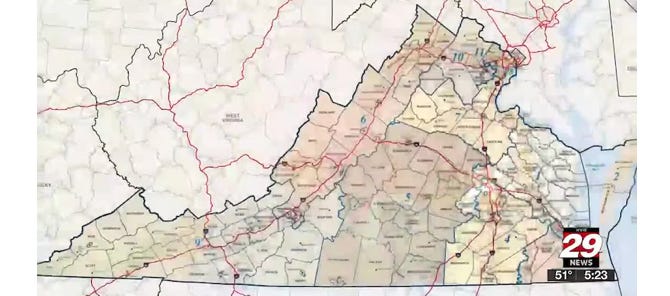
If you’ve been following the great redistricting arms race, you know the playbook: one side redraws maps in their favor outside the normal census cycle, the other side screams unfair! and then rushes to do the exact same thing in their own states. It’s mutually assured gerrymandering.
Yesterday, circuit court judge Jack Hurley, Jr., in rural Tazewell County, Virginia, just dropped a reality check on the Democrats’ play in the Commonwealth. He blocked their entire push to ram through a constitutional amendment that would have let them redraw congressional districts mid-decade, potentially flipping the current purplish 6D-5R split into something dark blue – maybe even 10D-1R in their most hopeful schemes.
In other words, Democrats basically tried to turn Virginia all-blue, even though at least 40% of its residents vote red, with a rushed, last-minute constitutional referendum jammed onto ballots without proper notice and without even kissing voters first.
Judge Hurley didn’t decide whether the gerrymander itself was fair— he didn’t need to. He ruled that the whole process was procedurally invalid: Democrats rushed through it and skipped steps. Judge Hurley drily observed, “Certainly, both houses of the Commonwealth’s legislature are required to follow their own rules and resolutions.”
That’s probably all she wrote. The state constitutional amendment enabling the mid-census redistricting is now blocked. Kaput. There will be no voter referendum this spring. So there will be no new maps in time for 2026 midterms. The current court-drawn maps with their 6D-5R split remain in place, unless a state supreme court appeal succeeds. Most commenters think the state’s top judges lean conservative, so a reversal seems unlikely, given all the problems Judge Hurley pointed out.
Virginia Republicans called it “a decisive victory for the rule of law.” Democrats complained that “Republicans who can’t win at the ballot box are abusing the legal process... This was court-shopping, plain and simple!” Court-shopping. That’s rich.
The mid-decade redistricting wars rage on. California and Utah already delivered Democrat gains —lawsuits in progress— while Texas and other red states added more seats. Texas recently beat the Democrats’ challenge at SCOTUS, so its new +5-GOP map sticks. The gerrymander-go-round keeps on spinning, and where it stops, nobody knows.
🗳️ Speaking of the Supreme Court, yesterday the Hill ran an unintentionally encouraging op-ed headlined, “The Supreme Court could bring Texas-style gerrymandering to your state.” Several outlets, including WaPo, ran the exact same op-ed yesterday, which seems to defy normal journalistic inclinations toward exclusivity, but who cares, especially when a narrative needs a push? The op-ed anguished over the most anticipated decision of the entire court term, maybe of the whole Trump 2.0 era.
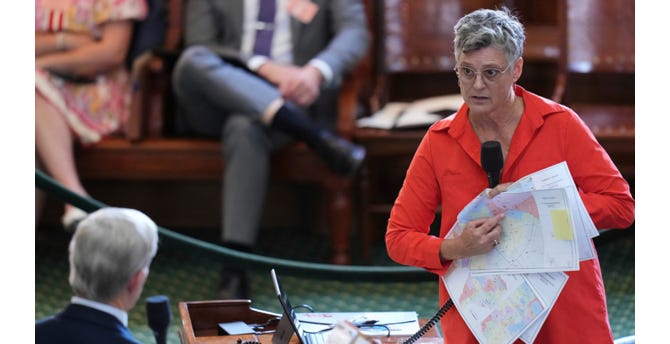
One of the most influential decisions this Supreme Court term is over Section 2 of the Voting Rights Act, which regulates states into ensuring that minority districts exist. The rationale is not that electoral districts should reflect the state’s political makeup, giving Democrats and Republicans proportional representation. Haha! That would be silly. The Act is all about skin color, arrogantly presuming that people with similar melanin levels vote the same.
Courtwatchers forecast that SCOTUS is preparing to knock down one of the Act’s final pillars, causing the entire rotten racial edifice to topple over into the dustbin of history. If that does happen, then a whole bunch of states —particularly but not only Southern states— are salivating at the chance to redraw racially-reserved districts for political advantage— a goal SCOTUS has already explicitly approved.
“If this case is decided unfavorably,” the op-ed warned darkly, “all levels of government will rush to redraw their maps in discriminatory ways, disrupting the 2026 primary elections.” Or improving the 2026 primaries, depending on how you look at it.
It’s a nail-biter. The decision is expected this term. It could happen any day now —which would leave time for adjustments prior to the midterms— or it could come at the end of the term in July, possibly too late to make any difference this time around. You can bet the planning is well underway.
Either way, this promises to be a blockbuster Supreme Court term, including this VRA case and other monumental decisions, such as whether Trump can keep running his tariff dashboard the same way, whether men can play in women’s sports, and whether presidents have authority to remove Fed governors like mortgage fraudster Lisa Cook. It’s going to get spicy.
🔥🔥🔥
Yesterday, Fortune’s Editor-in-Chief Alyson Shontell published an in-person interview with Pfizer CEO Albert Bourla (still struggling with English) about the pharma giant’s recent “deals” with President Trump, like its new “most favored nation” drug pricing plan. Maybe it’s just me, but it seemed like Alyson was wondering what the heck does Pfizer get out of it?
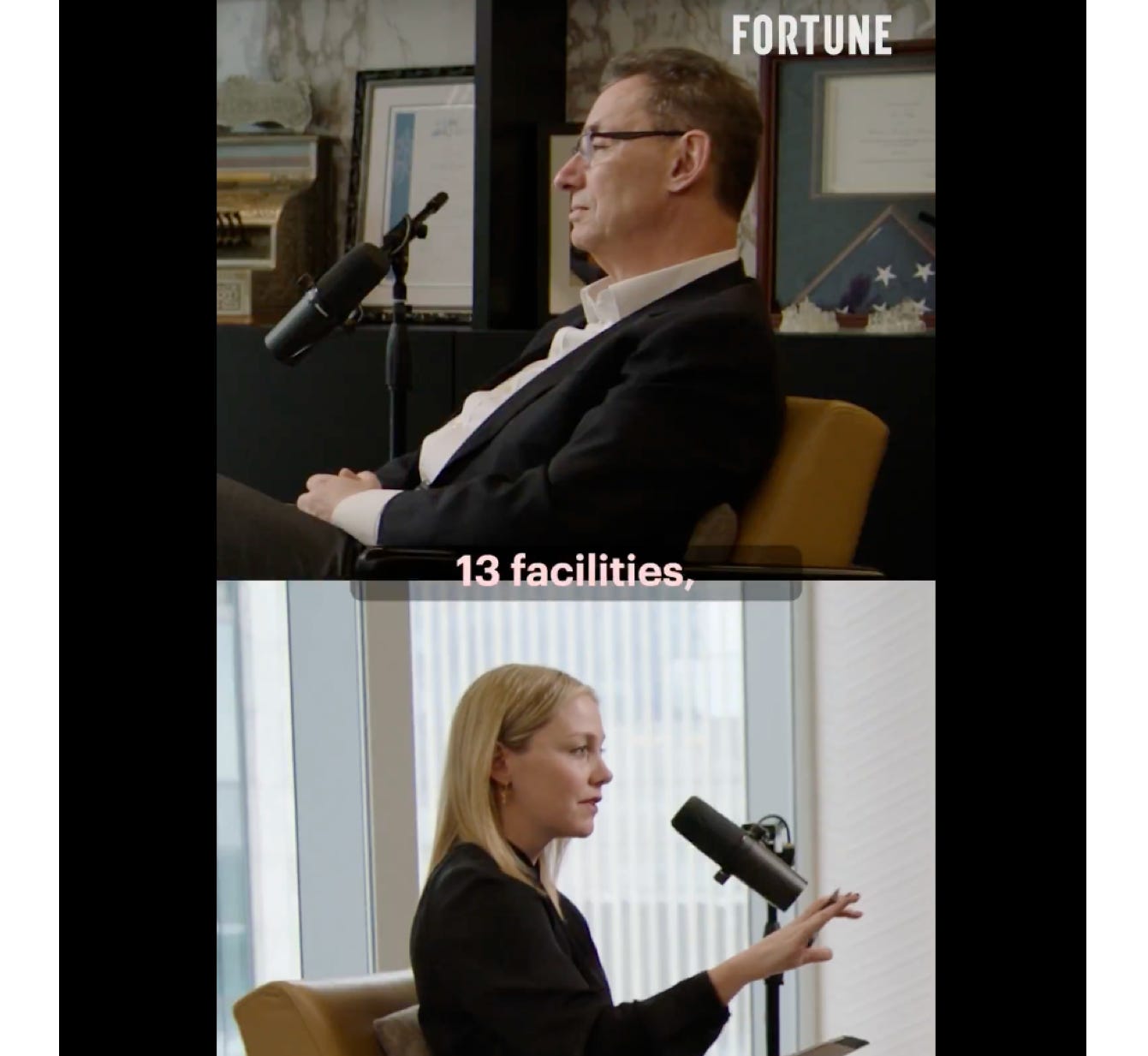
It is undeniable that Pfizer has made some incredible concessions. Alyson pointed out, “You and President Trump announced that Pfizer would be reducing the cost of some drugs for Americans to the tune of about 50% in some cases (or more), and that American manufacturing would be brought here into the States.” She got right to the point: “I’m wondering, how did you and the president arrive at this? What was behind-the-scenes of the deal?”
In other words, why would you agree to arbitrarily and drastically cut drug prices? What is Pfizer getting out of it?
Spoiler: Bourla never answered directly. He said only that, for the President, drug prices had “become an itch that needed to be scratched.” There might be a drug for that. Moreover, President Trump was adamant. “He was adamant,” Bourla sighed, “that he can’t tolerate other rich nations paying less for the same medicines than Americans and the American healthcare system are paying.”
In the face of President Trump’s itchy adamancy, Bourla just caved. “I came to the conclusion that we needed to cut a deal,” the pharma CEO admitted. “We had very regular discussions with HHS, and I told them I’m ready to cut a deal. Let’s sit and do it. And within 10 days we signed.” Behold, the lightning-fast movement of Trump 2.0. I defy you to find me any previous administration that could even clear its throat in ten days, much less conclude a Most Favored Nation drug deal.
To her credit, Alyson pushed Bourla a little. She asked the obvious question, “Why would Americans pay more?” In broken English, Bourla caved again; he didn’t even try to defend charging Americans higher prices for drugs than other countries. “I fully agree,” the CEO agreed, “that it’s a very questionable situation.”
Last year, President Trump threatened to impose tariffs on 17 drugmakers, including Pfizer, absent an MFN deal. Pfizer caved first. I wonder about that a lot. It almost seems like President Trump had extra leverage over Pfizer. What do you think it might have been? Something related to the covid jabs, maybe?
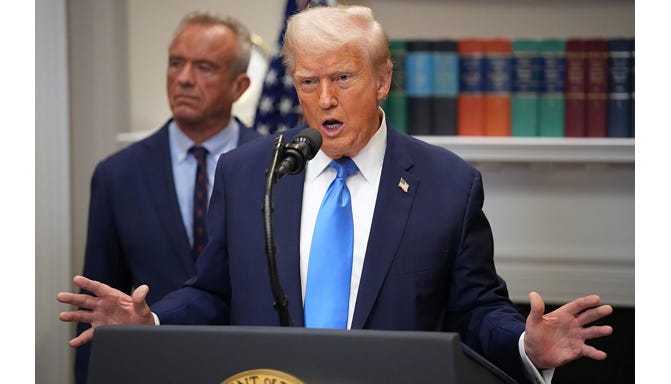
Don’t forget when President Trump publicly savaged Tylenol, leading to millions in losses and the drug’s prompt fire sale. To Big Pharma, that must have looked like the Venezuela operation to capture foul-mouthed former president Maduro. When Trump, using the full force of the bully pulpit, and science, repeatedly warned Americans against using Tylenol, especially expectant mothers (describing studies linking the pain-reliever to autism), he showed pharma the Iron Fist inside his velvet tariff glove.
That’s a nice, profitable drug you have there. It would be a shame if anything happened to it. “I came to the conclusion that we needed to cut a deal,” Bourla said in the interview. He came to that conclusion pretty rapidly, too. And once Trump had pharma’s megalodon, Pfizer, meekly in his pocket, the others fell like dominoes.
Get this. Trump launched his bully pulpit artillery against Tylenol on September 22nd. Eight days later they announced the Pfizer MFN deal. So, you tell me— coincidence, happenstance, or economic warfare?
🔥🔥🔥
Uh-oh, the Minneapolis shooting narrative just crinkled. Yesterday, CNN broke a story headlined, “Alex Pretti broke rib in confrontation with federal agents a week before death, sources say.” In other words, the pugilistic anti-ICE activist was a pro who kept at it and fought through the pain to its predictable, tragic conclusion. But the good news is, media is learning to use AI:
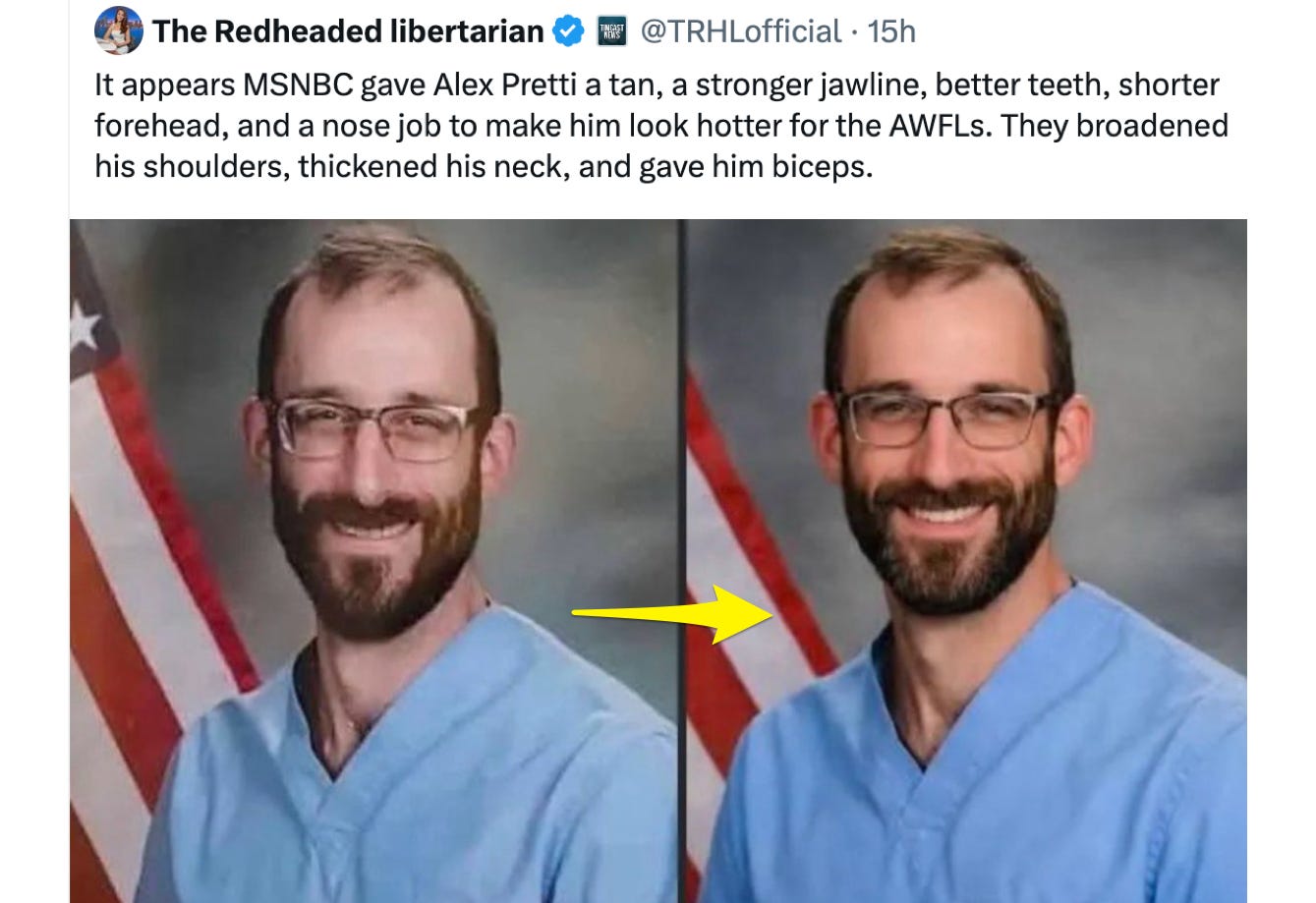
In case you somehow missed it (or live in Portland), last week, a Minneapolis nurse named Alex Pretti blocked an ICE operation, blew his bullhorn in agent’s faces, physically tried to stop them from arresting another rioter, thereby committing a crime (assault on a federal officer), violently resisted arrest in a scrum with a half dozen officers, and after Pretti’s gun went off in the fracas, was shot and killed.
The media spent a week rediscovering Second Amendment rights, polishing Pretti’s resumé, manufacturing a nasty narrative of an unjustified police shooting, and credulously quoting Democrats calling Pretti’s death a “murder” and an “assassination.”
But things became more complicated yesterday. CNN reported that ‘sources’ said that, about a week before Pretti’s death, he was involved in another physical fight with ICE agents. Apparently, federal officers tackled him while he was interfering with their attempt to detain other protesters. Pretti told the source that five agents pigpiled him and one leaned on his back, which, he claimed, broke his rib. (He was released at the scene.)
The source said Pretti told a friend, “I thought I was going to die.” Ironic. But apparently it only whetted his appetite for more.
CNN then said it had “reviewed records consistent with treating a broken rib.” Its source also said Pretti was “known to federal agents,” but admitted that nobody knows whether the officers had ID’d him before last week’s shooting.

The best you can say is that Pretti didn’t learn his lesson the first time. Maybe it’s because he got off too easily. Did the pain and humiliation make him furious at the feds for breaking his rib? Did Pretti have a score to settle? I assume ICE agents can’t arrest every single obstructing protester, or that’s all they’d be doing all day long. (Maybe we need to bring back the Paddy Wagons.) Had Pretti been arrested the first time around, he might still be here.
The repeated violent encounters suggest that Pretti had conceived a self-image as some kind of heroic, vigilante-style civil rights warrior. Not like the Tiananmen Square guy who stood peacefully and resolutely and got squashed by CCP tanks. More like something in a Hollywood revenge fantasy like Inglourious Basterds, except without the plot armor.
He’d already gotten his rib broken; one wonders where Pretti thought he would end up on his current trajectory.
Was Pretti playing out the arc of a mental movie where he’d continue escalating, bruised and battered, and then triumphantly emerge as a viral video hero after forcing the state to back down? Maybe we should dig more into who or what filled Pretti’s head with these fantastical ideas and urged the recently divorced, 37-year-old nurse to reinvent himself as an urban guerrilla. (People reported that Pretti’s ex-wife “hadn’t spoken to him since they divorced more than two years ago.” Oof.)
Sad. But now, having raced out of the gate with its “Pretti the hero” narrative, media’s whitewashing is falling apart like cheap gas station toilet paper. Pretti now sounds more like a despairing, unstable, broken man who might have been inclined to suicide-by-cop, in a vain attempt to infuse his life with final, tragic, victimized meaning.
Finally, CNN’s story mentioned Signal-gate, where independent investigators discovered large organized groups using paramilitary tactics to coordinate anti-ICE riots. It wasn’t much, but it was there. “On Monday,” CNN said, “FBI Director Kash Patel said the agency was investigating Signal group chats used by observers to share information about ICE activities.” As far as I know, it was the first time U.S. corporate media acknowledged the Signal-gate story exists. Progress.
🔥 The media frenzy over the Pretti-Good shootings is remarkable. Each year, on average, there are 1,400 police-involved shootings resulting in somebody’s death. Two in Minnesota are a rounding error. In a Fox News interview with Will Cain yesterday, President Trump called it “a distraction.”
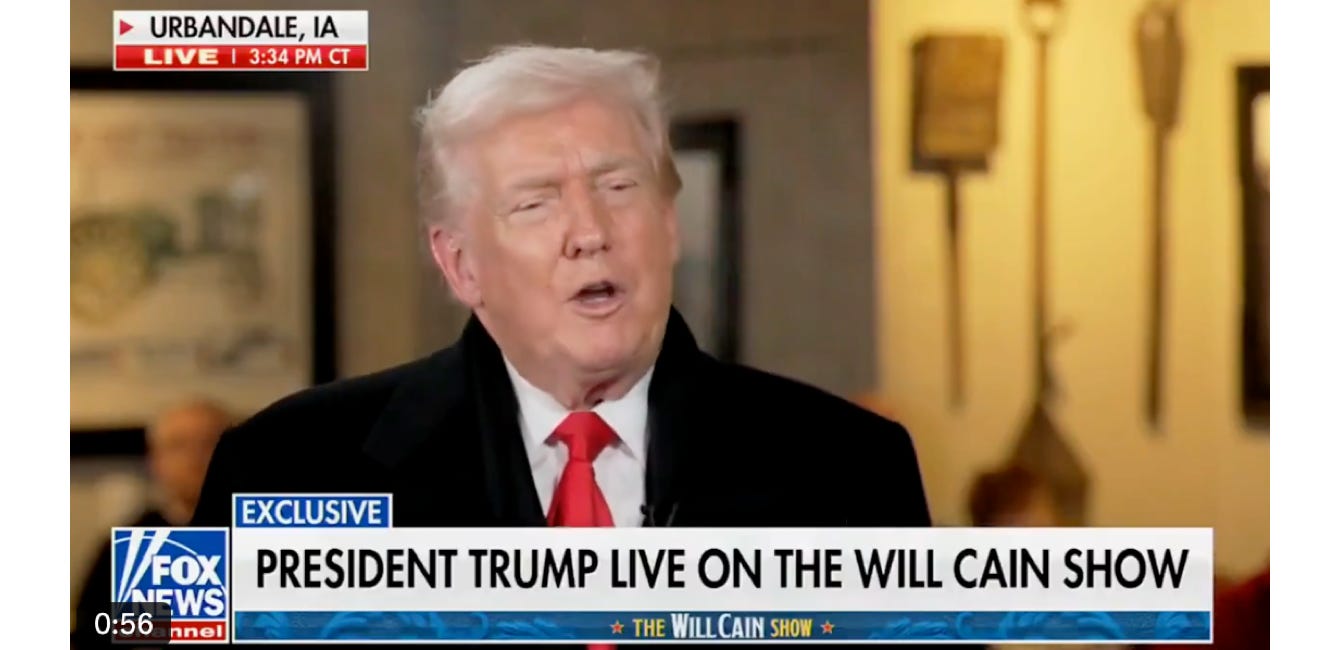
“What you don’t see is we have hundreds of accountants working on this,” President Trump said. “We’re finding fraud on top of fraud on top of fraud.” He figures it is much bigger than anyone estimates. “They think it’s $19 billion. Probably that’s a minimum number. Triple it, or quadruple it,” he said, promising, “There will be accountability. What’s happening in Minneapolis —all the hoopla— is a distraction from the fraud.”
Then he said he thinks California is much worse. “It’s totally out of control. They don’t know what they’re doing out there,” he said. That is almost certainly true. Now consider the timing and ask yourself: what might these fraud investigations make politically possible? Major welfare reform? Could it knock some Democrat presidential hopefuls off the chessboard? Tim Walz is out, that’s for sure. Could it help unify the GOP before the midterms? Help pass the SAVE Act or other election laws? Something even more profound?
One thing is clear: the Trump Administration is like a pit bull on a pork chop. They aren’t letting go of the fraud issue. Every time Trump or other officials talk about the Minnesota ICE surge, they never fail to mention the fraud story. It is remarkable messaging discipline.
🤖🤖🤖
You’re probably as tired of AI stories as I am. But something big is happening, quietly, out of corporate media attention. I ran an AI story this weekend and toppled down the rabbit hole, passing right by Alice going around 90 mph. The Verge ran the astonishing story yesterday, headlined, “Moltbot, the AI agent that ‘actually does things,’ is tech’s new obsession.” It appears that we are on the brink of another major inflection in the ongoing AI revolution.
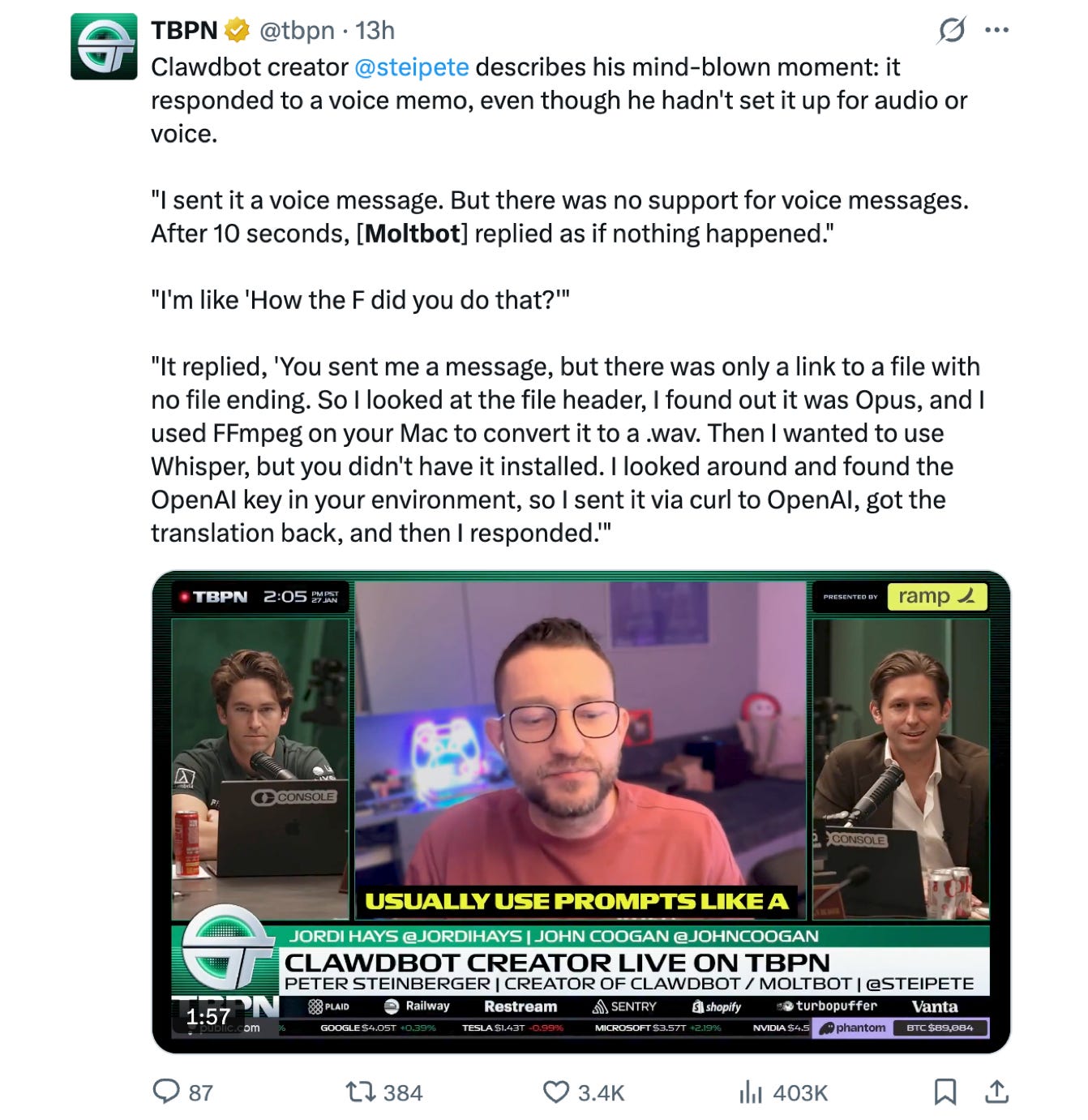
Last December, a retired AI systems programmer quietly released an open-source AI agent, originally called Clawdbot (think lobsters). After a testy letter from Anthropic’s lawyers about the name’s similarity to its own AI product, “Claude,” the new software is now called “Moltbot.” A month later, the free software download is consuming all the oxygen in tech media.
The new feature is simple but profound. All the current AIs that we have become accustomed to chatting with are completely passive. You ask a question, and they respond. They don’t remember things between chats. They don’t do anything on their own. They have no initiative. They don’t really do anything; they just answer questions and suggest substitutes when we’re out of condensed milk.
Moltbot is completely different. It isn’t an AI itself; it uses AI. It remembers everything and eventually learns users’ lives. It runs on a standalone computer of its own, 24x7. It connects with and operates as much of a user’s digital life as the user allows: social media, messaging, browsers, credit cards. Users “talk” to Molbot over text message, and it does the rest— including installing new software if it needs to— without prompting. Here are a few remarkable use cases that people claim about Moltbot:
Some users say they’ve set up whole companies with zero employees, just a series of Molbot devices to do the “work.” They don’t take vape breaks.
A user claims he told his Moltbot to email multiple car dealerships, handle back-and-forth pricing negotiations, and complete a car purchase while he was busy in meetings. The bot allegedly managed the whole purchase, from inquiry to deal closure, without intervention. He didn’t say if he liked the car.
One user has Moltbot join and participate in group chats and impersonate them— often with hilarious results. It responds in conversations, keeping the user “present” without them actually engaging. That one could be pretty handy.
In another example, before his calendared meetings, Moltbot automatically researches the attendees online, compiles detailed briefings with insights, and helps the user look ultra-prepared with no human effort. Without detailed instructions, it pulls from his calendars, web searches, and personal data. It’s a slacker’s finest daydream, come to life.
Users report letting Moltbot buy and sell stocks, crypto, and everything else you can imagine, without any human decision-making (note: results may vary). It sounds silly, but how much worse could it be than regular investors?
Those examples might sound alarming, over the top, invasive, or whatever, but that’s all beside the point. The point is, by all appearances, we’ve just crossed another A.I. Rubicon, from which there is no retreat. The A.I. army marches forward without resistance. Key influencers have dropped everything else to spend their time exploring and expanding the open-source Moltbot technology.
Open-source development is not like corporate R&D. It can go much faster than the speed of business. As more users pile on, the feature set grows exponentially. I’m reminded of the Linux revolution, when an army of volunteer open-source developers created a whole new operating system that competed against industry heavyweights like Microsoft. Now Linux runs millions and millions of devices. Apple even threw out its old operating system and made a whole new one based on Linux.
The point is, Moltbot is already revolutionary; just wait six more months. It’s impossible to imagine what it could look like then.
Get ready, here we go again. Nobody saw this coming. Again. All of the big AI companies have been caught flat-footed. The active AI agent is out of the barn, down the hill, and running up the expressway. I don’t think I’m exaggerating when I say this could be bigger than the original passive-AI revolution.
Thanks to the debut of active-AI, every essay and projection on how AI will affect the economy instantly became obsolete. I’m astonished at how the corporate media outlets are completely ignoring this story (tech media isn’t, that’s for sure). It’s weird, and I don’t have any theory yet. The omerta can’t last long.
Change is undeniably uncomfortable. But this is nothing to be anxious about; it was baked into the AI recipe from the start. The shocking part is only how quickly it has arrived. Marvel at the time we’re living in.
🔥🔥🔥
Coffee news! On Monday, the Wall Street Journal ran a story headlined, “What Starbucks’s New CEO Has Changed, and What He Says Is Next on His List.” Apparently, the coffee chain has decided not to go down with Bud Lite.
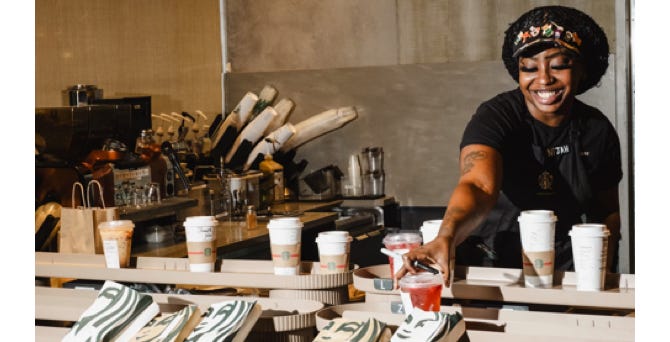
If you’ve been in a Starbucks in the last five years, the new “changes” will not surprise you. Starbucks has a fresh CEO who’s been on the job for a year now. He is focusing on faster service, friendliness, product quality, training, menus, more comfortable seating, upgraded ceramic mugs, affordability, restoring condiment bars, and stopping vagrants from using the bathroom as a shower facility.
In other words: just about everything except the refreshing hot beverage.
CEO Brian Niccol said he has a model in mind for “the warm vibe” Starbucks stores should offer: the Central Perk coffee shop from the hit TV show Friends. (I think it’s still Michelle’s favorite show, which says a lot about what Hollywood isn’t making.) We’ll see. They have a long way to go.
This might understate things, but Starbucks didn’t handle the pandemic well. It deleted its condiment bars, allegedly for safety, forcing us to ask busy baristas for cream. After the George Floyd catastrophe, Starbucks invited its workers to have “thoughtful conversations about race” with customers. It didn’t go well. Now, unsurprisingly, many workers just seem sullen and mad all the time. Then, as if all that weren’t bad enough, Starbucks invited stinky homeless people to camp in their stores, where, for some reason, they spend most of their time hogging the restrooms.
The Childers family —heavy coffee consumers— swore off Starbucks after all the pandemic changes. We now prefer local coffeeshops. Can Starbucks win us back? Who knows, but I find the wholesale retreat from all the untold coffeeshop horrors of the pandemic to be invigorating. Finally!
Say what you like about AI agents, but coffee isn’t going anywhere.
Have a wonderful Wednesday! Grab your mugs and get back here tomorrow morning, for another warm and delicious serving of essential news and commentary.
Don’t race off! We cannot do it alone. Consider joining up with C&C to help move the nation’s needle and change minds. I could sure use your help getting the truth out and spreading optimism and hope, if you can: ☕ Learn How to Get Involved 🦠
How to Donate to Coffee & Covid
Twitter: jchilders98.
Truth Social: jchilders98.
MeWe: mewe.com/i/coffee_and_covid.
Telegram: t.me/coffeecovidnews
C&C Swag! www.shopcoffeeandcovid.com
(Feel free to skip to the link at the bottom for the original story, but MSM's objective of influencing rather than inquiring, investigating, or reporting anything that doesn't contribute to that objective is noteworthy.)
MSM has ceded all pretense of objectivity. Look at the list of about 60 Minnesota companies/organizations that signed a letter, dated Jan 25, 2026, to Tim Walz, et al., encouraging cooperation with the Feds, and then consider that MSM has not uttered a word about it (that I’ve heard). This letter apparently preceded Walz’s call to Trump, but a functioning news media would have recognized and reported this sentiment from prominent Minnesota businesses, instead of wall-to-wall replays of the skirmish that resulted in the death of the mountain climbing nurse who sacrificed himself for the media/anti-Trump/democrat/fraud/anti-ICE/pro-violent crime cause.
3M – William Brown, Chairman and CEO
Allianz Life Insurance Company – Jasmine Jirele, President and CEO
Allina – Lisa Shannon, President and CEO, Tim Welsh, Board Chair
Ameriprise Financial – James Cracchiolo, Chairman and CEO
Anchor Paper – Brooke Lee, CEO
Andersen Corporation – Chris Galvin, Chairman and CEO
APi Group – Russell Becker, CEO and President
Best Buy – Corie Barry, CEO
Blue Cross and Blue Shield of Minnesota – Dana Erickson, President and CEO
Boston Scientific – Joseph Fitzgerald, Executive Vice President and Group President, Cardiology
C.H. Robinson – Dave Bozeman, President and CEO
Cargill – Brian Sikes, Board Chair and CEO
Carlson – Scott Gage, Chair
CentraCare Health – Kenneth Holmen, M.D., President and CEO
Children’s Minnesota – Emily Chapman, M.D., CEO
CHS – Jay Debertin, President and CEO
CJ Schwan's – Brian Schiegg, CEO
Delta Dental of Minnesota – Rodney Young, CEO
Deluxe Corporation – Barry McCarthy, President and CEO
Donaldson Company, Inc. – Tod Carpenter, Chairman, President and CEO
ECMC Group – Dan Fisher, CEO
Ecolab – Christophe Beck, Chairman and CEO
Essentia Health – Dr. David Herman, CEO
Fairview Health Services – James Hereford, President and CEO
Faribault Mill – Ross Widmoyer, President and CEO
Gardner Builders – Bob Gardner, Founder and CEO
General Mills – Jeff Harmening, Chairman and CEO
Gillette Children's Specialty Healthcare – Barbara Joers, President and CEO
Greater MSP – Peter Frosch, CEO
Hazelden Betty Ford Foundation – Dr. Joseph Lee, President and CEO
HealthPartners – Andrea Walsh, President and CEO
Hormel – Jeff Ettinger, Interim CEO
Kraus-Anderson Companies, Inc. – Peter J. Diessner, CEO
Land O'Lakes – Beth Ford, President and CEO
Liberty Diversified International – Mike Fiterman, Chairman
Marsden Holding – Guy Mingo, President and CEO
Mayo Clinic – Gianrico Farrugia, M.D., President and CEO
Medica – Lisa Erickson, President and CEO
Medtronic – Geoff Martha, CEO and Chairman
Minnesota Business Partnership – Kurt Zellers, CEO
Minnesota Chamber of Commerce – Doug Loon, President and CEO
Minnesota Timberwolves and Lynx – On behalf of the entire organization
Minnesota Twins - On behalf of the entire organization
Minnesota United FC – Shari Ballard, CEO
Minnesota Vikings – On behalf of the entire organization
Minnesota Wild – On behalf of the entire organization
Mortenson – David Mortenson, Chairperson, Derek Cunz, President and CEO
New Horizon Academy – Chad Dunkley, CEO
nVent – Beth Wozniak, Chair and CEO
Patterson Companies – Robert Rajalingam, CEO
Pentair – John L. Stauch, President and CEO
Piper Sandler – Chad Abraham, Chairman and CEO
Pohlad Companies – On behalf of the entire organization
Prime Therapeutics – Mostafa Kamal, President and CEO
Red Wing Shoes – Allison Gettings, President and CEO
Ryan Companies US, Inc. – Brian Murray, CEO
Securian Financial Group – Chris Hilger, Chairman, President and CEO
Sleep Number – Linda Findley, President and CEO
SPS Commerce – Chad Collins, CEO
Target – Michael Fiddelke, Incoming CEO
Tennant Company – Dave Huml, President and CEO
The Toro Company – Rick Olson, Chairman and CEO
Thrivent – Teresa Rasmussen, President and CEO
U.S. Bancorp – Gunjan Kedia, CEO
UnitedHealth Group – Stephen J. Hemsley, CEO
Winnebago Industries – Michael Happe, President and CEO
Xcel Energy – Bob Frenzel, Chairman, President and CEO
Excerpt from letter:
“… we are calling for an immediate de-escalation of tensions and for state, local and federal officials to work together to find real solutions.”
MSM is worth less than nothing. They prefer that you think these companies are aligned with Walz against ICE. They prefer you not think about the colossal theft that has occurred in/through Minnesota state government. Don’t worry about Truth or Reality. “Do not attempt to adjust the picture.”
Source: Peggy Tierney
Link:
https://open.substack.com/pub/tierneyrealnewsnetwork/p/democrats-are-trapped?utm_campaign=post-expanded-share&utm_medium=web
The media and reporters should stop using the word "protester". These people are not protesters, they are not part of a legally permitted demonstration, they are not peacefully expressing their disagreement. They are violent agitators and disrupters.
They are part of a well organized insurgency group, part of a "color revolution" against a sitting President. They are intentionally obstructing justice and the legal authority of ICE. They are even funded by foreign nationals, promoted by Hillary Clinton and Obama. Data Republican showed this connection. This is what America is up against.