

Good morning, C&C, it’s Saturday! I appreciate the generous day off yesterday, which I used well for recovery and family time. We are riding 2025’s stored-up momentum right into the new year without pausing or taking a breath. In today’s roundup: the U.S. military effects a sudden and unexpected law-enforcement arrest of Venezuela’s narco-communist president and liberals go beserk; post-9/11 New York swears in communist mayor using a Quran, making a trifecta of surrealism; on day one, Mamdani surprisingly explores free-market principles; Wall Street Journal frames falling real estate prices as a crisis instead of a solution to housing affordability; daycare scandal continues to expand; federal agencies hit back; a closer look at how the fraud works based on long-standing official reports; and suggestions for fixing the welfare fraud problem.
🌍 WORLD NEWS AND COMMENTARY 🌍
🚀 🚀 🚀
Like 2025, 2026 is also starting with a bang. But this year is beginning with an astonishing military victory instead of two twisted domestic terror attacks. The story broke early this morning. The New York Times deployed its rare, all-caps headline style, which the paper reserves for the most historic moments:
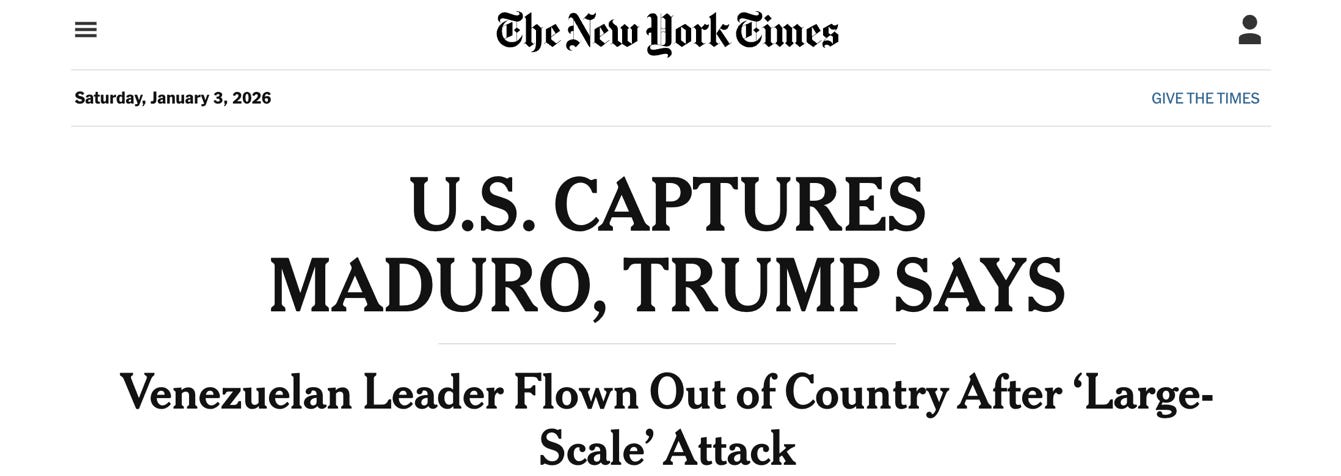
Sometime in the dark, midnight hours, the U.S. military attacked Venezuela’s capital city, Caracas, and captured its defiant narco-communist leader, Nicolás Maduro (and his wife). At the time of going to press, the pair were reportedly on their way back to the U.S. in DOJ —not DOD— custody. That distinction will be important in a moment.
By all accounts, the operation was perfectly executed, during a holiday week, with complete surprise. Maduro was tie-wrapped before the Venezuelans knew what hit them. In a clear sign of how well it went, President Trump even answered a quick call from a Times reporter at 4:30am this morning (“he picked up after three rings,” the reporter said).
“It was a brilliant operation,” said the President, sounding tired but happy, with “a lot of good planning, and lots of great, great troops and great people.”
The Times’ reporter asked the President about congressional authority— a phrase you should prepare yourself to hear about one million times over the next few weeks and months. Trump replied that he’d tackle that issue at 11am this morning, when he plans to address the nation from the Southern Command Center at Mar-a-Lago.
🚀 It was another remarkable, if not historic, military accomplishment. For two hours in the early morning, wild social media began trickling out of Venezuela. Spectacular independent videos showed U.S. Apache and Chinook helicopters flying over dark cityscapes without resistance and firing at various targets. The U.S. evidently disabled the Venezuelans’ Russian and Chinese air defense systems and made it look like a cakewalk.
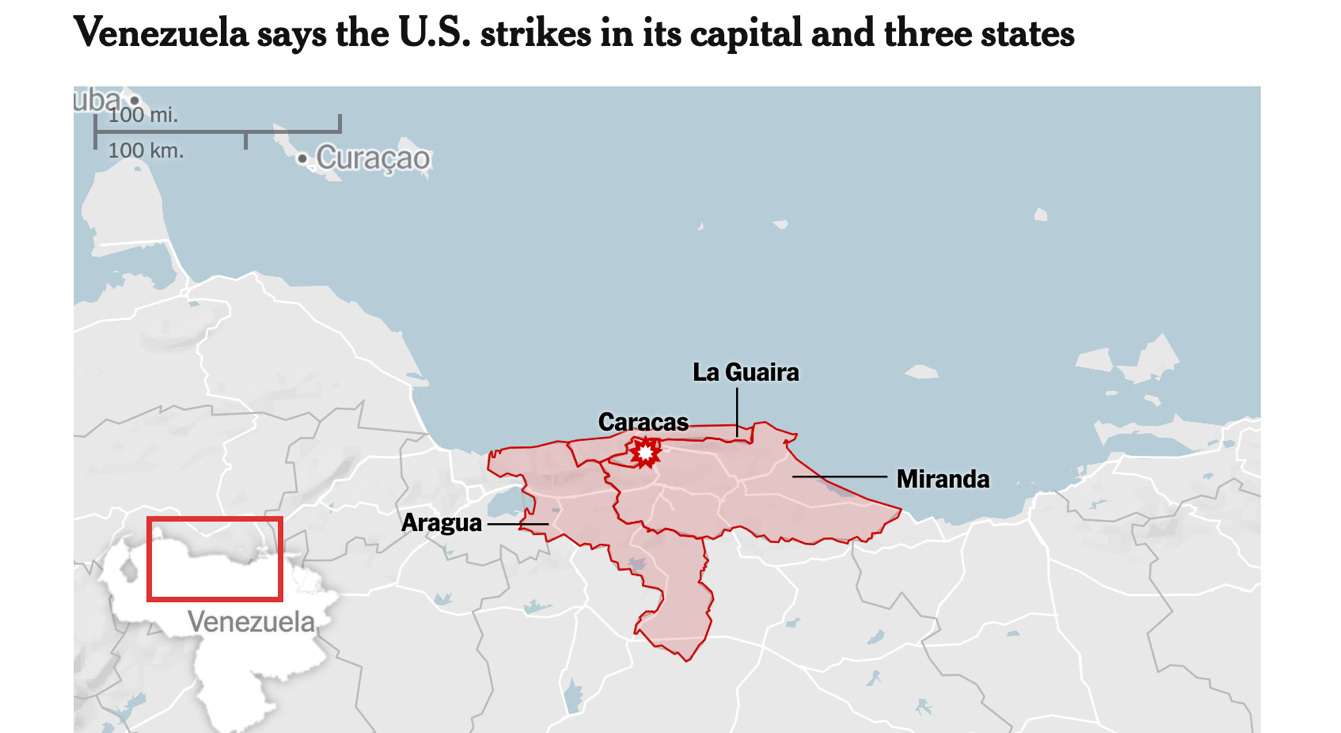
My best guess is that our military confused the communist regime with three decoy attacks in Aragua, Miranda, and La Guaira. The real action was in the capital city of Caracas. It’s also possible that those three target cities hosted airbases that were suppressed to protect US troops.
Boy, was it fast. The FAA issued a NOTAM (commercial flight restrictions) at 2am. By just after 4am, Trump had posted a celebratory message to Truth Social. Shazam.
The operation will distress our libertarian friends and infuriate Democrats. Immediately after the strike, Senator Mike Lee —who was apparently awake— tweeted that he “looks forward to hearing what, if anything, constitutionally justifies this use of force.” Then, about an hour later, he tweeted the answer, having heard from an equally sleepless Secretary of State Marco Rubio, who provided the astonishing explanation:
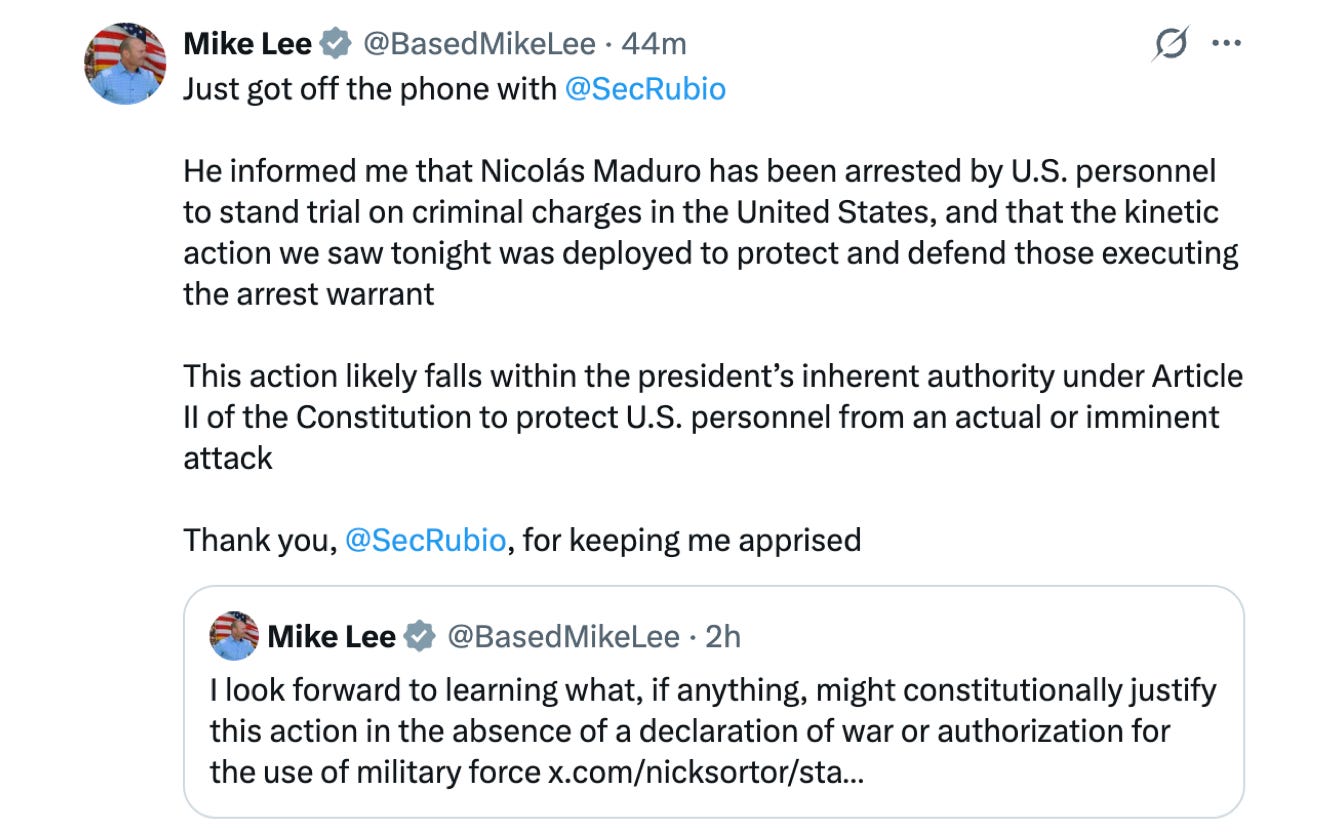
(I’ll just say it: this dialog looks pretty coordinated. Some members of Congress were probably fully briefed in advance, and Senator Lee’s first tweet appears intended to tee up a quick answer. If so, well done.)
Based on everything we know so far, it sounds like the military escorted DOJ officials into Caracas to serve an arrest warrant on Venezuela’s cartelized president Maduro (Sen. Lee: “the kinetic action we saw tonight was deployed to protect and defend those executing the arrest warrant”). Since 2020, Maduro has been subject to long‑standing U.S. federal indictments centered on narco‑terrorism and cocaine trafficking, plus related weapons and corruption counts. In one sense, this operation is his own fault. He could have just turned himself in anytime, after all.

Since we’ll soon know more at 11am, I won’t speculate too much. But this looks like a dramatic Joint Special Operations Command (JSOC) operation to capture a fugitive, Maduro, who was then bundled over to DOJ personnel —DEA? US Marshals?— at a safe transit point, like maybe the deck of a destroyer.
Whatever it was, this will make for an even more exciting movie than Zero Dark Thirty.
Senator Lee’s tweet, including its reference to Trump’s Article II powers, suggests that the Administration considers the action to be a law enforcement operation, with military involved only to protect federal DOJ personnel, which is constitutionally permissible. The inevitable debate will probably be whether the operation was law enforcement with protective force, or was a purely military decapitation strike.
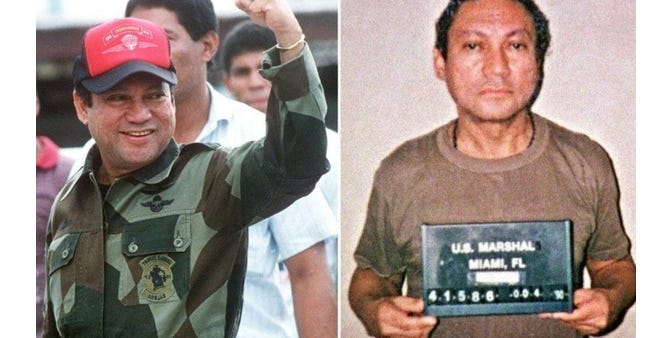
Unfortunately for his critics, President Trump sits on solid legal precedent. In December, 1989, the U.S. military (under Bush I) invaded and occupied Panama, eventually nabbing dictator Manuel Noriega for drug trafficking and other crimes. As opposed to Maduro’s lightning-fast seizure, Noriega’s capture took weeks, during which time he went to ground in the Vatican’s embassy. (U.S. troops notoriously blasted the embassy with loud rock music to annoy him into surrendering.)
Noriega comparisons are sure to come. (FYI—in the Noriega operation, over 1,000 civilians were killed. Just saying.)
This time around, Trump didn’t give the Democrats weeks. They would have savaged him 24x7 and probably called him “king” again. The complaints about Maduro’s seizure have already started. Whereas, in 1990, Democrats mostly supported Bush’s Noriega operation, which shows you how far left the party has drifted.
I’ll conclude with two quick points. First, whichever side you come down on, you must credit Trump for one thing: He doesn’t do forever wars. The kinetic phases of the Iranian nuclear strike and this Venezuelan decapitation were both completed within hours.
Second, once again we see a massive operation that obviously took enormous logistics and involved tons of folks, but— no leaks. It was peak operational discipline.
I’ll brief you tomorrow, following the President’s address this morning.
🔥🔥🔥
Yesterday, local New York affiliate NBC-4 pushed out a story headlined, “Mayor Zohran Mamdani unveils new orders to tackle NYC housing crisis on Day 1.” New York City’s newest (and shortest) socialist mayor kicked off his tenure as the City’s youngest mayor (in 100 years) with an enthusiastic screed that would have warmed Chairman Mao’s heart: “If the people of New York yearn for solidarity … we will draw this city closer together, we will replace the frigidity of rugged individualism with the warmth of collectivism!” Cheers followed. Good luck, New Yorkers. 25 years after 9/11, Bernie Sanders swore Mamdani atop the Quran.

As a Florida man, born and bred, I will keep my warm rugged individualism, thank you, even if it is expressed down here in the practice of wearing board shorts and flip-flops while operating power tools and standing on ladders above the top step. Live free or die! (Even if from self-inflicted injury.) But I digress.
Much has already been written about Mamdani’s commie comments and initial actions, such as ending controversial special protections for New York’s Jewish community, which the City’s former mayor had established after problems related to the October 2023 war began.
Instead, I’d like to examine the surprisingly un-communist elements of Mamdani’s initial economic actions related to his signature campaign issue: housing affordability.
Collectivism could not be found anywhere in Mamdani’s Day One housing orders. He did not, after all, “freeze the rent” as he’d promised during the campaign. Not even close. But he wasn’t criticized for breaking that promise. Listen to how NBC framed the little proto-dictator’s failure to promptly deliver on his chief political initiative as “… building upon his campaign crusade to freeze the rent with a series of orders to create two new task forces designed to speed up housing construction and increase supply.”
NBC didn’t accuse him of breaking his campaign promises. NBC credited him for building on unfulfilled promises. Cue a painful eye-roll. It must be nice to have a captive, commie-friendly media. “Yes, we know we are fighting for a rent freeze,” Mamdani, 34, explained to the cheering crowds, who also seemed not to care, “but that is not the extent of our efforts.”
No, the actual extent of Mamdani’s first housing orders could have been lifted from the first chapter of a textbook on Reagan-style supply-side economics. The Mayor didn’t tinker with free market prices on the demand side. Instead, his orders were intended to increase the supply of housing by (1) privatizing public property for use as private housing developments, and (2) cutting green tape, to lower developers’ costs and speed development.
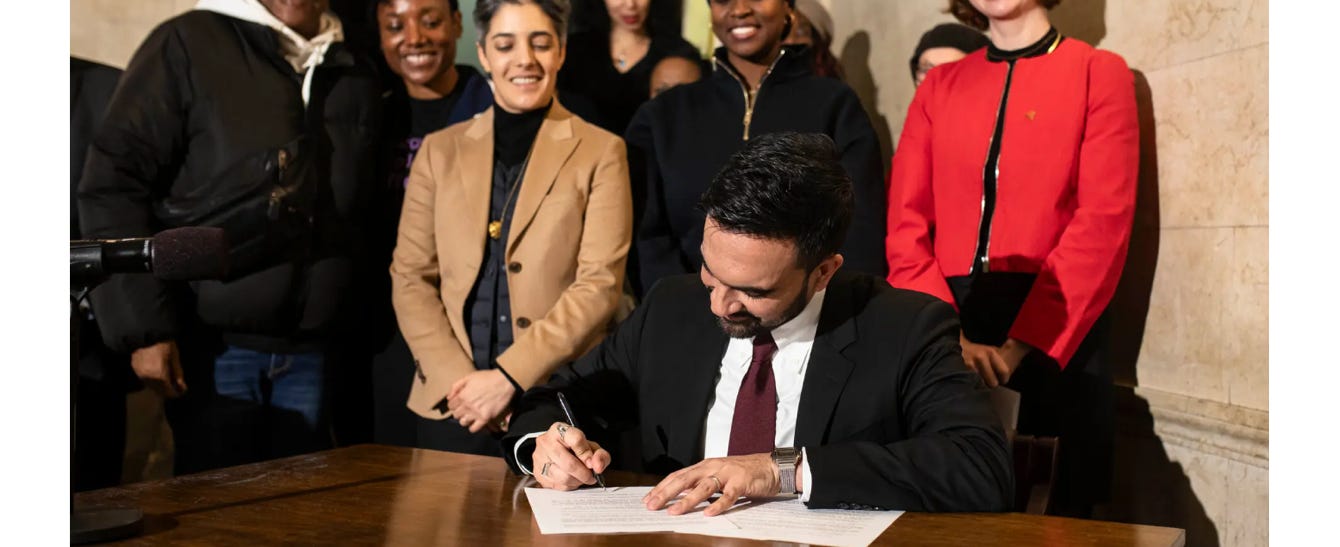
I’m not making this up or exaggerating. Here’s how NBC carefully explained it. First, “the LIFT Task Force (Land Inventory Fast Track) will leverage city-owned land to accelerate housing development, increase supply, and drive down costs.” In other words, he’s going to turn over city property to private developers for new housing. It doesn’t seem like something Karl Marx would embrace.
Second, “The SPEED Task Force (Streamlining Procedures to Expedite Equitable Development) will identify and remove bureaucratic and permitting barriers that drive up costs and slow housing construction and lease-up, making it more affordable to build.”
In other words: deregulation. We noted with great amusement that neither Mamdani nor NBC mentioned which “bureaucratic and permitting barriers that drive up costs” would be “removed.” In this case, it will almost certainly require waiving or rescinding environmental regulations.
To be fair, and for completeness, Mamdani also appointed a crazed liberal activist to the city’s “tenants’ rights division,” announced a legal crusade against a particular big landlord (which is already in bankruptcy), revoked several of his predecessor’s orders, and practically gushed with communitarian claptrap.
Don’t get me wrong— Mamdani is a commie. But could he be a different kind of Marxist? Although the proof will be in the socialist pudding, these housing orders suggest he’s trying to lower rents using free-market principles —supply and demand— instead of mandates and edicts.
Put differently, Mamdani’s most significant practical orders —LIFT and SPEED— were conservative strategies. Fascinating! We’ll continue to watch the city’s first socialist mayor’s progress with great interest.
📉 📉 📉
In the “report good news as bad news” file, the Wall Street Journal oozed out a schizophrenic entry headlined, “The Condo Market Hasn’t Been This Bad in Over a Decade.” About 1,000 previous stories assured us that President Trump faced an intractable housing affordability crisis. But the Journal’s story’s sub-headline complained, “Condo prices this fall posted their biggest declines since 2012.” Which the Journal promptly labeled as awful news.
Of the various affordability issues that Democrats have been constantly crying about lately, housing is the one they cite most often. There are two reasons for this. First, the price of housing affects young voters more than any other affordability issue. But it’s also because Democrats are sure that fixing the problem will take longer than President Trump has before next year’s midterm elections.
In other words, usually housing policies, no matter how ambitious or aggressive, would not be expected to show any meaningful local effects before November.
But —defying all expectations— some housing prices are already starting to shift in the right direction, which is why the Journal tried to frame it as bad news.
📉 “Prices for U.S. condominiums,” the Journal reported, “posted their biggest annual decline since 2012.” Condos are the canaries in the housing mine, but the Journal noted that increases in “single-family home prices have also slowed.” This referred to Florida— one of the hottest real estate markets in the country. But it wasn’t just Florida. The story also reported sagging condo prices in Austin and San Antonio due, get this, to “a glut of supply.”
It’s supply-side economics again!
The story rounded up some heart-rending personal anecdotes. For instance, in Flagler Beach, Florida, Sandra Phillips and Dennis Green have struggled since early last year to sell their townhouse. They delisted it in July, and plan to relist it soon at around $200,000— roughly the same amount they paid in 2020. “Flagler Beach is saturated with places for sale,” Sandra mourned.

In August, Janice and Edward Grimm listed their vacation condo in Murrell’s Inlet, South Carolina. After months without an offer, they have slashed the price to $295,000— less than they originally paid in 2022. “Buyers,” the Journal ruefully noted, “have many condos on the local market to choose from.”
📉 Economists call real estate prices “sticky,” meaning they fall more slowly than changing market conditions demand. Sellers will only reluctantly make major price concessions, and they always hold out until they’re forced to accept losses. Sellers are rational— it can be much cheaper to carry a property for a while, hoping for a better market, than to sell it sooner at a loss.
But eventually, when sellers conclude that the market isn’t going to recover, then prices can start falling all at once, in what economists call a preference cascade. That’s what seems to be starting now, for condominiums.
The Journal’s gloomy article —“condo owners hardest hit”— speculated about a dozen possible causes, but never mentioned the ICE elephant in the room: immigration enforcement. Fewer subsidized illegals means fewer renters, which trickles right up the economic food chain by pressuring sellers. In other words, carrying unwanted properties is more expensive if you can’t rent them.
The Journal’s framing of falling real estate prices as bad news was especially offensive since lower prices are exactly what it has been demanding for the better part of last year. This isn’t rocket science. Obviously, falling real estate prices will hurt sellers while helping buyers. The painful truth is that real estate has been overdue for correction ever since Obama destroyed the market during the 2008 crisis.
This ridiculous media narrative also helps explain why things usually never change— there’s always one constituency or another that doesn’t like it.
But falling real estate prices —while other assets like stocks are increasing— is great news for the so-called “affordability crisis.” It is obviously happening too fast for Democrats’ tastes.
🔥🔥🔥
Speaking of bad investments, you might want to avoid putting your savings in day care centers. Yesterday, the AP popped a story headlined, “Minnesota must provide documents to US government in child care fraud probe by next week.” And the day before, ABC ran a story headlined, “HHS freezing child care payments to all states after Minnesota fraud allegations.” HHS Deputy Secretary Jim O’Neill delivered the bad news:

CLIP: HHS announces national freeze on federal child care subsidies (1:58).
O’Neill announced three encouraging developments:
Starting immediately, all Children & Family payments nationwide will require a written justification, and a “receipt or photo evidence” before money is transferred to a state. O’Neill said HHS will release funds only after “states prove they are being spent legitimately.” It’s not entirely clear yet what “receipt or photo evidence” means.
Governor Walz must immediately (by next week) provide HHS with attendance records, licenses, complaints, investigations, and inspections for the flagged daycare centers from Nick Shirley’s video.
HHS launched a dedicated fraud-reporting hotline and email at www.childcare.gov. It has already received over 200 tips.
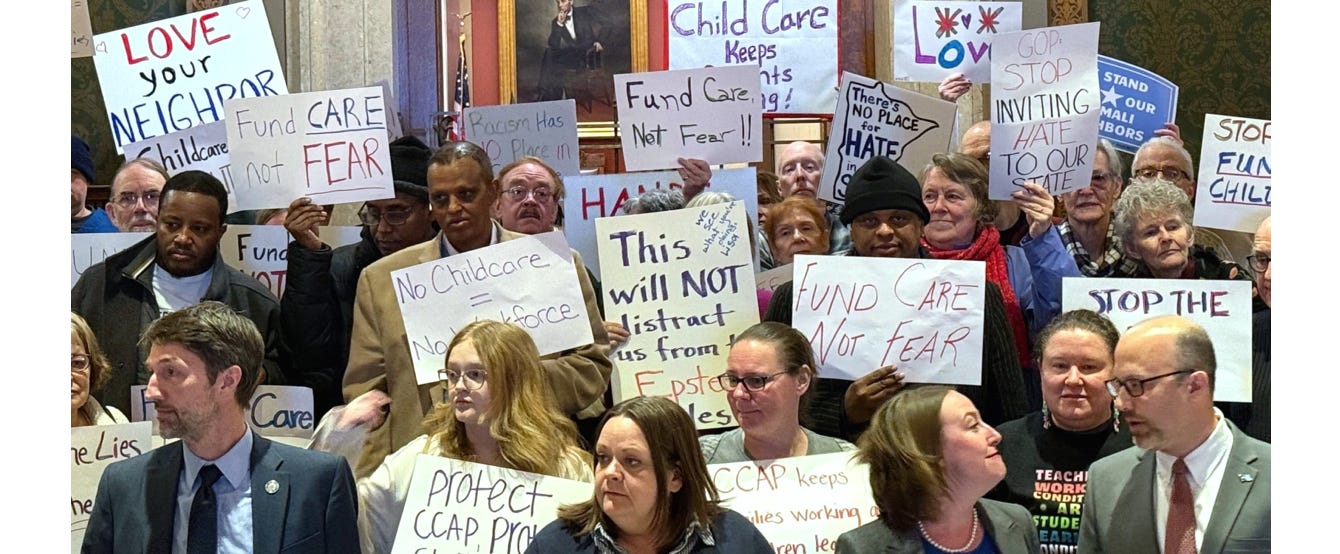
Minnesota activists were hardest hit.
Who knew that daycare was one of the most lucrative investments going? Until just now, that is. Just like with Bitcoin, most of us missed the gravy boat. Now it’s too late to get in on the ground floor.
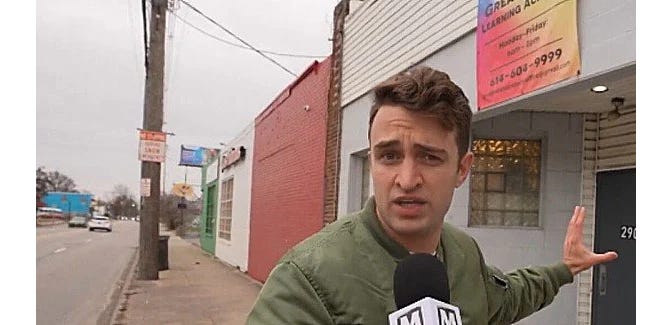
Nick Shirley’s video exposé kicked off a massive ‘hot takes’ moment. Bad actors are flooding the zone with fake intel that sounds like outrage, but is really designed to make everyone look stupid for falling for things later disproved.
So let’s tote up what we know for sure.
🔥 Chapter 142B of the Minnesota Statutes should already prevent “ghost daycare” centers like Nick Shirley apparently exposed. The state statute provides that: “for a licensed child care center, the commissioner shall conduct one unannounced licensing inspection at least once per calendar year.” Governor Walz and the state’s DCF chief insist that the statute has been upheld and claim that new inspections were conducted of the sketchy centers in Nick’s viral video.
(The statute’s inspection requirement leaves a massive loophole for “unlicensed child care centers,” which also get subsidies, but leave that aside. All Nick’s targets were ‘licensed’ centers.)
So … how can the multi-billion-dollar daycare fraud happen, if state auditors are conducting annual surprise inspections?
🔥 Some people have speculated that scammers recruit low‑income families who qualify for subsidies, but rarely or never actually bring in their children— in exchange for a cut. The scammers then bill the state as though the kids had attended full‑time. The kids could even be enrolled at multiple centers simultaneously —with parents earning a “cut” from each enrollment— by exploiting the state’s inability to cross-check.
Others speculate whether some state officials have been threatened or bribed into giving scammers heads-ups about annual surprise inspections in advance.
But we have a lot more information than mere speculation.
In one 2019 investigative report, Jay Swanson, manager of the CCAP investigations unit, explained to state legislative investigators how some of the fraud actually works:
Our investigations have shown that mothers are not receiving legitimate employment experience, by having no-show jobs or jobs that simply require them to spend a few hours a day at a center watching their own children, and that several internal video systems seized from these centers show day after day that children are unsupervised, running from room to room while adult “employees” spend hours in hallways chatting with other adults, or talking or texting on their phones. One could reach the conclusion that the entire amount paid to that provider in a given year is the fraud amount, since neither the children or the taxpayers received what was being paid for.
Mr. Swanson estimated that at least half of the total amount paid to daycare centers was fraudulent: “Investigators, as well as the Supervisor and Manager of this unit, believe that the overall fraud rate in this program is at least 50% of the $217M paid to child care centers in CY2017.”
In other words, according to the lead investigator, at least half of all Minnesota daycare funding is fraudulent. Half! That was in 2017. The report’s conclusions were published seven years ago, in 2019. If anything, the scale of the fraud is even bigger now. So the first problem is that Minnesota’s political leadership is unable or unwilling to do anything about it.
🔥 The next problem is that the risk to scammers is extremely low. Prosecution of daycare fraud in Minnesota is too time-consuming and too difficult. According to the 2017 Minnesota fraud report:
The complicating factor in prosecuting individuals for CCAP fraud is that the fraud occurs in the context of a legal business, which is providing child care. If a center bills the state for more children than attended, prosecutors must prove a particular person intended to defraud CCAP; there must be more than sloppy bookkeeping or an error due to bad business practices.
It can be difficult to prove who is the person or persons at a child care center responsible for intending to defraud the state. For example, it could be the person submitting the bills, but then again it may not be. That person may just be doing the administrative work of submitting bills and depending on others for the accuracy of the number of children who attended, their ages, and when they attended.
The state’s laws seem designed to frustrate prosecution:
In February 2013, Minnesota IT Services (MNIT) changed the wording on the billing forms generated by the DHS CCAP payment systems to drop the phrase, “I certify the following child care billed is correct.”
Given how little documentation is required from providers, it takes massive human effort to prove that any fraud occurred:
Obtaining, analyzing, and preparing the evidence for trial involves a significant amount of work and numerous challenges. After law enforcement officials complete the surveillance taping, investigators must watch the videos and manually count the number of children coming in and going out of the child care center. It is extremely labor-intensive, particularly given that investigators must watch weeks, if not months, of video recordings.
Even when investigators do make the effort, the videos are often inconclusive:
Sometimes cameras were not set up at all of the doors, so the child care center could argue that children also used another door to explain why investigators saw a lower number of children than for which the center had billed.
Minnesota childcare centers are not required to keep an electronic database, which is even worse than it sounds— prosecutors must audit figures using incomprehensible scribblings on handwritten sign-in sheets:
The paper sign-in/sign-out attendance sheets at child care centers present a serious prosecution challenge. One prosecutor characterized these sheets as ‘almost comical’ and another called them ‘useless’ from an evidence standpoint, because the sheets were often half empty and sometimes it looked like the same handwriting filled in ten rows of different names with the same pen.
The report ended by summarizing a sampling of cases, dismissals, and prosecutions. It’s depressing. Trying to successfully prosecute these cases is clearly a you-know-what show. The majority of filed cases did not result in any jail time, with deadlocked juries, cases overturned on appeal, liberal “wrist slap” sentencing, and unavoidable evidentiary failures all being the norm rather than the exception.
Thus, for fraudulent providers, the risks of successful prosecution are low, while the rewards are counted in the millions. It is an “honor system” program designed to manufacture industrial-scale fraud.
🔥 Obviously, Minnesota could —if it wanted to— come up with a much better system. Take my recent adventure in law enforcement from last week as an example.
I got a “notice” from Baker County fining me $100 for ‘speeding’ (26 mph in a 15). The entire process was automated from start to finish. It came from a robotic speed camera allegedly placed in a school zone, and it attached a blurry picture of my license plate.

Never having seen or heard of such a thing before, I researched the enabling statute. The law flirts with the outer limits of constitutional due process, landing just on the safe side only because the penalty is posed as a civil fine, like a parking ticket, and not as a criminal traffic charge.
The hook is that you have thirty days to pay the fine. Then it becomes a criminal charge, which coincidentally resembles in all ways a traditional speeding infraction. But the secondary —and much worse— criminal charge is not for speeding. It is for failing to pay the fine.
I paid it. For $100, it wasn’t worth fooling around with. Which was obviously the point. But most importantly, the automated speed cameras greatly increase the risk of speeding or even driving through a school zone in the first place.
I mention this contretemps not to brag about my scofflaw driving ways, but because it shows how easily the state can enforce whatever laws it wants. When it doesn’t enable enforcement, and when it deliberately makes crimes harder to enforce, that’s intentional.
The purpose of a system is what it does.
🔥 Two days ago, President Trump called the Minnesota daycare scandal “a total FRAUD!” He linked a hilarious story about a Somali daycare that claimed all its records were stolen in a racially motivated retaliatory burglary. It’s actually clever and convenient. How can we prove attendance when some racist stole our records?

The idea that the FBI can possibly prosecute 20,000 Somali scammers is a cute fantasy. It took hundreds of FBI agents nearly three years to prosecute only 1,800 January 6th tourists, and those cases didn’t include massive evidentiary headaches. The horrifying truth is that the fraud is so widespread that it cannot be prosecuted on a case-by-case basis. It’s simply not possible.
Here are my top four suggestions for what must be done.
First, the penalties for defrauding the government should be massively increased. This strategy also faces limits. A life sentence sounds good, but it would probably be overturned as an unconstitutionally unreasonable punishment. Even with a constitutional version, there would be inevitable sob stories about people who only did a little fraud but got whacked with a huge minimum sentence.
But here’s the point. To effectively deter fraud, when the risk of prosecution is low, then the individual cost of a conviction must be made astronomical. It’s simple economics.
Second, the laws need to enable easier convictions. The days of empathetic, feel-good rules have to stop. Someone identifiable needs to sign every required report under penalty of perjury. If sufficient records are not properly kept, then equally harsh and immediate punishments should apply, with the same low evidentiary standards as speed camera citations. This will also produce sob stories. But when dealing with low-trust communities, it is the only way.
Next, immigrants and immigrant-owned businesses should simply be ineligible for any welfare, for at least ten years from entry. Maybe forever. The logic is simple. If America is a better place to live without public assistance, they should apply to come here. If not, then they should stay home. It’s that simple. Plus, until they have fully adopted American culture, they should not participate in any “honor system” program.
Fourth and finally —and I deliberately left this biggest suggestion for last— the government should get completely out of the welfare business. I get it, life is unfair. And many innocent people suffer unavoidable misfortunes. We all want to help them. But government-based welfare simply doesn’t work at scale and it is destroying the country.
There are other ideas, like counting welfare benefits as income for tax purposes. But anyway you slice it, we need to start over. We should completely cancel all payments to individuals, NGOs, and small businesses. Maybe we could directly fund established churches and let them address local needs.
I don’t know. It’s not my problem or my job. Legislators, bureaucrats, and scientists are paid very well to figure this stuff out.
This expanding, intensely public, long-in-the-making scandal is proving one thing: change is not optional. And based on the speed and scope of the federal response so far, the best bet is that change is in the mail. Hopefully, the nation is finally learing its lesson.
Have a wonderful weekend! Thanks again for giving your author the day off yesterday. We’ll be back on Monday, to explore the political implications of Maduro’s arrest and a cascade of related geopolitical developments.
Don’t race off! We cannot do it alone. Consider joining up with C&C to help move the nation’s needle and change minds. I could sure use your help getting the truth out and spreading optimism and hope, if you can: ☕ Learn How to Get Involved 🦠
How to Donate to Coffee & Covid
Twitter: jchilders98.
Truth Social: jchilders98.
MeWe: mewe.com/i/coffee_and_covid.
Telegram: t.me/coffeecovidnews
C&C Swag! www.shopcoffeeandcovid.com
✝️✝️✝️
Then Nebuchadnezzar the king was astounded and stood up in haste; he said to his high officials, “Was it not three men we cast bound into the midst of the fire?” They replied to the king, “Certainly, O king.” He said, “Look! I see four men loosed and walking about in the midst of the fire without harm, and the appearance of the fourth is like a son of the gods!” Then Nebuchadnezzar came near to the door of the furnace of blazing fire; he responded and said, “Shadrach, Meshach and Abed-nego, come out, you servants of the Most High God, and come here!” Then Shadrach, Meshach and Abed-nego came out of the midst of the fire. The satraps, the prefects, the governors and the king’s high officials gathered around and saw in regard to these men that the fire had no effect on the bodies of these men nor was the hair of their head singed, nor were their trousers damaged, nor had the smell of fire even come upon them.
— Daniel 3:24-27 NAS95
✝️✝️✝️
In your list of suggestions about what to do about the rampant Somali fraud, you missed the easiest, most simple one. Unless the laws have been changed since the '60's, naturalized citizenship does NOT have the same rights as people who are born in the US. You can have your citizenship revoked and be deported for committing crimes. I do not recall there being any specificity about the nature of the crimes, AKA it is discretionary to the government. You might want to check and see if this is still in effect. That would make deportations easy peasy for any number of crimes.