

Good morning, C&C, it’s Saturday! Your Weekend Edition roundup includes: the story of how progressives sued the mail-ballot Executive Order in two different courts at once and accidentally lawfared themselves into a circuit split, delivering the real voting fight to the Supreme Court while everybody stood around watching the SAVE Act; why a humble barcode may accomplish what sixty Senate votes never will; the Canada tariff war everyone assumed was over, back at the maximum legal setting, with a hit list — wine, cement, hockey sticks — that reads like the receipt from a Winnipeg bachelor party, with an exemption list shaped suspiciously like the only two provinces that still like us; Alberta’s independence referendum landing later this year, entirely by coincidence, I’m sure; and young conservatives rehabilitating Richard Nixon on a strict regimen of rap edits and merch, a comeback going considerably better than anything the man managed while he was alive.
🌍🇺🇸 ESSENTIAL NEWS AND COMMENTARY 🇺🇸🌍
⚖️⚖️⚖️
It’s the Goldilocks problem! Sometimes, lawfare fails. Sometimes it works. Other times, too much lawfare itself can be a bad thing. This mainly affects progressives, who never saw a lawsuit they didn’t like, so long as it can be written down, and so long as it hurts, slows, or somehow confounds the conservative agenda. While everyone’s eyes are riveted to the SAVE Act, the real fight over voting-by-mail just reached the Supreme Court. On Thursday, ScotusBlog reported, “Trump administration, states urge justices to allow full implementation of executive order on mail-in voting.”

Meet Judge Indira Talwani, appointed in 2013 by Barack Obama— the nation’s first female federal judge with Indian-American parents. I realize that slices the diversity cake a little thinly, but that’s where we are these days. Anyway, Judge Talwani presides in the deep blue district of Massachusetts, one of the preferred destinations for the steady stream of lawsuits complaining about the latest Trump outrage.
Last month, Judge Talwani froze President Trump’s Executive Order directing the Postal Service to create a scheme for step-by-step tracking of mailed ballots. Twenty-three blue states plus the District of Columbia had sued, arguing that the ballot-tracking plan was terrible, horrible, and simply no good. Judge Talwani completely agreed, finding the executive order created confusion, disenfranchised voters, and on top of that, was unconstitutional.
“The Constitution does not grant the president any specific powers over elections,” the first female, Indian-American judge wrote in her order.
Trump’s lawyers appealed. But the First Circuit —the appellate court that hears cases from Massachusetts— upheld Judge Talwani’s injunction, and said the Executive Order may not move forward. Apparently, the Constitution requires that mailed ballots remain enigmatic ciphers swirling in dark areas of the postal system right up until blue states get around to counting them, when they can be finally and dramatically revealed. Ta-da!
Judge Talwani said no further action could be taken toward implementing the Executive Order in the 23 states and the District of Columbia. Full stop.
⚖️ So far, so good for Team Blue. But then a wrinkle appeared. Unsatisfied with only suing in Massachusetts, a bunch of blue NGOs had also sued separately in DC itself, and even friendlier jurisdiction for Trump lawfare. Defying all predictions, the DC judge found the exact opposite from Judge Talwani. And last week, the DC Circuit Court of Appeals agreed. That court —knowing the Talwani decision was out there— held that it was too soon to sue, since the USPS plan wasn’t final yet, and the harm would actually be to the Administration, since if it can’t move forward, the rules won’t be final in time for the midterms.
That decision produced an immediate and uncomfortable tension between the First Circuit, which had said the USPS cannot move forward in DC, and the DC Circuit, which said that it could. That is what lawyers call a “circuit split,” and it opens the door for immediate Supreme Court review. The Supreme Court got the case on Monday and immediately ordered insta-briefs to be filed in one week, due by this coming Monday, August 3rd.
The smart money is on SCOTUS siding with the DC Circuit, finding the rules aren’t “ripe” for review yet, and letting the USPS move ahead for now. Come back when you know what to actually complain about. The complication is that the 23 states are crying about having to completely “rebuild” their systems less than three months from a federal election— even though 15 red states filed briefs saying it would be no problem at all.
So SCOTUS could find that we are just too close now to the midterms and it’s better to keep the status quo for now— which they often say in election-related cases. That’s what makes this so hard to handicap.
“We want to have honest voting in our country,” President Trump said when he signed the Executive Order in March, “because if you don’t have honest voting, you can’t really have a nation.”
Unsurprisingly, Democrats really disagreed.
“Trump’s USPS is threatening to withhold mail ballots unless states turn over voter rolls,” Illinois governor J.B. Pritzker complained, adding, “we’re going to fight it like hell.” The ACLU officiously declared, “Attempts to end voting by mail are part of the Trump administration’s larger strategy to undermine elections and subvert the will of the people.”
Antique Senate Minority Leader Chuck “Iceburger” Schumer promised “to fight in courts to ensure every voter can cast their ballot this November.”
Never mind that you haven’t heard much about it. This is the real fight, folks. Forget about the SAVE Act.
⚖️ If I had to pick, I would take the USPS ballot-tracking and gating scheme in Trump’s March 2026 executive order every day over the SAVE Act. The postal plan offers conservatives a more durable, lower-friction, and politically resilient win than the SAVE Act. It embeds federal control and auditability right into the mail-ballot pipeline via existing postal authority and technology, instead of a politically thermonuclear congressional war over brand new requirements for registration documents.
The SAVE Act requires documentary proof of U.S. citizenship (a passport, birth certificate, or equivalent) to register or update voter registration for federal elections. It offers nothing for existing registrations. As you know, it has passed the House multiple times (throughout 2025–2026), but it is bogged down in the Senate over the filibuster.
Implementation of SAVE would force the states to overhaul their registration systems and handle provisional ballots for voters claiming they can’t pay $10 for a replacement birth certificate. You can imagine all the stories about goofy ‘disenfranchised’ voters we’d see in the news.
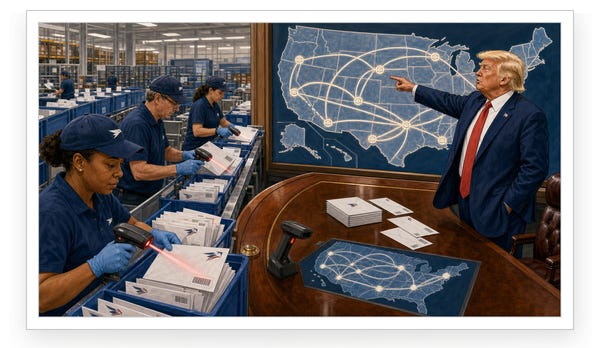
Meanwhile, the USPS plan is already quietly working for states that voluntarily opted in. It short-circuits Congress entirely, running through USPS rulemaking under existing statutory authority and executive direction. No 60-vote Senate hurdle, no reconciliation gimmicks.
It is also much simpler politically. Barcodes, tracking, and “Official Election Mail” logos sound like package-delivery confirmation and chain-of-custody tools— which everyone already accepts and enjoys from everyday package delivery services like Amazon, Fedex, and UPS. It is much harder for opponents to paint unique identifiers and real-time visibility as racist or disenfranchising compared to the demand that every voter dig up a birth certificate. The White House language emphasizes “auditable mechanisms” and “reducing the risk of fraud”— without “unduly burdening” eligible voters.
Conservatives’ core distrust centers on unsupervised mail ballots. The Trump plan lets the federal government gate who receives a ballot (via existing citizenship lists) and track every ballot through the mailstream, creating near-real-time data, anomaly detection, and most importantly, forensic evidence for DOJ prosecutions. ‘Accidents’ like mass disappearances of mailed ballots from red counties would become as obvious as another black eye on a celebrity.

SAVE, on the other hand, only polices the front end of registration. There are no black eyes to stick out. Once registered, mail ballots still flow into the inky darkness with zero federal visibility.
Once USPS requirements, design reviews, and participation-list systems go live, they become sticky operational reality. Unwinding them later would require new rulemaking or legislation. Citizenship lists can be improved, refined, or expanded over time. And all the work is done by the federal government. But SAVE’s burdens fall right on voters and local clerks, every cycle, and would surely generate endless ‘as-applied’ litigation and provisional-ballot chaos.
Best of all, the USPS system generates the data conservatives have long pined for— proof of delivery only to verified citizens, chain-of-custody logs, timelines for each ballot, and political ammo justifying future reforms and enforcement. Even imperfect citizenship lists coupled with mandatory tracking would advance the ball more than a pure registration statute that may never clear the Senate.
Think about it. The SAVE Act lacks any transparency mechanism.
In short, the USPS barcode-and-list regime will turn the postal service into a federal election-integrity checkpoint with real-time surveillance and audit capabilities. It delivers concrete control over the mail-ballot stream using administrative devices that are harder to demonize, easier to lock in, and free from the Senate’s arcane arithmetic— making it the higher-value, longer-term conservative victory even if SAVE eventually passes.
Everyone (including me) has demanded the Senate pull the plug on the so-called ‘silent filibuster,’ which makes sense in today’s fractious political climate. But, to be fair, we haven’t spent much time considering the cost for conservatives when a future Democrat Congress tries to ram some unpopular law through. In short, it might come back to bite us in the cushiony parts, a tradeoff that seems justified now, but could look horribly short-sighted in hindsight.
The USPS solution avoids all that unknown peril. For better or worse, the filibuster can stay. The postal plan is simpler and arguably better in every way than the SAVE Act. Everyone —corporate media included— has been distracted by the high-profile SAVE Act controversy. But now the real solution has finally landed in the Supreme Court.
Frankly, and I hate to say this in print, if the USPS program survives —even if it misses the midterm target— we’ll still be vastly better off in 2028 and after. Yet, for now, we are still in the game for November. And who knows? We could still get both.
Briefs are due Monday. Stand by. The fireworks show will begin shortly.
🔥🔥🔥
Remember Castro lookalike Justin Trudeau? Me neither. It seems like ages ago that the dapper lockdown queen was swanking around bragging about debanking Canadian truckers. Now the WEF Young Leader, international darling, and Black-Eye Club member (just saying) is busy canoodling with celebrities, his lost political career having settled to the bottom of the global septic tank. Meanwhile, Canada’s problems are only beginning. On Wednesday, the Guardian UK ran an op-ed headlined, “Trump has singled out us Canadians for special treatment in his tariff war – there is no choice but to get nasty.”

The jokes write themselves. Get nasty? Canadians? Will they subject us to a harsh stare? Annex Vermont? Cut us off from back bacon?
Justin may have ridden off into the political sunset, replaced by bankster Prime Minister Mark Carney, but the tariffs stayed behind to clean up. Canada originally escaped the worst of the Trump Tariffs last year, shielded in large part by the USMCA trade deal. That deal expired, and this month, the US declined to extend it, which means it is now subject to annual renegotiation.
Then, last week, the White House announced tariffs as high as 50% on a selection of Canadian products including, for the first time, items previously protected by the trade agreement. “The tariffs will hit a wide range of products,” the Guardian said, “including wine, hockey sticks and cement.” (Who drinks Canadian wine?) Headline, July 21:
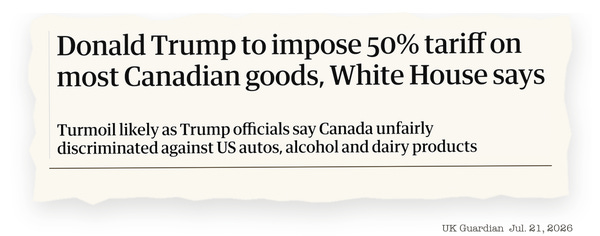
The Supreme Court shot down Trump’s easiest tariff tool late last year, including the 10% tariffs Canada then faced, and progressives celebrated too soon. As I pointed out at the time, SCOTUS ratified other ways of imposing tariffs, which might be slower, but ultimately would be stronger. Well— behold!
Last week, President Trump signed three new tariff declarations against Canada. He imposed the maximum allowable tariff —50%— under the 1930 Smoot-Hawley Act (which, frankly, is fun to say over and over). It’s another first. To do it, the Administration was required to conduct an investigation and publish findings, which took a few months, but is now complete.
The Canadian journalist who published the outraged op-ed conceded that Trump might have a point. “The US has some legitimate gripes with us,” he generously allowed, “including trade barriers and Canada’s chronic underinvestment in defence. It’s reasonable to be angry about those things.”
It hurts— a lot. “An unfriendly, potentially even hostile US is a staggeringly consequential change,” he said. “It’s hard to overestimate how huge a shock this has been.” You’d think it would make bigger news here in the US, but the news cycle is, as they say, a target-rich environment.
If you’re wondering about the odd selection of tariffed products, all I can say is that coincidentally, they hit the three most anti-US provinces hardest. They exclude energy products, fish, and critical minerals— which are most economically important to pro-US provinces. (They were also the strongest anti-mandate provinces during the pandemic.) “The economies of Alberta and Saskatchewan were relatively spared,” the author noted.
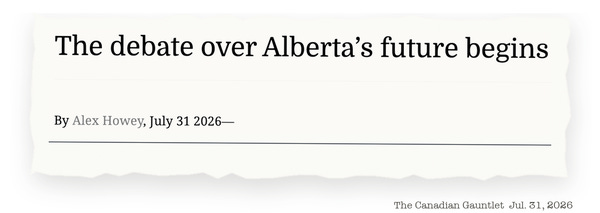
Also coincidentally, Alberta is holding an independence referendum later this year. Headline from the Canadian Gauntlet, yesterday:
What can we say about this sudden reinvigoration of Trump’s tariff dashboard? About the fact that the battle with Canada —which critics crowed the Canucks had won— is still indisputably raging, even if it has faded into media’s background noise?
Let’s be honest. We don’t know the plan. (Nor should we.) But we do know that the plan continues. Canada can replace their lockdown-loving WEF Young Leader with a Prime Minister whose main qualification seems to be a bad case of fulminant TDS. SCOTUS can tear the biggest button off the tariff dashboard and make Trump refund hundreds of billions in taxes. They can file lawsuit after lawsuit.
Think of it. One major legal setback would have caused previous Republican administrations to give it up as a lost cause. Not this administration. When the Court slams the door, the Trump Team climbs out the window.
Against all odds, the plan of re-imagining the Western Hemisphere keeps humming down the tracks. The tariff threat is bigger and more conspicuous than ever. We should keep our eyes on the ball— and not on corporate media’s hairy, transgender cheerleaders.
🔥🔥🔥
Prepare yourselves for the most unexpected story, perhaps, of all time. About two weeks ago, the Wall Street Journal reported, “Young Conservatives Have an Unlikely New Icon: Richard Nixon.” The subheadline explained, “‘Nixonmaxxing’ swag and TikTok videos have helped trigger a rethinking of the former president’s legacy among some conservatives.” It’s not a blip. Two days ago, the Free Press reported, “‘Nixonmaxxing’ Is More than a Meme.”
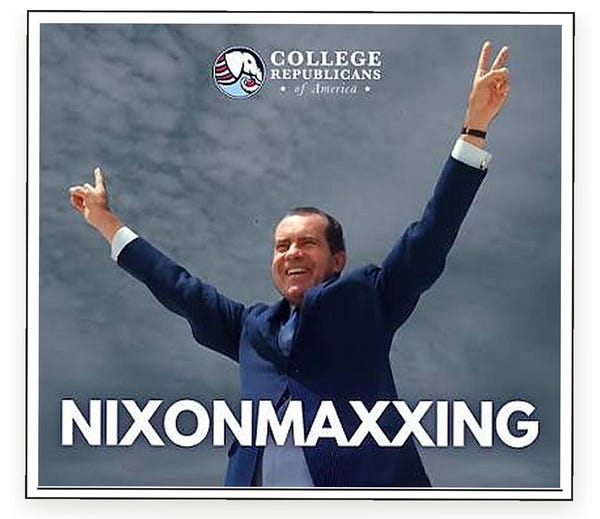
“The kids,” the Journal began, “are Nixonmaxxing.”
Apparently, more than half a century after the Watergate scandal that corporate media still won’t shut up about, young conservatives are discovering the “aesthetic and attitude” of our 37th president. Videos featuring archival footage of Nixon set to rap music are going viral on Instagram and YouTube. Influencers are wearing hats that say “Nixon Now More Than Ever” and carrying swag announcing “Pretty Girls for Nixon.”
The Journal quotes one bewildered commenter asking: “Is Nixon pulling off the greatest posthumous political comeback in history?”
Yes. Yes, he is.
And the corporate media is absolutely terrified. Why? Because if there’s one thing the establishment possibly hates more than Donald Trump, it’s Richard Nixon. They spent fifty years building the narrative that Nixon was the ultimate political villain. They taught it in schools, they made movies about it, they carved it into stone. They wouldn’t shut up about it. Nixon was the actual boogeyman.
But here’s the buried lede: the kids aren’t just wearing fanny packs ironically. They’re actually looking at Nixon’s record. They’re seeing the man who went after Alger Hiss. They’re seeing the relentless anti-communist crusader who actually understood the threat of Marxism before it was again fashionable to talk about it.
The irony is delicious. When young progressives wear Chairman Mao t-shirts, the media calls it “youthful idealism.” But when young conservatives start making TikToks about the guy who literally created the EPA, ended the draft, went to China, and forced the Soviet Union to the negotiating table? Break out the smelling salts. It’s panic in the streets.
Can you see it? This is the ultimate Boomerang story. The left spent decades trying to convince young people that all Republican presidents are basically Richard Nixon in disguise. And now the kids are looking around, seeing the absolute state of the country, and saying, “You know what? A little more Nixon sounds pretty good right now.”
As young conservative intellectual Christopher Rufo pointed out in his terrific 2023 City Journal piece defending Nixon, the left’s destruction of Nixon was essentially a bureaucratic coup. (Rufo platformed the concept of “counter-revolution,” which long-time readers will recall we’d been discussing since 2021 at least.)
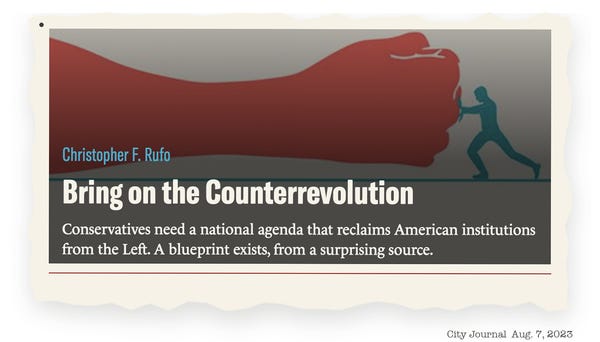
Democrats weaponized his mistakes —difficult-to-describe peccadillos that the modern deep state makes look like he misplaced his cell phone— as a lever to remove a president who threatened the deep state’s authority. Conservatives weren’t prepared for that type of combat. It should sound painfully familiar by now. I’m not sure they really even understand it yet. Here’s Chris Rufo’s tweet reacting to the WSJ piece:
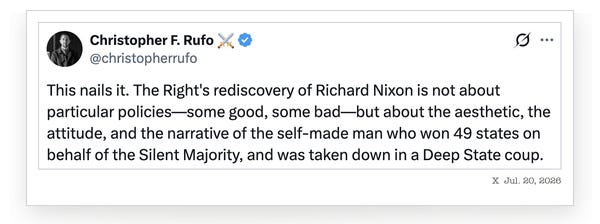
Nixon’s policy legacy is a mixed bag. The EPA, for instance, was downright disastrous. His ‘aesthetic’ is downright unique, all right, like when he wore a full suit and dress shoes on the beach.

But more than anything —and this is the real reason I think Nixon is becoming a hero our time desperately needs— Richard Milhous Nixon was a notorious anticommunist.
Before Nixon was the Watergate villain the corporate media spent fifty years teaching your kids about, he was something far more dangerous to the left: he was right. As a young congressman from California in the late 1940s, “Red Scare” Nixon sat on the House Un-American Activities Committee and did what the entire Georgetown establishment called boorish, paranoid, and beneath a serious man — he went after Alger Hiss, a senior State Department official and darling of the foreign policy elite, and refused to let go.
Late in the 1990s, the declassified Soviet Venona intercepts confirmed Nixon was right. Hiss was a communist spy, passing secrets to Moscow while hobnobbing with the progressive elites who ran American foreign policy. Nixon was right, and they never forgave him for it. That early battle defined his entire career— he understood, viscerally and early, that the Soviet threat was not a dinner party topic but an existential war being fought inside American institutions, and he fought it accordingly.
Nixon negotiated the first serious nuclear arms control treaties with Moscow from a position of strength, drove a strategic wedge between the USSR and China by opening Beijing before anyone else dared, and spent his entire career treating communism not as an abstraction but as the enemy it actually was. The left hated him for all of it. Which, if you think about it, is the highest possible character reference.
The Democrats did such a complete job of assassinating Nixon’s character that they forced him to become the only American president to resign and from there built an edifice of slander and defamation higher than the Obama Presidential Library. Nixon wasn’t perfect, not by any measure, but he won in a 49-state landslide because Americans hated communists, and so did he.
So Alice, we’ve gone all the way down the rabbit hole and come out the other side. The generation that grew up watching the establishment try to destroy Donald Trump is suddenly very skeptical of the establishment’s narrative about Richard Nixon. They see the parallels. They see the same media playbook, the same bureaucratic maneuvering, the same coordinated outrage.
And the kids aren’t buying it.
“Nixon hype edit was not something I knew I needed,” one young fan wrote. Well, maybe this is exactly the healing that the country needs. A reminder that before you can negotiate from a position of strength, you have to actually have strength. A reminder that fighting communism isn’t a cocktail party— it’s a down-and-dirty street fight.
So ladies, grab your “Pretty Girls for Nixon” hat and enjoy the show. If it continues, the media’s collective meltdown over this will be spectacular.
Have a wonderful weekend! C&C will return on Monday, bright and early, with another delicious and intellectually nutritious roundup of essential news and caffeinated commentary.
Don’t race off! We cannot do it alone. Consider joining up with C&C to help move the nation’s needle and change minds. I could sure use your help getting the truth out and spreading optimism and hope, if you can: ☕ Learn How to Get Involved 🦠
How to Donate to Coffee & Covid
Twitter: jchilders98.
Truth Social: jchilders98.
MeWe: mewe.com/i/coffee_and_covid.
Telegram: t.me/coffeecovidnews
C&C Swag! www.shopcoffeeandcovid.com
“When the Court slams the door, the Trump Team climbs out the window.” 😂 Best Quote Ever Mr. Childers! ❤️❤️❤️
I M H O
To me the republicans need to learn a lot about law fare and use it when so needed if this is ever to be fixed. A presidential pardon does not stop the justice department from investigating, indicting, prosecuting, and convicting a person that has received a presidential pardon. Crimes against humanity, lying under oath, obstructing a federal Senate investigation, illegally funding gain of function viruses, having federal employees on the federal payroll filing paperwork for someone to get rich, etc. All of these crimes can be prosecuted even without a prison sentence. Once a person is found guilty of any of these crimes it would not only open them up to state and civil lawsuits, which I believe is what is deserved, it also would be grounds to strip them of a pension, federal benefits and all issued licenses. Makes sense to me. The democrats have no problem putting innocent people behind bars like Peter Navarro, Steve Bannon, Roger Stone and thousands of others. The communist didn’t seem to have a problem putting an innocent 79 year old former president in prison for 400 years! There’s a lesson here to be learned, if you live by the sword you die by the sword.
A diary, which is said by a plaintiff to be their own personal unredacted diary (big mistake), can prove so many lies and guilt. The Beaton down American taxpayer deserves justice to be served.
J.Goodrich