
☕️ MODESTLY ☙ Monday, February 16, 2026 ☙ C&C NEWS 🦠
RFK Jr. tears Big Food apart on 60 Minutes; coffee officially makes you smarter; OpenClaw goes mainstream; Trump plans America's biggest birthday; ICE builds a deportation machine; more.

Good morning, C&C, it’s Monday! A fresh new week. Your roundup today includes: RFK Jr. and a former FDA chief team up on 60 Minutes to expose the GRAS food additive scandal (10,000 vs. 400), JAMA says coffee cuts dementia risk by 18% (you’re welcome), OpenClaw’s creator joins OpenAI in a deal dripping with irony, Trump orchestrates America’s 250th birthday bash using foreign elites’ money, and ICE’s $38.3 billion mega-center plan reveals what mass deportation actually looks like.
🌍🇺🇸 ESSENTIAL NEWS AND COMMENTARY 🇺🇸🌍
🍎🍎🍎
MAHA has officially gone mainstream. Note these numbers, they’ll be important later: 10,000 vs. 400. Last night, CBS’s 60 Minutes aired a pro-MAHA segment with HHS Secretary Robert F. Kennedy, Jr., tearing Big Food a new evacutory aperture. Later last evening, CBS ran a story that —shockingly— didn’t compare Kennedy to a Third Reich warlord, headlined, “RFK Jr. says ultraprocessed food manufacturers hijacked GRAS ‘loophole’ to use questionable ingredients.”
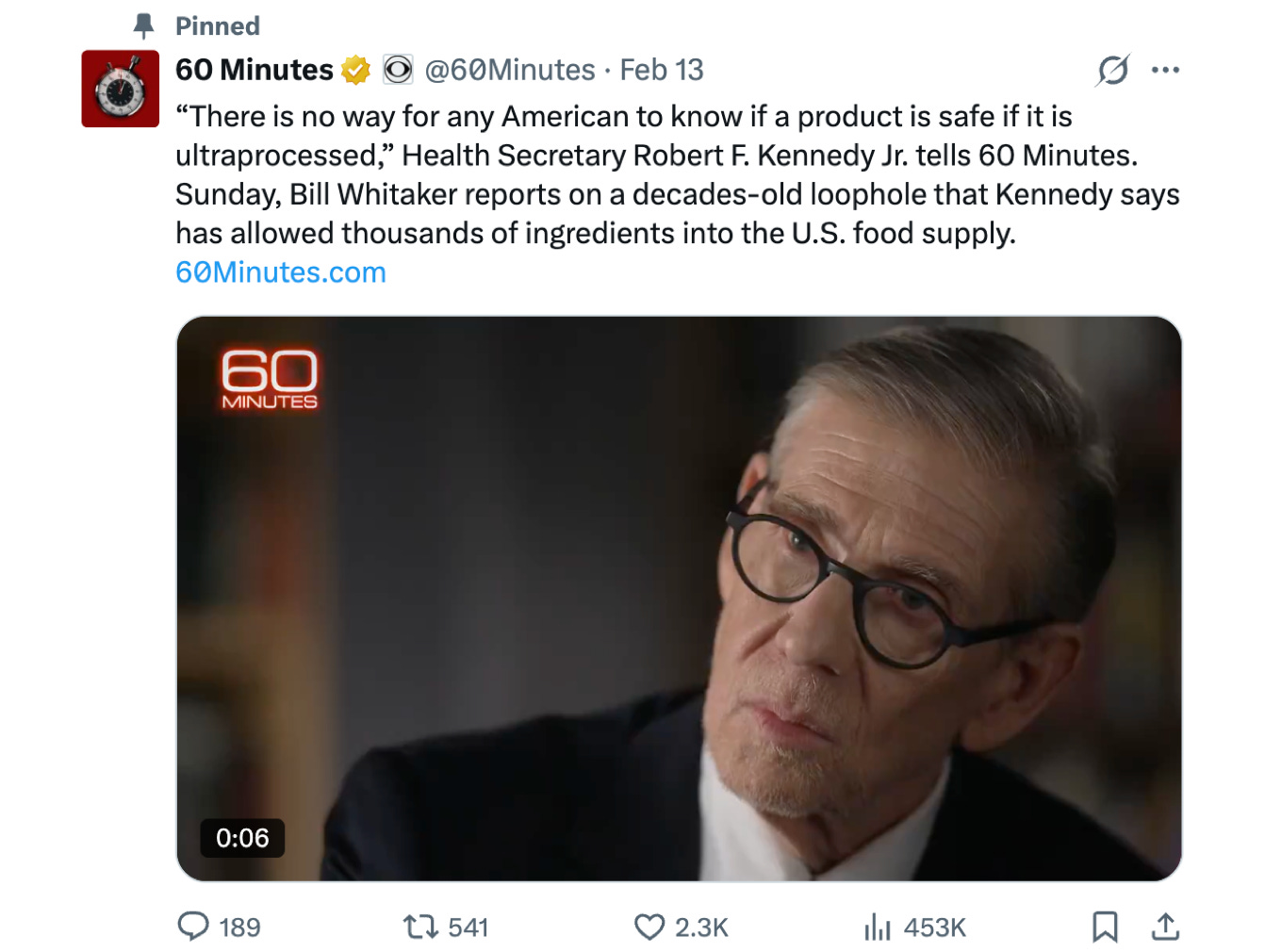
CLIP: RFK. Jr. pins America’s obesity on ultraprocessed food, calls it “poison” (13:45).
It was bad news for Ho-Hos, Ding-Dongs, and birthday-cake-flavored Doritos. “There is no way for any American to know whether any product is safe if it is ultra-processed,” Kennedy said in the interview, which also featured former FDA Commissioner David Kessler (Bush/Clinton-era), who disagreed completely with Kennedy’s vaccine positions— but wholeheartedly agreed with the Secretary about food. (Kessler’s not just any old former FDA Commissioner— he led the charge against Big Tobacco. Now he’s back.)
The segment was ostensibly about GRAS. Not the green growing stuff your miniature schnauzer eats outside to aid his digestion, then comes back in and throws up on your favorite throw rug. GRAS is a class of food ingredients. The four-letter acronym stands for “Generally Recognized as Safe,” but as always, it includes sneaky, rhetorical sleight of hand.
The trick is: recognized as safe by whom?
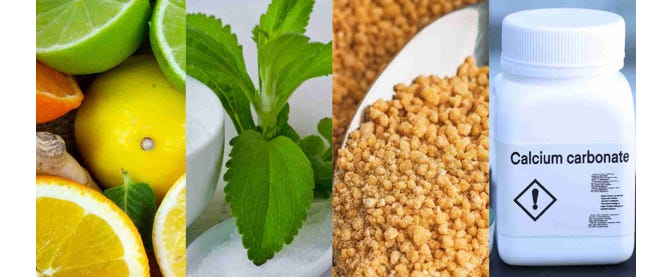
🍎 In 1958, Congress created the GRAS classification to exempt common household ingredients like salt and vinegar from full FDA review. Seems logical, but as usual, they mangled the good intentions; the language was too broad. Food companies exploited the new GRAS exemption to self-certify hundreds, then thousands of novel industrial ingredients as quote-unquote “safe” — no independent government testing or approval required.
In short, something is “generally recognized as safe” so long as it’s not explicitly banned and somebody says so.
GRAS additives include innocent and delicious-sounding ingredients like theobromine, partially hydrogenated rapeseed oil, high-fructose corn syrup, acesulfame potassium, brominated vegetable oil, potassium sorbate, EGCG, and what the Pew Charitable Trusts estimates are over 1,000 completely ‘unknown’ chemicals labeled as ‘natural flavor’ and ‘artificial flavor.’ Pew calls them “secret GRAS” — self-affirmed by manufacturers who never even told the FDA they existed.
“Over the last 40 years,” former FDA chief Kessler told CBS, “the United States has been exposed to something that our biology was never intended to handle. Energy-dense, highly palatable, rapidly absorbable, ultraprocessed foods that have altered our metabolism and have resulted in the greatest increase in chronic disease in our history.”
Somewhere between 4,000 and 10,000 GRAS ingredients are currently in food sold in American supermarkets— the FDA isn’t even sure how many, since it doesn’t track them. Of the 10,000+ additives allowed as GRAS in American food, the FDA has never even glanced at the safety of about 3,000 of them. Think of it: The agency tasked with ensuring American food safety doesn’t even know what is in the food.
It’s not apples-to-apples (pun intended), but Europe allows only 400 of these ingredients, and somehow has better food anyway. It’s an astonishing contrast: 10,000 versus 400.
GRAS is big money. In 2017, independent science journalist and skeptic Gary Taubes said he’d met an economist at a Congressional hearing. The economist told a staffer (who toldTaubes), “If you create a new market with a brand-new manufactured food, give it a brand-new fancy name, put a big advertising budget behind it, you can have a market all to yourself. You can’t do that with fruits and vegetables. It’s harder to differentiate an apple from an apple.”
Consider the timeline. Congress created the GRAS exemption in 1958. In the 1960s, only 13% of American adults were obese. It expanded to 15% in the 1970s. Obesity swelled to 23% in the 90’s, 31% by 2000, 36% by 2010, and currently crushes the scales with 70% of Americans either obese or overweight.
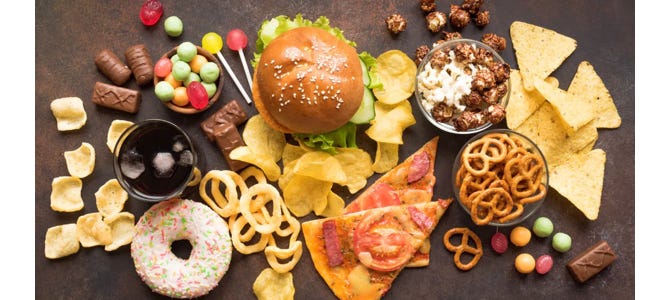
For our entire adult lives, doctors, scientists, and nutrition experts have scolded us as undisciplined, lazy lard-butts— even while most of them were packing on the pounds, too. Meanwhile, politicians and technocrats assured Americans that our food was perfectly safe— even as big food dumped an entire industrial chemistry lab into the Snackwell’s cookie mixer.
It was a political gamble for CBS to platform Kennedy in a positive light. On the plus side, defending ultraprocessed food is a dead loser (progressives already tried it and failed spectacularly). But the risk is that people might connect Kennedy’s favorable media coverage related to clean eating to his vaccine ideas. In other words, he’s not a complete moron, so maybe he also has a talking point or two about jabs.
Here we are, against all odds. Kennedy was just favorably platformed on a primetime corporate media mainstay. CBS is doing actual journalism again. Maybe it’s too soon to pull a George W. Bush and declare victory. But you can see victory from where we’re standing.
☕☕☕
Follow the science! My goodness, what can’t coffee do? Last week (on Michelle’s birthday), the gold-standard Journal of the American Medical Association (JAMA) released a breakthrough study titled, “Coffee and Tea Intake, Dementia Risk, and Cognitive Function.” It was even good news for our beloved but deluded tea-drinking friends. (Well, real tea, anyway. Not that fruity stuff.)
JAMA published a massive, peer-reviewed study last week confirming what Coffee & Covid readers have known all along: coffee makes you smarter. More importantly, it stops you from getting dumber. The study tracked a horde of 131,000 people for up to 43 years (far longer, by the way, than the FDA has been tracking most of the 6,300 ingredients in Cap’n Crunch). Researchers found that 2-3 daily cups of caffeinated coffee cut dementia risk by 18%. Decaf did nothing. In other words, it’s the caffeine, dummies.
“After adjusting for potential confounders and pooling results across cohorts,” the scientists wrote, “higher caffeinated coffee intake was significantly associated with lower dementia risk.” Not only that, but it gets better. It’s not just dementia protection. They added, “higher caffeinated coffee intake was also associated with better objective cognitive performance.”
In short: Drinking coffee literally makes you more intelligent.
Eighteen percent! From coffee! That’s a bigger risk reduction than most pharmaceutical drugs can claim, and even expensive coffee only costs about four dollars instead of four thousand. Even better, the protective effect held up regardless of genetic predisposition — meaning coffee isn’t racist or sexist or patriarchal; it doesn’t discriminate. It protects your brain whether or not dementia runs in your family.
Sadly, decaffeinated coffee provided zero protection. None. The researchers concluded that caffeine does the heavy lifting. So all those years of expert advice to “switch to decaf” weren’t just wrong. They were, according to Harvard, MIT, and Mass General Brigham, potentially depriving you of brain protection. I feel so vindicated right now, I think I’ll have an extra cup.
They also found similar protective effects for caffeinated tea drinkers (mostly British, of course). That’s all I plan to say about that. I don’t want to encourage them.
The scientists were surprised— and a little embarrassed. They didn’t want to find a natural remedy. “While our results are encouraging, it’s important to remember that the effect size is small,” said Dr. Daniel Wang, offensively minimizing coffee in the study’s press release. Oh, please. If Pfizer found an 18% risk reduction in anything patentable, it would be a front-page miracle drug with a Super Bowl commercial and a $700 price tag.
The next time someone tells you to “listen to the experts,” ask them how their decaf is treating their memory.
So there you go! Drink your coffee, read your C&C, smile, and rest easy knowing that both activities are now scientifically associated with improved cognitive outcomes. You’re welcome.
🤖🤖🤖
In AI news, corporate media finally discovered what I’ve been telling you about for weeks: the ‘OpenClaw’ phenomenon. I called it ‘tectonic,’ or words to that effect, and it just broke through into the mainstream. Investment heavyweight CNBC ran the story yesterday, headlined, “OpenClaw creator Peter Steinberger joining OpenAI, Altman says.” There’s a lot of delicious irony in this story nugget, plus a couple things you should keep your eye on.

Alert readers will recall that I told you about OpenClaw (then Moltbot, and right before that, ClawdBot) a couple weeks ago. It is an independent, free, open-source project built by a retired programmer over a long weekend in December, and I predicted it would soon transform the AI landscape and become a chapter, or at least a footnote, in history.
Three major innovations set OpenClaw apart from your desktop chatbot. It’s not even an AI itself (it uses other AIs to do the work). It’s a framework for managing AIs. First, and most importantly, it remembers stuff, and it doesn’t start fresh every time you open it.
Second, it runs on its own computer, and is always running. Which means it’s always working (if the user tells it to). Third, it can do stuff proactively, including building new software, monitoring emails, researching competitors, making phone calls, and even wilder and riskier things that some extremely brave or reckless users are experimenting with, like making stock trades with real money.
What we learned yesterday was that two of the biggest institutional AI players almost immediately began trying to buy OpenClaw. Both Meta (Facebook) and OpenAI (ChatGPT) were relentlessly calling the developer, Peter Steinberger. Yesterday, he made a deal with OpenAI, which is the first irony, since OpenAI is criticized for starting up promising to remain open-source, but quickly went private, keeping the billions for itself but also keeping “Open” in the name.

According to the CNBC article, developer Steinberger insisted that the OpenClaw project stay open, and it gets its own foundation under the deal. (Nobody yet knows how much money will change hands; one suspects a lot.) Steinberger will join OpenAI. OpenAI’s tousled frontman, CEO Sam Altman, called Steinberger a genius: “He is a genius with a lot of amazing ideas about the future of very smart agents interacting with each other to do very useful things for people.”
I should mention all the discussion over legitimate security risks. What happens when lots of folks give AI their most personal and private information? Can hackers clean them out? These are all realistic issues that deserve attention, but miss the point. The tech is potentially so useful and transformative that many cutting-edgers will accept those risks. There will probably be casualties, too, but it won’t make any difference. No pain, no gain.
The second irony was Anthropic’s fumble. Anthropic is a rising AI player. It offers Claude, which also made news last week with a significant new update that I covered. When OpenClaw first appeared in December (then called ClawdBot), it set Anthropic’s AI Claude as the default engine— potentially bringing the AI company millions of new paying users. But Anthropic immediately responded with tall-building lawyers demanding Steinberger change the name, and it created a major headache and distraction.
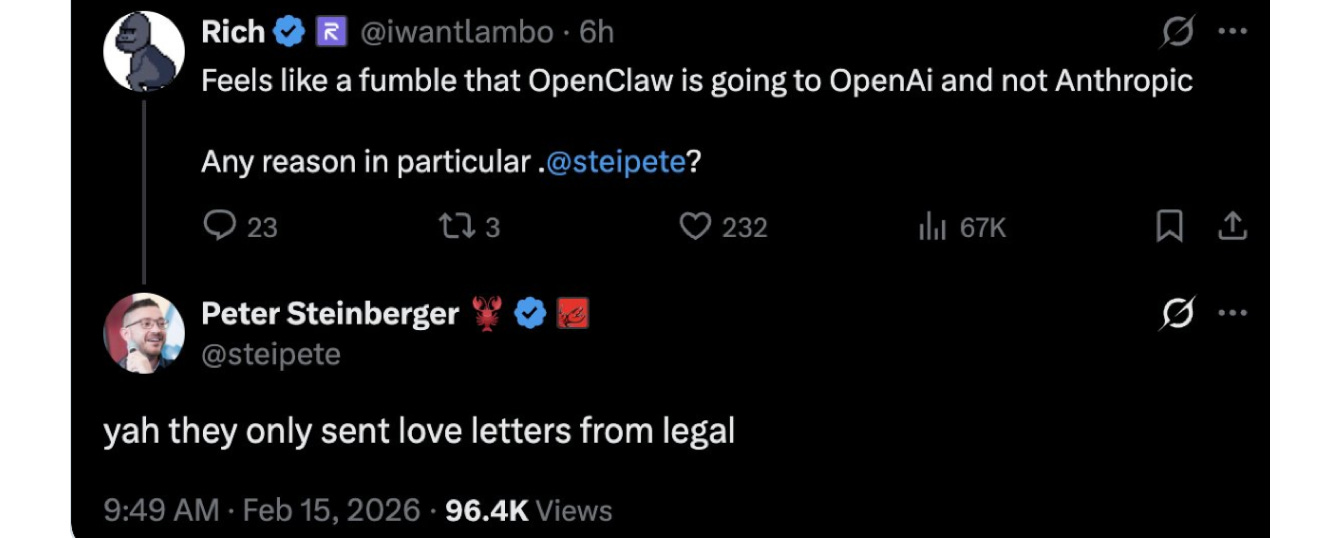
With this acquisition or partnership (or whatever they’re calling it), Anthropic’s chief competitor, OpenAI, has leapfrogged the litigious company. It just goes to show you. Sometimes you should take a day to think it over before you press ‘send’ on the cease-and-desist. Anthropic’s missed opportunity will probably also appear in the OpenClaw chapter of the AI History Compendium. Not smart.
Note: Since I first mentioned OpenClaw, I have been messing around with the new tech, best that I can, since it seems important to understand as we move into the next phase of the AI revolution. I’m a lawyer; I am being careful.
🇺🇸🇺🇸🇺🇸
President Trump is using America’s 250th birthday to promote our nation worldwide. And he’s using the Art of the Deal —other people’s money— to do it. That burns the nasty New York Times, which sullenly reported, “Like Trump, U.S. Embassies Are Raising Cash for Lavish July Fourth Parties.” It breaks tradition and is unseemly, the Grey Lady complained, bitterly.

The news was that the Times discovered that American embassies are competing with each other to raise money for unforgettable local Independence Day events. “I think there is a competitive environment between some of the ambassadors right now of who can raise the most,” said Ted Osius, a former ambassador to Vietnam (2014-2017).
To the Times, it’s a grotesque shakedown.
If so, there is good news: It seems to be working. The Times reported that in Hong Kong, local businesses received “America 250” forms from the U.S. consulate requesting donations. In Japan, companies have already committed tens of millions of dollars. In Singapore, the American ambassador addressed a room full of executives at a function held at one of the city-state’s most expensive hotels.
The US ambassador to Singapore, Anjani Sinha, told local bigwigs that another U.S. embassy in the region had already raised $37 million and exhorted them to raise more. “Singapore is a better country than that,” he told them, adding, “There are better people here making more money.”
The “other embassy” is probably Japan. In his own letter to Japanese donors, US Ambassador George Glass explained, “President Trump has tasked me with ensuring this celebration in Japan is the greatest celebration in the world outside of the United States.” Game on.

🇺🇸 According to the Times’ sources, donors who give a million dollars or more receive bespoke gift packages that include access to the president himself. The Times sniffed that these plans “lack any obvious connections to the Boston Tea Party or the signing of the Declaration of Independence.” Maybe not. But they do have obvious connections to something the Founders would have appreciated: sheer, unapologetic American audacity.
Nor can the Times legitimately complain about the July 4th fundraising, since it’s not new, it’s just bigger this time. “There is a long history of U.S. embassies raising private funds to supplement their July Fourth celebrations,” the Times admitted late in the story, but qualifying: “though donations have typically been relatively modest.”
Um. Modest? President Trump doesn’t do anything “modest.” Has the Times been in a coma? Wait till they find out what he has planned for America’s 250th birthday here at home.
Through a new organization called “Freedom 250,” Trump is orchestrating what he modestly described as “the most spectacular birthday party the world has ever seen.” The plans include construction of a massive marble arch overlooking Washington, an IndyCar race screaming through the streets of the nation’s capital past the National Mall, a UFC match on the White House lawn timed to coincide with both Flag Day and Trump’s own 80th birthday, a traveling “Freedom Truck” show complete with the Army’s Old Guard Fife and Drum Corps, a national prayer event, and a full military parade.
Not only that, but since America’s 250th is our biggest birthday yet, it seems natural that the celebration would also be bigger. Trump is a brand guy, and he is burnishing America’s brand. People in countries all over the world will never forget our 250th birthday celebration. In that sense, President Trump is spreading joy and happiness all over the world. Using their own elites’ money. Of course.
🔥🔥🔥
On Friday, the UK Guardian ran an unintentionally encouraging story headlined, “ICE to spend $38bn turning warehouses into detention centers, documents show.” That’s not all the documents show; best of all, they show a long-term plan. Here’s one of the warehouses ICE just bought, this one in Georgia. Just look at this thing:

On Friday, Republican New Hampshire Governor Kelly Ayotte posted an internal ICE memo after supposedly catching ICE ‘falsely’ claiming it had worked with her office on a planned facility in Merrimack. The memo —marked ‘For Official Use Only’— revealed ICE’s “$38.3 Billion Detention Reengineering Initiative,” a plan to expand detention capacity to 92,600 beds by this November. It describes eight “mega-centers” holding 7,000 to 10,000 detainees each, with sixteen regional processing centers. According to the memo, ICE has already quietly purchased at least seven warehouses —some exceeding one million square feet— in Arizona, Georgia, Maryland, Pennsylvania, and Texas.
You would think progressives would be pleased. The planned mega-centers will include medical care, dental, recreation areas, law libraries, courtroom space, cafeterias, and scheduled phone calls. Which, to be honest, is more amenities than a freshman college dorm.
To give you a sense of the scale: ICE is currently holding about 75,000 people, up from 40,000 when President Trump took office a year ago. The new target is 92,600. Last week, ICE Director Todd Lyons told the Senate Homeland Security Committee that 1.6 million illegal aliens have final deportation orders— of whom half, roughly 800,000, have criminal convictions. That’s 800,000 convicted criminals, outward bound.
Meanwhile, twelve thousand new ICE officers are coming online to help process them all.
But the buried story that corporate media seems to miss is that this obviously isn’t a plan to handle a temporary surge. You don’t spend $38.3 billion building eight mega-centers that each hold 10,000 people, sixteen regional processing sites, and a standardized, “scalable” nationwide detention network just to round up a few busloads of criminal aliens and call it a day.

The memo itself calls this ICE’s “long-term detention solution.” Long-term. The infrastructure is designed to be operational by November 2026 — and that’s when it will start operating. They’re hiring 12,000 new agents to fill it out. They’re buying million-square-foot warehouses across seven states— and still shopping for more.
In other words, this memo reads less like an emergency response and more like the blueprints for a permanent deportation pipeline— an industrial-scale system designed to process 1.6 million people with final deportation orders (half of whom have criminal convictions) and then keep running for whoever and whatever comes next.
The Trump administration isn’t just catching up on a backlog. They’re clearly building a massive, multi-armed deportation machine that can actually handle 20 to 40 million illegal immigrants— by making mass deportation a routine government function rather than a political slogan. Critics who sneered that it was too late, that it would be impossible to deport 40 million illegals, are looking at how President Trump could actually deliver on his promises.
Once again, President Trump thought bigger —less modestly— and saw possibilities nobody else did. More promises kept.
Have a massive Monday! C&C will be waiting for you again tomorrow morning, at the usual time, with an all-new roundup of essential news and commentary. And not any modest one, either.
Don’t race off! We cannot do it alone. Consider joining up with C&C to help move the nation’s needle and change minds. I could sure use your help getting the truth out and spreading optimism and hope, if you can: ☕ Learn How to Get Involved 🦠
How to Donate to Coffee & Covid
Twitter: jchilders98.
Truth Social: jchilders98.
MeWe: mewe.com/i/coffee_and_covid.
Telegram: t.me/coffeecovidnews
C&C Swag! www.shopcoffeeandcovid.com
Ho Ho's and Ding Dongs. I thought you were talking about Democrats for a second there. Boy, take a little time off and the senses get dull. As a side note - and this is no joke - at the grocery store I noticed a pancake syrup brazenly touted as "Butter Rich." Just below it in small letters a disclaimer read: "Contains no butter."
Nowadays, even the terms "organic," grass fed," "pasture-raised," "raised-by-pastors," "cage free," "free range," "rage against the machine," "orange yolks," "cave dwelling," "hand picked," "real chocolate," "cheese product," etc...are totally ambiguous....so named to fake you out. What the hell is soy milk? Who's milking almonds and oats? Who even knew it was possible? Seems like nimble, exacting, painstaking work for teeny weeny circus people.
Addendum: Here's a chortle worthy recipe from "Farm Rich.": SAUSAGE STUFFED BISCUITS, 14oz
Pay particular attention to where the term "sausage" first makes its appearance.
DOUGH: BLEACHED WHEAT FLOUR, PALM OIL, LEAVENING (SODIUM BICARBONATE, SODIUM ALUMINUM PHOSPHATE, SODIUM ACID PYROPHOSPHATE, MONOCALCIUM PHOSPHATE), BUTTERMILK POWDER, DEXTROSE, SALT, ASCORBIC ACID, WATER, WHEAT GLUTEN, SOYBEAN OIL, BUTTER FLAVOR (WATER, PROPYLENE GLYCOL, XANTHAN GUM, LESS THAN 0.1% SODIUM BENZOATE ADDED TO PROTECT FLAVOR, NATURAL MIXED TOCOPHEROLS, A NATURAL SOURCE OF VITAMIN E USED TO PROTECT FRESHNESS), YEAST, SORBITAN MONOSTEARATE, ASCORBIC ACID, FILLING: WHOLE EGGS, CORN STARCH, SALT, CITRIC ACID, XANTHAN GUM, CHEDDAR CHEESE (PASTEURIZED MILK, CHEESE CULTURE, SALT, ENZYMES, COLOR ADDED, POTATO STARCH AND POWDERED CELLULOSE ADDED TO PREVENT CAKING, NATAMYCIN (A NATURAL MOLD INHIBITOR), SAUSAGE CRUMBLES (PORK, WATER, SALT, SPICES, SUGAR, SODIUM PHOSPHATES, FLAVORINGS). CONTAINS: MILK, EGGS, WHEAT. CONTAINS A BIOENGINEERED FOOD INGREDIENT.
I'm sort of a stickler for truth in advertising, but I don't suppose christening this as: Palm Oil Stuffed Bleached Dough or Sodium Aluminum Phosphate Enriched Buttermilk Powder Biscuits would do much for sales.
✝️✝️✝️
But as for us, we will bless the LORD
From this time forth and forever.
Praise the LORD!
— Psalm 115:18
We proclaim Him, admonishing every man and teaching every man with all wisdom, so that we may present every man complete in Christ.
— Colossians 1:28
NAS95
✝️✝️✝️