

Good morning, C&C, it’s Saturday! Your roundup includes: Trump lands a permanent Greenland security deal for zero dollars and a few hundred mean tweets, and the Times grades it a failure. Here’s why the deal quietly removes the biggest practical barrier to America walking away from NATO, and why Europe’s bargaining position just got a lot colder. IEEE rounds up what the $100,000 H-1B fee actually did, and twenty-five tech giants suddenly have nothing to say. And a barely reported new executive order opens the H-1B archives, proving once again that the blackpillers had it exactly backwards.
🌍🇺🇸 ESSENTIAL NEWS AND COMMENTARY 🇺🇸🌍
🔥🔥🔥
Chalk up another Trump win; possibly one of the most historically significant of his two terms. Yesterday, deploying its arsenal of adjectives, the New York Times sneeringly reported, “U.S. and Denmark Reach Security Deal on Greenland, Trump Says.” Got that? Trump says.
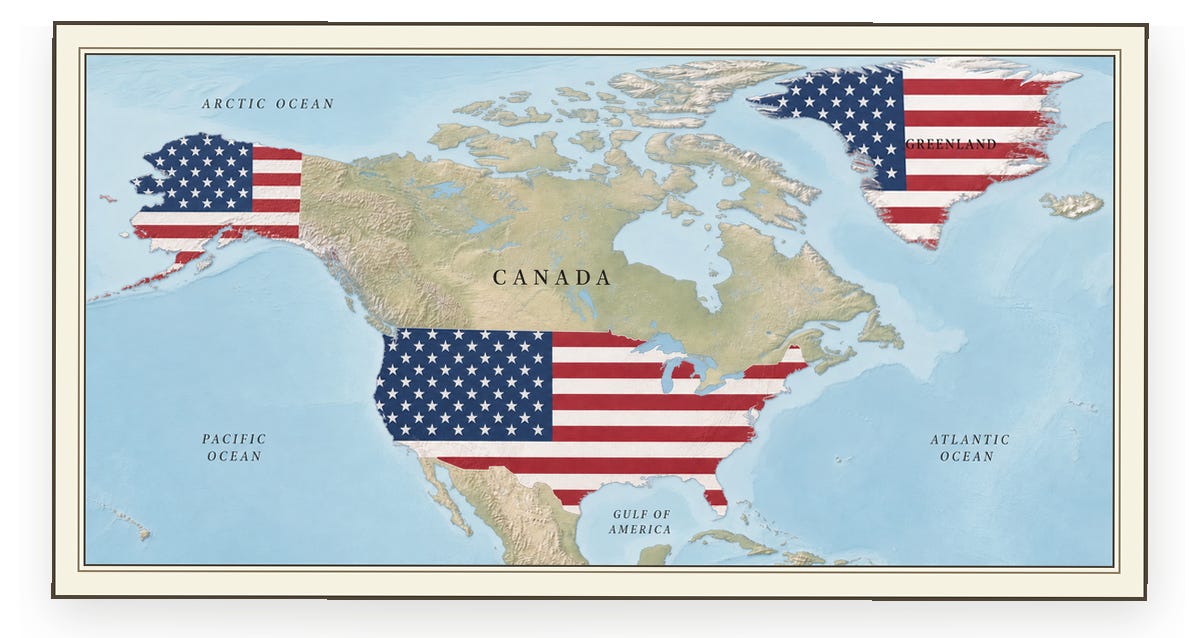
Though Times readers will never learn this, Greenland is not just an oxymoronically named ice floe at the bottom of every travel agent’s recommended list. Only the hardiest adventurer travelers who relish a fresh case of frostbite find a trip there at all tempting. But the world’s largest “island” has been the subject of constant anxiety among geopolitical security analysts ever since World War II, when its strategic importance in controlling northern access into the Atlantic Ocean became clear. (During WWII, we had to go up there and kick some Nazi rear-ends out of their heavily armed “weather stations.”)
Then the ICBM was invented. Suddenly, Greenland was not merely a frozen North Atlantic maritime outpost; it was a giant, ice-encrusted early-warning station sitting directly beneath the most efficient flight paths from Soviet launch sites to North American cities.
Shortly after the Second World War, as the Cold War settled in, in 1951 Denmark and the United States signed the Greenland defense agreement, and America built what became Thule Air Base —wokely renamed by the Cabbage as Pituffik Space Base— where its radar ceaselessly scans the skies for intercontinental and submarine-launched ballistic missiles and tracks objects in space. (Denmark was in the chat because Greenland —with a tightly clustered population of only about 56,000— is, for now, a Danish territory.)
From time to time, the Greenlanders, trapped indoors in the dark for months at a time, rattled U.S. military planners by getting bored, drinking heavily, and ginning up independence movements, occasionally canoodling with Russian and Chinese emissaries who offered the frigid islanders free power plants, airports, and hot spas. What most scared U.S. generals was that, if Greenland became independent, the 1951 treaty with Denmark might be ripped to shreds.
Or, more likely, renegotiated by people suddenly holding one of the world’s most valuable strategic choke points and a large pile of Chinese business cards.
And, needless to say, the 1951 treaty was not completely up to date with 2026 realities. It was written when Soviet bombers and missiles were the principal worry, China was an impoverished communist backwater, and nobody imagined Beijing might someday be waving gift cards at Nuuk for airports, mines, telecommunications, ports, nuclear reactors, highways, and lifetime Hot Hands subscriptions.
As the Times was forced to concede, the archaic 1951 treaty “did not explicitly restrict the presence of ‘adversary’ nations.” (The Times never explained why it bracketed doubtful quotation marks around the word ‘adversary.’)
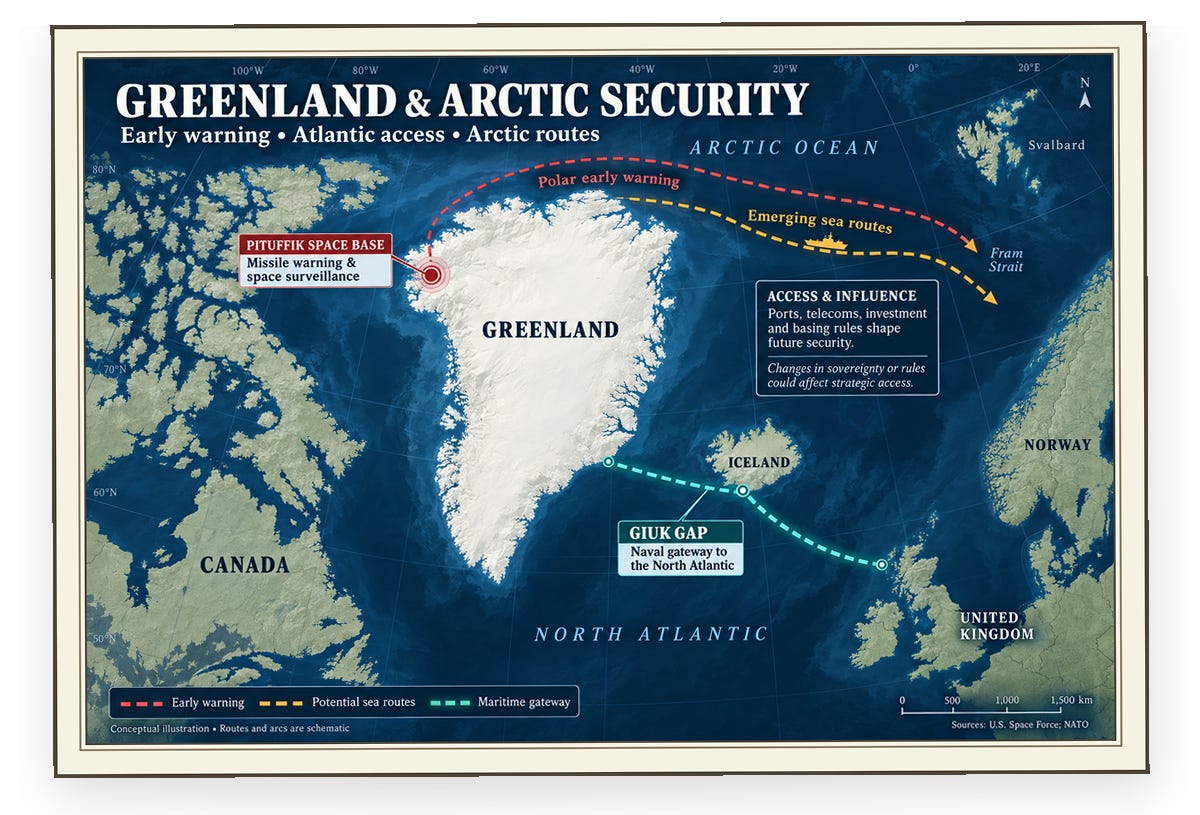
Regardless, those are real, documented risks. For decades, military and naval journals have churned out reams of alarming white papers about Russian Arctic rearmament, Chinese infrastructure diplomacy, the GIUK Gap (“Greenland-Iceland-UK”), missile-warning vulnerabilities, and the strategic consequences of an independent Greenland bursting with Chinese yuan.
So it was an outright lie when the New York Times sniffed at the issue and effectively portrayed a well-known, looming crisis as something that just had popped into President Trump’s feverish imagination.
🔥 Since his first week back, as alert readers probably recall, President Trump made a noisy bid for “buying Greenland,” which twisted NATO allies’ knickers and, in the Times’ alarmed description, “worsened the relationship.” But Trump’s loud demands also created a crisis that has now resulted in a new, improved, historic 2026 agreement.
“President Trump said on Friday that his administration had reached a deal with Denmark and Greenland,” the Times reported, giving “the United States … ‘permanent control over security, and all other needs’ in Greenland.” Secretary of State Marco Rubio tweeted, “this historic agreement permanently guarantees U.S. security interests in the Arctic at zero cost to the U.S. taxpayer.”
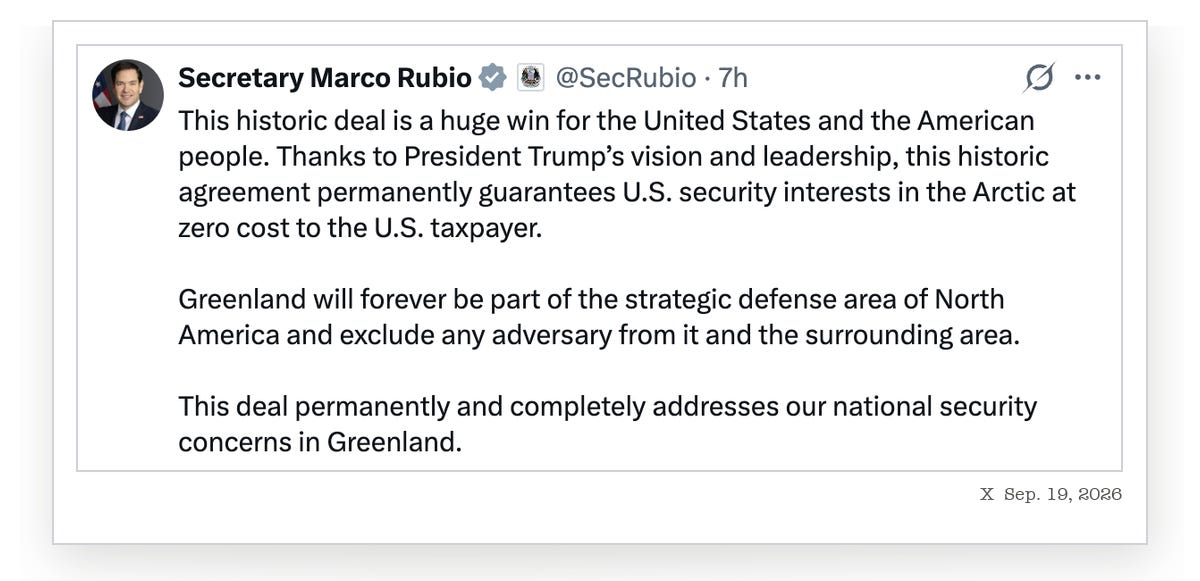
“Greenland,” Secretary Rubio explained, “will forever be part of the strategic defense area of North America and exclude any adversary from it and the surrounding area.” Trump’s Truth Social post was less diplomatic: “This is an ‘Infinite Life’ Agreement, there is no end!”
Behold: The Art of the Deal. No money. Just mean tweets.
In one stroke, the agreement solves the U.S.’s two biggest Greenland problems: the deal stands even if Greenland ever becomes independent, and it reportedly gives U.S. veto power over Chinese or Russian involvement in the island’s affairs. To the Times, this is a dismal failure: “the agreement fell well short of Mr. Trump’s longstanding demand of total control over Greenland.”
He got the bases, the ban, the veto, and forever, and the Times marked him down for not also getting the gift shop or inheriting Greenland’s welfare state.
But in the very same story, the Times also reported that the announced terms include: a larger U.S. military presence and a build permit; a ban on non-NATO bases or military presence; full flyover rights; continued effect after a future Greenlandic independence; and a U.S. approval right over sensitive Russian or Chinese investments.
As I have explained before at painful length, Trump’s public demands to buy Greenland were a negotiating anchor. Under the announced deal, Denmark “wins” by keeping sovereignty while simultaneously giving the U.S. everything we need. Without having to “buy” anything. It was a masterstroke of negotiation.
Reading between the lines, the Times was really fretting about the creaky NATO relationship. It has a good reason. The Greenland deal was bigger than it looks.
🔥 Here’s what nobody is reporting. America’s continuing membership in NATO was another self-destruct trigger in the old 1951 deal. It was a NATO-era agreement between the United States and Denmark, built on the two countries’ mutual obligations to defend the North Atlantic treaty area. Article XIV of the 1951 agreement said, “This Agreement, being in implementation of the North Atlantic Treaty, shall remain in effect for the duration of the North Atlantic Treaty.”
In other words, if America ever quit NATO —as Trump has often threatened to do— the old treaty would at best become highly questionable, and at worst a piece of Cold War parchment ready for Nuuk’s shredder. We could lose all Greenland rights.
So, in that sense, Greenland was the biggest barrier to U.S. withdrawal from the cross-Atlantic alliance. We couldn’t afford to quit.
Back in March, on Hannity, Secretary Rubio directly raised the NATO question. He pointed at European refusals to allow U.S. planes to use their bases in the Iran War. “If now we’ve reached a point where the NATO alliance means that we can’t use those bases, that in fact, that we can no longer use those bases to defend America’s interests, then NATO is a one-way street.”
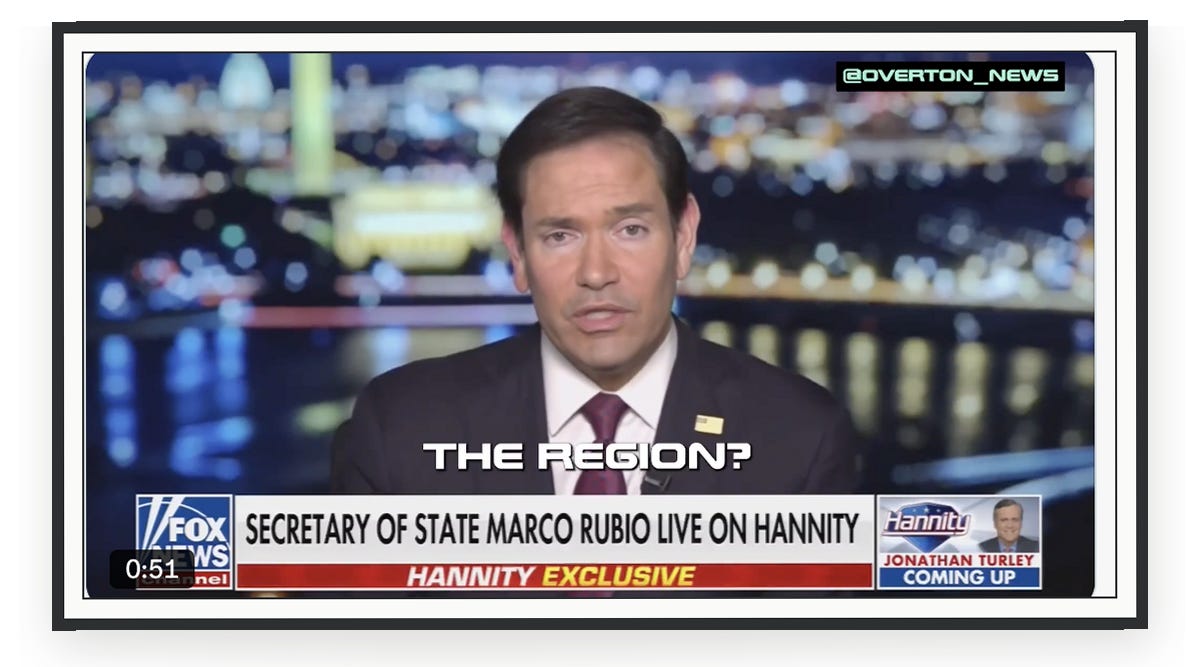
CLIP: Sec. Rubio questions the value of U.S. staying in NATO (1:26).
“Unfortunately, we’re going to have to reexamine the value of NATO and that alliance for our country,” he said. In March, that was a bluff— and Europe knew it. After Friday, it isn’t.
Rubio’s anti-NATO sentiments were not new. What’s new is that the threat is now credible. With the Greenland problem now apparently solved, U.S. threats to leave NATO land with thunderbolt force. The largest practical impediment —the danger of losing reliable Arctic access, missile-warning coverage, and a northern defense foothold— has been removed. For years, allies held Washington over a barrel while dithering over financial and military contributions. Now they are in a far weaker bargaining position.
The cards in President Trump’s hand just got terrifically better. He didn’t just solve the ever-present Greenland problem. He laid the foundation for solving the NATO problem, too.
Years from now, history may view the Greenland deal as one of the most enduring and consequential achievements of both Trump administrations.
🔥🔥🔥
How about another terrific update? Yesterday, the Trump Administration published a new order limiting H-1B visas for foreign workers. But first, let’s check in on how well things were already going before that. On Tuesday, IEEE Spectrum reported, “Tech Giants Silently Reroute Jobs as H‑1B Costs Skyrocket.”
Regular readers will recall that last November, a “MAGA civil war” broke out after online conservative influencers falsely claimed that the Administration had not only failed to curb H-1B visa abuse, but also was secretly enabling more H-1Bs. Rage and fury ensued. (For instance, on November 12th, Evan Kilgore tweeted, “Donald Trump has betrayed the American people over some H-1B Indians.”)
But it was all a psyop, and we helped squash the bizarre claim. On Tuesday, IEEE helpfully rounded up how well it was actually working.
Last year, the Administration unveiled a bold new innovation: the Visa Purchase Decision Enhancement System, also referred to as “What if this application form cost $100,000?” Critics of H-1Bs have long argued that employers —especially tech companies— hired foreign workers over Americans because the foreign workers were cheaper and easier to control. Employers claimed it was because they couldn’t find any American workers no matter where they looked, which was mainly inside a locked, sub-basement cabinet.
Thus, the $100K fee dared employers to put their checkbooks where their HR department was. If critics were right, you’d expect overseas hires to fall. Well, guess what?
The article said most employers who might have hired H-1B candidates chose not to apply at all. (IEEE complained about lost fee revenues. I’m not kidding.) Meanwhile, DHS recorded an 87 percent year-over-year decline in applications subject to the fee. That is a lot. In fact, only 85 application fees total were collected between September and February.
Not only that, but the administration has started targeting foreign students. In July, it set a fixed 4-year time limit on student visas. Previously, those visas lasted as long as the student’s course of study— ten years, twenty years, no problem. The federal government is currently studying a proposal to charge foreign students between $70,000 and $100,000 to stay for 1 to 3 years after graduation— something they can currently do for free. “If there is a $100,000 fee for that, it’s going to cut the talent pipeline,” one of the experts, Julia Gelatt of the Migration Policy Institute, said.
Yesterday, the State Department announced that, starting October 1, all student visas will undergo mandatory “online presence” checks. Meaning, their social media. Presumably, tweeting “Death to America” will start counting against them.
The crackdown is working. “As of March,” the article reported, “U.S. universities were reporting 20% fewer international enrollments in bachelor’s programs than the year before.” Master’s degree students fell even more (24%). The reason is not a mystery: “84 percent of the participating universities listed government policy as a significant obstacle to enrollment.”
In fairness, government policy is usually an obstacle. That’s the whole point.
The reporter said he contacted 25 companies for a comment, including the top 20 historic H-1B users. None —zero— would provide a statement. Not even to complain. “Companies,” the article concluded, “do not appear eager to provoke the federal authorities on whom they depend for visas.”
They have good reason to appear uneager. Yesterday President Trump signed a brand-new H-1B executive order— and the stakes got even higher.
🔥 In a barely reported story, yesterday afternoon President Trump signed the latest in his long series of H-1B orders. This one might have escaped notice on account of its bureaucratic title, “Enhancing Program Integrity and Interagency Coordination in the Administration of the H-1B Nonimmigrant Visa Program.” But it was the bureaucratic equivalent of a sharp punch in Microsoft’s face.
Before Friday, the downside for tech giants who flooded their offices with cheap foreign labor was mostly just bad P.R. (That’s one reason why they decline to give comments to reporters about H-1B hiring practices.) The fee was forward-looking and mired in court orders. But as the IEEE article helpfully explained, it has still helped curb applications a lot. Yesterday, Trump gave the rules some razor-sharp teeth.
It began by officially applying a rhetorical baseball bat to the H-1B franchise just as it was reeling from the $100K application fee. (It’s currently blocked, but don’t worry, a new, higher fee is waiting out the clock in public comment.)
🔥 First, in the “Purpose” section, the order bluntly accused tech companies of using foreign workers to avoid paying Americans— which breaks the law. “H-1B visa holders earn far less than comparable United States-born workers, despite the statutory mandate that H-1B workers be paid equally to their domestic peers,” it said.
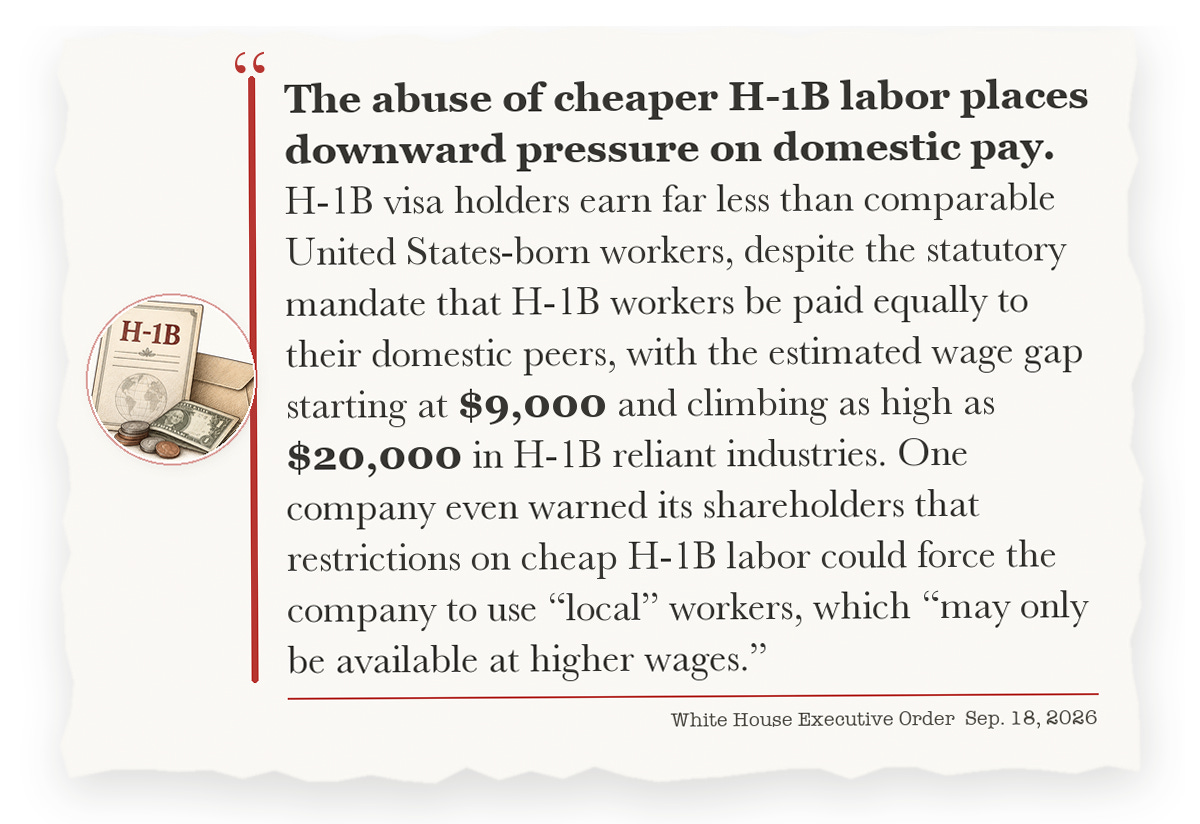
It said one company warned shareholders that the new limits on H-1Bs meant the company might be forced to use higher-wage “local workers.” That’s us. We’re the locals.
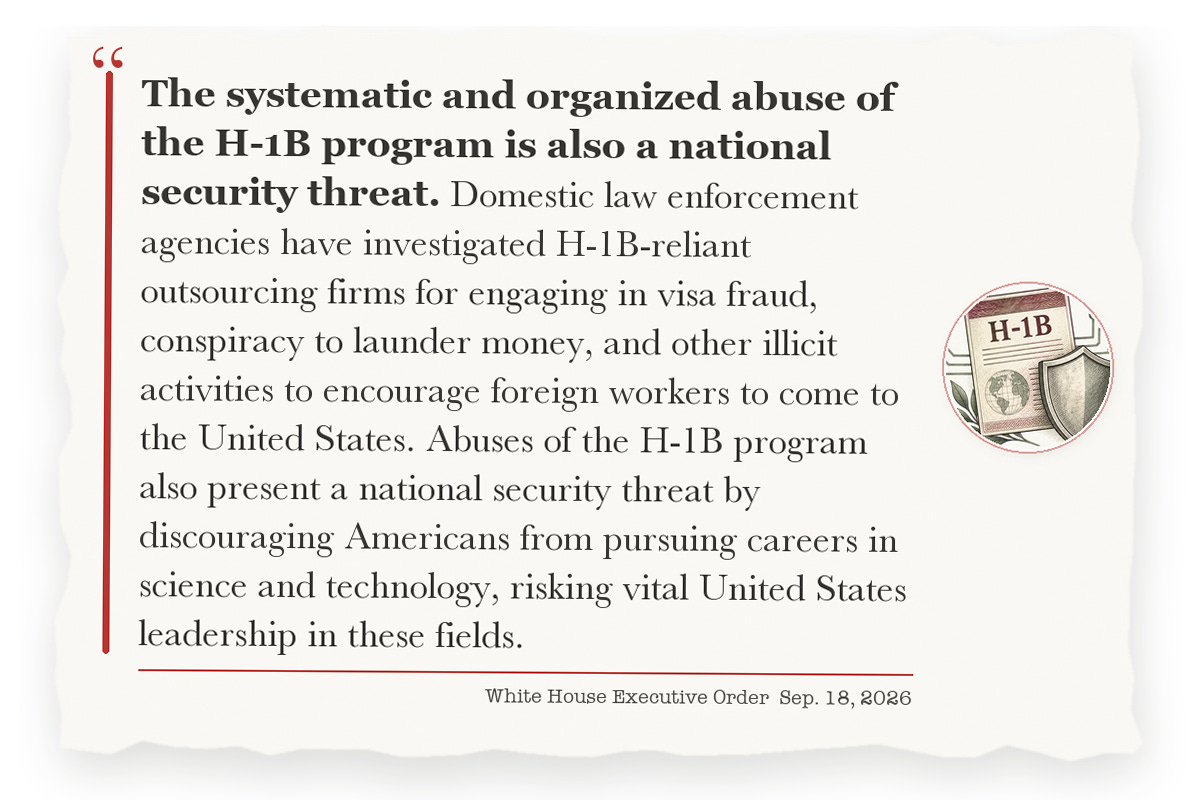
Next, it escalated the H-1B problem to the level of a national security threat. It found that H-1B recruiting shops that match foreign candidates with U.S. employers are rife with “systematic and organized abuse,” basically describing them as a type of placement mafia, with rampant “visa fraud, money laundering, and other illicit activities.” It further argued that H-1B abuses discourage Americans from getting STEM degrees— undermining our historic leadership.
The order then reported that government investigations uncovered “widespread fraud and noncompliance” and “pervasive violations” of H-1B rules among employers. These included things like: preferring foreign workers to Americans, misrepresenting job descriptions so only foreign workers could qualify, and my favorite, “submitting questionable foreign degrees from diploma mills” to prove specialized skills.
So the President ordered a remedy, which bore a remarkable resemblance to a legal wood chipper.
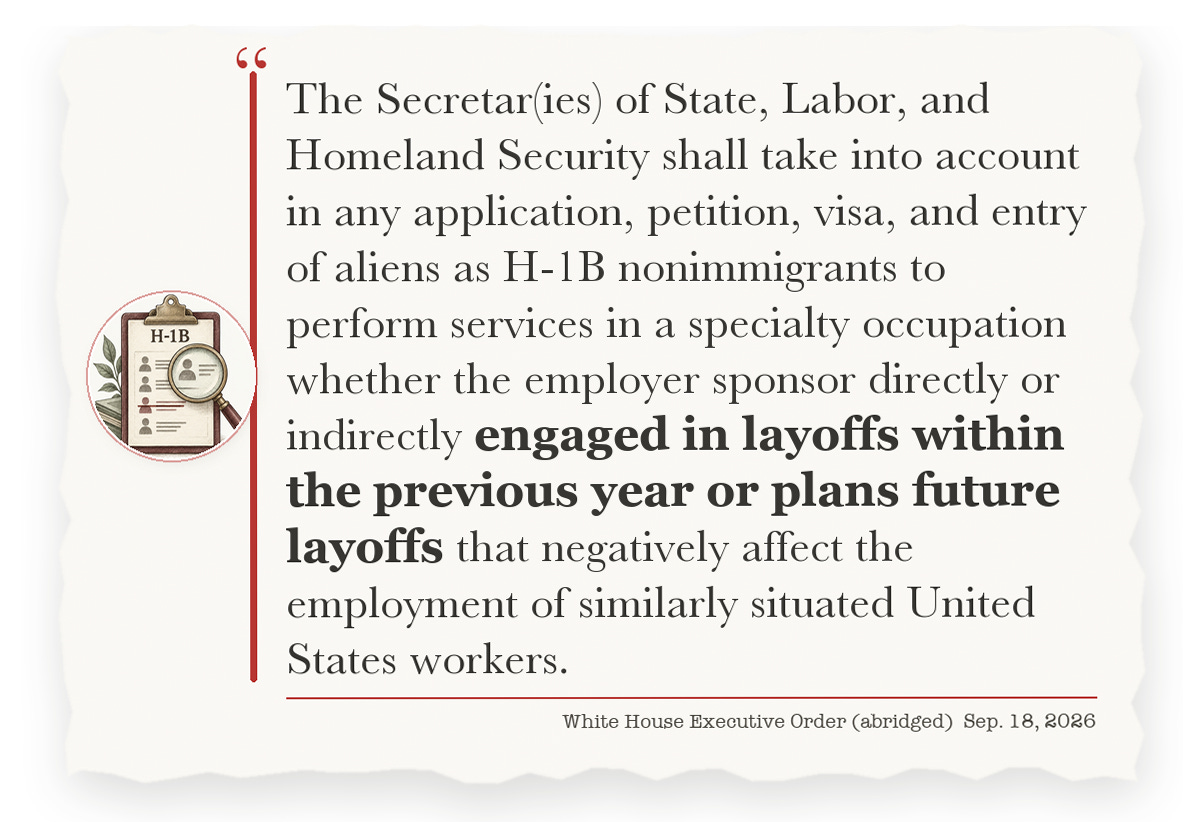
🔥 Section 3 delivered the punch. First, it directed the Secretaries of State, Labor, and Homeland Security to evaluate all H-1B applications —including at the border— by looking at their employers’ record: did they lay off American workers within the last year? Or have plans to do so? If yes, and those layoffs hurt U.S. workers, the petition can be denied, regardless of whether the fee is paid.
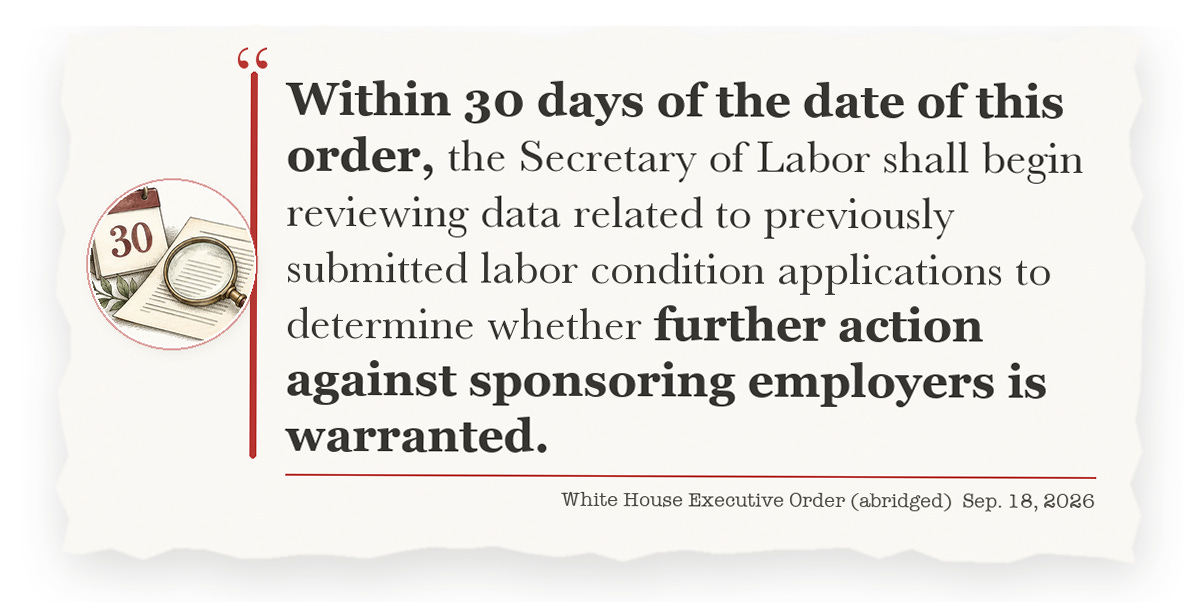
Then the scalpel cut deeper. Within 30 days, the order requires the dreaded Wage and Hour Division to start investigating past layoffs and applications, and if abuses are found, to take appropriate action. It all falls under existing laws, cited in the order. Congress is not necessary.
They are building an enforcement database. “The Secretary of Commerce, the Secretary of Education, and the Administrator of the Small Business Administration shall provide any relevant wage, employment, academic, industrial, or other economic information,” the order modestly added.
The dreadful significance is that companies who gamed the H-1B as a checkbox form just learned that the archives are open. Not “be good going forward.” We are reading the old ones. The companies that under-described the jobs to lower the wage level, mislabeled a commodity coding job as a rare specialty, or ran the displace-and-replace shuffle while swearing on the record that U.S. workers were doing fine— those filings are now an evidence locker for an agency under a 30-day starting gun.
It’s a pincer movement. The first part makes future petitions dangerous if you’ve laid off any Americans. The second part makes past petitions dangerous if you already did. The net effect is that companies won’t just have to stomach the additional cost of the new H-1B fees (assuming they survive the legal gauntlet), but they’ll also have to start digesting accurate job descriptions, and stop forcing Americans to train their foreign replacements.
🔥 Altogether, we can see how unfair the November criticisms were. No previous Administration before Trump has risked getting sideways with the Chamber of Commerce by curbing H-1B abuse. Not even close. No prior president has dared offend academia by crushing foreign student enrollment.
This is why I keep telling you to ignore the blackpillers. When I refer to blackpillers, I’m not talking about Democrats. We expect Democrats to lie and be impossible to please. I’m talking about folks who claim to be conservatives but always seem to find something to criticize— and they are always wrong.
It’s not that blackpillers always overreact (though that is also true). It’s not that they are being unfair or stingy by failing to give Trump credit when he’s earned it. It’s that they are consistently dead wrong, and wrong so badly that it completely inverts the truth. Assuming good faith —granted, a stretch— they are their own worst enemies.
Think of it this way. Assume blackpillers’ red line is the H-1B issue (any issue works, but stick with this one). Their ‘solution’ to get what they claim they want —eliminating H-1B abuse— is to fracture MAGA and force a midterm loss, so as to “teach Republicans a lesson.” But in reality, they are sabotaging the one administration in U.S. history that actually invested the political capital to do the exact thing they claim to want.
I’m not leveling accusations. But I am questioning good faith. Nobody who predicted the Great H-1B Betrayal has issued a correction. They’ve just moved on to the next betrayal. There’s always a next one.
Cough up the black pill. Whenever you read some social media polemic about the latest Trump betrayal (or Kennedy, or Bessent, or whoever), presume it is a well-packaged distortion, or an outright lie, until we get a chance to put their claims under the microscope.
Finally, I’m not saying that I am ready to plan a holiday in Greenland. I have thin Florida blood, after all. But I’m pretty chuffed. That’s two massive wins in a single Friday afternoon, and the people who told us to give up missed them both.
Have a wonderful weekend! Enjoy the cooler weather, and then return here on Monday morning for more all-new essential news and caffeinated commentary.
Don’t race off! We cannot do it alone. Consider joining up with C&C to help move the nation’s needle and change minds. I could sure use your help getting the truth out and spreading optimism and hope, if you can: ☕ Learn How to Get Involved 🦠
How to Donate to Coffee & Covid
Twitter: jchilders98.
Truth Social: jchilders98.
MeWe: mewe.com/i/coffee_and_covid.
Telegram: t.me/coffeecovidnews
C&C Swag! www.shopcoffeeandcovid.com
There are many people today who all they have is hope. At one time or another we all know that even hope can starve. Every soul you meet has fought a battle we know nothing about. A person that is rude to you may have a sick child. The woman that cuts in line may be rushing to her mother’s death bed, we never know. So the only sensible thing to do is to be kind, always kind, even when you have nothing left to give. Especially then, that’s when it matters most. That’s when you discover what you’re really made of.
Faith isn’t about believing everything will be fine, it’s about believing you’ll be fine even when everything isn’t.
Precious things are meant to be passed along. The promise made when you were in need and someone reached out and helped you, that one day when you’re able you would reach out and help another, is the most precious gift we can pass along. This is how light spreads in dark places. It’s all about passing along the light.
We are all just links in a chain that goes back to the beginning of time and forward to eternity, we’re all just passing it along. Keep the promise, keep helping people and always remember it’s never about money, it’s about that moment when everything seems wrong and someone sees you, really sees you, and reminds you that you matter, that you’re worth saving, that your dignity is sacred, and they helped you. Passing the light continues the chain of human connection.
J.Goodrich
The next part of the H1B Visa scam that needs to be addressed is the number of "family members" brought in as soon as the foreign worker gets their Green Card! Microsoft, Amazon, Boeing, et. al get a cheaper worker and we, the American taxpayer, get saddled with the forever cost of their wife, their parents, their in-laws and crazy old Uncle Charlie to boot!
No, they don't qualify for Social Security and Medicare, but they DO get SSI (Supplemental Security Income) and Medicaid, because they are "low income seniors"! And that often adds up to thousands of dollars per month, per household, which is how so many immigrant families can afford million dollar homes, pricing out the young people who grew up in the same area!
All "reunification" policies need to be completely rewritten, immediately! Anyone who wants to bring over family members must agree to assume the care of and pay the living expenses of said persons for LIFE, just as they would be expected to do back home, in most cases! And we need to stop offering 27 different languages for services, too!! Learn English, just like every other group of immigrants was expected to do in the past - PERIOD!! (I am married to the son of legal immigrants and all of these policies were in place when his family arrived and they survived, and even thrived, in their new country, and we need to return to those standards, immediately, IMHO!)