

Good morning, C&C, it’s Tuesday! It’s also the final day of June— tomorrow we cross the demarcation line into the second half of Trump’s Year of Action. Yesterday, the Supreme Court dumped nearly all of its controversial decisions that —predictably— ignited a social media firestorm of controversy, recriminations, and hot takes. As a blogging lawyer, it is my duty to show you what really happened and why yesterday was a much better day at the Court than the doomscrollers’ clickbait posts suggest. Three decisions, one of which just changed everything.
🌍🇺🇸 ESSENTIAL NEWS AND COMMENTARY 🇺🇸🌍
⚖️⚖️⚖️
As ever, yesterday the Supreme Court gaveth and tooketh back. It was a Goldilocks day: a clear win, a tepid loss, and one that could go either way. The tangle of hot takes makes it impossible to know what to celebrate, double down on, or go cry in a corner. Let’s try to blow off some of the methane fog. We begin with the unequivocal win, which the New York Times reported as, “Justices Expand Trump’s Power to Fire Officials.”
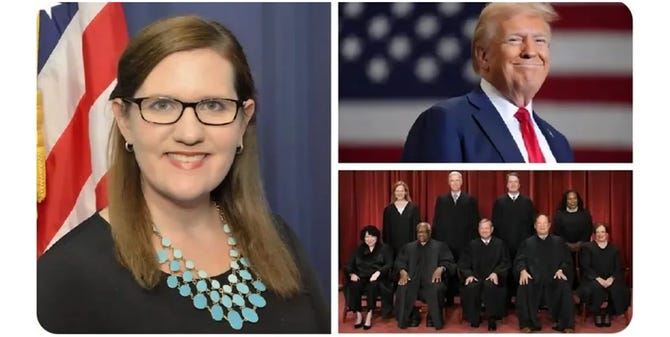
In the aptly named case Trump v. Slaughter, the Supreme Court issued a common-sense decision. But that ninja-like common sense had managed to evade judicial cerebellums ever since the 1930’s New Deal. Yesterday, the Justices returned to the Founders’ sensible notion that the President, as the Executive Branch’s CEO, may hire and fire the employees who work for him, and Congress cannot game the system by making certain employees quote-unquote “independent.”
Get ready for The Apprentice, 2026 edition. President Trump wasn’t exaggerating this time when he called the decision “historic,” “monumental,” and “the Greatest increase in Presidential Power in the last 100 years.”

SCOTUS scotched a 91-year-old rule allowing for unaccountable “independent commissioners” to be placed on various important boards and powerful federal commissions. That rule was created amidst progressives’ Cambrian Explosion Period, in the infamous 1935 case of Humphrey’s Executor v. United States, which arguably launched the modern deep state.
Put plainly, Humphrey’s moved major administrative decision-making agencies, such as the FTC and the EPA, out of Presidential control. After Humphrey’s, Congress kept creating agencies with five-member boards having staggered six-year terms, so that a new president could replace only two seats in their first six years in office.
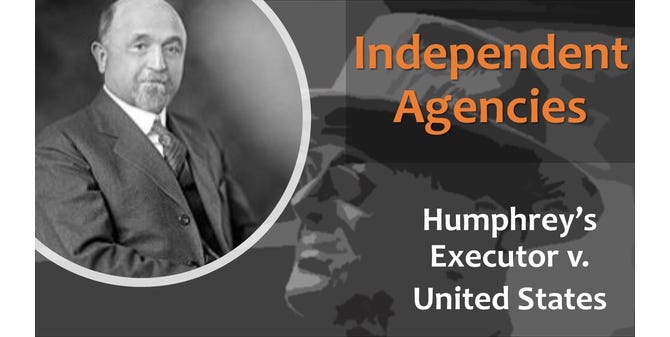
In other words, aided by FDR’s Supreme Court, Congress minted a permanent executive-branch government that ran outside both the president’s and the voters’ control. Ultimately, this became the Deep State. Democrats called that progress.
For example, voters might want a more conservative EPA that isn’t busily declaring cow farts to be toxic hazards. Not unreasonably, voters might think that, by electing a Republican president, they’d also get a conservative EPA. But no.
A new Republican president faced an EPA stacked with Democrats, who would defy him and keep on doing cuckoo things like declaring rain puddles to be nationally protected wetlands and making it a felony to step in the mud. The president was powerless. Rinse and repeat, for each federal agency.
Meanwhile, frustrated conservative voters, missing the nuance, concluded once again that they’d voted for a squish.
That era —which has been reality for the entire lifetimes of anyone reading this— is now over. Trump has a green light to clean house and start packing those boards and commissions with conservatives who will do what the voters want. (Apart from one lone exception; stand by.)
🔥 Writing for the majority, Justice John Roberts quoted the Father of the Country while making the decision’s central, logical point, elegantly transforming George Washington’s words into constitutional principles:
“To ‘discharge the duties of his trust,’ the President must have the assistance of officers he can trust. Although it is up to the Senate to decide whether to confirm those with whom the President would prefer to work, neither Congress nor the courts may saddle him with those with whom he cannot work. Subordinates who exercise the President’s power are subject to removal by him. Then, and only then, can they remain accountable to the President, and the President to the people.”
It’s not a tweak. Even in dissent, self-described ‘wise Latina’ Justice Sonia Sotomayor saw the case as profoundly significant, just like President Trump, albeit with much less enthusiasm. It’s a deep-state wrecking ball.
“Today the majority reshapes our Government,” Sotomayor began, warming up. “Dozens of independent commissions are now likely to become purely executive agencies, shifting tremendous power over broad swaths of American life into the President’s hands... Seldom, if ever, has this Court worked such a profound bait and switch on a coequal branch.”
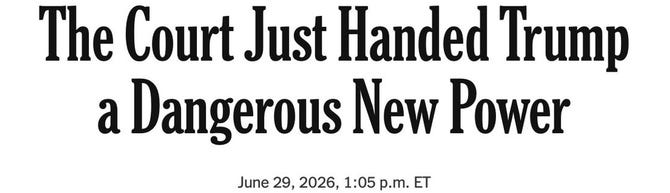
The entire New York Times Editorial Board found the decision ‘dangerous’:
In the comments, Times readers were unified in shock, horror, and outrage (admittedly, their default setting):
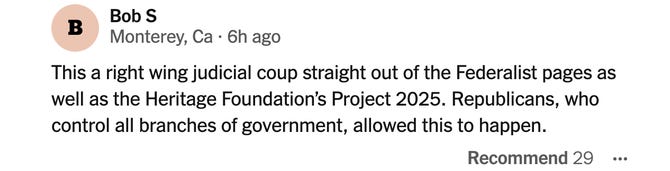
I doubt very much that ‘Bob S’ has any clue what will “happen,” apart from Democrats losing their monolithic partisan control of “non-partisan” independent agencies. How monolithic, you ask? Well, we can thank the Times for the answer, and for accidentally giving away the game while trying to make an altogether different point. Self-own.
🔥 Behold, the Times’ eagerly helpful infographic, which purported to show how Trump has ‘gutted’ so-called independent boards and commissions. But it really shows how nearly every single “non-partisan” board was controlled by Democrats when Trump took office in January, 2025. Every. Single. One:
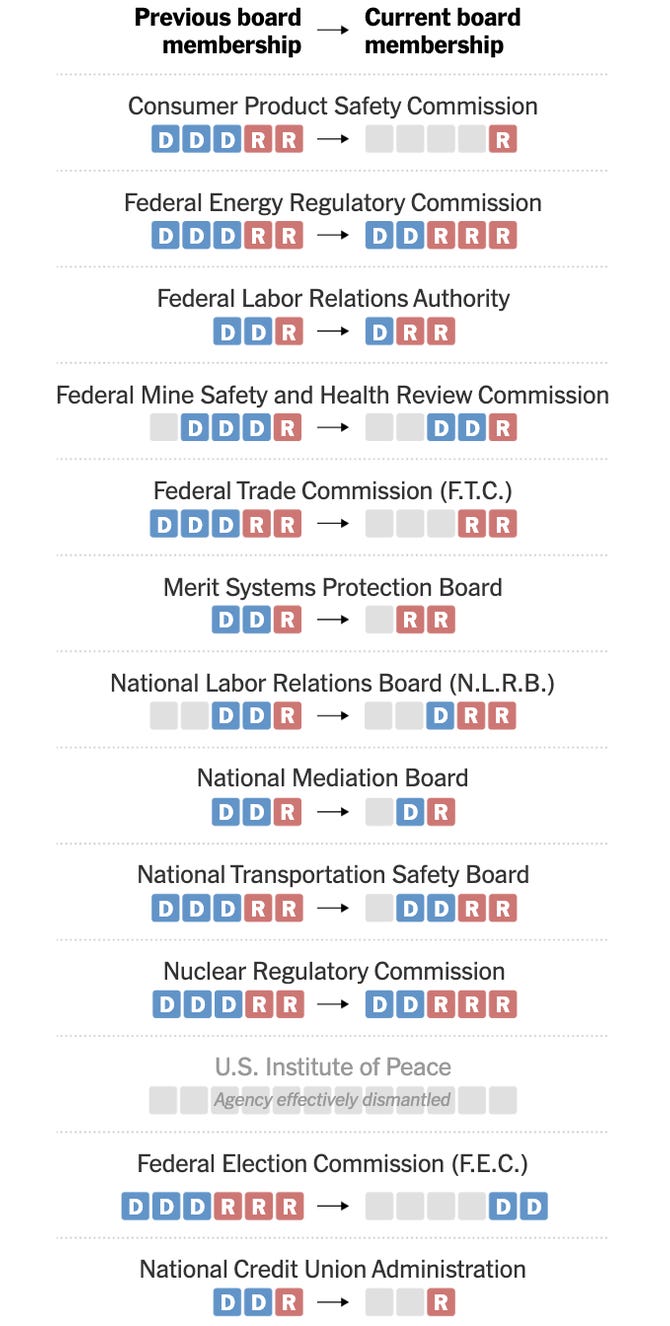
You see it, right? Democrats intended for Trump to be completely paralyzed, a one-term washout, unable to accomplish anything meaningful except for a few easily reversed executive orders, while all the big government agencies continued enforcing Biden Administration policies in zombie-like suspended animation.
To the President’s great credit, even before yesterday’s Supreme Court decision, which reversed nearly 100 years of judicial silliness, Trump had already moved aggressively to make every possible board conform to the wishes of the electoral majority that elected him, by at least firing the Democrat majorities, even if he couldn’t yet appoint Republican replacements.
But now he can. Get ready for a lot of fast action. It might be impossible to keep up with it all.
Let’s turn to the exception that proved the rule. Yesterday’s second decision appeared to tack the exact opposite way from the Slaughter case and erroneously triggered the first tidal wave of furious hot takes.
🔥 In Trump v. Lisa Cook, SCOTUS held that Trump couldn’t fire a goblin-like Federal Reserve Governor accused of retail mortgage fraud. (Accused by Bill Pulte, we might add, who is now also running the nation’s top spy agency.) Corporate media is celebrating this as a major defeat for Trump and a victory for the independence of the Federal Reserve.
But‚ did the President really lose? Is TAW broken?? Consider this triumphalist headline from yesterday’s Public Broadcasting System:
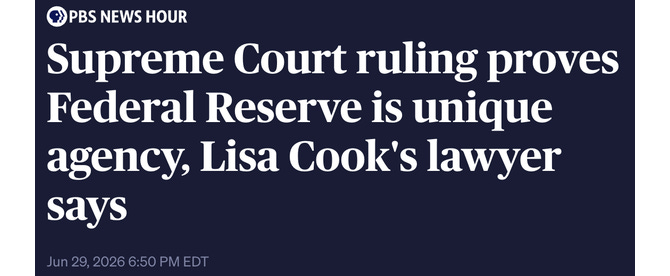
By the way, for those of you keeping up with your media malfeasance studies, PBS’s sleight of hand was in headlining Lisa Cook’s lawyer— not the Supreme Court. Cue massive eye roll. Outraged conservatives on social media, who wrongly relied on these silly corporate media schemes, and without actually reading the decision, reacted with the usual hot takes. Betrayal!
Alas for Democrats. It was not, in fact, the win PBS wished it were. In the 6-3 decision, with Chief John Roberts once again writing for the majority, the Court carved out a simple, narrow exception to the rule it had just created in the Slaughter case. Rather than seeing the glass 99% full —every other agency is not subject to Cook’s narrow exception— too many conservatives failed to celebrate the massive, historic win because the winning was not absolute.
Corporate media flat-out lied about the case’s holding. Here’s NBC, claiming that SCOTUS ruled President Trump can’t fire mortgage fraudster Lisa Cook:
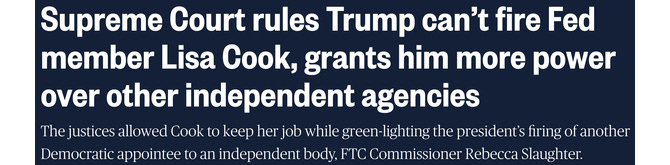
That headline is false. The Court did not rule that the President can never fire a Federal Reserve Governor, not even repulsive Lisa Cook. It did not absolve Lisa Cook of mortgage fraud or say fraudsters can be Governors. It did not throw any babies out with their lukewarm bathwater. The decision did only one thing: it let Lisa Cook stay on the Board until she can respond to the claims against her.
SCOTUS then shot the case back down to the district court to do just that.

That being said, the Court did, clearly, stretch to reach a strange result that it wanted and then backfilled the reasoning to support that result. After all, in Slaughter, it had just said presidents can fire board members at will. The opinion spent far too many words gushing about the Federal Reserve’s ‘unique’ historical character, tricking inattentive readers into thinking that was the basis of the decision.
It wasn’t. The linchpin was that Trump’s lawyers agreed that Lisa Cook could only be fired for cause. SCOTUS accepted that framing, and said that when people are fired for cause, due process requires they have a chance to prove they didn’t do whatever they were accused of.
“At minimum,” Justice Roberts wrote, “Cook was entitled to some explanation of the evidence at issue, some avenue for a response, and a deadline by which a response would be due... Because Cook did not receive such process, her removal was ‘erroneous and void’ from the start.”
🔥 That’s uncontroversial. It comports with Americans’ basic sense of fairness. Having founded Cook’s firing on alleged misconduct, it only seems fair that she gets a chance to prove her innocence. But it did seem jarring in light of the simultaneous Slaughter rule.
And the dissenting conservatives pounced on that incongruity. Writing in dissent, Justice Amy Coney Barrett explained:
“The Court’s holding is in serious tension with Trump v. Slaughter, which we also decide today. Slaughter announces a categorical rule: Whenever ‘an agency “executes” a congressional mandate against private parties, it exercises executive power’ and must be subject to plenary executive control—’no ifs, ands, or quasis about it.’ Yet here, the Court claims a special exception ‘sanctioned by history’ and based on the Federal Reserve’s role in setting monetary policy. How can history support both a categorical rule and a carveout?”
Unqualified midwit and DEI hire Lisa Cook will not survive her due process review. Unless Bill Pulte made up his allegations of garden-variety mortgage fraud, which seems unlikely, to say the least, Cook cannot remain in a trusted position that sets rates and rules for mortgages. It’s not going to happen.
Trump will be able to fire her. Sorry, NBC.
But why would Chief Justice Roberts want to give Lisa Cook a little more time? The answer seems simple and ugly. As it always is. My read is that it was because politics.
Cook gives Democrats a cheap, valueless ‘win’ to offset the massive, historic, precedent-reversing Slaughter decision.
I don’t like it, but I can see it. It’s not my job to preserve the Supreme Court’s reputation or fend off Democrat court-packing. But that is part of Justice Roberts’ job. It wasn’t elegant or pretty, but it was practical and inexpensive.
Now let’s look at the third big decision, the one that is generating the most blackpilling, angst, and hottest hot takes of all.
🔥 In Watson v. RNC, another 5-4 decision authored by Justice Barrett, the Court ruled that federal laws establishing a uniform Election Day do not preempt state laws allowing for counting absentee ballots received after Election Day, provided they are postmarked by Election Day. Corporate media jubilantly declared another ‘win.’ Headline from far-left Vox:
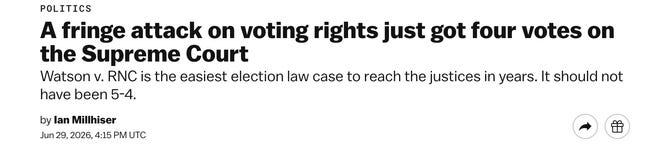
Conservative social media was outraged. Influencers argued that this allows for post-election ballot harvesting and fraud. Part of the reason is shock and surprise because, during oral arguments, the conservative justices had universally asked deeply skeptical questions about late ballot counting.
It just goes to prove, once again, that oral arguments are not the final say. Don’t use them to decide how much to bet on Polymarket.
🔥 Once again, though, this so-called ‘win’ is much less complete than it looks at first blush. The majority —the three liberals joined by two conservatives, Barrett and Roberts— merely held that all votes cast before Election Day must be counted, even if they are mailed in. You can fairly argue that this creates boatloads of opportunities for fraud because of the logistics of mail-in balloting, but the legal reasoning isn’t completely crazy.
Not only that. This is key. The majority’s decision did not rest on the Constitution but turned on federal law. And those statutes can be changed, for example, through the SAVE Act.
“As we have said time and again, policy arguments are properly directed to legislatures, not courts,” Justice Barrett explained. “The question today is not whether requiring ballots to be received by election day is a good or bad idea; the question is whether the idea has made its way into the United States Code.”
In other words, SCOTUS punted back to Congress, saying, “Don’t ask us to fix your mess.” It’s fine to argue that the Justices should have fixed the late counting problem, but then we must grapple with the time-worn complaint about judicial activism, which conservatives are supposed to eschew.
Either way, it provided the dissenting conservatives a marvelous opportunity to give Congress more ammunition. Justice Alito, for example, relished in his dissent:
“The majority holds that a State complies with the federal election-day statutes if it requires that ballots are postmarked by election day and received within five days after. But this ostensibly simple holding obfuscates the many unsettling questions that the majority’s position entails. For instance, do the federal election-day statutes impose any ballot-receipt deadlines? ... If the ‘election’ is complete when voters fill out their ballots and send them on their way, may States eliminate ballot-receipt deadlines entirely?”
Alito mocked the majority for not even saying how long is too long. “Some States will count mail-in ballots that arrive as late as 21 days after Election Day,” he observed. “If the ‘election’ is complete when voters fill out their ballots and send them on their way, may States eliminate ballot-receipt deadlines entirely?”
Having posed that thorny rhetorical question, Justice Alito drew the logical conclusion: “Even in the absence of partisan rhetoric, drawn-out ballot-counting ‘induces a large, significant decrease’ in Americans’ trust in elections.” So there.
Mississippi Governor Tate Reeves (R), whose state’s rules were at issue in Watson, had the right attitude:
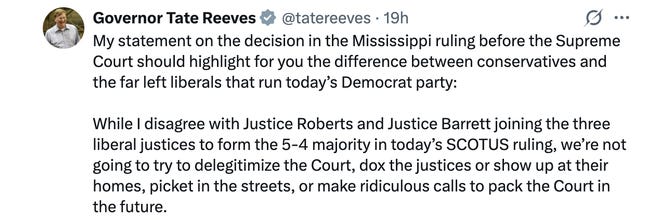
🔥 The dissenters enjoyed a dissenting field day, and there were simply too many saucy quotes to include in a manageable Substack post. That’s nice and all, you might ask, but what good are dissenting opinions? Who are these comments even aimed at?
Maybe they are aimed at Republican holdouts who still oppose the SAVE Act. And here is the most encouraging and most under-reported fact: The majority’s choice to resolve Watson on purely statutory grounds almost certainly helps the SAVE Act’s prospects.
Justice Barrett was emphatic that Watson was not a constitutional case. She wrote, “This is not a case about the Constitution. We do not consider the scope of Congress’s authority to regulate federal elections.” By grounding itself in statutes rather than constitutional limits, Watson implicitly confirmed the most important proposition: Congress absolutely could legislate a uniform ballot-receipt deadline if it wanted to — it just hasn’t done so yet.
Barrett didn’t just say it once, either. From her closing section: “When voting on different days in different States sparked allegations of fraud, Congress set a nationally uniform deadline for voting. If varied deadlines for ballot receipt similarly call for a national solution, the American people must choose it through their elected representatives.” BOOM.
If, say, the Court had instead ruled that the Elections Clause prohibits Congress from reaching into ballot-receipt mechanics, that reasoning would have been weaponized against the SAVE Act. Barrett’s opinion lifted that move right off the lawfare chessboard.
🔥 The majority went further. It also reaffirmed that the Elections Clause places power over congressional elections in state legislatures “primarily,” but in Congress “ultimately” (citing Hamilton’s Federalist No. 59). The word “ultimately” is load-bearing for the SAVE Act. It signaled that Congress’s override authority is real and plenary when exercised, not a narrow or suspect power needing special justification.
In other words, Watson held that the problem isn’t constitutional barriers; it’s just legislative inaction. That is precisely the legal posture the SAVE Act needs.
At bottom, SCOTUS did punt the decision back to Congress. But it didn’t merely punt. It also cleared the field for a long drive back to the goal line.
Notably, President Trump’s Truth Social feed didn’t criticize the Court’s decisions in either Cook or Watson. He’s not usually stingy with his criticism. Just saying.
To wrap this up, like the Cook decision, Watson was not any clear win for Democrats. Trump is already moving forward with an executive order to tighten USPS ballot tracking, which will eliminate mysteriously appearing post-election ballots and require certification of citizenship for delivery. Meanwhile, he’s still demanding that Congress pass the SAVE Act.
In sum: we got one decision that massively and historically expanded Trump’s executive power and drove the stake deeper into the Deep State— according to his own reckoning, the dissent, and the Editors at the NYT. And then, we got two lukewarm decisions; thin, tasteless legal patties that give Democrats two buns of ‘winning’ without any beef inside.
And maybe the ‘losses’ create a menu for more conservative consolidations. So be encouraged, maybe even enthusiastic. Nothing happened in yesterday’s decision except that the Swamp’s water levels fell even lower. The Slaughter decision changed everything. May the draining continue.
Have a terrific Tuesday! We’ll be back tomorrow morning, with all-new essential news and caffeinated commentary.
Don’t race off! We cannot do it alone. Consider joining up with C&C to help move the nation’s needle and change minds. I could sure use your help getting the truth out and spreading optimism and hope, if you can: ☕ Learn How to Get Involved 🦠
How to Donate to Coffee & Covid
Twitter: jchilders98.
Truth Social: jchilders98.
MeWe: mewe.com/i/coffee_and_covid.
Telegram: t.me/coffeecovidnews
C&C Swag! www.shopcoffeeandcovid.com
I knew Jeff would clear things up for us, and keep us in a positive attitude. These clarifications from the SC are wins.
No matter what happens to that smug looking Lisa Cook at the Fed, Trump is working to replace that corrupt unconstitutional central bank and make it obsolete. Every "member" of that board are leeches on American citizens and serve zero purpose.
✝️✝️✝️
How numerous are Your works, O Yahweh!
In wisdom You have made them all;
The earth is full of Your possessions.
— Psalm 104:24 LSB
✝️✝️✝️