

Good morning, C&C, it’s Thanksgiving! First, please accept a heartfelt holiday wish from my family to yours for the happiest of days, whether you are celebrating this day of gratitude alone or with several dozen in-laws you haven’t seen since last year. Do your best to remember everyone’s name. As my gift to you, enjoy this special C&C essay about the progressive deconstruction of our unique national holiday. It’s a true history of Thanksgiving that I’ll bet you never heard before.
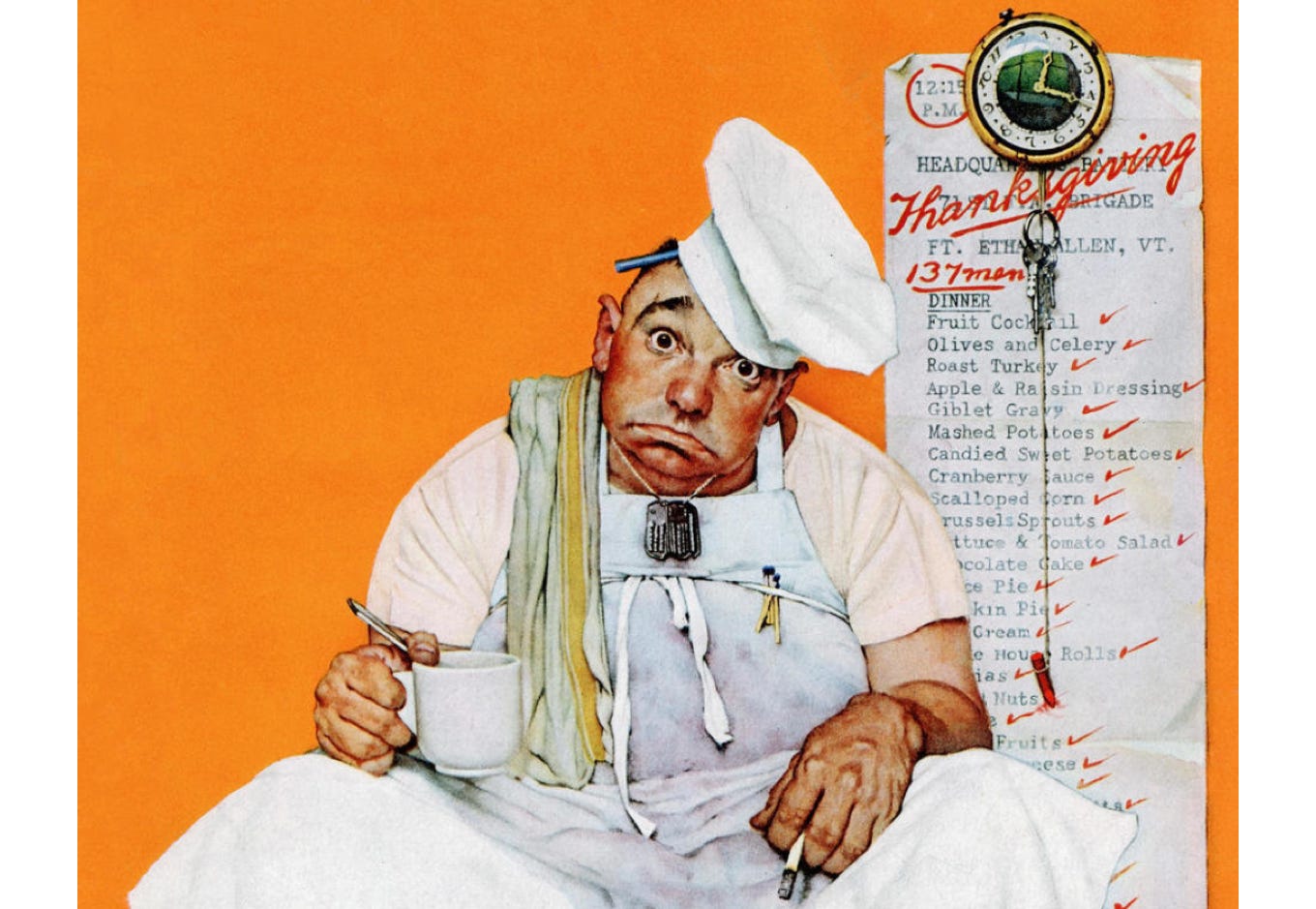
🍗 C&C SPECIAL: THANKSGIVING’S STRANGE JOURNEY🍗
Or, How we got from George Washington’s Day of Repentance to Turkey Pardons and DEI Storytime.
🍗 Part I: Washington’s 1789 Proclamation: 100% God, 0% Pilgrims
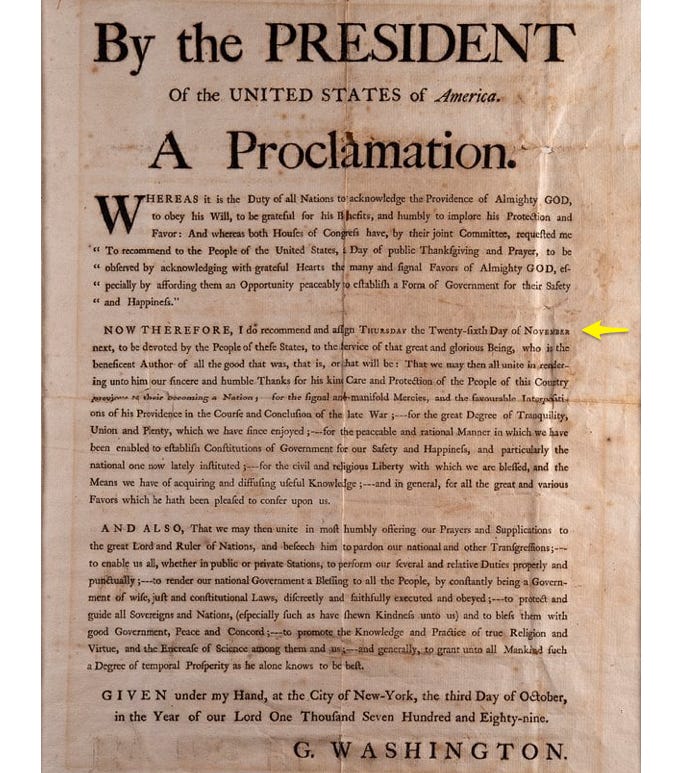
On October 3, 1789 —six months after ratifying the Nation’s new Constitution— a grateful Congress packed with recent war veterans called on its first president to express its thanks to the Divine Creator who shepherded the new nation through its trials and tribulations. Yea, though I walk through the valley of the shadow of death, I shall fear no evil.
Washington agreed, and promptly issued a formal proclamation of thanks, which became the birth certificate of the first official American holiday.
The text was unambiguous; the meaning was inarguable. Washington assigned “Thursday the 26th day of November” of that year to be devoted to thanking the “Author of all the good that was, that is, or that will be,” and “to promote the knowledge and practice of true religion and virtue.”
Not any religion. True religion. Just saying.
Here’s the key section, since the original can be hard to read, what with all the calligraphic ‘f’s and ’s’s:
Now therefore I do recommend and assign Thursday the 26th day of November next to be devoted by the People of these States to the service of that great and glorious Being, who is the beneficent Author of all the good that was, that is, or that will be--
That we may then all unite in rendering unto Him our sincere and humble thanks--
for His kind care and protection of the People of this Country previous to their becoming a Nation --
for the signal and manifold mercies, and the favorable interpositions of his Providence which we experienced in the course and conclusion of the late war--
for the great degree of tranquility, union, and plenty, which we have since enjoyed-- for the peaceable and rational manner, in which we have been enabled to establish constitutions of government for our safety and happiness, and particularly the national One now lately instituted --
for the civil and religious liberty with which we are blessed; and the means we have of acquiring and diffusing useful knowledge; and in general for all the great and various favors which he hath been pleased to confer upon us…
… and also that we may then unite in most humbly offering our prayers and supplications to the great Lord and Ruler of Nations and beseech him to pardon our national and other transgressions--
…to render our national government a blessing to all the people, by constantly being a Government of wise, just, and constitutional laws, discreetly and faithfully executed and obeyed --to protect and guide all Sovereigns and Nations (especially such as have shewn kindness unto us) and to bless them with good government, peace, and concord--
To promote the knowledge and practice of true religion and virtue, and the increase of science among them and us--
and generally to grant unto all Mankind such a degree of temporal prosperity as He alone knows to be best.
Most of you probably never saw that before. I blame the public schools. More on that later.
Notably, Washington’s Proclamation included zero references to Plymouth, Wampanoag, Squanto, corn, buckles, shared feasts, or debates about deep-fried versus roasted. The purpose was explicitly Christian and expressly civic-religious: national humility, repentance, and gratitude to Providence for the survival of the new Republic.
At the time Washington signed it, the ink on the new Constitution was barely dry. All his loopy religiosity would have driven the “Separation of Church and State” crowd to complete distraction. Had it happened now, in 2025, a federal judge would have struck down Washington’s grateful Proclamation before he even finished scrawling his signature at the bottom.
But it wasn’t 2025. It was 1789, and a new and fragile nation paused to thank the Creator for not immediately imploding.
This foundational fact matters, because Washington established the baseline: Thanksgiving was created as a religious civic practice —true religion— not a heritage pageant, not an origin myth, and definitely not a cultural mediation exercise. But it was not a federal holiday. Not yet.
🍗 Part II: The Patchwork Custom (1790–1862)—Fifty States and Fifty Customs
For the next seventy years, Thanksgiving was a state-level affair. Governors sporadically proclaimed days of thanks, usually when they needed to distract the public from the latest railroad scandal. Some New England states held annual days; others observed them irregularly; the South mostly ignored them.
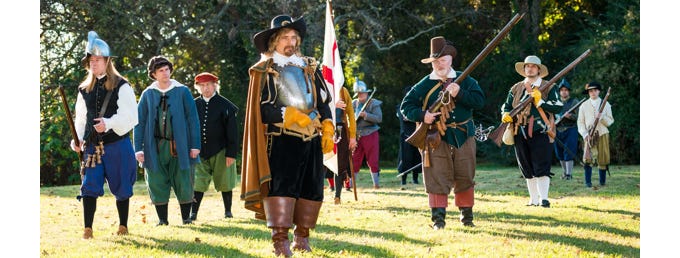
But no state declarations from this period —not one— ever tied the holiday to the 1621 Plymouth harvest. No Pilgrim stories. No native diplomacy tales. Zip, nada.
Even in its diaspora, the holiday remained a day of prayer and repentance rather than a historical reenactment.
🍗 Part III. Proclamation Part II— Lincoln Federalizes Thanksgiving
On October 3, 1863, as the Civil War raged on, Abraham Lincoln issued a decisive proclamation establishing a new, official, federal national holiday: Thanksgiving. Lincoln was good like that; he federalized anything that wasn’t nailed down and a lot of stuff that was. Postal workers were especially thankful.
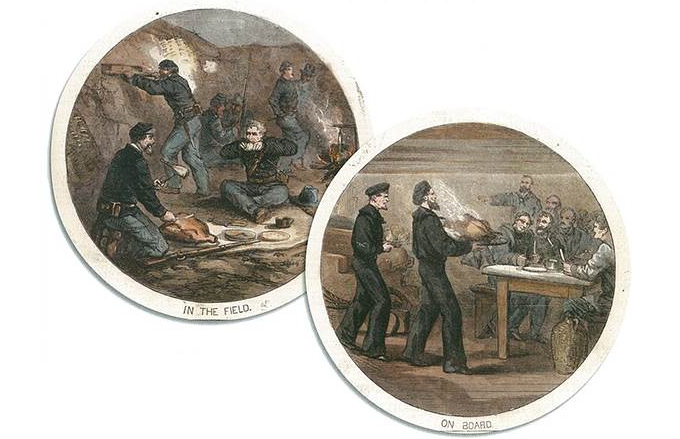
In Lincoln’s federal proclamation, the stovepipe hat-wearing president attributed America’s blessings to “the ever watchful providence of Almighty God” and called —like Washington had— for national repentance, humility, and unity. Here’s an excerpt from Proclamation II:
I do, therefore, invite my fellow-citizens in every part of the United States, and also those who are at sea and those who are sojourning in foreign lands, to set apart and observe the last Thursday of November next as a Day of Thanksgiving and Praise to our beneficent Father who dwelleth in the heavens.
And I recommend to them that, while offering up the ascriptions justly due to Him for such singular deliverances and blessings, they do also, with humble penitence for our national perverseness and disobedience, commend to His tender care all those who have become widows, orphans, mourners, or sufferers in the lamentable civil strife in which we are unavoidably engaged, and fervently implore the interposition of the Almighty hand to heal the wounds of the nation, and to restore it, as soon as may be consistent with the Divine purposes, to the full enjoyment of peace, harmony, tranquility, and union.
Fortunately, there was no ACLU to file for an injunction against all of Lincoln’s silly religious claptrap. But more importantly for our theme, once again, scientists have estimated the proportion of Pilgrims in Lincoln’s proclamation recipe as precisely 0% Pilgrims (they likewise detected 0% Indians). No cornucopia, no flightless fowl, no spiced fruit salad.
Lincoln’s Proclamation never even mentions Plymouth Rock. He never cited 1621. He was trying to save a nation, for Pete’s sake, not commemorate a neighborly feast.
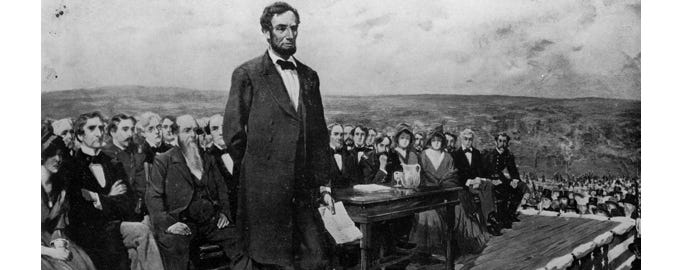
Two presidents. Two wars. Two proclamations, both calling for gratitude and repentance. Lincoln federalized it, which became the inflection point where the modern holiday began. But none of this Thanksgiving history explains the baffling mystery of where all those pesky Pilgrims came from.
🍗 Part IV. The Quiet 1841 “Discovery” of the Winslow Letter— The Spark of a Myth
We must now glance back a few years, at a small historical footnote (literally): in 1841, New England antiquarian Alexander Young published a collection of colonial documents. His quaint coffee-table-suitable tome included a December 1621 letter penned by one Edward Winslow —a Pilgrim— describing a charming-sounding three-day harvest celebration shared with his settlement’s Wampanoag neighbors. The whole story is encapsulated in a sentence fragment:
“… at which time amongst other recreations, we exercised our arms, many of the Indians coming amongst us, and among the rest their greatest King Massasoit, with some ninety men, whom for three days we entertained and feasted, and they went out and killed five deer, which they brought to the plantation and bestowed on our governor, and upon the captain, and others.”
That’s it. That’s the whole thing.
In a footnote, antiquarian Young casually called Winslow’s short description, “the first Thanksgiving.” (Young loved Pilgrims; he also published Chronicles of the Pilgrim Fathers and Chronicles of the First Planters.) The label was editorial, not historical — and no one paid much attention at the time. The letter had no effect whatsoever on official Thanksgiving proclamations and celebrations before the Civil War.
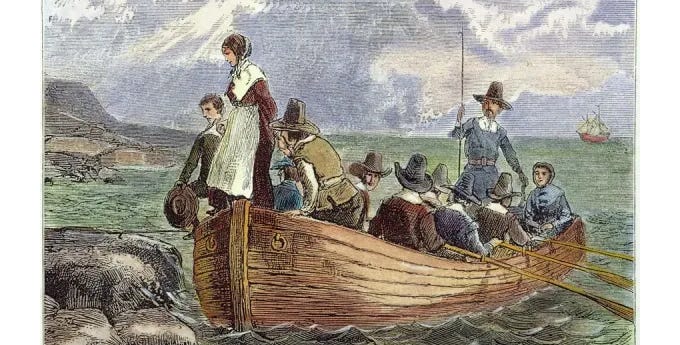
Get this: All that historians have to go on is that one sentence fragment about the Wampanoag dinner from Winslow’s 1621 letter, which pretty much only claims that 90 hungry indians arrived with five deer and stayed for three days. Only that single eyewitness account of the event exists, and everything else is either hearsay from decades later, gloss added by later historians, optimistic extrapolations, or archaeology that has never confirmed the meal’s details.
No other Plymouth colonist left a diary entry, journal note, or letter describing that supposed feast. Not one. Governor William Bradford —the author who surely would have noted it— never mentioned the Wampanoag supper or even the visit in his famous history Of Plymouth Plantation, which covered the year 1621 in mind-numbing detail, but never described the extraordinary “First Thanksgiving.”
Nor did Bradford ever mentioned it in any of his many later writings. (Note: if you go Googling, you will find many false claims that Bradford wrote about the First Thanksgiving. He did not. The myth runs broad and deep. Dig deeper.)
Nor was the famous cross-cultural soireé mentioned in John Alden’s writings, Miles Standish’s surviving correspondence, the letters of the Allertons, Brewsters, or Howlands, any Plymouth Colony records, or any merchant correspondence related to the colony.
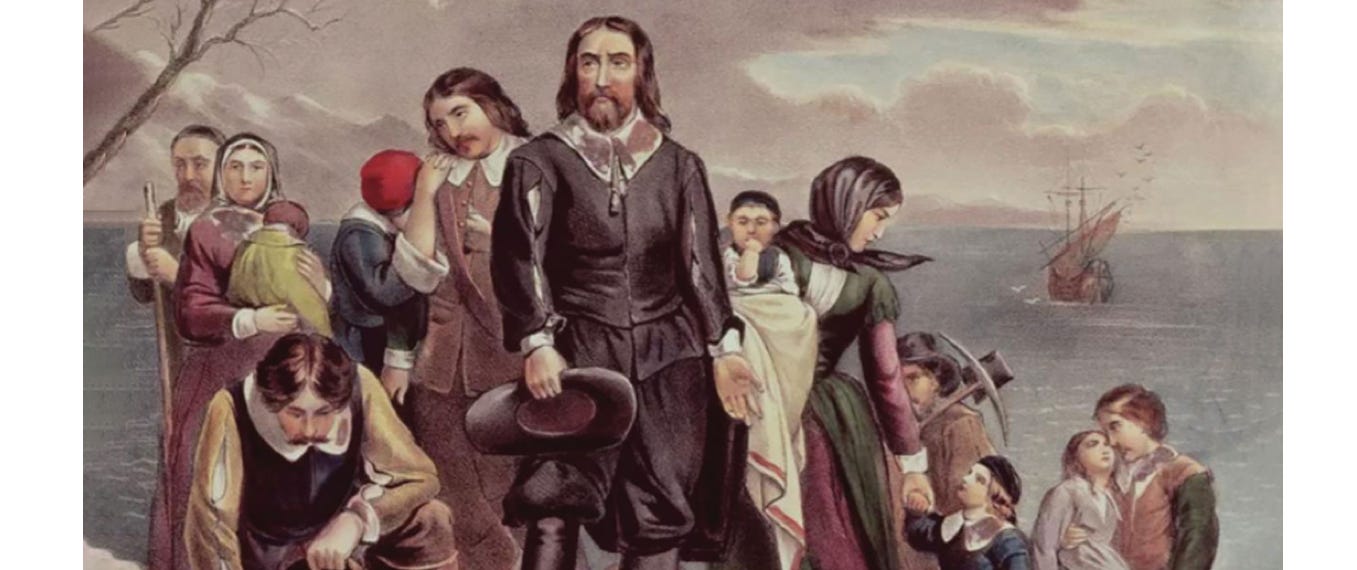
Even Wilsow’s letter fails to mention anything about the famous “Pilgrims invited the Indians to give thanks” story. It only says they “entertained and feasted” with the indians. The entire “First Thanksgiving” story ultimately rests on a single vague sentence fragment in a single letter, plus Young’s editorial (not historical) comment.
Which explains why Young’s footnote remained a niche curiosity… until politics entered the chat.
🍗 Part V: The Myth Factory Fires Up (1870–1910)— New England Elites Remake America
After the Civil War, the country’s demographics were shifting, and large numbers of legal immigrants were diluting New England’s cultural dominance. In response, New England’s elites —educators, ministers, and textbook writers— embarked on a marketing campaign to define “the real founding of America” as a story about Pilgrims, Plymouth Rock, and English Protestant values.
This well-intended revisionism is where the version 1.0 of the modern formula emerged: Brave Pilgrims + Friendly Indians + Divine Providence + Charming Potluck Dinner = America. But it was always just a pleasant founding fairy tale.
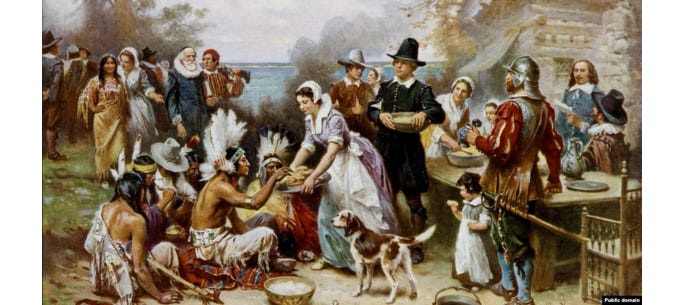
Between 1870 and 1910, Progressive-era schoolbooks began aggressively inserting Plymouth into the Thanksgiving story. The Young footnote —previously obscure— now became the narrative anchor. The holiday was retrofitted into a national origin myth, even though neither Washington nor Lincoln had ever tied the holiday to the Pilgrims. Instead, both presidents tied the holiday to wars.
Somehow, Washington and Lincoln were stuffed down in the footnotes, and the industrial-age textbooks elevated the quaint Pilgrim fairy tale to a full chapter.
This is where the Pilgrim Narrative™ got its cultural passport. Pilgrims and Indians breaking bread was still always just a sweet, harmless Thanksgiving story, like Rudolph the Red-Nosed Reindeer saving Christmas. It was a greeting-card meme.
At first. But then the liberals got hold of it.
🍗 Part VI: Industrialized Mythmaking (1910–1945)— Pilgrim Mass-Production
With industrialization came industrialized public schooling, mass-produced national textbook contracts, and the rise of “civic holidays” to help Americanize millions of new immigrants.
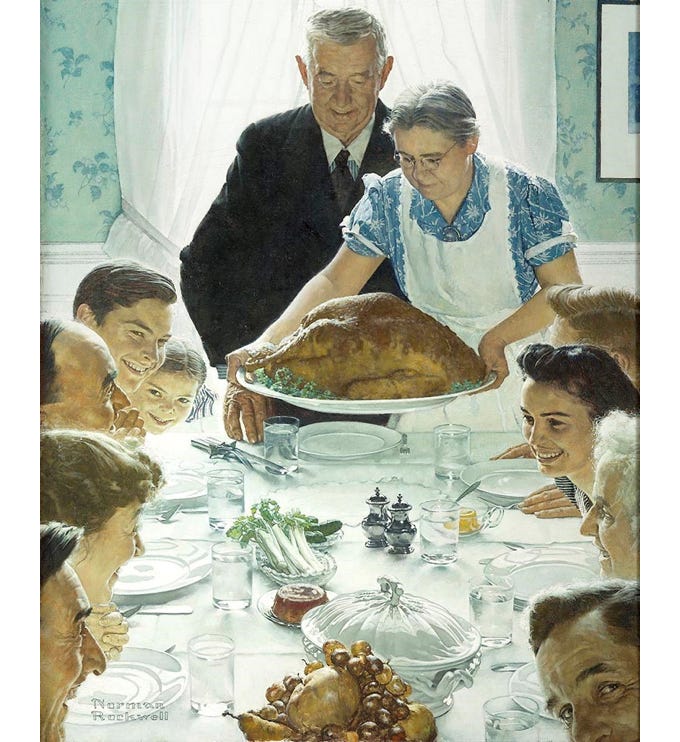
Thanksgiving was a perfect vehicle. Textbooks standardized the Pilgrim story, school pageants cemented it with morality plays, Hallmark diligently printed it, Norman Rockwell cheerfully painted it, and children everywhere made construction-paper feather headdresses that would later trigger woke historians and cause them severe emotional distress.
The Christian God hadn’t vanished entirely, not yet, He was just assigned to the kiddie table and given a small, polite serving spoon.
Meanwhile, in 1939, not at all acting like a king, President Franklin Delano Roosevelt summarily shifted Thanksgiving back a week, to stretch out the Christmas shopping season. Many states refused to follow him. For two years, America had two different Thanksgiving dates, depending on the state. In 1941, Congress officially set the holiday as the fourth Thursday in November.
🍗 Part VII: De-Christianization (1945–1970s)— The Side Dish Gets Dumped
After WWII, as the global communist revolution shifted into high gear, and McCarthy chased Reds around the State Department, Democrats chased McCarthy around the Senate, and the United States mysteriously experienced a severe bout of secularization.
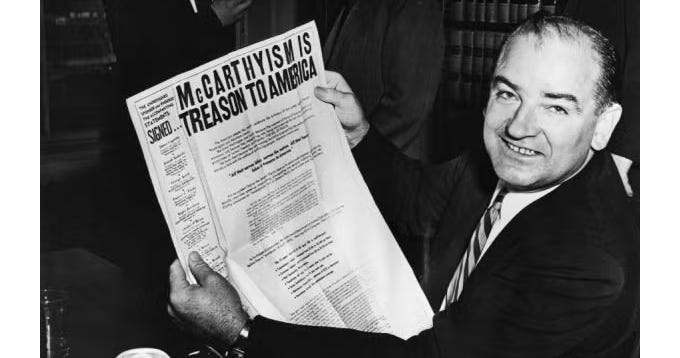
Bibles and prayer were banned from public schools, and the final leftovers of faith from the nation’s Washington-Lincoln tradition were scraped into the historical after-dinner trash can. The new Thanksgiving Pilgrim myth was baked to perfection, bubbling sweetly into a delicious parable of multicultural harmony: Pilgrims, Indians, Peace, Cooperation, and Pumpkin Pie.
As for Washington’s and Lincoln’s religious traditions of prayer and repentance, well, they were given the bird. The middle-fingered one, not the gobbler.
Washington’s “Author of all the good that is, that was, and that will be”? Quietly erased from the cookbooks. Lincoln’s “beneficent Father who dwelleth in the heavens”? Sanded off the Thanksgiving table.
By 1954, when Dwight Eisenhower first started pardoning turkeys on television, Thanksgiving had completed its metamorphosis into a charming civic fable with all the depth of a Hallmark movie and none of the theological clarity of Washington or Lincoln.
🍗 Part VIII: From National Repentance to National Freshman Five
This is the holiday’s historical arc:
• 1789: Washington Proclamation I — All God, no Pilgrims.
• 1863: Lincoln Proclamation II — Still all God, still zero Pilgrims.
• 1870–1910: New England elites — haul Pilgrims and Indians out of a dusty footnote and add them to God.
• 1910–1945: Industrial America — mass-produce the Pilgrim Myth; Natives and Early Americans expand, God shrinks.
• 1945–1970s: Progressives — All Pilgrims and Indians, no God, plus a new turkey pardon.
We started with 0% Pilgrims and 100% thanksgiving to the Divine Creator, and somehow wound up with a Thanksgiving that feels like a DEI refresher module with better food and a celebration of conspicuous consumption (plus an appointment with the treadmill).
Don’t get me wrong. I was raised on Pilgrims and Indians. I made construction paper headdresses in school. It’s a great story. Furthermore, the New England protestant elites who started the whole myth going had good intentions. But liberals effortlessly stripped off the Pilgrims’ religious motives and turned the whole thing into a way for “colonizers” to thank “original land owners” with roasted turkey and stuffing.
Like those who lived in 1789 and 1863, we are also veterans of a great war, a bioengineered war waged against us by co-opted parts of our own government. We are thankful to our Creator, for shepherding us through that terrifying ordeal and delivering us from our enemies. We repent from our national sins, that led inexorably to the very disaster from which we needed to be saved.
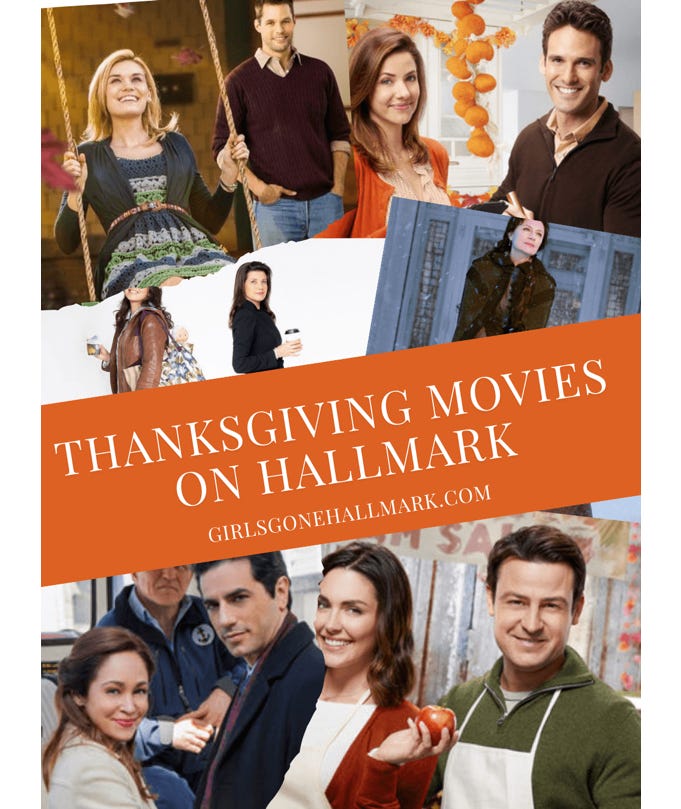
Let us now recommit to teaching our children the true story of Thanksgiving, and not the progressive myth. Enjoy your non-offensive Pilgrim memes and sickly-sweet Hallmark movies. But stick Washington, Lincoln, repentance, and God’s great Providence back on the dinner menu.
Thank God for America!
Have a joyful and grateful Thanksgiving! I hope you enjoyed this year’s special Thanksgiving essay, and a grateful Childers family wishes the very best for you and your family. See you tomorrow.
Don’t race off! We cannot do it alone. Consider joining up with C&C to help move the nation’s needle and change minds. I could sure use your help getting the truth out and spreading optimism and hope, if you can: ☕ Learn How to Get Involved 🦠
How to Donate to Coffee & Covid
Twitter: jchilders98.
Truth Social: jchilders98.
MeWe: mewe.com/i/coffee_and_covid.
Telegram: t.me/coffeecovidnews
C&C Swag! www.shopcoffeeandcovid.com
I'm alone, yet still thankful for so many blessings. My sister's husband is in a stable recovery mode from prostate cancer that went to his kidneys. He is visiting his large extended family in AL, while my sister stays in TX with her kids. His family includes attorneys and FBI agents of all things.
I'm preparing for a major snowstorm here in Illinois that is supposed to hit Friday night into Saturday. Getting the birdseed and winter gear ready.
The story of the Pilgrims should be mandatory reading for every generation. Thanks Jeff.
✝️✝️✝️
O LORD, You are my God;
I will exalt You, I will give thanks to Your name;
For You have worked wonders,
Plans formed long ago, with perfect faithfulness.
— Isaiah 25:1 NAS95
✝️✝️✝️