

Good morning, C&C, it’s Monday! Happy Columbus Day. (And only to Senator Elizabeth Warren: Happy Indigenous People’s Day.) To celebrate the holiday, I have the flu. Which means I must now disappear for twelve days. Don’t try calling around. You’ll never find me. Today’s abbreviated roundup includes: dramatic anti-Flock court ruling by a Biden judge raises all the right questions, and candidate Talarico’s mysterious invisible man story continues to roil social media— maybe a little too much. Hot takes alert.
🌍🇺🇸 ESSENTIAL NEWS AND COMMENTARY 🇺🇸🌍
🪿🪿🪿
I finally caught up to one of the stories that slipped through last week’s busy news cycle, one that I knew would either delight or infuriate you depending on where you land on the surveillance-safety spectrum. On October 1st —while James Talrico’s mysterious flu virus had turned him invisible— the Hill reported, “Federal judge rules warrantless Flock camera searches may violate 4th Amendment.”
Let’s start with the difficult facts. First, it wasn’t a lawsuit against Flock. It was a serious criminal prosecution that began with a Flock search and ended with some eye-popping evidence, which the federal judge —a Biden appointee— threw out as illegally obtained. “Freedom from persistent, dragnet-style surveillance while in public is not a foreign concept in our society, and it is a reasonable expectation that society already accepts,” U.S. District Judge Sara Hill soaringly wrote in her 38-page ruling.
It was, at last, the judicial recognition of a broad, get the Flock away from me privacy interest that many of you have yearned for. As we shall see, Judge Hill did not hold back, even though it might have been prudent to have shown a little more judicial restraint.
🪿 A diligent Oklahoma traffic cop, Tulsa County Deputy Sheriff Freddie Alaniz, alertly spotted a Mazda with California plates and, apparently relying on his finely honed police intuition, began following it. He entered the plate into his in-car Flock database and learned that the car was just returning from a short trip to the California/Arizona border area. At that point, he quickly observed additional dangerous driving conditions, such as the driver failing to use her turn signal when making a lane change and following another car too closely for safety.
So he pulled her over for two infractions and to protect the public from reckless driving.
What follows in the opinion is an extremely detailed, moment-by-moment description of the entire interaction between the officer and defendant Melissa Kyle based on the officer’s bodycam record, which I will omit repeating in order to avoid reaching 38 pages in this roundup. The short version is that, after she acted somewhat sketchily, the cop, now on high alert, asked Melissa for permission to search her suspicious rental car, and Melissa declined that “opportunity.”
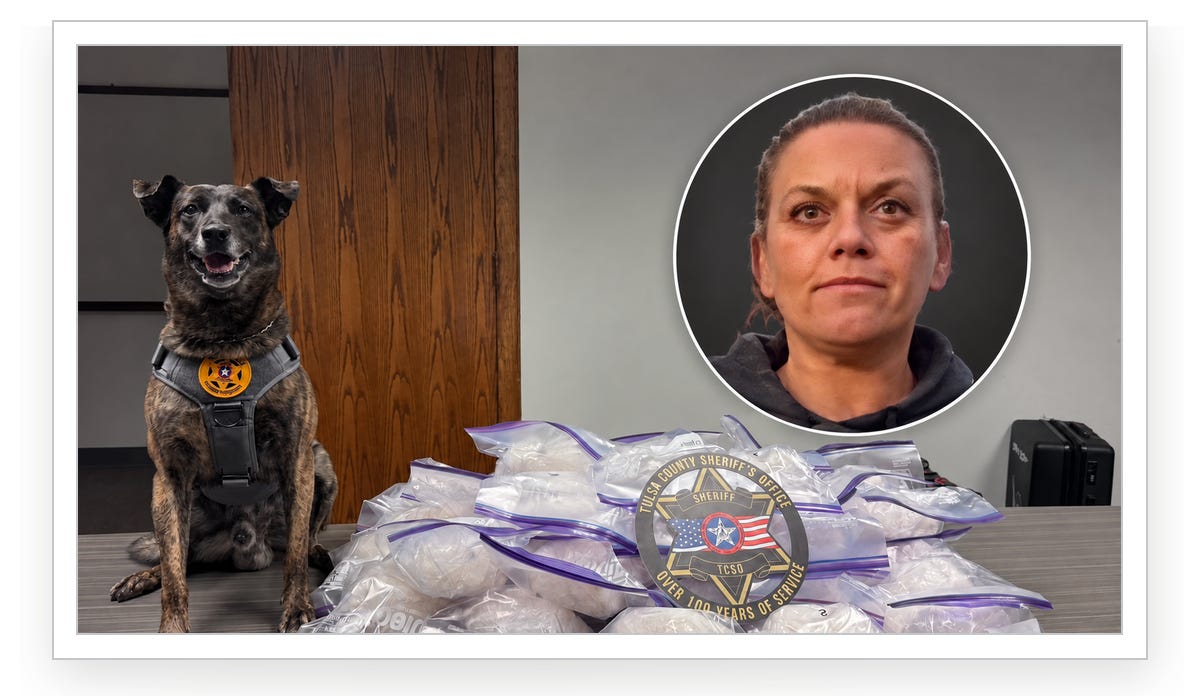
So Officer Alaniz requested a police drug-sniffing dog. “Officer” Kaine responded. (Officer Kaine is a German shepherd.)
It turned out that Officer Alaniz’s had excellent instincts. And Officer Kaine was a very good boy. He sniffed out 91 pounds of meth in Melissa’s luggage, which consisted of several large suitcases— which was suspiciously well-equipped for one small woman on a short trip, a fact that even Judge Hill was forced to admit as “a little excessive.” (I always thought it was a little excessive when Michelle packs one large suitcase for a three-day trip. Admittedly it’s overstuffed; she has to sit on it to get it to close. But still. It weighs more than she does. I’d be even more suspicious if she showed up with 4 or 5 of them.)
Anyway, back to the story: 91 pounds is a lot of meth.
🪿 To give you an idea of just how much meth that is, only around a fraction of a gram is needed to get users high. (Or so I have been told.) Melissa was therefore transporting a smidge over recreational levels: hundreds of thousands of doses. She was less of a meth mule and more of a meth rancher.
I couldn’t find a reliable estimate of the street value. It seems to vary quite a bit, depending on whether you’re pricing it wholesale or street retail. In an unrelated 2025 story, Nevada cops estimated a 90-pound meth bust having a street value of around $530K, whereas around the same time, a different South Dakota bust estimated its 200 pounds of meth at $12 million. So results may vary. Like everything else these days, it probably depends on the price of gas.
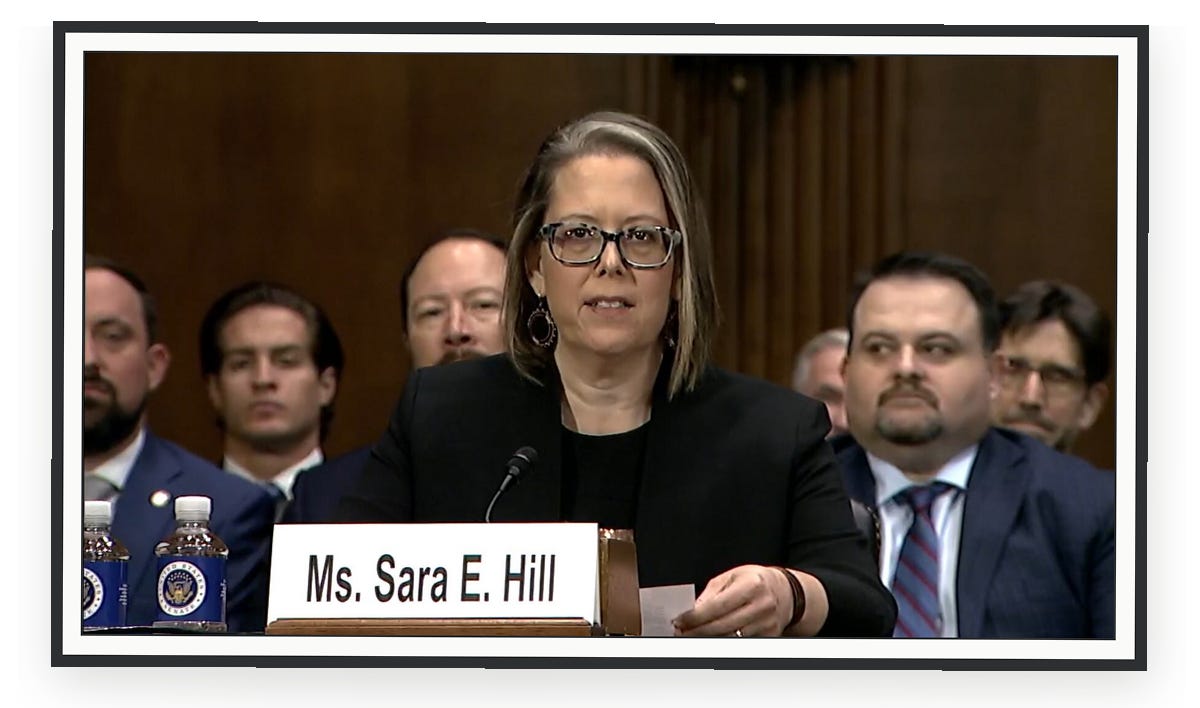
Regardless, Judge Hill never mentioned the meth in her order, not in 38 pages. She never even typed the word “drugs.” I had to get it from the Sheriff’s department’s press release. Whatever else you might say about Judge Sara Hill— when she suppresses evidence, she suppresses it all the way. (She might argue it was irrelevant, since her decision had nothing to do with the methamphetamines. Which is fair, but still a little chicken.)
The point is: it wasn’t just a “drug bust.” Melissa’s inventory might not reach say hello to my little friend levels, but she’s in the club. That is a trafficking-level shipment. And Judge Hill threw the whole thing out while wading right into the most contentious privacy debate in a generation.
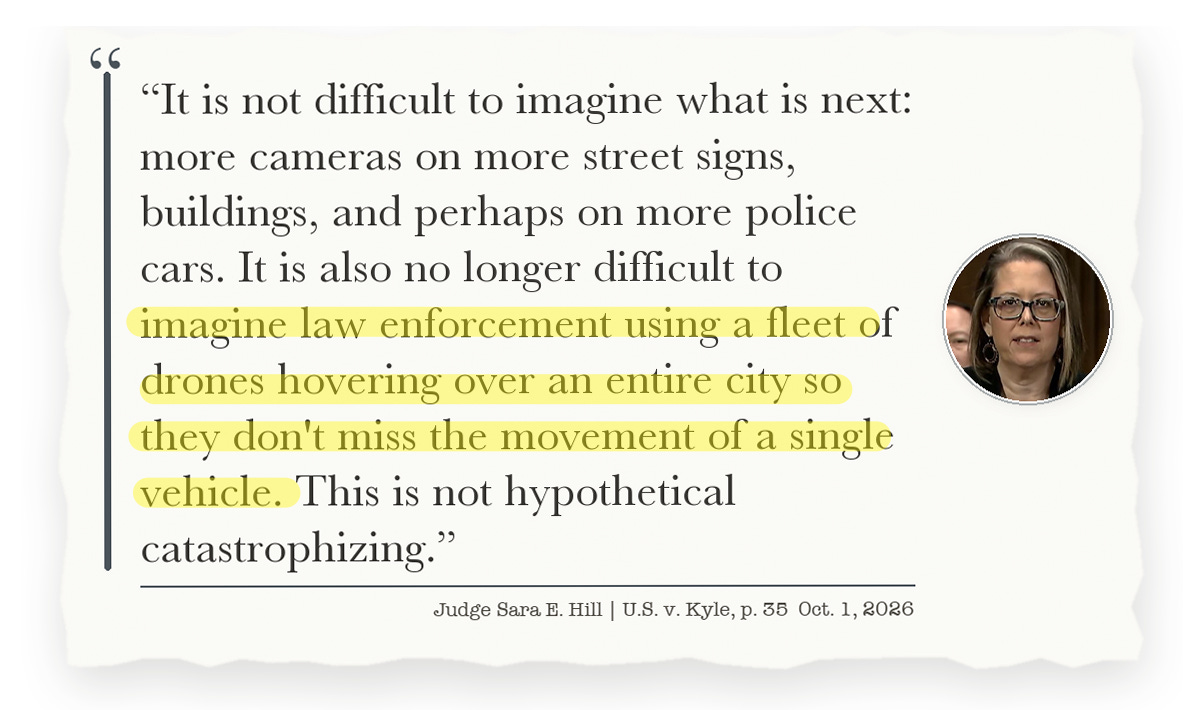
🪿 In her order, Judge Hill imagined a bleak, dystopian future where Flock cameras will be strapped to drones and just follow everybody around and see where we are going, to the casino, the liquor store, and the strip club (come to think of it, she seemed to have a pretty low view of where we are all going). Anyway, Judge Hill posed a dramatic, catastrophic hypothetical:
This is where it took as fascinating turn. Judge Hill admitted that she was traveling against nearly every other court, and those courts were citing Supreme Court law:
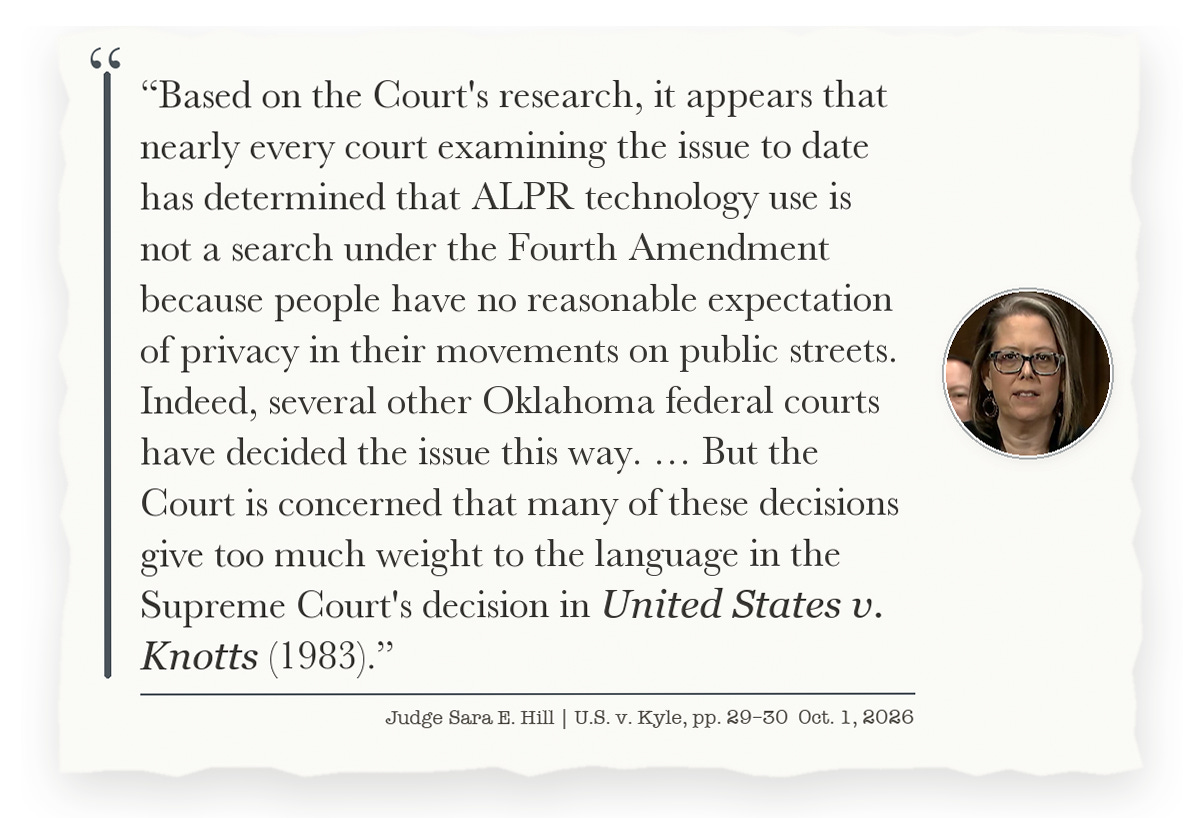
(Portlanders: “ALPR technology” means Automated License Plate Readers. You should have expected there to be a multisyllabic acronym in here somewhere.)
Judge Hill was right about two things, which each cut in opposite ways. First, nearly every other court reviewing Flock cases is applying the Supreme Court’s 1983 decision in Knotts as the baseline. There, the Supremes said plainly: “A person travelling in an automobile on public thoroughfares has no reasonable expectation of privacy in his movements from one place to another.”
That simple, declarative sentence would seem to settle the question, and, as Judge Hill noted, nearly every other court is citing it to beat the band. But back in 1983, superintelligence-fueled ALPRs were inconceivable. The Knotts case was only about beepers.
Nearly every other court has glossed over the fact that the Supreme Court’s 1983 beeper decision left room for a future change in technological circumstances. Check out what Knotts said right after the famous sentence I quoted above:
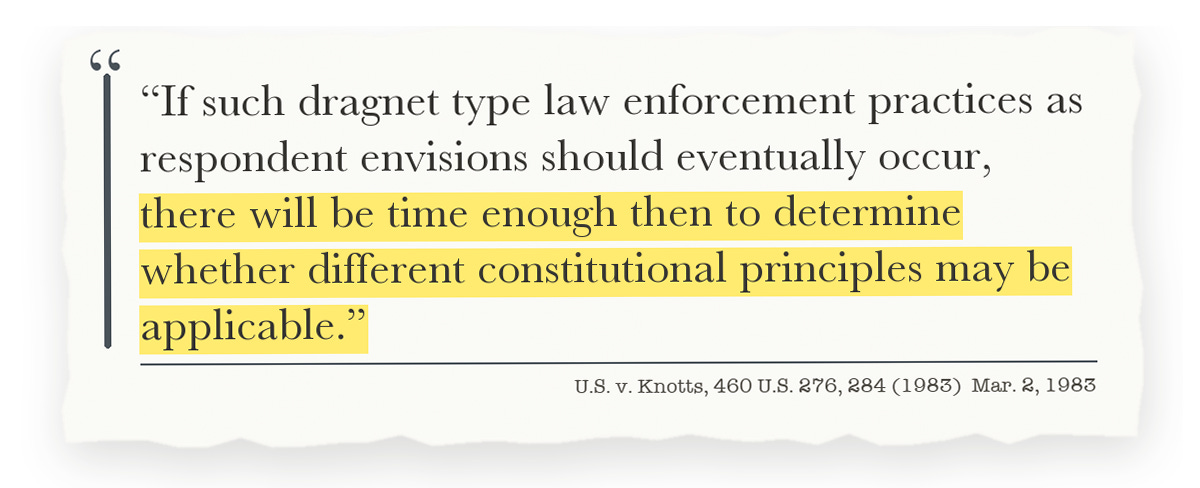
This qualifying sentence was the hook Judge Hill needed. She wrote, “More than 40 years have passed since the Supreme Court’s decision in Knotts, and this Court is now faced with technology that appears to be approaching the dragnet type law enforcement practice Mr. Knotts warned of.” In other words, they told us so. “Therefore,” she concluded, “lower courts need to reexamine the result in Knotts as technology advances past the rudimentary beeper in that case.”
Well? She’s not wrong.
🪿 I have mixed feelings about this. My conservative side appreciates that a smart, intuitive officer used a tool to stop a major drug trafficking operation while respecting due process. After all, law-abiding citizens have nothing to worry about. And now, a serious trafficker was just put back on the streets. However, my libertarian side is horrified at the thought of sacrificing the privacy of all citizens for a slight increase in law enforcement efficiency.
What about you? Are you with Judge Hill? Do you sympathize more with the “no reasonable expectation of privacy” in public, given that we are all probably under the glassy, unblinking stare of a dozen Ring doorbell cameras at any particular time? Or do you relate more to the Supreme Court’s warning that we should rethink all this when technology approaches dragnet-style law enforcement practices?
Let me know in the comments.
🔥🔥🔥
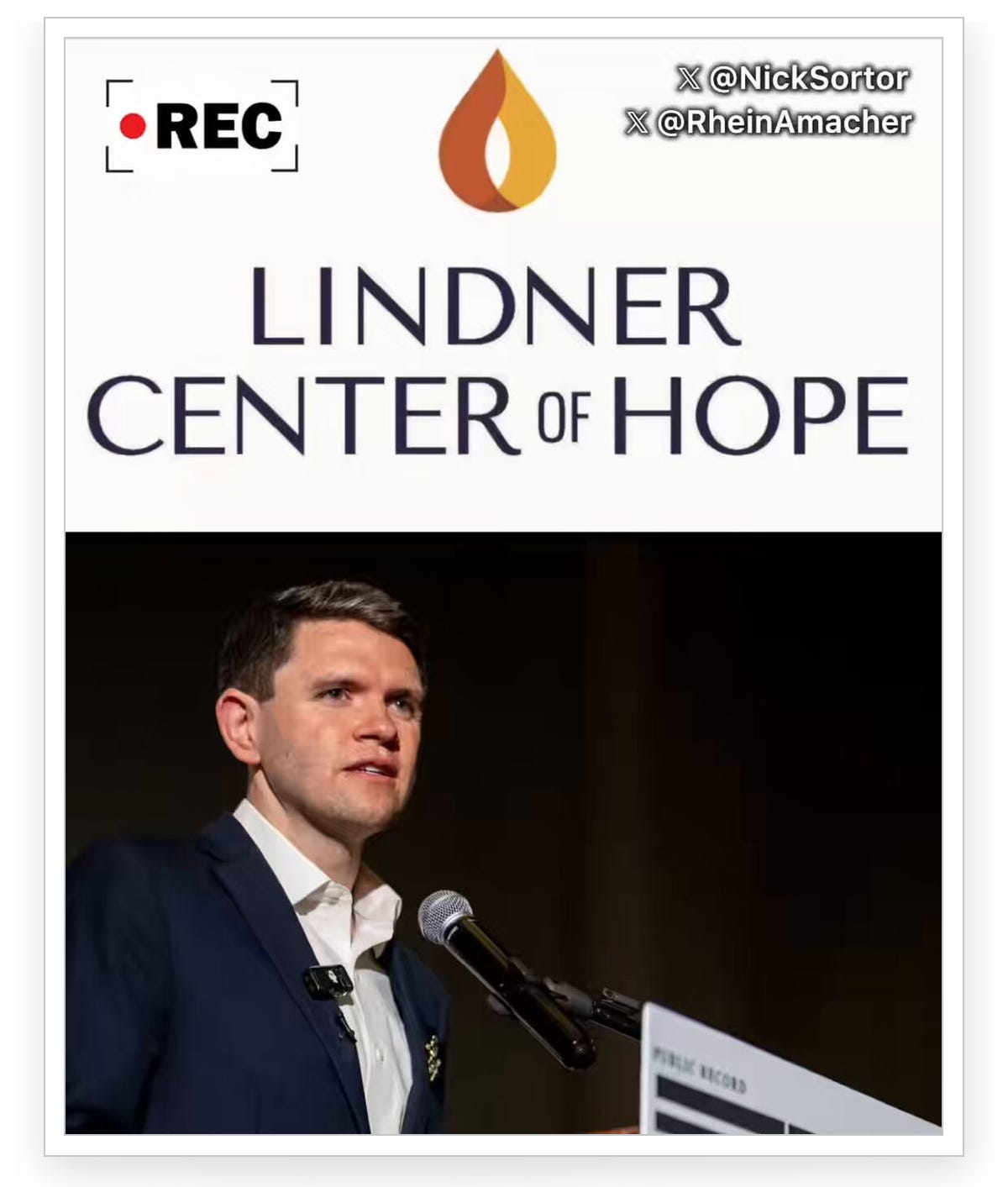
Hot takes alert! Social media feeds are buzzing this morning over Talarico-gate. Yesterday, YouTube journalist Nick Sortor (1.2 million followers, not to be confused with Learing Center sleuth Nick Shirley) published a short audio clip apparently confirming that the Senate candidate was discharged from an Ohio clinic specializing in mental disorders of LGBT people. The clinic officially denied it, but in a way that further inflamed the story. Sortor has promised more. But we should be very cautious.
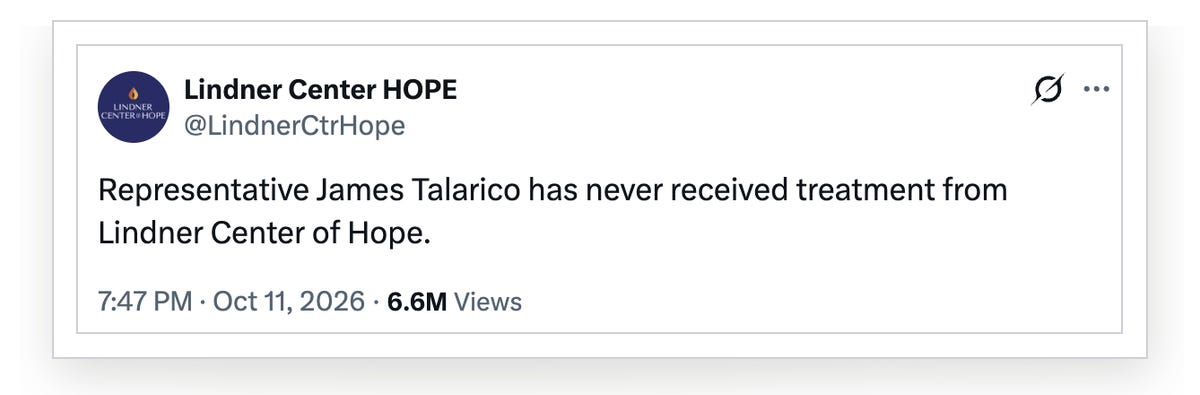
This “denial” is worse than useless. If he checked in under an assumed name, then “Representative James Talarico” was arguably not at the clinic; it was “Captain Joyboy” or whatever. Second, “received treatment” is different from being there; if Talarico “received treatment” from a private doctor at the clinic, rather than the center’s staff, then the statement is technically true but misleading.
They could have —but didn’t— say he “was never a patient at the Lindner Center of Hope.” It would have been perfectly lawful under HIPAA.
Now. Having applied that level of skepticism to the Center’s hopeful statement, we must do that same to the audio. On Saturday night, Rhein Amacher called the Lindner Center in Mason, Ohio, outside Cincinnati, and asked whether “there’s anything for James Talarico.” The woman who answers can’t find him at first, then says: “Let’s see. Well, this is — what is today? Looks like he was just discharged this evening. That’s why I don’t have it.”
That’s it. That’s the whole clip. 47 seconds. There is already a timing problem.
Talarico went to the Austin City Limits music festival the day before, on Friday. So he could not have been “discharged this evening.” If the employee were confused about that, she could have been confused about who she wasn’t finding, too. It’s a lot to assume she mistook the day but not the patient.
In the full version of the call (~ 6 minutes), Amacher pretends to be “Tim,” Talarico’s “cousin,” wanting to send a care package. When asked, he gave a fake four-digit code, which the operator accepted without question. Before the “discharged” line from the shorter version, the staffer says, “I do not see that name here. So maybe he’s been discharged.” Maybe. Uh oh.
More alarmingly (to me), from various social media posts, a lot of folks had been calling the Lindner Center trying to confirm Talarico being there. So the Center was pre-warned. It would have been easy for them to help the campaign by planting a fake rumor that could be easily debunked later. A honeypot to discredit everyone involved, turn the whole flu story into a joke, and generate sympathy for Talarico as a victim of conservative conspiracy theories.
The frustrating thing is that the story is already weird and disqualifying enough, without the Lindner Center. A candidate for the U.S. Senate completely disappeared for 12 days three weeks before the election. For “flu.” That’s all we need to know.
Now, Nick Sortor seemed untroubled by the Center’s denial, and has promised more audio this afternoon. It will need to be a lot stronger than what we’ve heard so far. And remember— as soon as its name popped up on X last week, the Lindner Center could predict what was coming. Unless it is completely incompetent, it would have prepped its staff.
According to FEC records, the Center and two generations of owners are, apparently, major Republican donors. But their record of donations includes plenty of establishment Senate Republicans (like Mitch McConnell), and the Senate’s old guard is furious with Trump and Ken Paxton for primarying incumbent John Cornyn.
The Republican establishment in Texas tried to impeach Paxton. So they might be happy to help tank Paxton’s campaign with an embarrassing debunked conspiracy.
So there is ample opportunity here for dirty work at the crossroads and plenty of reason for caution. If Talarico’s team convinces Nick Sortor to crawl too far out on this limb and then hack it off —and all it would take is a real denial— they can discredit Sortor, too, and his days of commenting on outed Learing Centers could be over.
Obviously, I do not know. Nobody except the Talarico team and the Lindner Center of Hopeful Learing does, which makes the whole “nervous breakdown” story extremely dangerous. My advice: for now at least, stay focused on the real story —the candidate’s bizarre, two-week invisibility— and edge away from the hot takes without a lot more.
If it changes, you will get the whole story right here in C&C.
Have a magnificent Monday! Since I will NOT be disappearing for twelve days, I will meet you back here tomorrow morning for more essential news and caffeinated commentary. Trust me, tomorrow’s news will jolt you awake. Be sure to be here.
Don’t race off! We cannot do it alone. Consider joining up with C&C to help move the nation’s needle and change minds. I could sure use your help getting the truth out and spreading optimism and hope, if you can: ☕ Learn How to Get Involved 🦠
How to Donate to Coffee & Covid
Twitter: jchilders98.
Truth Social: jchilders98.
MeWe: mewe.com/i/coffee_and_covid.
Telegram: t.me/coffeecovidnews
C&C Swag! www.shopcoffeeandcovid.com
ERRATA
— Clarified that Nick Sortor is not Nick Shirley
I, too, have mixed feelings about Flock cameras. So I will err on the side of individual freedom, as hard as that is to come by these days.