

Good morning, C&C, it’s Friday! Not just any Friday— it’s Good Friday. Today, Christians worldwide remember the Crucifixion, the second-most significant theological event in human history, as well as one of the best-attested historical occurrences in antiquity. In the Philippines, some hardcore believers are even nailing themselves to crosses, a nearly indescribable act of faith that you aren’t likely to see repeated in the comfortable developed world.
Good Friday is NOT a federal holiday in the US, making America one of the few Western nations that doesn’t formally recognize it. But 12 states observe it as a state holiday (Connecticut, Delaware, Hawaii, Indiana, Kentucky, Louisiana, New Jersey, North Carolina, North Dakota, Tennessee, Texas, and — thank goodness — Florida.)
Your Good Friday roundup includes: my mea culpa on the Bondi story (I was premature, not wrong — there’s a difference); why the Atlantic’s tearful ‘crystalline humiliation’ coverage reveals more about the Atlantic than about Bondi; Hegseth’s very productive Thursday, during which he transitioned three generals into private life; the most significant political corruption story of the 2026 cycle — the New York Times published ActBlue’s confidential legal memos showing the Democrats’ biggest fundraising platform may have committed federal crimes, and its lawyers knew it; why the timing of Todd Blanche’s arrival at the DOJ is not a coincidence; the terrifying fundraising gap Democrats are hiding; and what Trump actually said to Iran on Tuesday night — and why the pundits were grading the wrong assignment.
⛑️ C&C ARMY BRIEFING — EDITOR’S DESK ⛑️
I suppose it had to happen sometime. My 100%-correct track record was just diluted to 99%. Fortunately, I wasn’t wrong, exactly, just premature.
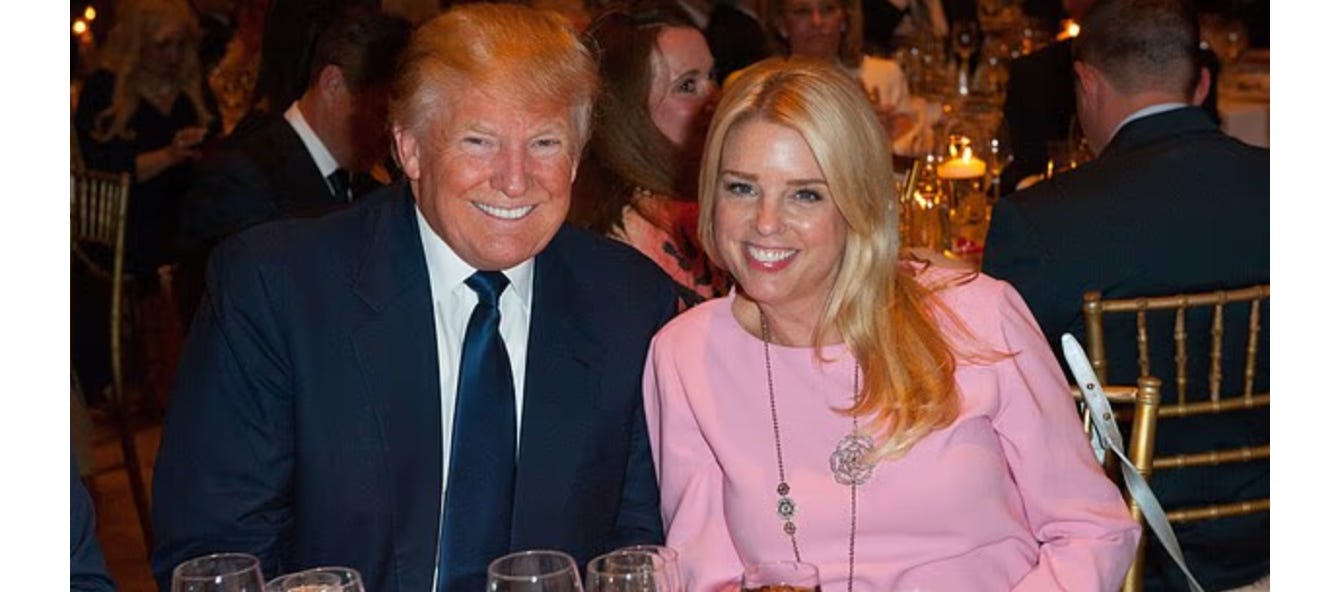
Yesterday, I excoriated the New York Times for its lame article citing only four anonymous sources who, without any evidence or even a direct quote, said President Trump was “considering” firing Attorney General Pam Bondi. Within minutes of publishing my post, other platforms started reporting it too, and by the afternoon, the end of the Bondi era had been formally announced.
Bondi says she is “transitioning to an exciting opportunity in the private sector.” That is a marginally better template than “spending more time with family.”
She wasn’t ‘fired’ in the sense the Times meant; they were clearly hoping for a dramatic curbside escort out of the building while awkwardly carrying a banker’s box of her personal items and desk pictures of arrested Democrats. Instead, she has 30 days, and will be helping Deputy Attorney General Todd Blanche get up to speed as interim AG.
Publicly, Trump and Bondi thanked and effusively praised each other in reciprocal tweets.
“Leading President Trump’s historic and highly successful efforts to make America safer and more secure has been the honor of a lifetime, and easily the most consequential first year of the Department of Justice in American history,” Bondi tweeted. “I remain eternally grateful for the trust that President Trump placed in me to Make America Safe Again.”
For his part, Trump posted, “Pam Bondi is a Great American Patriot and a loyal friend, who faithfully served as my Attorney General over the past year. Pam did a tremendous job overseeing a massive crackdown in Crime across our Country, with Murders plummeting to their lowest level since 1900. We love Pam.”
Deputy Attorney General Todd Blanche, who will be replacing her in the interim, also praised Bondi. He said, “The attorney general made our country safe again. And she is a friend, and she did a great job in the first year.” In other words, they heaped praise on her.
I wasn’t ‘wrong’ yesterday; the Times’ article was lame. But its intel turned out to be right. In hindsight, I overlooked one rare possibility: that the un-leaking Administration does sometimes leak— when it wants to. Bondi’s transition was eased by an informal disclosure hours before the official notice. Approved leaks happen; it helps Administration officials build credibility with journalists. Rumors, especially accurate ones, are like candy corns they can feed to well-behaved reporters.
It stung a little, but I will keep calling the plays as I see them. It was a good reminder for me —for all of us— that, outside this well-sealed Administration, nobody knows what’s going to happen until the moment it actually happens, which might be the most impressive feature of Trump 2.0 of all.
🔥 Trad-media continues speculating about the why. Trump didn’t give any reason; he praised Bondi. I had to let her go because she was too successful. The Daily Mail ran a viral story claiming Trump was upset that Bondi warned Eric Swalwell about the FBI’s latest Fang Fang investigation.
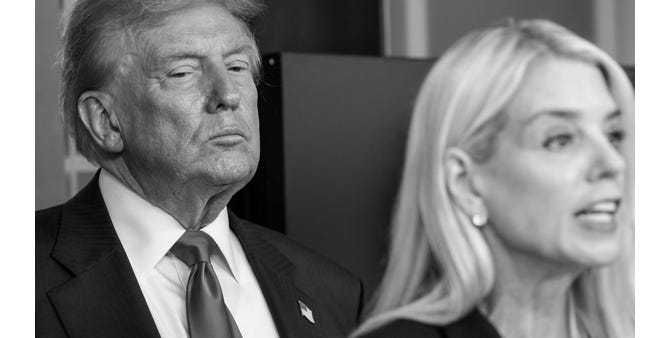
The problem with that theory is that the President didn’t act upset. I suggest caution about all the hot takes and rumors.
Not that it will stop or even slow down corporate media from reporting rumors as news or wildly speculating. Yesterday, for instance, the Atlantic reported that Bondi was fired because she’s just the beginning, kicking off a purge that could include (the Atlantic hopes) well-known officials like FBI Director Kash Patel and Commerce Secretary Howard Lutnick. Yesterday’s headline:
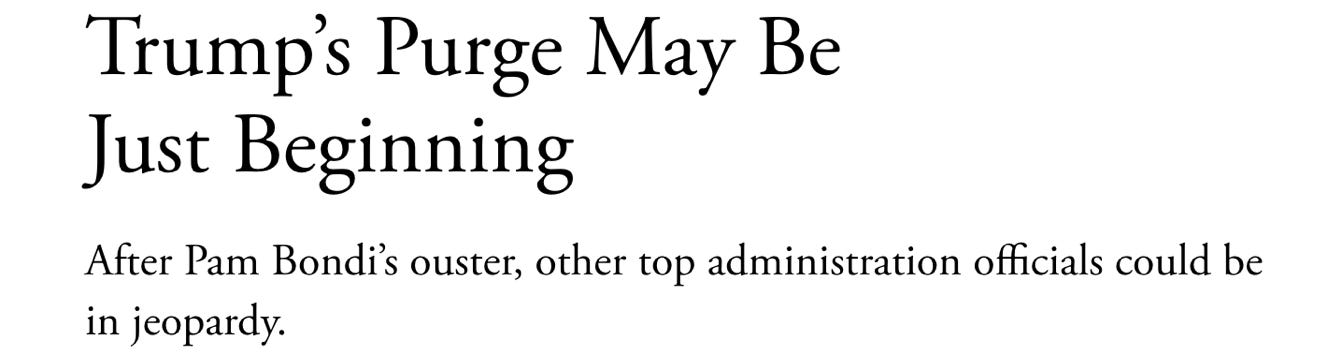
“Bondi did everything right—or, at least, everything Trump asked her to do—but in the end, it was not enough,” the Atlantic said with saccharine sympathy, like a jungle python consoling a nesting robin over her mysteriously disappeared chicks. “For Trump,” the Atlantic sighed, “it is almost never enough.”
The Atlantic, which until five seconds ago described Pam Bondi as a Hitlerian stooge or puppet, has suddenly developed fond feelings for the former AG. Her firing, it insisted, waxing poetic, was “a singular moment of crystalline humiliation, after weeks of low-grade indignities.” Crystalline humiliation! A neat turn of phrase, but what does it even mean?
Seriously, how was Pam humiliated (crystalline-ly or not)? The whole thing unfolded in a single news day and Trump heaped praise on her. They gave her a month of notice. How could it have been less humiliating? Why do I keep asking these questions about moronic corporate media?
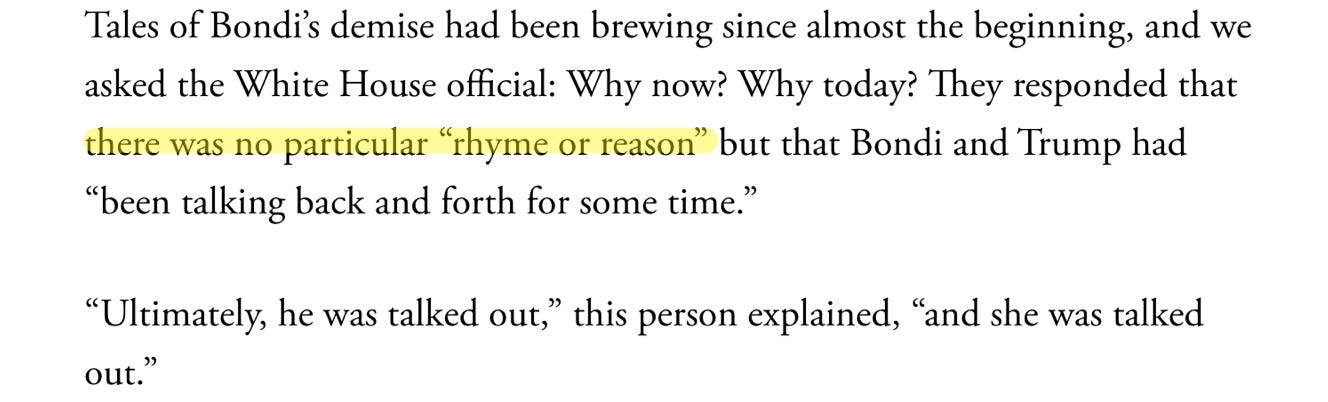
Anyway, the Atlantic continued by investing a dozen paragraphs speculating about what led to Bondi’s “humiliating crystallization” —her ‘transition’ to the private sector— but ended with the most insightful point of all: there was no rhyme or reason. Bondi and the President, it reported, were just talked out.
Is it just me, or did the media coverage project some kind of romantic melodrama? Nothing she did could ever please him. It sounded more like an ugly, painful breakup, a 2026 update to ‘Kramer v. Kramer.’ They talked all night until they just talked themselves out. I think trad-media might need a little more male energy. Just saying. Don’t cancel me.
The Atlantic wasn’t completely wrong about its ‘purge’ theory, though. War Secretary Hegseth transitioned three top generals into private life yesterday, including the Army’s top uniformed officer, its Chief of Staff, General Randy George. As with Bondi’s transition, Reuters reported that the Pentagon provided no reason for the firings.
Something is afoot. But we must await a few more dots to connect.
Whatever you want to call it —ouster, firing, ‘transition,’ or the media’s euphemism du jour— it wasn’t even the most interesting thing that happened yesterday.
🌍🇺🇸 ESSENTIAL NEWS AND COMMENTARY 🇺🇸🌍
🔥🔥🔥
I told you to keep an eye on this story as the midterms got closer. It’s playing out just as I suspected. (Hey— my “rightness ratio” is stabilizing!) Yesterday, the New York Times ran a remarkable, long-form, 4,000-word exclusive exposé headlined, “ActBlue May Have Misled Congress on Vetting Foreign Donations, Its Lawyers Warned.” Oh, no!
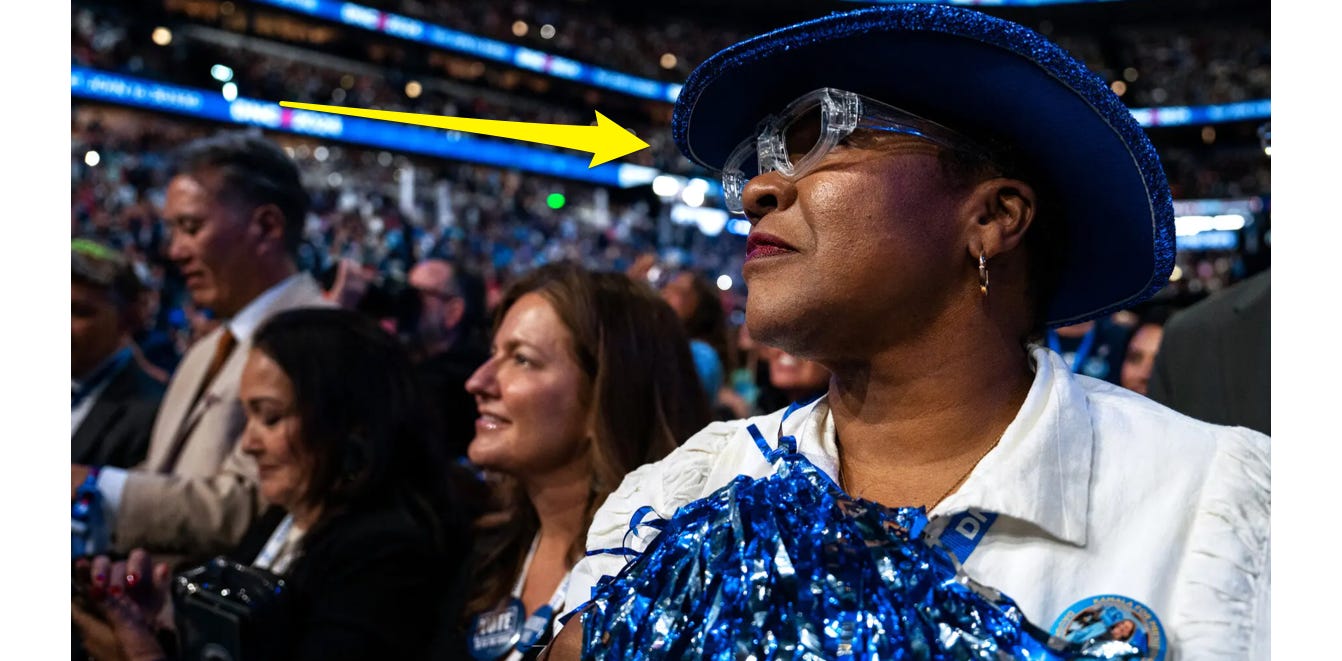
To remind Portland readers, ActBlue is essentially the Democrats’ main online money machine: a nonprofit payment platform that launders, I mean processes individual donations for Democratic candidates and left-leaning causes, similar to how WinRed serves Republicans. Since its founding in 2004, ActBlue has processed nearly $19 billion in donations, some of which have come from actual donors.
Last year, James O’Keefe’s viral videos showed elderly Democrats supposedly making hundreds of daily donations they furiously denied making. The DOJ and three House committees opened investigations. Seven senior ActBlue officials resigned like rats fleeing a Celebrity cruise after a norovirus outbreak at the soft-serve station. Then, frustratingly, the story went dark.
It hibernated for the rest of the year.
🔥 Yesterday, all the lights suddenly switched back on, and the story roared into life. The soft-serve station has reopened for business! And it revived in the most unexpected place— the New York Times, which is practically the official spokesperson for the DNC.
The Times claimed credit for breaking the story. “The legal warnings about potentially misleading Congress over vetting foreign donations,” the story said, “is being reported here for the first time.”
The only legitimate way to characterize the Times’s story is as a hit piece. Oh, it was delicate. It showed reserve. It pulled several punches. But in 4,000 words, it methodically —albeit gingerly— deconstructed ActBlue. For instance, under the header “A Potential Criminal Investigation,” the story explained, “ActBlue is under the most intense scrutiny it has ever faced.”
Intense and unprecedented scrutiny in the Times.
This time, the heart of the wide-ranging story was not sources to anonymous gossipers. It was attributed to ActBlue’s own former lawyers— the Democrat-darling firm Covington & Burling. In other words, the Times quoted confidential legal memos between ActBlue and its own lawyers. ActBlue’s lawyers warned the board members that ActBlue’s conduct could be considered criminal.
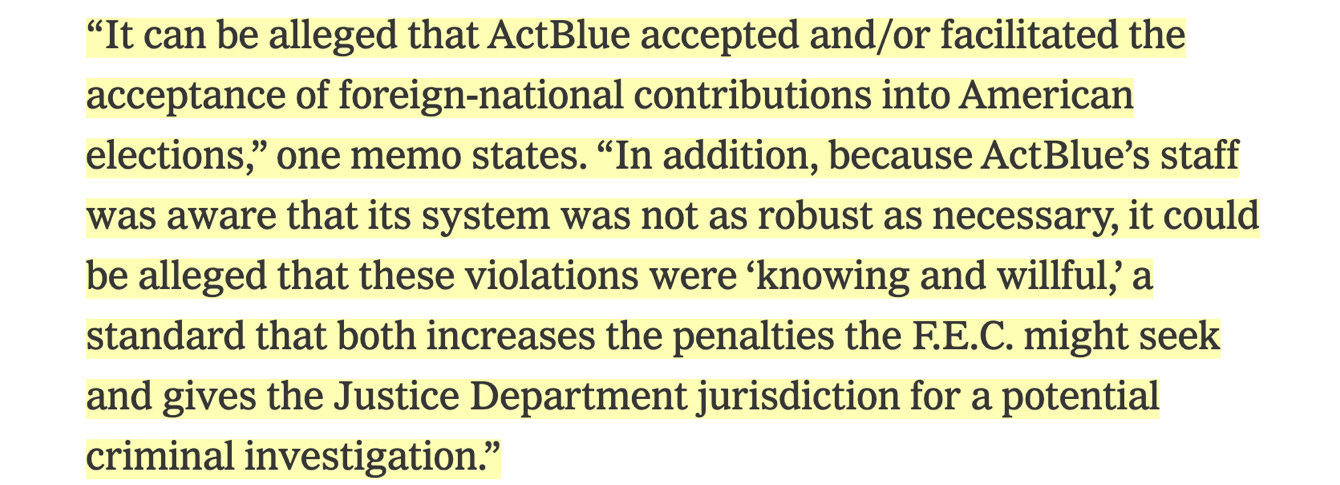
Don’t miss the reference to “knowing and willful.” It said, “because ActBlue’s staff was aware that its system was not as robust as necessary.” That one sentence forever foreclosed ActBlue’s ability to claim it didn’t know. One damning sentence from ActBlue’s own lawyer.
It’s one thing when Republicans accuse ActBlue of committing election crimes. It’s a completely different thing when ActBlue’s own lawyers say it. In confidential memos. That got leaked. To the most widely circulated paper in America.
The Times clearly had access to remarkable levels of inside information. “In a tense video conference days after the memos were delivered,” the story recounted, “Dana Remus, a Covington lawyer who served as White House counsel in the Biden administration, warned ActBlue’s CEO Ms. Wallace-Jones that she needed her own personal lawyer.”
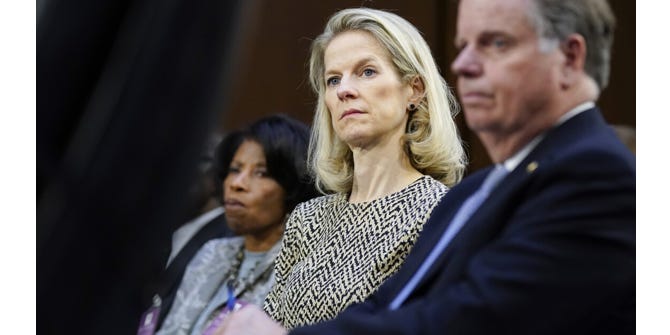
CEO Wallace-Jones responded professionally and thoughtfully by firing Covington and accusing them of malpractice. “Within weeks, ActBlue and Covington parted ways,” as the Times put it. I guess she didn’t like their advice.
Covington “transitioned” from being outside counsel to being former counsel. But the damage was done; the legal genie was out of the criminal-liability bottle. That’s when all the board members started quitting. One of ActBlue’s remaining in-house lawyers, Aaron Ting, resigned. The last lawyer in the organization’s in-house legal department sent copies of the Covington memo to the entire board, and then his computer access was cut off. An HR staffer warned about whistleblower and anti-retaliation laws— and then announced her resignation 30 minutes later.
It was pure chaos.
They can’t afford any more chaos. With only seven months remaining before midterm elections, the stakes are massive, and the timing is excruciating. “Democrats,” the Times reported, “are nervous that any additional upheaval at ActBlue could destabilize the party’s critical fund-raising apparatus ahead of the midterm elections.” You don’t say.
🔥 In contrast to yesterday’s anonymously-sourced Bondi story, consider how the Times obviously knows how to source its stories when it wants to. Here’s how the Times carefully documented its sources for this potentially explosive story:
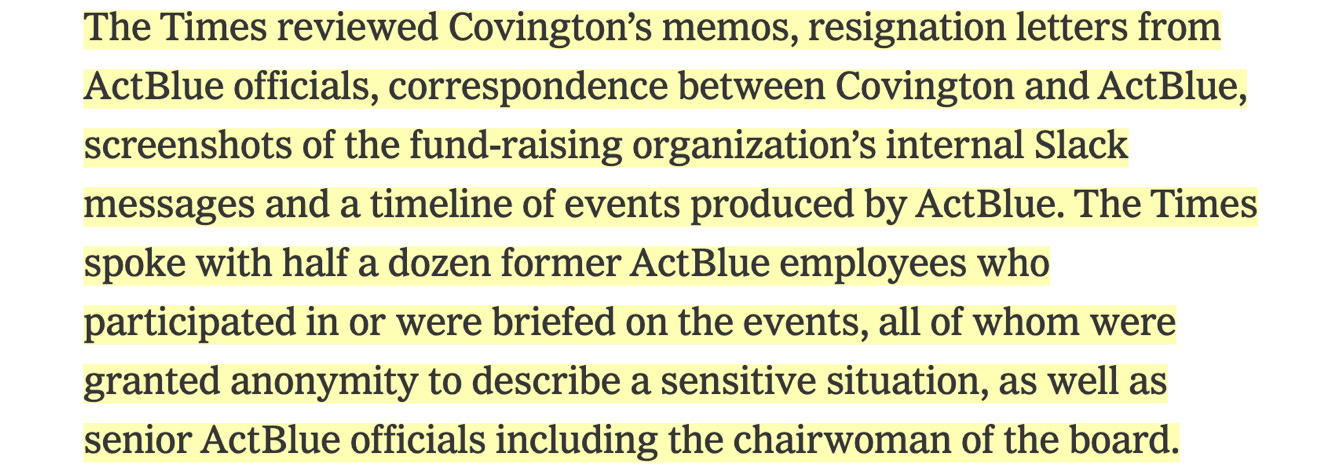
The reporter left no wiggle room for plausible denials. Legal memos, resignation letters, lawyer correspondence, internal Slack messages, and interviews with six former ActBlue employees, senior officials, and the chairwoman, plus a ‘timeline of events’ produced by ActBlue itself.
Now consider this: legal memos and correspondence are strongly protected by attorney-client privilege, and would have been very hard (if not impossible) for the DOJ or Congress to get. Somehow, the Times got them. And under the law, since the Times has them and published them in a newspaper, they’re almost certainly no longer confidential or privileged, and may be subpoenaed.
The Covington memo isn’t news. It’s over a year old. The Times didn’t claim it just got all this evidence. But the Times published these damning memos from ActBlue’s own lawyers right before the midterm campaigns begin in earnest.
On the same day the Times ran this remarkable exclusive exposé, Todd Blanche began taking over as interim Attorney General. It’s not controversial to suggest that Blanche —Trump’s former defense lawyer from the Biden lawfare era— will be aggressively interested in ActBlue.
In technical terms, the Times just handed Todd Blanche his first case file on Day One. You’re welcome. How could he not investigate this story?
It was also terrible timing because the last thing Democrats need is a legal spanner flung into their fundraising apparatus. Despite corporate media’s relentless narrative about how “fired up” Democrats are, the DNC faces an eye-watering funding gap.
🔥 The latest publicly disclosed figures show the RNC has roughly a $109 million cash reserve, versus about $17 million for the DNC, leaving Democrats with a nearly $100 million gap (not counting $18 million in DNC debt left over from the Cabbage/Cackler campaign; a throbbing Biden hangover.)
When you add in Trump’s main super PAC, MAGA Inc., flush with over $300 million on hand, Republicans’ combined war chest is more than half a billion dollars ahead of Democrats.
And that’s not even counting the world’s richest man, Elon Musk, or a separate Crypto Bros PAC loaded with another $200 million, or outside groups like Turnout for America, with $50 million. Consider this NOTUS headline, published yesterday:
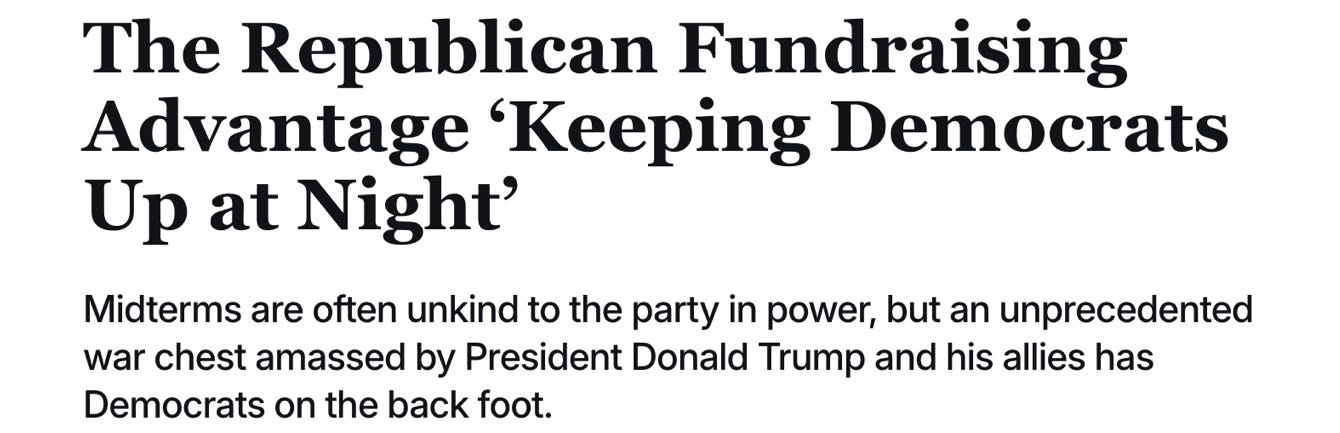
“I don’t think it has broken through, the level of money that Donald Trump and Republicans are sitting on as it compares to Democrats,” said Mike Smith, president of a Democrat super PAC aligned with minority leader Hakeem Jeffries. “It’s a real concern,” Smith said. “I do think there’s a real chance we may not be able to swing the election, at the end of the day.”
Corporate media is losing its mind because nobody is leaking the Republicans’ midterm financial strategy. “MAGA Inc is committed to retaining and building the GOP majorities in the House and Senate,” Alex Pfeiffer, a spokesman for MAGA Inc., told NOTUS, “but we are not in the habit of sharing our battle plans with the opposition through their co-conspirators in the legacy media.”
It’s the exact opposite of the situation the GOP faced during the Trump 1.0 midterms in 2018. Then, Democrats held the financial advantage, and Republicans lost 41 seats in the House. This time it’s the other way around. “Trump’s money advantage is one of the biggest differences from 2018,” said Jesse Ferguson, a veteran Democratic strategist. “And one of the biggest things that should be keeping Democrats up at night.”
If you only got your news from corporate media, you wouldn’t know about any of this encouraging news. Trad-media is monofocused on a handful of special elections where Democrats won, and on Trump’s popularity polling during a war.
But, as they always say, money talks, and glutinous reporters file fake stories.
🔥 Amidst the angst over the Democrats’ terrifying fundraising gap, why would the Times investigate ActBlue and run a damning story exposing internal attorney memos about potentially criminal conduct and lying to Congress?
There is certainly some reason. Equally certainly, we don’t (yet) know what that reason is.
But there is one thing we can count on. All the hype about Democrats being super confident about the midterms is bluster and fake propaganda. They’re short of cash. And the Times just made the legal problems for the DNC’s biggest fundraising platform about 1,000 times worse. Right as Trump’s most loyal legal deputy, Todd Blanche, is walking into the AG’s office.
Add it up: Republicans have over half a billion dollars. Democrats have a fundraising platform under federal investigation, an IOU from the Biden campaign, and a worst-nightmare Acting Attorney General. Place your bets.
Under the law, Blanche can continue as unconfirmed Acting Attorney General for 210 days. If Trump proposes a nominee who’s rejected by the Senate or withdrawn, the clock resets, and Blanche gets another 210 days. All of that to say, he’s sitting pretty for the rest of the year, right through the elections. Next year, Trump will have a new Congress, including a new Senate.
Democrats are not even counting chickens. They are sweating like an OnlyFans influencer attending Easter services. They don’t know —nobody knows— Trump’s plan. But they do know something wicked this way comes. Prepare to see something we’ve never seen before.
🚀🚀🚀
On Tuesday night, the White House announced the President would deliver a rare primetime national address about the Iran war. Speculation ran wild. Was he announcing ground troops? A ceasefire? The destruction of Iran’s power grid? For hours, the entire world held its breath. Politico sneeringly reported, “‘What the hell did he just say?’ GOP Iran worries build after Trump speech.”
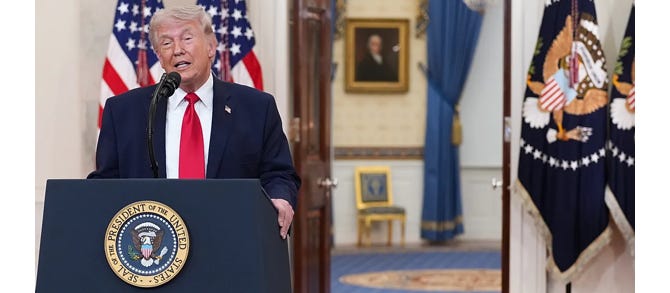
Then Trump walked out and said nothing new. In a brisk 20-minute address, he repeated what he’s been saying for a month: Iran’s navy is sunk, its air force is crashed, its leadership is laid out. He predicted “two to three more weeks” of hard hits. “We’re getting very close,” the President said. If they don’t deal, he’ll bomb them back to the Stone Age, et cetera.
He compared the 32-day campaign favorably to WWII and Vietnam, praised the troops, and wished everyone good night.
That was it.
🔥 The expert class was baffled. “I did not detect anything new,” complained myopic Trita Parsi of the Quincy Institute. “It was essentially a summary of all his tweets over the last 30 days, almost in chronological order.” Al Jazeera’s analysts concluded that Trump “does not have a plan.” Democrats called it “delusional” and “rambling.” The consensus across trad-media was unanimous: the President had assembled a primetime audience of 50 million Americans and completely wasted it.
But … what if they’re analyzing the wrong audience?
Consider the possibility that Trump’s Tuesday night address wasn’t for the American television audience at all. Consider instead that he might have been talking to somebody inside Iran.
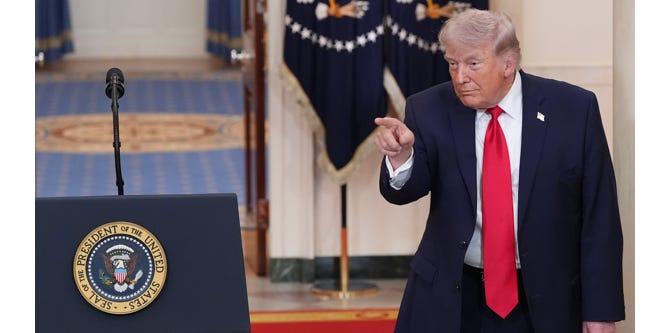
Think about what actually happened. Hours before the speech, nobody —not the Pentagon press pool, not Congressional leadership, not even most White House staff— knew what Trump planned to announce. For several agonizing hours, anyone negotiating with the Administration had to assume the worst. Was this the announcement of a ground invasion? The order to take out the power grid and seize Kharg Island? Is he going to nuke us?
During that window of war fog, Trump could say anything he wanted to the Iranians behind the scenes. You’d better call me back before I walk out to that microphone and it’s too late.
Then the President went out and delivered a greatest hits compilation. He didn’t escalate. He didn’t announce anything. He showed the stick, prominently, to 50 million viewers — but he conspicuously didn’t swing it.
For factions inside Iran trying to negotiate their way out of this, that restraint is the message. It says: I had the whole world watching me, and I held back. That was a courtesy. You’re welcome. Don’t make me book a second show. For all we know, Trump got the concession he wanted before he walked to the podium. The speech wasn’t the negotiation— it was the proof of payment.
It would also explain one otherwise odd and largely unnoticed remark. Almost in passing, Trump mentioned a “new, less radical group” that had emerged among Iranian leadership. He didn’t name them. He didn’t elaborate. He just casually noted their existence, like a poker player showing one card and sliding the rest back in his hand.
If you’re signaling to a new, more reasonable negotiating partner that you’re willing to deal, you might not want to identify them on live television. You just acknowledge they’re there. You just wink at them. This was for you.
The pundits, trained to analyze speeches for content, heard nothing new and concluded the President was floundering on the beach of the Strait. But reporters were grading the wrong assignment. The speech wasn’t a briefing. It was a negotiating tactic dressed up as a briefing— a primetime demonstration of power withheld.
Every great negotiator knows: it’s not what you say at the table. It’s what the other side thinks you might say if they don’t take your call. No reason for Bondi; no reason for the Pentagon shake-up; no reason for the ActBlue exposé; no reason for the Prime Time speech. Trump 2.0 is a masterpiece of strategic ambiguity.
Something huge is transitioning. I can’t wait to find out where.
Enjoy a hopeful and rewarding Holy Friday! Tomorrow delivers an all-new weekend edition roundup of essential news and commentary— along with Easter wishes. Don’t miss it.
Don’t race off! We cannot do it alone. Consider joining up with C&C to help move the nation’s needle and change minds. I could sure use your help getting the truth out and spreading optimism and hope, if you can: ☕ Learn How to Get Involved 🦠
How to Donate to Coffee & Covid
Twitter: jchilders98.
Truth Social: jchilders98.
MeWe: mewe.com/i/coffee_and_covid.
Telegram: t.me/coffeecovidnews
C&C Swag! www.shopcoffeeandcovid.com
✝️✝️✝️
When the sixth hour came, darkness fell over the whole land until the ninth hour. At the ninth hour Jesus cried out with a loud voice, “Eloi, Eloi, lama sabachthani?” which is translated, “My God, My God, why have You forsaken Me?” When some of the bystanders heard it, they began saying, “Behold, He is calling for Elijah.” Someone ran and filled a sponge with sour wine, put it on a reed, and gave Him a drink, saying, “Let us see whether Elijah will come to take Him down.” And Jesus uttered a loud cry, and breathed His last. And the veil of the temple was torn in two from top to bottom. When the centurion, who was standing right in front of Him, saw the way He breathed His last, he said, “Truly this man was the Son of God!”
— Mark 15:33-39 NAS95
✝️✝️✝️
He could have summoned legions of angels. He could have destroyed His captors. He could have said no to taking our sin upon Himself. Yet He chose mercy. Hallelujah.
This won't surprise most C & C readers; it's sadly funny:
"Analyses of doctors’ strikes in modern history have revealed a paradoxical trend: when doctors go on strike and elective surgeries are suspended, population mortality often stays the same or decreases
. A review of the literature identified 156 articles, with several key studies highlighting instances where death rates significantly fell.
The three most famous, frequently cited examples of declining death rates during doctors’ strikes are:
1. Israel (1973): During a one-month doctor strike, mortality rates dropped by 50%.
2. Bogotá, Colombia (1976): A 52-day strike by medical doctors resulted in a 35% drop in the death rate.
3. Los Angeles County, USA (1976):Doctors went on strike for five weeks over high malpractice insurance premiums, leading to an 18% reduction in mortality.
Additional instances where mortality dropped or remained steady during industrial action include Israel in 1983 and 2000, Spain in 1999, and Croatia in 2003.
I would bet that not only did fewer surgeries contribute to the lower death rate, but also fewer prescriptions for pHARMa toxic potions. I read that the morticians in Israel had such a crisis with a staggering 50% fewer deaths that they begged the government to end the strike! (https://substack.com/redirect/eb59f1c4-0a37-40a6-a637-304ebfd9e937?j=eyJ1IjoiOTgyeTgifQ.G9CN6opTAieXEVBws-vZi_yEVpE_gfX76i-T-0tu6oY)(Remember, Israel has one of the world’s most advanced, technologically innovative healthcare systems.)
We have a crisis in our land. We face fiscal demise due to exploding disease maintenance costs. The more “medical care” we give (funded by government and private insurance) the likely more adverse outcomes we will have since what gets funded is after the fact symptoms suppression chemicals. Your degeneration started in your childhood. If you have known cancer, you’re likely to have harbored the malignant cells for at least 10-20 years. Better to make lifestyle changes. Best to prevent decades before. Please remember that in your activities with your dearest ones. And again, this is why I am here to report to you, and I humbly thank you for being here for me.
To Your Excellent Health,
Robert Jay Rowen, MD"