

Good morning, C&C, it’s Saturday! Your Weekend Edition roundup includes: Trump channels his inner Ulysses S. Grant with two words that drove the media insane — but the numbers back it up, with Iranian missile launches collapsing 98% in five days while CENTCOM announces 3,000 targets hit and counting; Iran’s president orders his own military to stop attacking neighbors, and the IRGC responds by attacking two more countries; Britain dispatches its mightiest warship to help — as soon as the union finishes slow motion repairs; oil approaches $100 as the Strait of Hormuz stays blocked; James Woods rage-quits the GOP over the SAVE Act, and I put on my mediator hat to explain why it’s too soon to panic because of Trump’s senatorial succession plan.
⛑️ C&C ARMY BRIEFING — IRAN WAR UPDATE ⛑️
This morning’s top War Update story comes courtesy of the New York Times, which engaged in a rare bit of historical perspective. Headline: “Trump Echoes F.D.R. and Grant in Calling for ‘Unconditional Surrender.’”
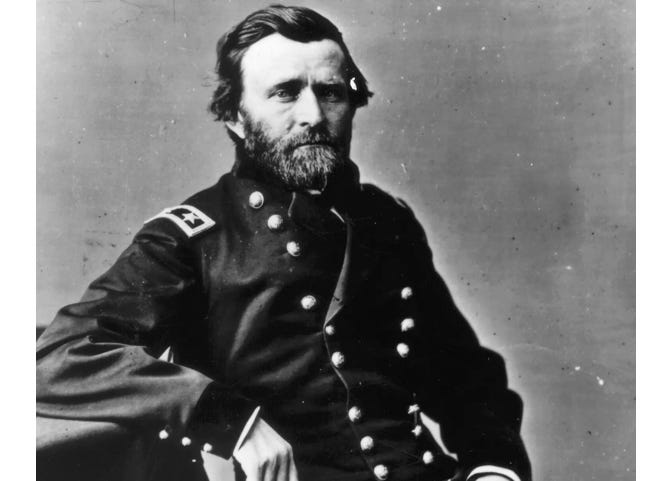
Full disclosure: in my opinion, Ulysses S. Grant was America’s greatest president. But that’s for a different post. Discussing his Iranian operation, President Trump borrowed President Grant’s most famous two-word line, which during the Civil War garnered him the enduring nickname “Unconditional Surrender Grant.” Later, FDR would borrow Grant’s slogan for World War II.
The Times could have marveled at how, once again, it was forced to compare President Trump with the country’s most significant historical presidents. Instead, it quoted a single historian who’s worried about unconditional surrender demands. “The risk is, you prolong the conflict,” the historian fretted.
Tell that to Grant. At Fort Donelson, where he coined the gag, the two-word demand ended the conflict more or less immediately.
We can get a good sense of what Operation Epic Fury’s first week looked like by a single set of numbers. The Iranian side is collapsing like a cheap folding chair under a gender studies major. Last week, UAE’s Ministry of Defense kept a running count of daily Iranian ballistic missiles that were targeting the Emirates. Observe the trend:
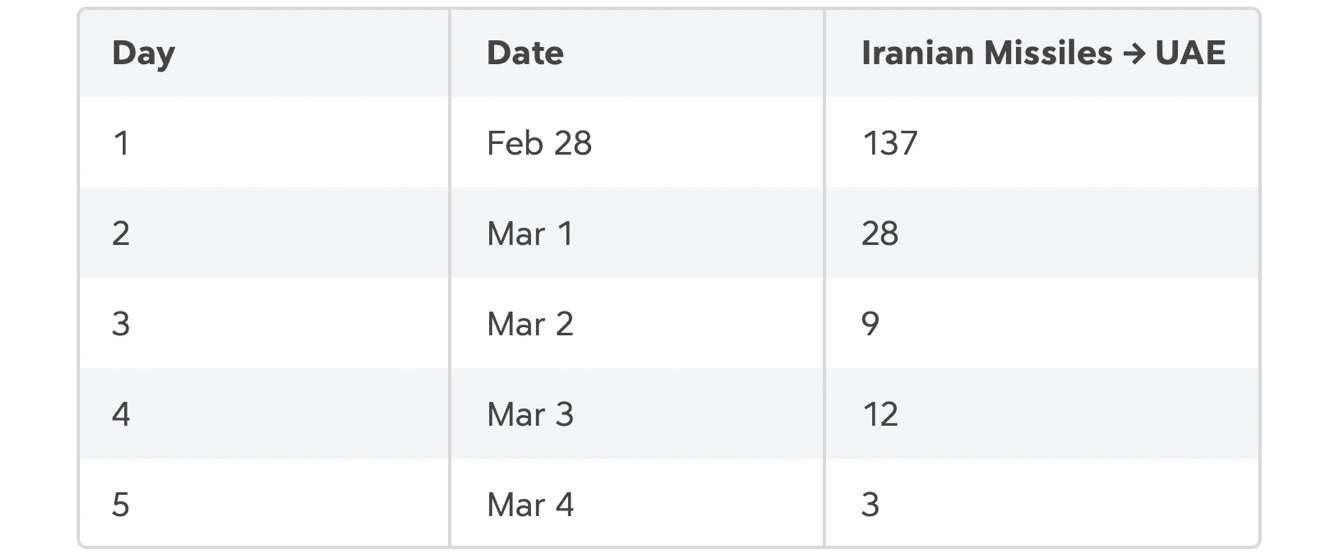
From 137 to three. That’s a 98% drop in the first five days. And it’s not just the UAE. On Wednesday, Joint Chiefs Chairman Dan Caine told reporters that Iranian ballistic missile launches are down 86% overall from Day One. And their one-way drone-launched attacks are down 83%.
According to D.C.-based Middle East think-tank JINSA, the U.S. and Israel have now destroyed roughly 75% of Iran’s launcher force:

🚀 On our side, CENTCOM announced it has struck over 3,000 Iranian targets in one week and added cheerfully, “We are not slowing down.” Using math, I deduced that’s about 18 targets per hour, around the clock, for seven straight days. And the pace is accelerating.
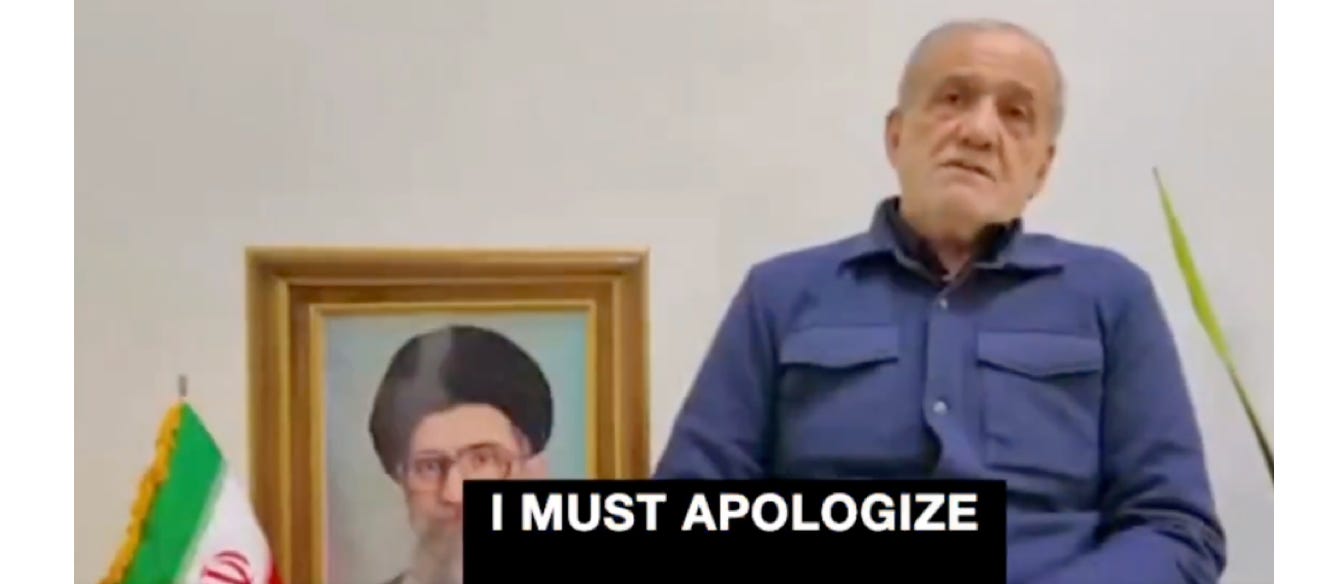
Iran seems not only missile-starved but discombobulated. Yesterday, Iran’s President Pezeshkian —operating under a Temporary Leadership Council, which is what you call the government when you’re not sure who survived the last B-2 run— apologized to neighboring countries and announced that Iran’s armed forces had been ordered to stop striking neighboring countries. A gesture of de-escalation!
But only a few hours later, the IRGC launched missiles and drones at Bahrain and Qatar anyway.
Apparently, the IRGC does not follow the Temporary Leadership Council’s Facebook feed. Apparently, wisely or not, Iran pre-planned for an attack by delegating targeting decisions to individual IRGC units if the Ayatollah went to paradise. Now unleashed, there is little practical way for an ad-hoc government to rein those units in. Pezeshkian is auditioning for that Hitlerian bunker scene from Downfall.
Thus, Iran is in a bad way. Its president —the civilian leadership— can’t control its own military. Pezeshkian issues an order; they ignore it and attack two more countries. Which is either the best argument for why this regime cannot be negotiated with (literally), or the best evidence that the regime is fracturing under pressure. Or possibly both.
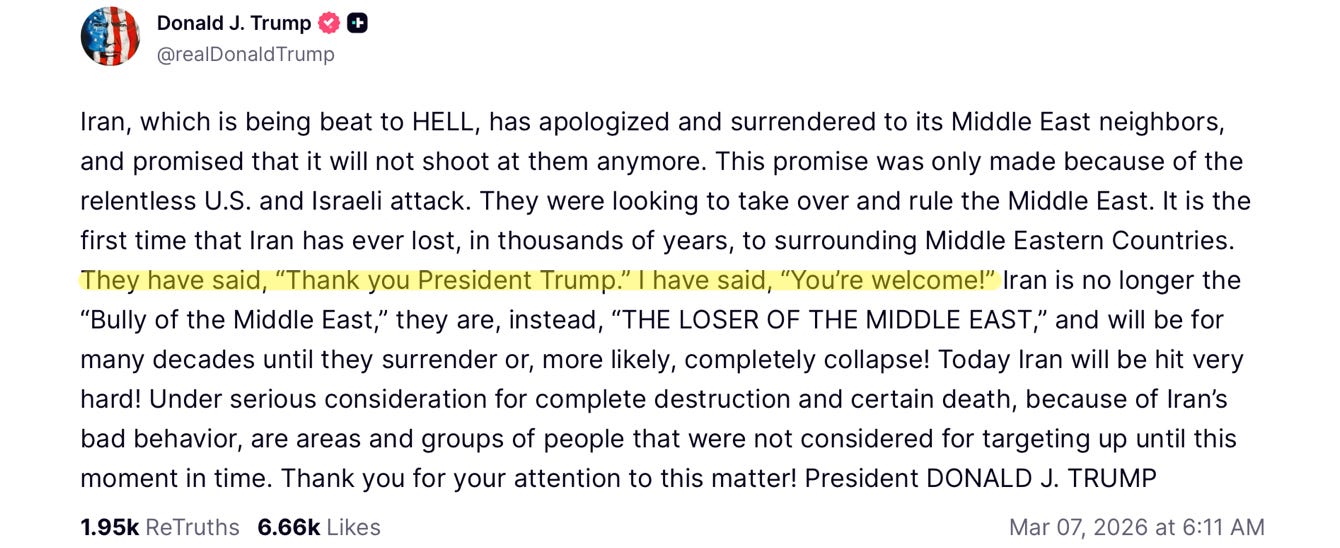
🚀 President Trump immediately seized on President Pezeshkian’s apology and used it to ratchet the pressure on Iran even higher:
Overnight, Iranian drones also struck Dubai International Airport —again— briefly shutting down the world’s busiest international hub. The Emirates suspended all flights. A fire broke out at the Jebel Ali Port in UAE.
Meanwhile, Great Britain has sprung into action with all the alacrity of a specially abled quadriplegic lion, dispatching one of its best warships to Cyprus to provide a missile shield for its military base located there. Unfortunately, the HMS Dragon is partially disabled and requires minor repairs. Even more unfortunately, the minor repairs will take at least two weeks. Minor repairs will take two weeks because of union contracts. The UK Telegraph, yesterday:

But don’t worry, democratic socialism works. It just works nine to five. And not on weekends. Britain, whose navy once ruled the global seas, has been reduced to six destroyers. Three of those are currently considered “non-operational.” They count the Dragon as one of the three operational ones. I’d hate to see what the other two “operational” destroyers look like.
No wonder Trump complains that our NATO allies are letting the US do all the work. Britain, one of NATO’s biggest European spenders, can’t even field a single destroyer in an emergency. But I digress.
Finally yesterday, a cheap IRGC drone boat damaged an undefended Malta-flagged oil tanker near the Strait of Hormuz, explaining why Brent crude spiked to $91.89 last night, its highest since 2024. Analysts warn of $100/barrel prices by next week if the Strait remains blocked. President Trump told CNN’s Dana Bash not to worry, that “it’ll recover quickly.”
🚀 The media narrative’s through-line continued to be chaos, and their favorite “proof” was their claim that President Trump has “no reason” for attacking Iran. For example, yesterday’s Guardian UK:

This is the most sidesplittingly funny narrative they’ve ever cooked up to complain about Trump. It’s aimed at the lowest of low-information readers, who weren’t paying any attention during the entire month leading up to the attacks, when Trump set a deadline for the stubborn mullahs to say six words (“no more nukes or nuclear enrichment”).
You don’t even have to connect any dots. They are right next to each other. The strikes started two hours after the deadline expired. Everything was done in public.
Now, like demanding children asking if we’re there yet, the muddled media keeps asking, “but what’s the real reason for the attacks?” President Trump literally told Iran this was coming if they didn’t make a deal, about six thousand times. The mullahs didn’t make a deal. What did reporters think was going to happen?
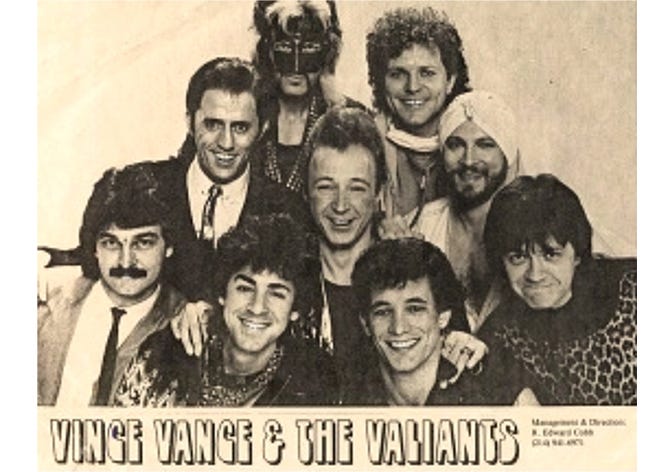
Even if current events are hard to keep up with, there’s a line of dots stretching back as far as the eye can see. As a candidate in 2015, President Trump promised to “bomb Iran,” two words that harkened all the way back to 1980, when Vince Vance and the Valiants were roaring into Billboard’s top requested song, with their hit Beach Boys parody, “Bomb Iran.” (Set to the tune of ‘Barbara Ann’:)
🎵Went to a mosque, gonna throw some rocks
Tell the Ayatollah, “Gonna put you in a box!” Bomb Iran
Bomb, bomb, bomb, bomb, bomb Iran
Bomb Iran
Our country’s got a feelin’
Really hit the ceilin’, bomb Iran
Bomb, bomb, bomb, bomb Iran 🎵
(Note: In fairness, Vince Vance reportedly intended it to be an anti-war song, but nobody realized that. Funny how that works sometimes.)
The case for bombing Iran is so old it has its own pop music catalog. It predates the iPhone, the internet, and most of the reporters wondering “why?” The unpopped blister that is Iran has been swelling since before 1980. Trump was the only president politically courageous enough to actually do what Vince Vance sang about 46 years ago.
We can fairly argue about whether bombing Iran is good, or proportional, or mean, or risky, or expensive, or neoconish, or whether it unfairly gives Democrats Tourette’s syndrome. But you can’t act surprised, not fairly. Tucker can’t fairly claim that Trump only did it because Israel told him to, since the problem predates both Trump and Israel’s Prime Minister Ben Netanyahu. You can’t fairly call it unprovoked, since Trump telegraphed it for a month.
Still, suddenly, the media and its captive experts are allegedly baffled that anyone would want to bomb Iran. Please. What a stupid narrative. Get out of here.
🌍🇺🇸 ESSENTIAL NEWS AND COMMENTARY 🇺🇸🌍
🔥🔥🔥
James Woods woke up yesterday and chose violence. He’s had it with sandbagging RINOs and is p.o.’d about the SAVE Act apparently being stalled in the Senate. Yesterday, the conservative actor published an announcement in America’s official paper of record —I refer here to ‘X’, of course— that he’s done. He’s not doing this anymore. He’s going independent.
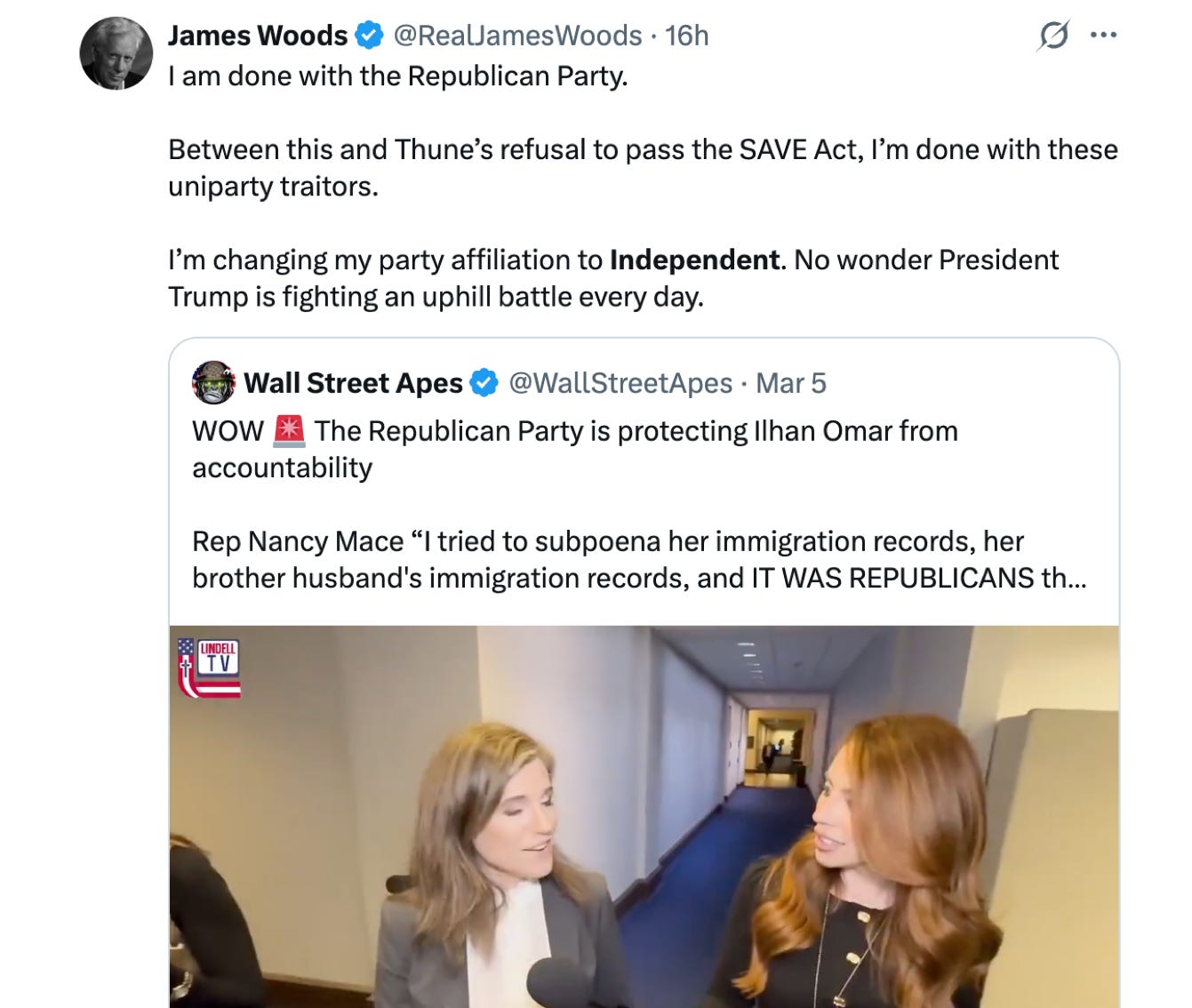
Before anyone panics, recall that Elon Musk rage-quit the GOP last year and even declared he was starting a third party, I can’t remember the name, America something. He’s since settled back down and even opened his Scrooge McDuck war chest for the midterms. So. We all have these moments, especially after long scrolling sessions. (Even we non-billionaires. Even those of us without Somali-daycare money.)
Among the various certificates, credentials, and party favors hoovered up along my legal career, I am a certified mediator. I am also a Floridian, which means I suffered through a ~90% RINO state legislature for decades prior to the DeSantis revolution. I shall now attempt to mediate the understandable MAGA fury over RINO recalcitrance in Congress. James, your attendance is respectfully requested.
I normally charge for mediations, but this one’s on the house. (Mostly because both sides would refuse to pay anyway. So.)
🔥 On Thursday, bosomy Representative Nancy Mace (R-SC) complained on X about her heroic efforts to pin down Representative Ilhan Omar’s (D-MN) highly questionable immigration status. Mace blamed “REPUBLICANS” (all caps hers) for obstructing her investigation. She didn’t say which Republicans.
But her post triggered lifelong contrarian James Woods, who had already had it up to here with Senate Republicans for apparently slow-walking the SAVE Act— which, in a minor miracle, was already passed by the House of Representatives.
To remind casual readers, the SAVE Act is a bill that would require people who vote in American federal elections to be, well, Americans. To say the Republican base wants that law passed as badly as teenagers want unlimited Call of Duty access, schnauzers want table scraps, and goldfish want cute little plastic castles to swim through. (Well, I’m not totally sure about that last one. But you get the idea.)
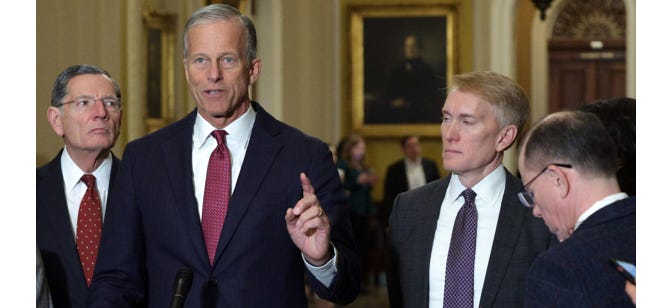
Senate Majority Leader John Thune (R-SD) never said he won’t pass the SAVE Act. In fact, he’s repeatedly promised it will get a vote. The trouble is, he won’t promise that he’ll tweak the Senate’s filibuster rule to give the Act a fair fighting chance. This bashful diffidence is aggravating everybody, especially people who draw a sinister conclusion from his commitment phobia.
🔥 One encouraging fact that could lower the temperature, but which everybody seems to have amnesia about, is that RINOs (Republicans in Name Only) in Congress are nothing new. In fact, if you subject the situation to pitiless analysis, there are many fewer RINOs in Congress than there were four years ago. Back then, reliable conservatives in the House were relegated to a feisty group of malcontents who self-identified as the House Freedom Caucus, constantly sparring with the RINO speaker.
Today, four years on, the House is pretty much sewn up for conservatives. That is a lot of progress.
But the Senate changes slower than the House, simply because Senate terms run for six years, compared to the speedy 2-year terms in the House of Representatives. Still, there has been some progress in the Senate. As we’ve discussed just this week, President Trump appears to have already replaced around 7% of the entire Senate —about 15% of the GOP side— with younger, more conservative Senators.
So, while I get it that people are unhappy about the pace of de-RINOization, it’s simply wrong to complain about RINOs in general. The problem is being addressed, and more successfully than any other Republican administration has ever done.
Congress isn’t like a tech company where you can hire a new CEO and instantly fire 40% of the workforce. Politics takes longer.
Patience, grasshopper.
🔥 Next, while there is no doubt that Majority Leader Thune is frustratingly unwilling to promise a filibuster fix that would allow the SAVE Act to pass, there are two points to consider. First, nothing’s happened yet. Thune could still do the right thing. He hasn’t “betrayed” anyone at this point.
Second, there could be good reasons for slow-walking the SAVE Act. We simply don’t know. Somebody asked me yesterday what I thought was the most remarkable feature of Trump 2.0. It’s a tough choice. After giving it some thought, I answered that the most remarkable feature of Trump 2.0 was its operational security. No leaks. No telegraphing. No political trial balloons.

To me, the best part is that our adversaries keep getting taken by surprise. The annoying thing is, we don’t know the plan until it kicks off either. This causes friction. For instance, everybody lost their minds when Trump dragged his feet over the Epstein files release and called it a “Democrat hoax.” Now it seems obvious that he delayed the document dump until the moment of maximum political impact.
In hindsight, Trump is, in fact, playing 4-D chess. Astonishingly, the United States faces zero organized resistance to the Iran operation. No countries are demanding UN Security Council votes. The General Assembly isn’t passing resolutions condemning American aggression in Tehran. Iran has no allies providing it with any material support. Its most important ally —Russia— evacuated its teams just before the strikes began. Iran’s Muslim neighbors are helping with the operation.
Even the Europeans are staying out of the way, and some EU countries are helping. (The UK is fixing its boat as fast as it can. Baby steps.)
Nothing like that kind of universal support/non-opposition has ever happened before. How did Trump do it? By demolishing USAID, draining the Swamp, and spending a year building a tariff dashboard, he surgically transformed global anti-Americanism into something that looks more like sullen cooperation, if not outright pro-Americanism.
He did it in one year. And only then —after creating a favorable global economic environment— did President Trump begin the kinetic phase, a whirlwind of military activity and consolidation.
Just in the last few weeks, Venezuela and the US have normalized diplomatic relations. Mexico agreed to work with the US military to quash narcoterrorists. Ecuador has invited US special forces to help evict cartels. The Panama canal is back under US control. Cuba —a thorn in the US paw since the Cold War— is on the brink of falling into line. CNN, yesterday:

In the first 90 days of 2026, the President is speed-running a geopolitical transformation that historians will analyze for generations. Beep, beep!
Again, in hindsight, Trump’s timing and sequencing were brilliant. But nobody —including MAGA— knew the plan ahead of time. It’s kind of like being a passenger in the backseat of the getaway car in a high-speed car chase scene, where we don’t know where we’re going, exactly who’s after us, or when or how the race ends. President Trump would tell us where we’re going if he could, but that would give the secret away to our adversaries.
The point is that, after a year of evidence, President Trump has earned a little latitude. We already know there’s a plan. We should assume the plan is working until it’s clear that it isn’t.
Now, let’s shift back to James Woods and the SAVE Act.
🔥 There’s a fascinating Senate race playing out in Texas. For the first time in decades, antique RINO incumbent Senator John Cornyn, 74, is facing stiff opposition in his primary. He’s opposed by MAGA darling and Texas Attorney General Ken Paxton, 63. Last week, the two essentially tied and are now headed for a runoff. Some reports say Cornyn has spent $116 per voter, versus only $5.67 per voter by Paxton.
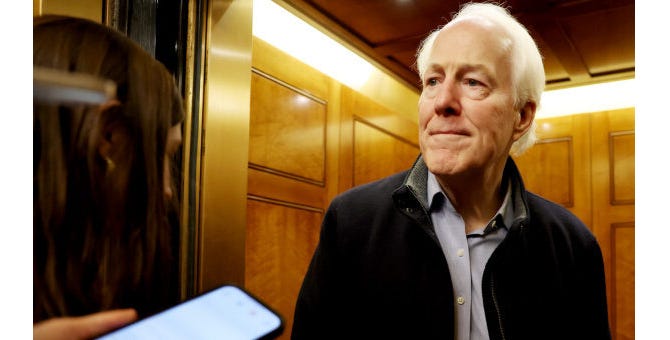
It’s a lot more lopsided than the tie looks. Paxton got a 20:1 return on his investment, and Cornyn got a participation trophy. So that was already unusual. But then things got even curiouser, as Alice would say.
Late this week, several peculiar events occurred in quick succession. First, Trump encouraged the two candidates to “stop” their destructive intra-party fight, said he’d soon endorse one of them, and said he hoped the loser would drop out for the good of the party. Cornyn’s team reportedly prepared a press release announcing Trump’s endorsement. But it immediately became a historical artifact when Paxton responded, saying he’d ‘consider’ voluntarily dropping out if the Senate passes the SAVE Act.
Then yesterday, as if in a synchronized swimming maneuver, Breitbart published this headline:

Breitbart’s report was sourced from CNN’s Dana Bash, who’d interviewed President Trump and tweeted this:
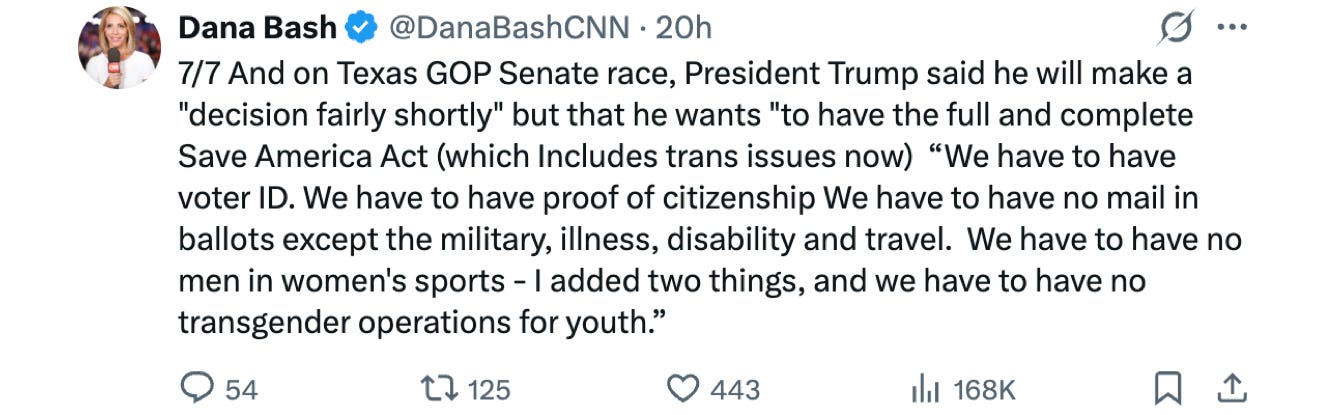
Checkmate! The Senate’s RINO wing must now choose: either pass the SAVE Act, or lose another member to Trump’s Senate succession plan. Paxton and Cornyn are so closely matched that Trump’s endorsement would push Paxton over the top, and that would be that. Frankly, it’s a win for Trump either way. Eventually, he’ll have enough loyal Senators to pass the SAVE Act anyway.
You can see that, far from Republicans “doing nothing” to pass the SAVE Act, it appears to be a coordinated part of Trump’s succession plan to mitigate the Senate RINOs and get the SAVE Act passed.
So, James, it might just be a tad too soon to start changing party registrations. You rage-quit right before the next shoe dropped. Hang in there. Be patient. Count our wins. And above all, let the man work.
Have a wonderful weekend! Be sure to get back here on Monday morning, when we’ll kick off another astonishing week of essential news and commentary.
Don’t race off! We cannot do it alone. Consider joining up with C&C to help move the nation’s needle and change minds. I could sure use your help getting the truth out and spreading optimism and hope, if you can: ☕ Learn How to Get Involved 🦠
How to Donate to Coffee & Covid
Twitter: jchilders98.
Truth Social: jchilders98.
MeWe: mewe.com/i/coffee_and_covid.
Telegram: t.me/coffeecovidnews
C&C Swag! www.shopcoffeeandcovid.com
The very notion that we have to fight it out - with our own government mind you - to ensure that only American citizens can vote in America should give even the dimmest fence-sitting blob a moment of pause....maybe even reflection. Gasp! Anyone who thinks this is a controversial and/or haphazard ideology should unconditionally police their belongings, i.e goats, hijabs, ill-gotten gains and anti-American sentiments and book the next flight out of here. Thanks for the memories.
By Jamie Dale-Jensen
Hallelujah…
Many people say this word without thinking about it. It has become a general religious expression. A worship word. Sometimes even just a way of saying “thank God.” But the Bible is much more precise.
“Hallelujah” is Hebrew. הַלְלוּ־יָהּ. Hallelu-Yah. The word has two parts. The verb הללו (halĕlū) is from the Hebrew root הלל (halal). It means to praise, boast, celebrate, or make known. But the form here is important. It is an imperative plural.
It is not “I praise.” It is not “praise if you feel like it.” It is a command. “Praise!” And because it is plural, it means, “You all praise.” “Everyone praise.” “Let all praise.”
The second part is יה (Yah), which is a shortened form of the divine name YHWH. So the phrase literally means, “Praise Yah.” Or more fully, “Everyone praise Yahweh.”
This is not a vague spiritual statement. It is not generic praise. It is not praise directed toward whatever someone personally believes about God. It is very specific. It is a command to praise the God of Israel.
Interestingly, the Bible does not scatter this word randomly. It appears mostly in one place. The Book of Psalms. Especially at the end.
Psalm 146 “Hallelujah.”
Psalm 147 “Hallelujah.”
Psalm 148 “Hallelujah.”
Psalm 149 “Hallelujah.”
Psalm 150 “Hallelujah.”
Each of these psalms both begins and ends with it, like a frame around the song. The book of Israel’s worship closes with a cascade of praise commands.
But the word appears one more time in Scripture. At the end of the story. In Revelation 19. And this is fascinating…
The New Testament is written in Greek. Most Hebrew words are translated. But this one is not. The Greek text simply carries the Hebrew sound forward.
“Hallelujah.”
And in Revelation it is not spoken by a psalmist. It is spoken by heaven.
“After this I heard what sounded like the roar of a great multitude in heaven shouting:
Hallelujah! Salvation and glory and power belong to our God.” — Revelation 19:1
The praise that began on earth in the Psalms ends in heaven in Revelation. The same word. The same command. Praise Yah.
So when we say “hallelujah,” we are repeating one of the oldest praise cries in Scripture. A Hebrew command that has passed unchanged through thousands of years of worship.
Not just a feeling. Not just an expression. A call. Praise Yah.
Hallelujah.