

Good morning, C&C, it’s Thursday! A tsunami of under-reported news broke loose yesterday. The hot takes and fake narratives are spinning wildly. So this morning brings a special Iran War update edition. Your roundup includes: Iran’s civilian government is flickering out as the president tries to quit and the IRGC runs a war nobody can stop; seven insurance emails closed the Strait of Hormuz and Trump turned it into the most devastating NATO leverage play in alliance history; and Congress voted for the third time NOT to stop the war, which is starting to look a lot like authorization.
🚀⛑️ C&C ARMY POST — IRAN WAR UPDATE ⛑️
Last week, I explained Iran’s split-screen government— a public-facing civilian façade with a president and parliament on one side, and the Ayatollah plus his secretive military-slash-corporation IRGC on the other. This week, the civilian screen cracked and is flickering out. The Wall Street Journal reported, “Escalating Attacks on Gulf Energy Assets Plunge Iran War Into New Phase.”
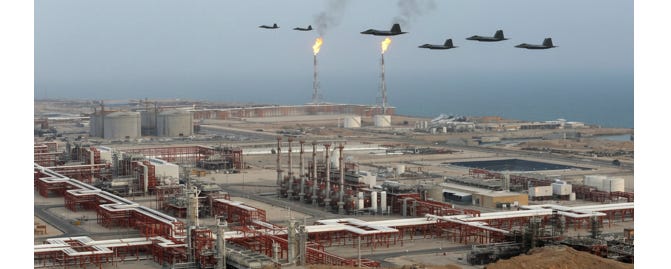
Remember yesterday’s Al Jazeera intelligence analyst, who called Iran’s Hormuz blockade “a wasting asset” that would “accelerate Iran’s isolation?” He published that Monday. Yesterday, Israel bombed what the Journal called Iran’s “crown jewel,” the South Pars Gas Field.
In retaliation, Iran bombed Qatar’s Ras Laffan Industrial City— the largest LNG production facility on Earth, responsible for 20% of the world’s liquefied natural gas. Qatar expelled all Iranian military and security diplomats in 24 hours— faster than a bouncer tossing drunks at closing time. Qatar takes longer to approve visa applications. It called the strike “a dangerous escalation, a flagrant violation of sovereignty, and a direct threat to national security.” Get bent.
Qatar is not just any old Iranian neighbor. Qatar was —until yesterday— Iran’s best remaining ally. It is the country that brokered every hostage deal, hosted every back-channel conversation, and shielded Iran from otherwise unanimous Gulf opposition at the United Nations.
Iran just drunk-dialed its last remaining girlfriend.
But the Qatar strike wasn’t the biggest story. The biggest story is what’s happening to Iran’s split-screen government.
🚀 On Tuesday, Israel killed Ali Larijani, the man who, by most accounts, was actually running the country. He was the last remaining civilian official with deep institutional knowledge of the government; he was the cable connecting the civilian screen to the military-IRGC screen.
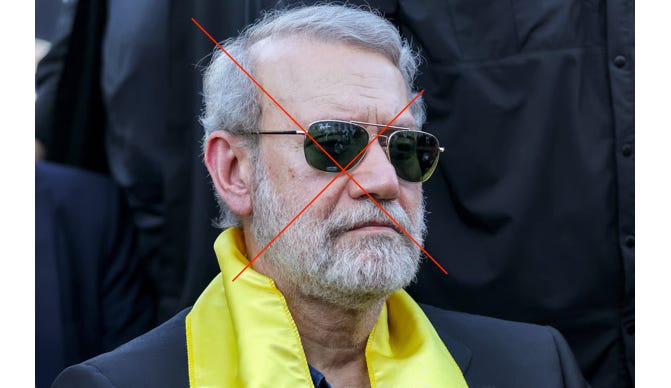
To give you an idea how many hats Larijani wore, he was the secretary of the Supreme National Security Council, the former Speaker of Parliament, a former IRGC commander, and Iran’s chief nuclear negotiator. CNN called him “a true insider” whose death “closed diplomatic off-ramps.”
With Larijani gone, nobody seems to know who’s in charge on the civilian side. Bloomberg asked the obvious question that nobody in Tehran can answer: “Who else can the US talk to?”
In a split-screen government like Iran’s, somebody has to operate both screens at once— translating between the IRGC’s military imperatives and the civilian government’s diplomatic needs. Larijani was the only man in Iran who could do that. He was the signal cable connecting the two halves. Israel cut the cable.
The cracked civilian screen immediately started flickering. Israeli Channel 14 reported —and multiple international outlets corroborated— that Iran’s civilian president, Masoud Pezeshkian, told aides he is trying to quit.
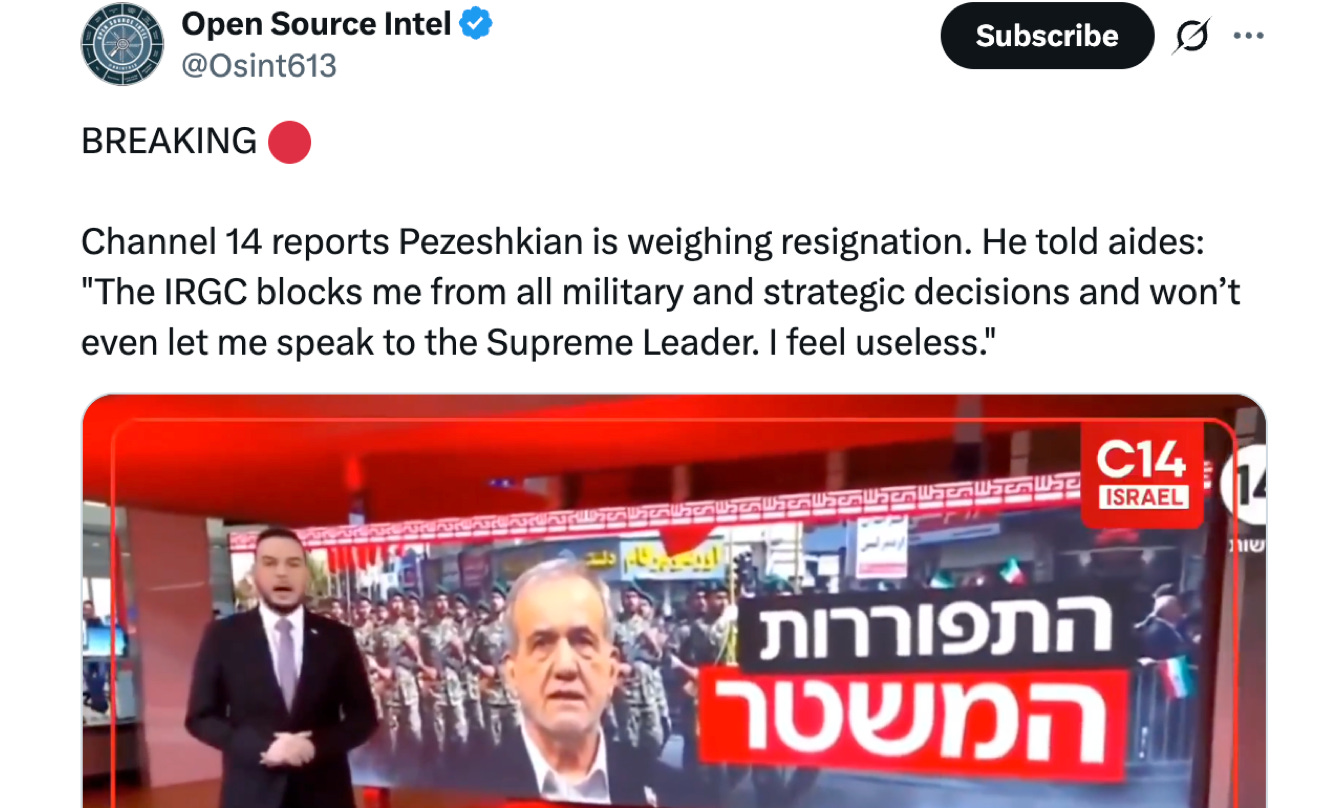
Multiple sources quoted President Pezeshkian saying, “The IRGC blocks me from all military and strategic decisions and won’t even let me speak to the Supreme Leader. I feel useless.” India’s The Week reported that Pezeshkian tried to submit his resignation to Supreme Leader Mojtaba Khamenei on Monday, but the IRGC refused to set a meeting.
Think of it. Even the president of Iran cannot get a meeting with Schrödinger’s Ayatollah. This isn’t very helpful for Khamenei Jr.’s proof-of-life. At best, he’s so paranoid he won’t even answer the phone. At worst, there’s nobody holding it.
It gets worse. Pezeshkian reportedly accused the IRGC of intentionally failing to protect Larijani from the Israelis because Larijani was the primary political rival of IRGC commander Ahmad Vahidi. After Larijani’s death, Pezeshkian reportedly warned aides that “the entire system is collapsing.“
Why would Pezeshkian’s people leak this astonishing admission? Simple. He doesn’t want to die. I’m just a powerless figurehead! It’s not my fault, I tried to quit! Please don’t kill me!
🚀 At this point, you could say that the IRGC has conducted a coup by allowing its civilian political enemies —the only checks on its power, however weak— to be destroyed. JFeed’s analysis simply headlined, “Civil War In Iran.”
The coup has been underway since the start of the war. Earlier this month, after Iran’s first self-destructive strikes on its neighbors, Pezeshkian publicly apologized to the Gulf states for the Iranian strikes and ordered them stopped. The IRGC publicly overruled him, and the strikes continued. Pezeshkian backed down. Gulf News asked the obvious question: “Who commands the Guards?”
The answer is: somebody the president can’t reach.
Yesterday, one of Iran’s remaining living ministers insisted that “the killing of Larijani will not destabilise the Iranian political system.” There are no American tanks in Baghdad. When a government is forced to announce that it is not destabilized, that is a good sign it is destabilized.
That civilian screen —the president, the parliament, the diplomatic corps— was always the weaker half of Iran’s split-screen government. But it served a critical function: it was the half that could talk. The shadowy IRGC can fight, but since it has no real diplomatic existence, it cannot negotiate.
Every war eventually ends at a table, but the IRGC just froze out everyone who knows where the table is and locked the conference room doors.
The Al Jazeera analyst described a three-phase campaign: suppress Iran’s defenses, degrade Iran’s industrial capacity, and ensure nothing can be rebuilt anytime soon. But a fourth phase is unfolding: cannibalism. The regime is degrading itself. It’s like when the starving occupants of a besieged castle stop fighting the army outside and start eating each other.
The replacement supreme leader is invisible and inaccessible. The regime’s consigliere is dead. The president is powerless and can’t even quit, held hostage by his own title. The IRGC is running a war it cannot end, against enemies it cannot beat, while bombing the allies it cannot afford to lose. The civilian half of Iran’s split-screen government just winked out. And the military half that’s left is the half that doesn’t know how to stop.
88 million ordinary Iranians who didn’t choose this war and didn’t choose this government are watching their country’s leadership eat itself while the bombs fall. Meanwhile, Crown Prince Reza Pahlavi stands just outside, a temporary leader in waiting, waiting to deploy a new transition government.
And here’s a hot take: America controls the Strait of Hormuz.
🚀🚀🚀
For the better part of a week, corporate media has run one article after another about Iran’s “brilliant strategy” of closing the Strait of Hormuz, which in the media’s frame punishes America politically by increasing prices at the pump. But what if that strategy isn’t so brilliant? On Tuesday, the Hill ran a sharp story headlined, “Graham tears into European allies over Strait of Hormuz reluctance.” Put simply: NATO cannot afford to lose neocons like Senator Lindsey Graham (R-SC).
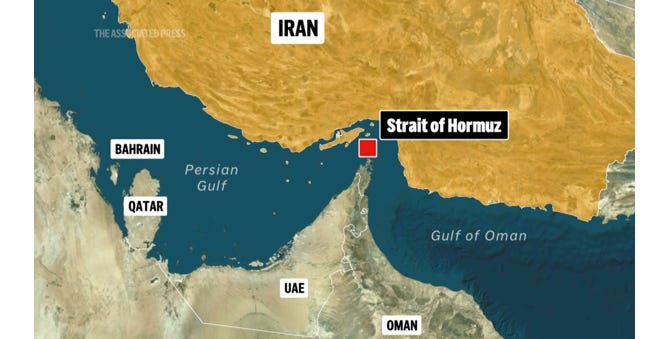
The question bears repeating: who actually closed the Strait of Hormuz on March 4th? Not Iran. Some unnamed IRGC general just sent a few emails threatening ships. CENTCOM immediately disputed the claim. But then the strait closed anyway, and not because the Iranian navy had blockaded it. The strait closed because seven insurance companies sent notices.
Between March 1st and March 2nd, seven of the twelve clubs belonging to the International Group of Protection and Indemnity Clubs —the entities that insure roughly 90% of the world’s ocean-going tonnage— issued 72-hour cancellation notices for war risk coverage in the Persian Gulf. Without coverage, ships can’t sail, ports won’t let them dock, banks won’t finance the cargo, and charterers won’t book the vessel. Transit volumes collapsed by 80% almost overnight. The Maritime Executive reported that tanker traffic through Hormuz dropped to zero— not because of mines or missiles, but because of paperwork.
As maritime journalist Captain John Konrad put it, the strait was closed by “the invisible siege” of the insurance market— a regulatory mechanism, not a military one. The European insurance framework forces insurers to exit rather than reprice when conflict risk becomes unmodelable. Cancellation takes 72 hours, but rebuilding coverage takes months. That’s all old news.
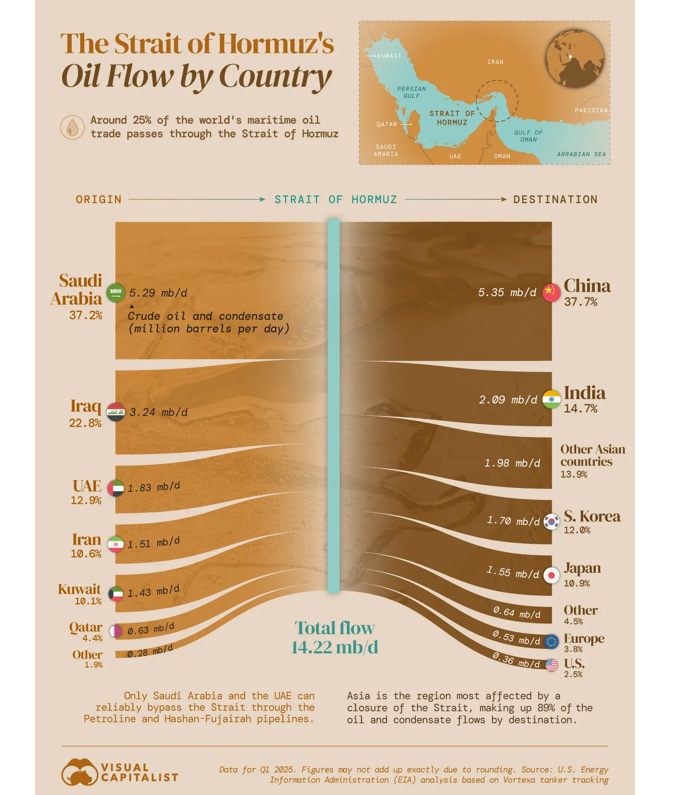
But here’s the thing. The United States doesn’t need the Strait of Hormuz. Thanks to President Trump’s “drill, baby, drill” policies, we are now a net energy exporter. We produce 24.2 million barrels of oil per day, more than Saudi Arabia and Russia combined. Nearly zero American crude transits Hormuz. Seventy percent of the oil that does pass through the strait goes to Asia —China, India, Japan, and South Korea— and most of the rest goes to Europe.
Follow me here. The insurance companies that closed the Strait are European. The regulatory framework that forced their hand is European.
In other words, Europe’s own regulatory architecture turned off Europe’s own energy supply. And America, standing comfortably on the other side of the Atlantic with a full tank of gas, watched it happen.
Watch this: the price gap tells the rest of the story. The difference between what Europe pays for oil and what America pays is called “the Brent-WTI spread.” Since the war started, the spread has widened to roughly $10 per barrel. Brent crude (Europe’s benchmark) hit $108. But WTI (America’s benchmark) sits near $98.
Natural gas is doing much worse. European natural gas prices have surged +75% since the conflict began, nearly doubling in two weeks— from €30 to over €60 per megawatt-hour. But the EIA says American natural gas prices remain “relatively unaffected.” At the pump: Americans are paying around $3.50 a gallon (it would be even less without averaging in California). Meanwhile, Germans are paying the equivalent of $7.85 a gallon.
Useless corporate media, which won’t explain any of this, calls it a crisis. It’s not a crisis. It’s a negotiating position.
🔥 Enter President Trump, stage right, asking ever so politely if America’s dear allies might consider sending a warship or two, not to fight, but just to help reopen the strait that their own economies depend on. Britain, France, Germany, Japan, South Korea, Australia, and even China were invited. The answer was a symphony of soft no’s.
On Monday, CNBC reported, “‘We will remember’: Trump warns countries to help secure Strait of Hormuz as shipping stalls.” Germany’s Defense Minister Boris Pistorius delivered the most consequential words in NATO’s 77-year history when he shot back, “This is not our war.“ British PM Starmer, looking like badly-stuffed taxidermy, “made clear” that he wouldn’t be drawn into “the wider war.” Japan said it had “no plans” to send ships.
Defense News ran the alliterative headline of the week: “European allies tell Trump ‘nein,’ ‘non’ and ‘no.’”
Corporate media celebrated. See? Europe was finally standing up to Trump’s illegal war! The allies were showing non-orange independence! What courage! What resolve! Ahura!
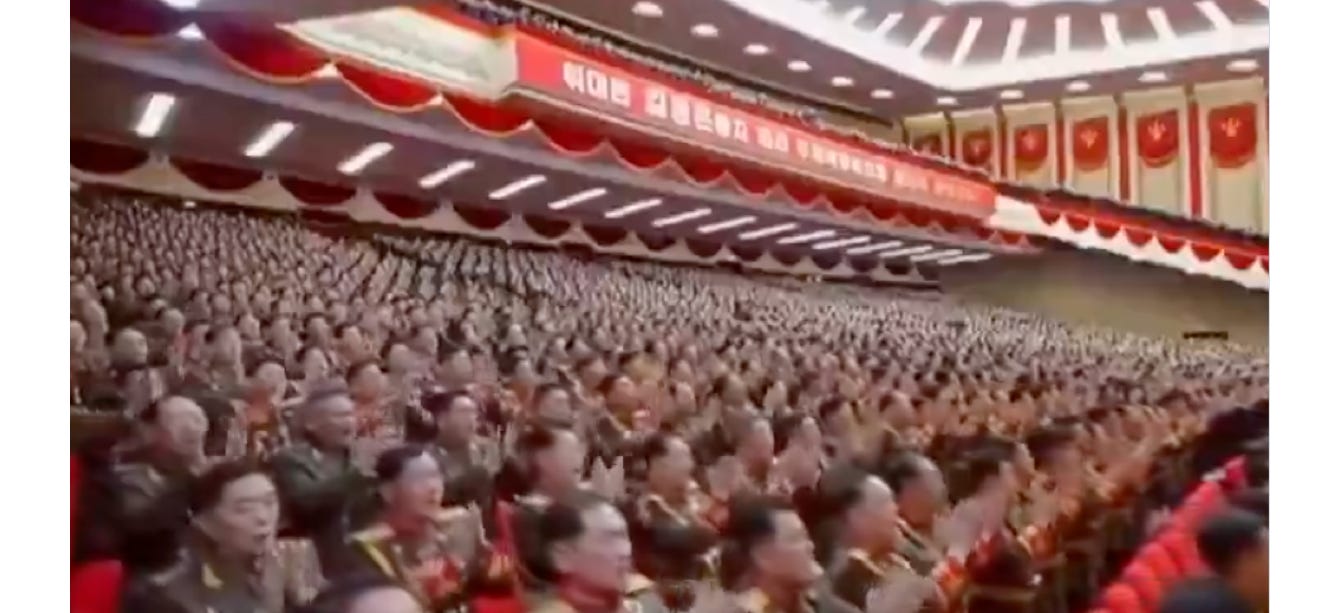
What incredible, historic, world-beating stupidity.
Trump wasn’t asking because we needed help. He was asking because he needed them to say no, non, and nein. And they lumbered right into it. Every refusal was a receipt.
No American president has ever held the hand Trump holds now: a documented, public, undeniable refusal by every major NATO ally to assist the United States during an active military operation. And Trump took out his torch and welded it directly to the one thing Europe needs most. He invoked Ukraine repeatedly and deliberately, linking NATO’s refusal on Hormuz to Europe’s continued expectation of American protection against Russia.
On March 17th, further titillating brain-dead corporate media reporters, who still hadn’t caught on, the President posted on Truth Social (in all caps): “WE DO NOT NEED THE HELP OF ANYONE.” Then, in the Oval Office, he said what he’s been waiting years to say with proof: “I always considered NATO, where we spend Hundreds of Billions of Dollars per year protecting these same Countries, to be a one-way street. We will protect them, but they will do nothing for us, in particular, in a time of need.”
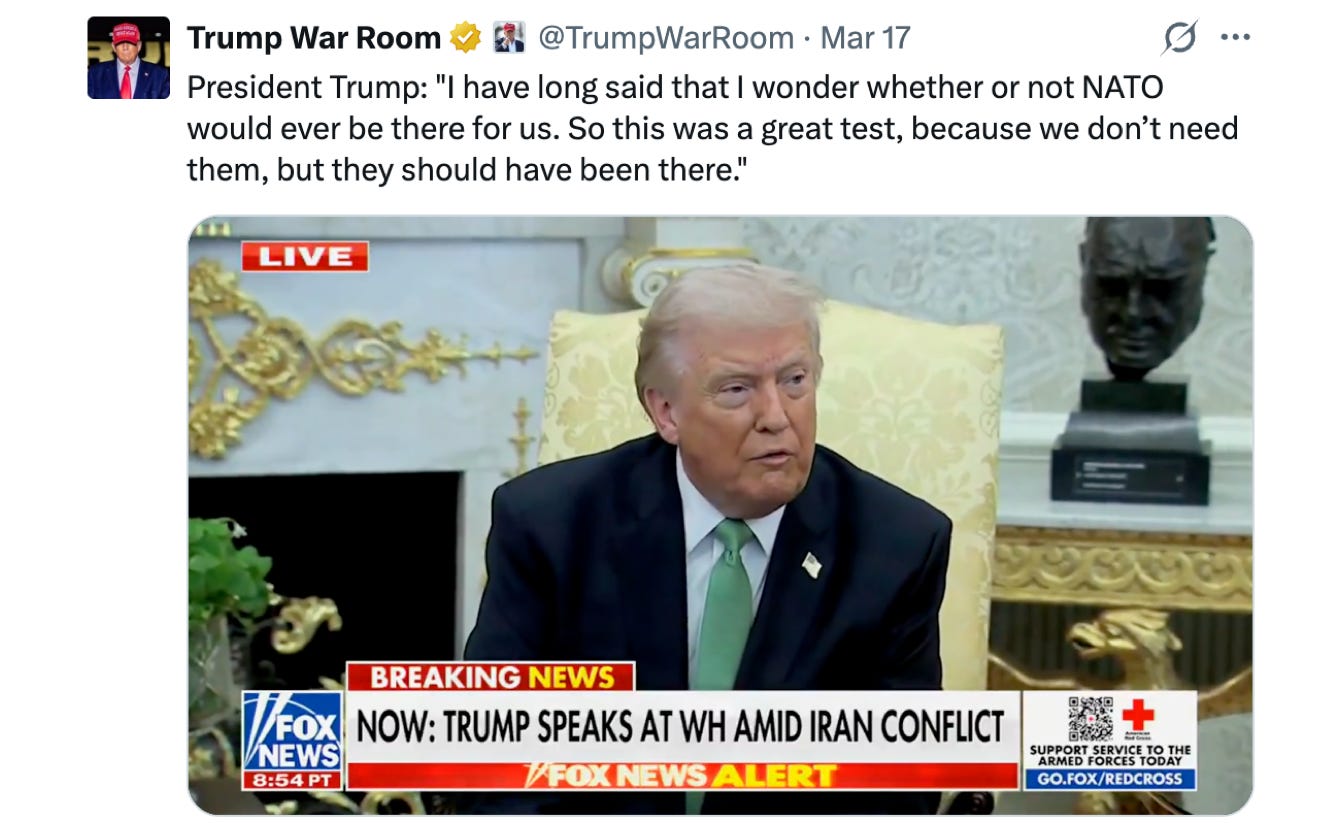
“Biden chose to spend hundreds of billions in Ukraine,” Trump said, “I wondered whether NATO would ever be there for us. This was a great test.” That phrase —in a time of need— was doing enormous legal and political work. It wasn’t a wonky complaint about abstract budget percentages. It’s a specific, documented, contemporaneous accusation on the record: we needed a little help from our allies, we asked, and they said no. During a war. A war that affects their own interests.
Germany’s snooty Minister of Defense uttered the line that instantly re-defined the next decade of Atlantic relations: “This is not Europe’s war.” Alrighty then. Boris Pistorius said it like it was the declaration of independence or something, failing to grasp that sentence works in both directions.
If Iran is not Europe’s war, then Ukraine is not America’s war. Duh. (And— buh-bye, Zelensky.)
The allies who refused to send minesweepers and escorts just handed the President the leverage to restructure the entire Western alliance on his terms— and they did it voluntarily, on camera, in front of the entire world.
Yesterday, President Trump —of course— immediately escalated on Truth Social: “I wonder what would happen if we ‘finished off’ what’s left of the Iranian Terror State, and let the Countries that use it, we don’t, be responsible for the so called ‘Straight?’ That would get some of our non-responsive ‘Allies’ in gear, and fast!!”

Things are happening so fast these days that we miss many historic moments as they whizz past. The President of the United States just publicly floated walking away from the Strait of Hormuz and letting Europe and Asia fend for themselves. When a reporter asked whether he was rethinking NATO, Trump didn’t hesitate: “I don’t need Congress for that decision.” (In 2023, Congress slid in a sneaky NDAA provision requiring a two-thirds Senate vote to withdraw from the alliance, but Trump’s team clearly thinks those velvet handcuffs are unconstitutional. In other words: yes, I’ve been rethinking it.)
But John Konrad’s “Hormuz Hypothesis” goes even deeper than mere NATO leverage. He noted that Trump’s 2026 National Defense Strategy, published in January, explicitly identifies American energy dominance as a pillar of national security— not an economic policy, as a defense doctrine. The White House published the bumper sticker version in February: “American Energy Dominance Is Back.“
Get this remarkable chain of events that our media has failed to connect: Through direct or indirect influence over production in Canada, Guyana, and post-Maduro Venezuela, the Washington Times reported that Washington now controls roughly a fifth of global output. One-fifth of all global oil is now controlled by the USA.

Don’t miss this. The “crisis in the Strait” is transforming the global energy market, and every road leads back to the USA. Every European LNG contract signed during the crisis is a contract that won’t go back to Qatar when the strait reopens. Every Asian refinery that switches to American crude is a customer that won’t return to the Gulf.
This war will eventually end, but the new energy relationships it is creating are permanent. Trump isn’t just squeezing allies into burden-sharing. He’s rewiring the global energy map with American producers at the center — and his 2026 National Defense Strategy said that was the plan, in writing.
🔥 You’re probably wondering how a humble coffee blogger can connect these dots, but the entire EU hierarchy in Brussels missed it. In fairness, they only missed it for 72 hours. Then Trump started tweeting. Now, they get it. With bells on. And they’re running back to daddy.
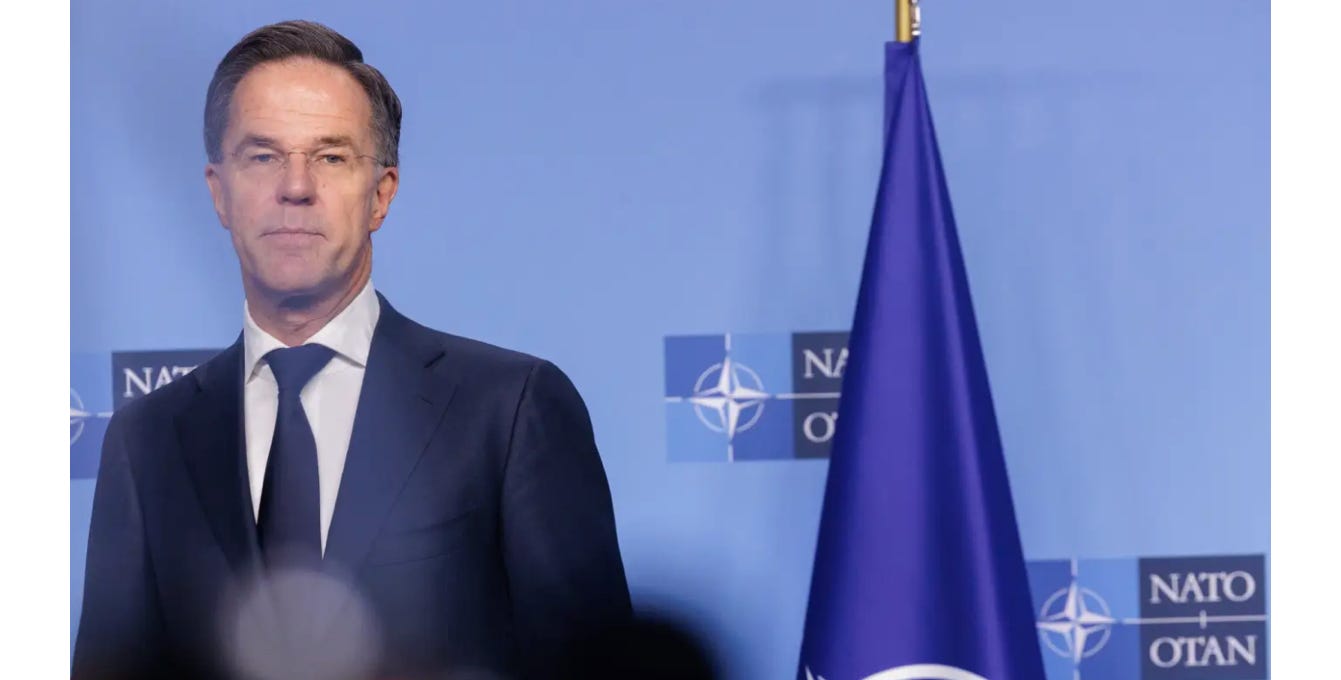
Within forty-eight hours of “nein, non, and no,” NATO Secretary General Mark Rutte announced yesterday that the allies were suddenly “working together, discussing the best way” to reopen the strait. The best way! AFP, yesterday:

Hahahahaha! Two days ago, it was “this is not our war.” Yesterday, it suddenly became “the allies are working together on the best way to help.” By tomorrow, it’ll be “we were always planning to help.” And corporate media— what clowns. Not one of our top papers —with all their “experts” and subject-matter “analysts”— ever saw this leverage option. Clowns. Only President Trump did.
It took Cuba ninety days to fold under the oil embargo. It only took NATO forty-eight hours to start walking back its independence and resistance. Apparently, $7.85-a-gallon gasoline and Trump’s threat to walk away focused the European mind rather sharply. Now they desperately need Trump to help them help us.
It reminds me of Samuel Johnson’s famous line: “Depend upon it, sir, when a man knows he is to be hanged in a fortnight, it concentrates his mind wonderfully.”
🚀 Here’s the thing that Europe’s dull-witted leaders failed to fully think through: Trump has longed to restructure NATO for decades. It’s probably on his nightly prayer list. The political obstacle was always that Americans broadly support the alliance in the abstract— after all, the slogan “we need our allies” polls well. But that polling always assumed allies who actually, well, ally.
“Nein, non, and no” during a shooting war —with their oil, their strait, and their economy on the line— changes the math entirely. Trump just proved what he’s always insisted: NATO is a one-way street. It doesn’t benefit the USA; it just costs us. He proved it so decisively that NATO-loving Lindsey Graham “tore into” the allies:
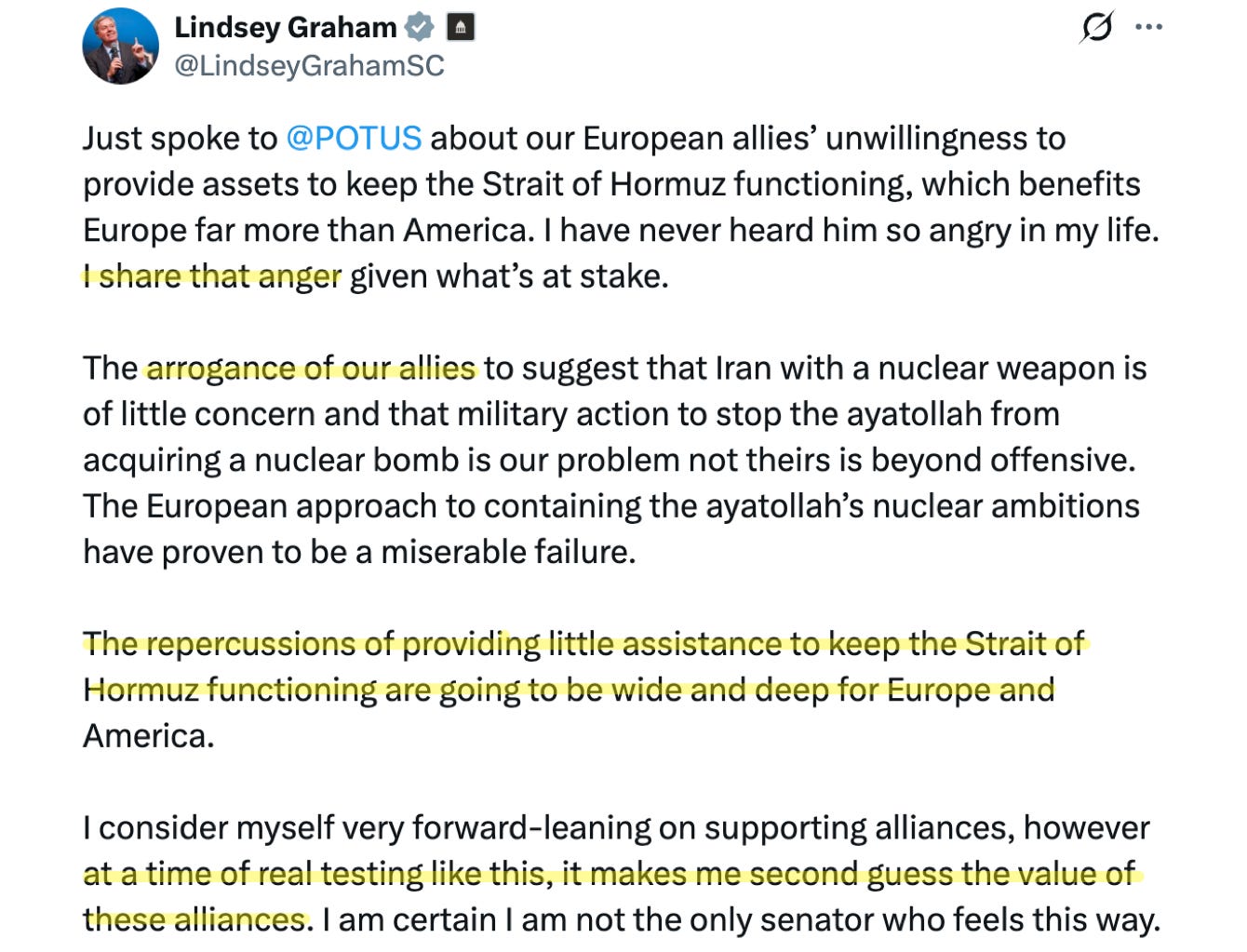
Suppose when Trump wins the Iran war, and reopens the strait without European help, he then turns to American voters and says, “I asked them to help protect the oil that they need, and they said no— so remind me why we are paying $800 billion a year to defend them?” That’s not a fringe argument anymore. It has become a permission structure.
Every European refusal is a brick in the anti-NATO wall that President Trump has been trying to build for thirty years. The German defense minister who sneered that “this is not our war,” may have just written America’s NATO exit speech— using Europe’s own words. It reminds me of that moronic California legislator who tweeted “f—ck off” to Elon Musk during the pandemic when he was begging them to reopen his car factory.
Tesla moved to Texas. Europe, take note.
The New York Times wants its readers to worry about the war’s cost to America. They forgot to mention that every day the strait stays closed, American frackers in the Permian Basin are having their best quarter since the shale revolution. Our energy industries are making money hand over fist, and the Europeans are paying. The real story here is the war’s cost to everyone who said no— and how much it’s going to cost them to get back to yes.
🚀🚀🚀
Yesterday, for the third time, the Senate voted down a Democrat-advanced bill that would have ordered President Trump to “immediately withdraw all U.S. forces from the conflict in Iran.” The Hill ran the story, headlined, “Republicans defeat resolution to halt US military strikes against Iran.”
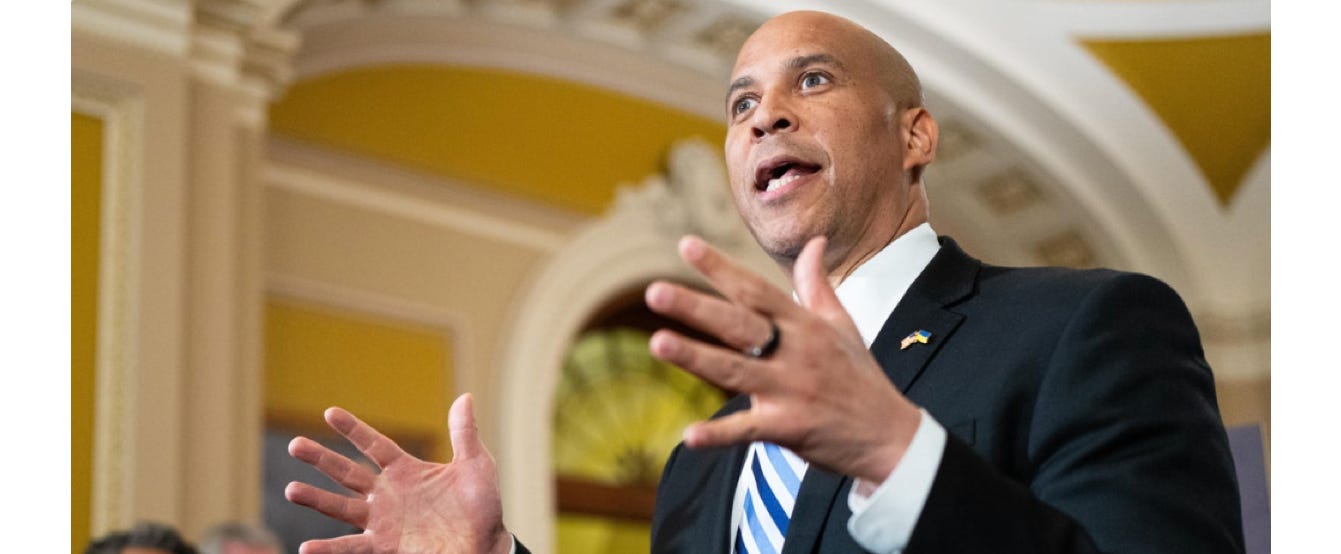
Since Operation Epic Fury began, Democrats and anti-war libertarians have shrilly complained the whole thing was a war crime because there was “no congressional authorization!” But Democrats tried to get the Senate to order it stopped three times. Three votes were held. Three times, it failed to pass.
Three times is a charm! Once again, track-suited Senator Fetterman was the sole Democrat to vote with Republicans— his second defection in two days. Pretty soon I’ll owe him a fruit basket. Rand Paul voted with the Democrats.
If three successive votes on the same issue aren’t congressional authorization, they are the next best thing. They didn’t okay the war, not exactly, but Congress expressly voted to let it keep going. You can’t honestly say anymore that the war lacks approval.
The UN unanimously condemned Iran without condemning the US. Congress voted three times to let the war continue. When every institution says ‘we’re not stopping you,’ that is the authorization— just without anyone’s fingerprints on it.
In legal terms, I would say that Trump now has “implied authorization” from both Congress and the UN. So.
Have a terrific Thursday! Sail back here tomorrow (not through the Strait) for another fantastic roundup of essential news and commentary.
Don’t race off! We cannot do it alone. Consider joining up with C&C to help move the nation’s needle and change minds. I could sure use your help getting the truth out and spreading optimism and hope, if you can: ☕ Learn How to Get Involved 🦠
How to Donate to Coffee & Covid
Twitter: jchilders98.
Truth Social: jchilders98.
MeWe: mewe.com/i/coffee_and_covid.
Telegram: t.me/coffeecovidnews
C&C Swag! www.shopcoffeeandcovid.com
Thank you to all C&C who pray for our troops. I have a child in the military in Turkey. Your prayers make a difference.
Hi Jeff! Just finishing watching your Mike Rowe podcast and reading yesterday's post. Have not missed a single post since early 2021 and tell everyone I can about C&C! My 14 year old daughter loves it when I read C&C to her EVERY morning over the past year or two. Her worldview training, and narrative/propaganda discernment skills are that much sharper because of it (not to mention her deep appreciation for and employment of the now famous Childerian wit!)
Just wanted to say thank you for all you do and all the optimism and encouragement and sarcasm you bring to all of our morning routines! My Americano tastes that much better with C&C!